








You’re probably looking at two cars in the driveway right now, both dirty in different ways. One’s picked up road film, brake dust, and a bit of coastal grit, the other’s covered in school-run swirl marks, dust in the trims, and the kind of light haze that only shows up when the sun hits the bonnet at the wrong angle. In Perth, that’s normal, and it’s exactly why Hand Car Detailing is its own craft, not just a nicer label on a quick wash.
A proper detail starts with inspection, contamination removal, then correction and protection in the right order. A rushed wash gets the surface clean enough for the day. A controlled hand detail gives you a clean base that’s safer for wax, more honest for paint correction, and easier to maintain between visits.
For WA households running more than one vehicle, the question usually isn’t “What’s the most expensive package?” It’s “Which cars need a full reset, which ones just need maintenance, and how often can I keep up without wasting money?” That’s the practical side of the job, and it’s the difference between paying for shine and paying for progress.
Why Hand Car Detailing Matters for Perth Drivers?
A Mundaring family with two dirty cars in the driveway sees the issue fast. The ute has sand and grit from daily use, the SUV has school-run marks, fingerprints on the door handles, and enough haze on the paint to make the finish look tired in direct sun. A drive-through wash clears the bodywork, but it does not properly deal with the surface condition.
Hand Car Detailing takes longer because it does more. A proper service covers paint inspection, contamination removal, correction where needed, and the right layer of protection. For WA households, the better question is usually how often each car needs attention and which package suits the way it is used. That is where regular hand car washing and detailing for vehicle longevity becomes part of the maintenance plan, especially when one household is trying to keep more than one vehicle in shape without wasting time or money.
In Australia, washing is routine maintenance, not a luxury habit. The Australian Car Wash Association’s 2023 consumer study put average annual professional wash frequency at 9.3 washes per year, while earlier national research reported 10.6 washes per year for professional consumers. The same industry materials compare one car wash’s water use to a load of clothes washing, four minutes of garden watering, or a five-minute shower (ACWA industry report).
That water comparison matters in WA. Perth drivers want a clean car, but they also want a process that uses water sensibly and does not wear the finish down over time. A controlled hand wash and light polish can slow swirl build-up, give wax a better base, and prepare the paint for ceramic coating later. The industry is still sizeable too, with Australian car wash and detailing revenue valued at AUD 608.4 million in 2026 and 1,683 active businesses in the same year, even after a 3.4% annualised decline over 2021 to 2026 (industry report).
Practical rule: if the car gets used every day, the finish usually needs a repeatable maintenance plan, not a once-a-year hero job.
Inspecting Your Paint Before You Touch It
The biggest mistake I see is people grabbing a mitt before they’ve even looked closely at the paint. Under shade, a panel can look fine. Under a bright LED torch or direct morning sun, the same panel shows swirls, haze, water spotting, and the kind of fine damage that makes a finish look dull long before it’s worn out.
Start with cool panels and clear light
Wash only after the car’s cooled down and parked in shade. A quick rinse knocks off loose dust and gives you a cleaner surface to inspect, but the true work comes from raking light across each panel. Hold the torch low and move slowly, because that angle shows the tiny marks that disappear when you stand back.
The baggy test is worth doing on any car with visible contamination. Put a clean sandwich bag over a finger and lightly glide it over the paint. If the panel feels rough, you’re dealing with bonded contamination, not just loose dust. That’s the sort of surface that needs a proper wash and decontamination before any polish has a chance of working evenly.
A good inspection also separates real defects from harmless ones. Light scratches that live in the clear coat can often be improved, but stone chips, normal orange peel, and texture on black plastic won’t polish away. Likewise, if a mark catches your fingernail, it’s usually deeper than a quick hand polish can safely fix.
The detailer’s job is to map the paint. I want to know which panels need a full correction, which ones only need a clean-up, and which ones should be left alone rather than chased into a thinner clear coat. That’s where the work gets smarter, not just shinier.
Check in direct sunlight if you’re unsure, because that’s when the truth shows up fast.
A useful baseline for Perth owners is simple. If the panel feels rough, looks cloudy in angled light, or shows marks that return after a wipe, the paint needs preparation before any product goes on. If the damage is just cosmetic and shallow, a hand approach can still make sense.
For a deeper breakdown of paint prep and what a safe clean should look like, the internal guide on car paint cleaning treatment is worth reading before you touch the bonnet.
Setting Up a Safe Hand Wash
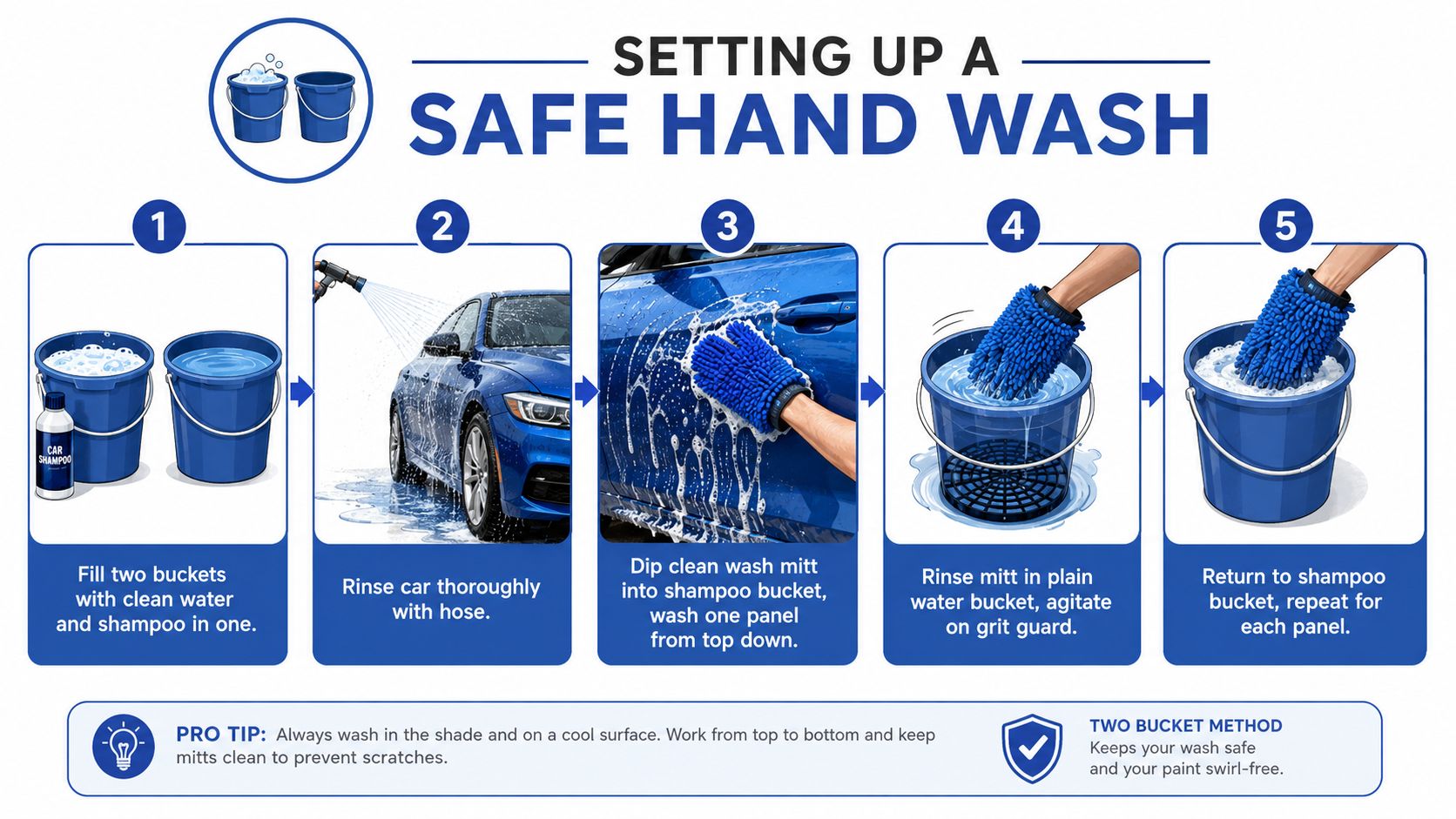
A safe wash is a controlled process, not a weekend churn-and-burn. The whole point is to remove dirt without dragging it back across the finish, because that’s how fresh wash marks get added to paint that was already tired. The right kit matters here, but the order of work matters just as much.
Build the wash around clean separation
Use two buckets with grit guards, a pH-neutral shampoo, a plush microfibre wash mitt, a separate wheel bucket, soft rim brushes, and a drying towel with good absorbency. The buckets are there for separation, one for shampoo and one for rinse water. The mitt goes back into the rinse bucket before it ever returns to the soap, which is what stops trapped grit from being redeposited onto the paint.
Wash the car from the top down. Roof, glass, bonnet, upper doors, lower doors, then wheels last. That order keeps the dirtiest areas away from the cleanest panels, and it means your mitt isn’t getting loaded with brake dust before it touches the paint. A clean mitt on a clean panel is the whole game.
Keep the shampoo mixed to the product’s label, use lukewarm water if the weather’s cool, and don’t wash under full sun if you can avoid it. Hot panels flash the solution too quickly and leave streaking or spotting behind. On Perth’s harder municipal water, drying becomes a finish-critical step, so towel the car panel by panel instead of letting it air-dry.
Common mistakes are usually simple. Circling on dusty paint, reusing the lower-panel mitt on upper panels, and letting detergent dry on the surface all lock in swirls or leave marks that weren’t there before. A final buff with a clean microfibre is the safest way to finish, because water spots are easier to prevent than to remove.
For a quick visual on the sequence, the two-bucket method flowchart below is the exact habit to build.
Practical rule: if the mitt touched the lower door or wheel arch, it doesn’t go back to the roof.
Reading Swirl Marks and Scratch Severity
A WA driveway full of cars exposes paint damage fast. One ute gets dusted off after school drop-off, the hatch sits under tree sap, and the family sedan picks up wash marks from rushed weekend cleans. Reading the finish properly saves time, and it stops you paying for correction you do not need.
Separate surface damage from deeper defects
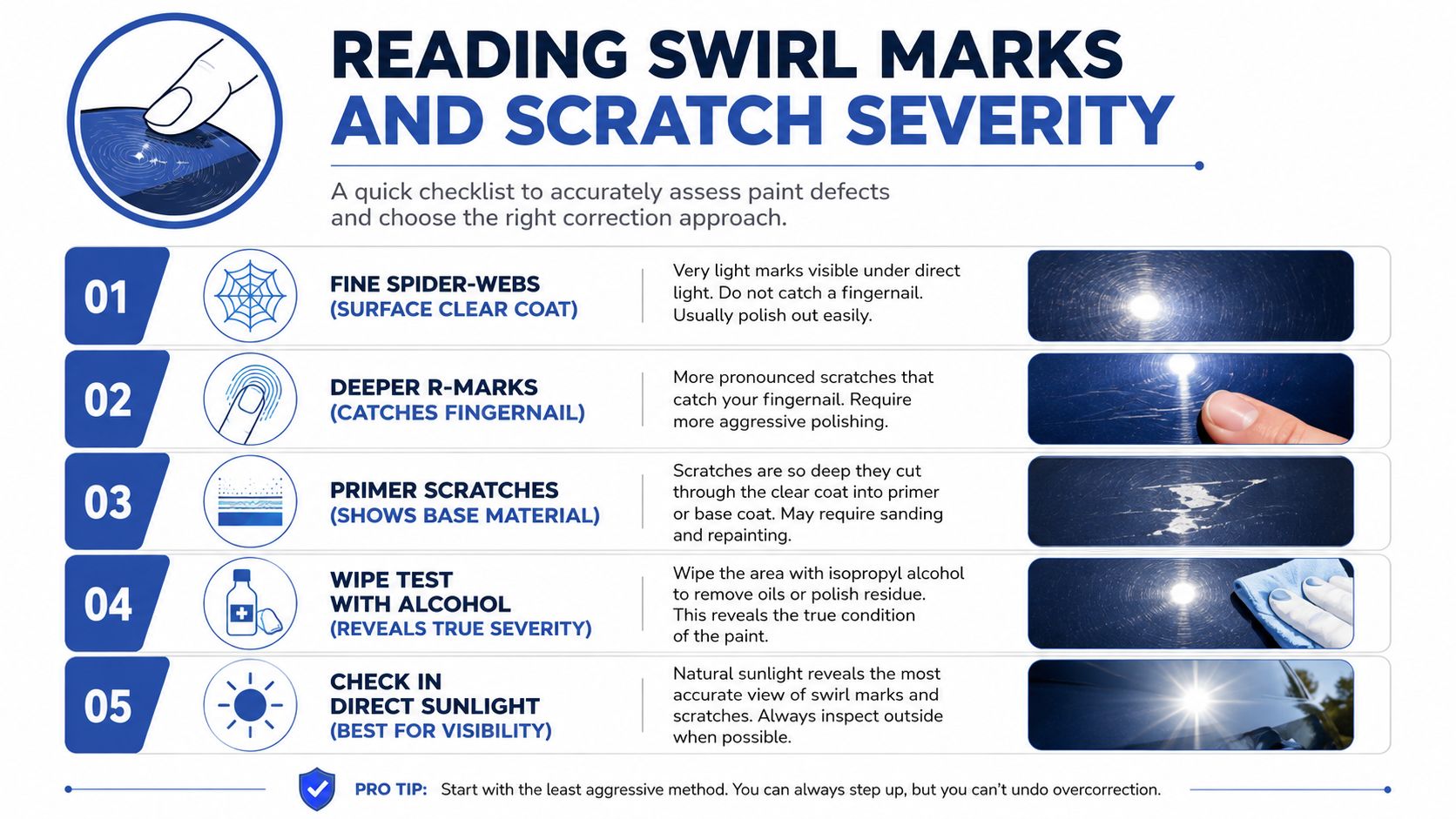
Start with strong light, either a torch or direct sun. Fine spider-webbing usually shows as a soft circular haze, most obvious on dark paint. Deeper scratches look sharper and cut a clearer line across the panel. If a mark catches a fingernail, it is beyond casual cleanup.
The wipe test confirms what you are seeing. Clean a small section with a light alcohol wipe, then inspect it again. If the mark fades or disappears, you were likely dealing with residue or surface contamination. If it stays put, you are looking at genuine paint damage, or something close enough that correction needs care.
Check the whole car before you choose a method. Bonnet, roof, front doors, and boot lids usually wear the most because they take the most dust and sun. Textured plastics can look dull, but they usually need a different approach from painted panels. Buffer trails matter too, because they show a previous polish was not finished properly.
A quick outcome guide for daily drivers:
- Fine spider-webbing: usually suitable for a careful hand polish or maintenance correction.
- Deeper R-marks: may improve partly, but often need machine work for a cleaner finish.
- Primer-visible scratches: stop and assess, because polishing will not replace missing paint.
- Textured plastic haze: usually left alone or treated differently from painted surfaces.
For a closer look at paint prep and cut stages, the guide on how to cut and polish a car in Perth covers the practical side of correction planning.
Hand Polishing Versus Machine Polishing
A Perth driveway full of daily drivers usually tells you which way to go before you even pick up a pad. If the paint just needs a light refresh, hand polishing keeps control high and risk low. If the bonnet has years of swirls, harder water marks, or a tired clear coat, machine correction earns its keep faster.
What each method really does?
A foam applicator and a decent finishing product can tidy light marring, bring back gloss, and make a maintained car look cared for again. On paint that’s still in good shape, hand polishing can reduce visible light defects enough to be worth the effort, especially on cars that get washed often and never go too long between touches. It will not pull out deeper wash damage, and it will not fix neglected paint by itself.
A dual-action polisher or rotary cut works on a different level. It reaches defects that a hand pad can only soften, and it does the job much faster. The trade-off is simple, more heat, more dust, and a higher chance of leaving marks if the operator rushes the job or uses the wrong pad on soft paint. That matters on dark colours and on panels that have already been worked before.
Here’s the practical split I use on daily drivers.
| Factor | Hand Polishing | Machine Polishing |
|---|---|---|
| Correction speed | Slow, methodical | Fast, efficient |
| Heat generation | Low | Higher |
| Learning curve | Mild | Steep |
| Dust and residue | Minimal | More likely |
| Risk of holograms | Very low | Real if technique slips |
| Best use case | Maintenance and light touch-ups | Neglected paint and stronger correction |
Soft paint can make machine work less forgiving, because every small mistake shows sooner. In that situation, a hand finish can be the better call if the car only needs a tidy-up. Once the bonnet is heavily swirled, the clear has gone flat, or a previous polish left holograms, machine correction is usually the cleaner result.
Family cars in WA also change the decision. A multi-car household that washes regularly may get more value from light hand polishing and a sensible maintenance plan than from paying for aggressive correction every time. If the paint needs more than that, a Westminster shop can handle the heavier work, and how to cut and polish a car in Perth is the right reference point for understanding where that line sits.
Wax and Ceramic Coating Aftercare
Wax and ceramic coating sit in different camps. Wax is the short, simple protection layer that a lot of daily drivers can live with. Ceramic coating is the longer-term answer for owners who want easier washing, better water behaviour, and a more durable finish, but only if the prep underneath is right.
Choose the protection that fits the car
A paste carnauba wax works well when you apply it thinly, let it haze, then buff it off with a clean microfibre. It gives warm gloss and decent short-term protection, which is why it still makes sense on cars that are leased, older, or just not worth a deeper spend. The catch is that it needs regular refreshment, so it’s more of a maintenance habit than a once-and-done shield.
Ceramic coating is a different decision. It relies on proper surface prep, including correction where needed, because the coating will lock in whatever the paint looks like underneath. The appeal is the long-lived protection, the hydrophobic behaviour that helps water bead and sheet off, and the easier wash routine that follows. The market pages for Australian detailing businesses describe ceramic coatings as durable, hydrophobic, and built for longer-term protection after paint correction, with some systems described as lasting 12 to 36 months.
That doesn’t mean coating is magic. It isn’t scratch-proof, it won’t stop poor washing technique, and it costs more because the prep is more involved. If the car is a beater, a leased runabout, or just something you want to keep simple, a spray sealant or wax is often the more sensible call. If the paint is already corrected and you want easier upkeep in Perth’s sun, coating starts to make sense.
Practical rule: if the finish hasn’t been corrected, don’t expect a coating to hide the damage.
Aftercare for both is straightforward. Wash gently, dry properly, avoid harsh brushes, and top up protection before the surface starts feeling dry or grabby. A clean wash pattern matters more than the label on the bottle.
For a local overview of coating prep and maintenance, the page on hand car detailing for ceramic coats gives useful context for Perth vehicles.
When to Book a Professional Detail?
There’s a point where DIY stops being efficient and starts becoming expensive guesswork. If the swirl coverage is heavy across the bonnet, roof, and front doors, if the clear coat has gone dull, or if a previous machine polish left holograms, you’re already outside what a casual weekend session should try to fix. The same goes for paint that still feels rough after claying or panels that need lighting and space you just don’t have at home.
Use the car’s condition to decide the job
A lightly used daily driver with shallow marring can be improved at home, but a neglected car usually needs a proper correction plan. The age of the car matters less than the condition of the paint. A newer dark car can look worse than an older light-coloured one, because soft clear coat and bright Perth sun make defects stand out fast.
That’s why a professional cut and polish is worth booking when the paint has moved from maintenance into recovery. A shop can inspect under proper lighting, choose the right pad and compound, and correct the finish without forcing you to gamble with a single applicator and a guess. If the car also needs long-term protection, it’s usually smarter to bundle the correction with coating prep instead of repeating the job later.
Watch the quote, not just the price. A one-price-fits-all offer, no before-and-after photos, or a refusal to inspect the paint in person are all warning signs. Good work depends on seeing the vehicle, because the same product can behave very differently on soft black paint, hard clear coat, or a car that’s already been polished before.
For Westminster drivers, Prime Shine Hand Car Wash is a relevant option because it offers hand washing, detailing, cut and polish, and ceramic coating from one local site at 9/436 Wanneroo Rd. That matters when you want a cleaner handoff between wash, correction, and protection instead of bouncing between services.
If you’re booking, ask what prep is included with the cut and polish, whether clay or paint prep is part of the process, and how the finish should be maintained afterwards. If the car lives outdoors or carries the family around every day, a maintenance detail on a regular cycle makes more sense than waiting until the paint looks tired again.
If your car’s paint is starting to look dull, swirled, or rough to the touch, book a proper hand detail before the damage gets baked in. Visit Prime Shine Hand Car Wash for hand washing, detailing, cut and polish, and ceramic coating in Westminster, then choose the service that matches how you use the car.