








In Perth, most cut and polish jobs land between roughly $195 and $500 for a passenger car, with SUVs and multi-stage correction pushing the figure higher. A light single-stage service costs less, while deeper defects, larger panels and extra correction stages move the quote towards the upper end.
You usually start searching for cut and polish cost after the car has been washed but still looks tired. You pull out of a Westminster car park into the low afternoon sun and suddenly see a web of swirls across the bonnet, water marks around the mirrors and dull patches along the doors. The car is clean, but it doesn’t look clean.
That’s when a basic wash stops being the answer. Perth’s UV exposure, coastal salt, dusty roads and everyday car-park contact gradually mark the clear coat, while poor washing can add fine scratches. Online prices vary because some listings describe a light machine polish and others include substantial paint correction. This guide ties the cost to the three things that matter, vehicle size, paint condition and correction stage.
Practical rule: A low “from” price only helps if you know which paint defects and preparation steps it includes.
Why Drivers Start Asking About Cut and Polish Cost?
The usual trigger isn’t a dramatic scratch. It’s the gradual loss of clarity. A Westminster driver washes a daily car on the weekend, dries it, walks back across the driveway and notices that the bonnet reflects light in grey arcs instead of a clean, sharp shine.
Water marks, light wash marring and oxidation make the paint look flat from certain angles. Coastal air and road film add to the problem, while tight parking spaces create the small scuffs that ordinary shampoo can’t remove. A wash removes dirt from the surface. It doesn’t level the clear coat underneath.
The next decision is often between a quick hand-applied polish and a proper machine cut and polish. The cheaper option may improve gloss temporarily, but it won’t necessarily correct the underlying marks. A professional service involves paint preparation, controlled machine work and a finishing stage, so the operator can improve the reflection without treating every panel aggressively.
Why Perth quotes look so different
Australian pricing guides place cut and polish in the mid-tier correction category, rather than as a basic wash add-on. Low-end references sit around $195-$300, while professional packages commonly start around $220-$350 and can rise above $400 for larger vehicles or more complex work, as shown in this Australian car detailing cost guide.
A Perth driver should therefore ask what sits behind the number. Does the quote include clay-bar preparation? Is it a single-stage polish or heavier correction? Will the detailer explain which scratches can be reduced and which ones are too deep?
I recommend choosing a quote that explains the process, not the cheapest number on a booking page. Once you understand where the labour goes, the price becomes easier to judge.
What a Cut and Polish Actually Does to Your Paint?
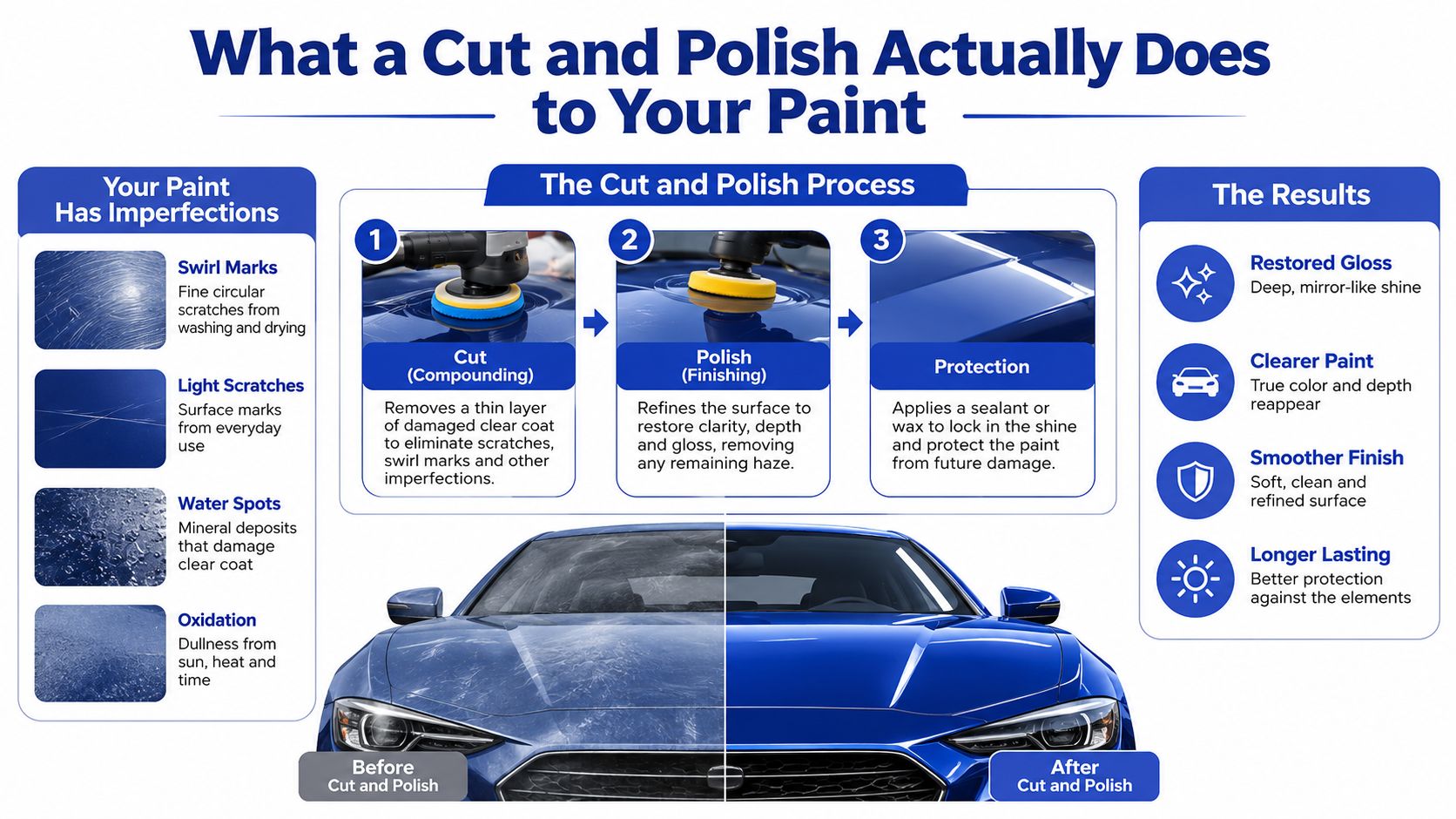
A cut and polish is controlled paint correction. The “cut” uses a machine polisher, cutting pad and compound to abrade a very small amount of the clear coat and level minor surface imperfections. The “polish” follows with a finer pad and product to refine the finish, improve clarity and restore gloss.
The process can reduce light swirl marks, fine wash scratches, oxidation and minor etching. It can’t safely erase every defect. If a scratch has passed through the clear coat into the colour or primer, machine polishing won’t rebuild the missing paint.
Explore Paint Correction Options
The difference between cleaning and correction
A hand wash cleans dirt, traffic film, wheels and tyres. It doesn’t perform paint correction. A full interior and exterior detail goes further by combining cleaning, decontamination and, depending on the package, a wax or sealant. It still may not include machine cutting.
A cut and polish sits between routine detailing and heavier correction. Prime Shine’s car paint cleaning treatment is a related preparation option, but a customer should confirm whether a quoted service includes machine correction or only paint cleaning and protection.
Machine work requires control. Pad choice, compound strength, pressure, speed and panel temperature all affect the finish. An experienced operator uses a test spot before committing to the rest of the vehicle, then adjusts the approach for softer, harder, older or previously repaired paint.
The clear coat is there to protect the colour coat, so it isn’t something to remove casually. Repeated aggressive polishing can reduce the available protection, particularly around edges and body lines. That’s why cut and polish is the entry point to a correction ladder that can progress to two-stage or multi-stage correction, followed by protection such as a ceramic coating.
Explore Paint Correction Options
What Really Drives the Cut and Polish Cost?
The biggest mistake is treating every vehicle as the same job. A small sedan with light haze doesn’t need the same preparation, machine time or correction strategy as a large four-wheel drive with oxidised panels and deep wash marks.
Size sets the labour base
More paint means more washing, claying, masking, machine passes and wipe-downs. One Australian price sheet lists cut and polish at $269 for a hatch or sedan, $299 for a small SUV or wagon, and $329 for a large SUV, 4WD or seven-seater, with the published detailing prices showing how vehicle size changes the starting point.
Broader time-based pricing places outside detail plus cut and polish at $280-$350 for a small car, $350-$420 for a medium-large car, and $420-$490 for a large SUV or 4WD. That spread reflects surface area and labour, not an arbitrary SUV surcharge.
Condition determines the correction stage
A near-new vehicle with light marring may suit a single-stage correction. A neglected bonnet with heavy swirls, bird etching and oxidation may need two or three stages. Australian correction pricing commonly sits around $350-$450 for single-stage work, $550-$800 for two-stage work and $999-$1,500 for multi-stage correction, according to this paint correction pricing reference.
Preparation adds time before the machine touches the paint. A proper quote may include:
- Decontamination: Removing bonded contamination with washing and clay-bar preparation.
- Masking: Protecting rubber, textured trim, badges and sensitive edges.
- Inspection: Checking defects, previous repairs and paint condition.
- Finishing: Removing compound residue and inspecting the panels under suitable lighting.
Product choice matters, but it’s usually less important than labour and technique. A basic compound and sealant package costs less to deliver than premium finishing products and more durable protection. Shop overhead, insurance and trained staff also influence the quote.
| Vehicle size | Single-stage cut and polish | Two-stage cut and polish | Three-stage or heavy correction |
|---|---|---|---|
| Small car | $195-$280 | $350-$550 | $600+ |
| Medium car | $250-$350 | $450-$700 | $800+ |
| SUV, ute or 4WD | $300-$450 | $550-$800 | $999-$1,500 |
These working ranges reflect Australian pricing references, including the Perth car detailing cost guide, and should be treated as a starting framework rather than a guaranteed quote. The cheapest offer often removes preparation, limits inspection or uses one aggressive pad across every panel. That's where a low price can become a poor-value repair.
Check Pricing for Your Vehicle
Cut and Polish Compared to Other Detailing Services
Cut and polish makes sense only when you place it beside the services around it. A standard wash-and-wax detail is mainly a cleaning and light-protection service. It can make a dirty vehicle look fresh, but it doesn't correct the clear coat in the same way machine work does.
A cut and polish adds paint preparation and controlled abrasion. A full paint correction goes deeper, often through multiple stages, to address heavier defects. Ceramic coating belongs after correction because it protects the finish underneath. It isn't a substitute for removing swirls.
The detailing ladder
| Service | Main purpose | Process depth | Typical Perth price | Best for |
|---|---|---|---|---|
| Standard wash and wax detail | Clean and lightly protect | Cleaning, drying and surface protection | Routine package pricing varies | Maintained daily drivers |
| Single-stage cut and polish | Improve gloss and reduce light defects | Preparation, machine cut and finishing polish | Commonly around $195-$350 | Swirls, haze and light marring |
| Multi-stage paint correction | Correct heavier surface defects | Several compound and polish stages | Commonly $550-$1,500 depending on stage and vehicle | Neglected or enthusiast vehicles |
| Ceramic coating | Protect corrected paint | Surface preparation followed by coating application | Packages can range from $800-$3,500, according to this Australian detailing cost reference | Owners wanting longer-term protection |
The figures are not interchangeable. A full detail may include interior work, glass, wheels and trim without performing correction. A cut and polish focuses on the exterior paint, so it can cost more than a basic detail despite involving fewer areas of the car.
Prime Shine’s full car detailing service suits a vehicle that needs a thorough reset inside and outside. If the main complaint is reflected swirls and dull paint, ask specifically for machine correction rather than assuming a full detail includes it.
My recommendation is simple. Choose a standard detail for dirt, choose cut and polish for light paint defects, choose multi-stage correction for substantial defects, and add ceramic protection only after the paint has been properly prepared.
What to Expect on the Day and How to Prepare?
A professional appointment should start with an inspection, not a machine switched on at the first panel. The detailer should look at the paint in natural or controlled lighting, identify obvious defects and discuss what the service can realistically improve.
The operator may take paint-depth readings and complete a test spot. That small test area helps determine whether the chosen pad and compound deliver enough correction without unnecessary abrasion. It also gives you a useful reference for the expected finish.

The usual workflow
- Pre-wash inspection: The detailer records the vehicle’s condition and notes damage, resprays or panel repairs.
- Wash and decontamination: The exterior is cleaned, then bonded contamination is addressed before polishing.
- Masking and test spot: Trim and edges are protected, and the correction method is tested.
- Compounding and polishing: The machine removes or reduces suitable defects, then refines the finish.
- Panel wipe and inspection: Residue is removed so the operator can assess the actual correction rather than product filling.
- Handover: The finish, remaining defects and aftercare instructions are discussed.
For a passenger car, a single-stage cut and polish commonly takes three to six hours, with longer appointments for SUVs, large vehicles or two-stage work. A Perth car detailing timing guide can help you plan the appointment, but condition and scope still control the day.
Before arrival, remove personal items and point out marks that concern you. Tell the detailer about resprays, repaired panels and previous coatings. Don’t expect machine polishing to remove every deep scratch, and understand that minor dust nibs inside the clear coat may remain because they are not surface contamination.
After collection, avoid automatic car washes for 48 hours and arrange a follow-up hand wash. Use clean wash media, rinse thoroughly and don’t let road film bake onto the panels.
Common Misconceptions About Cut and Polish
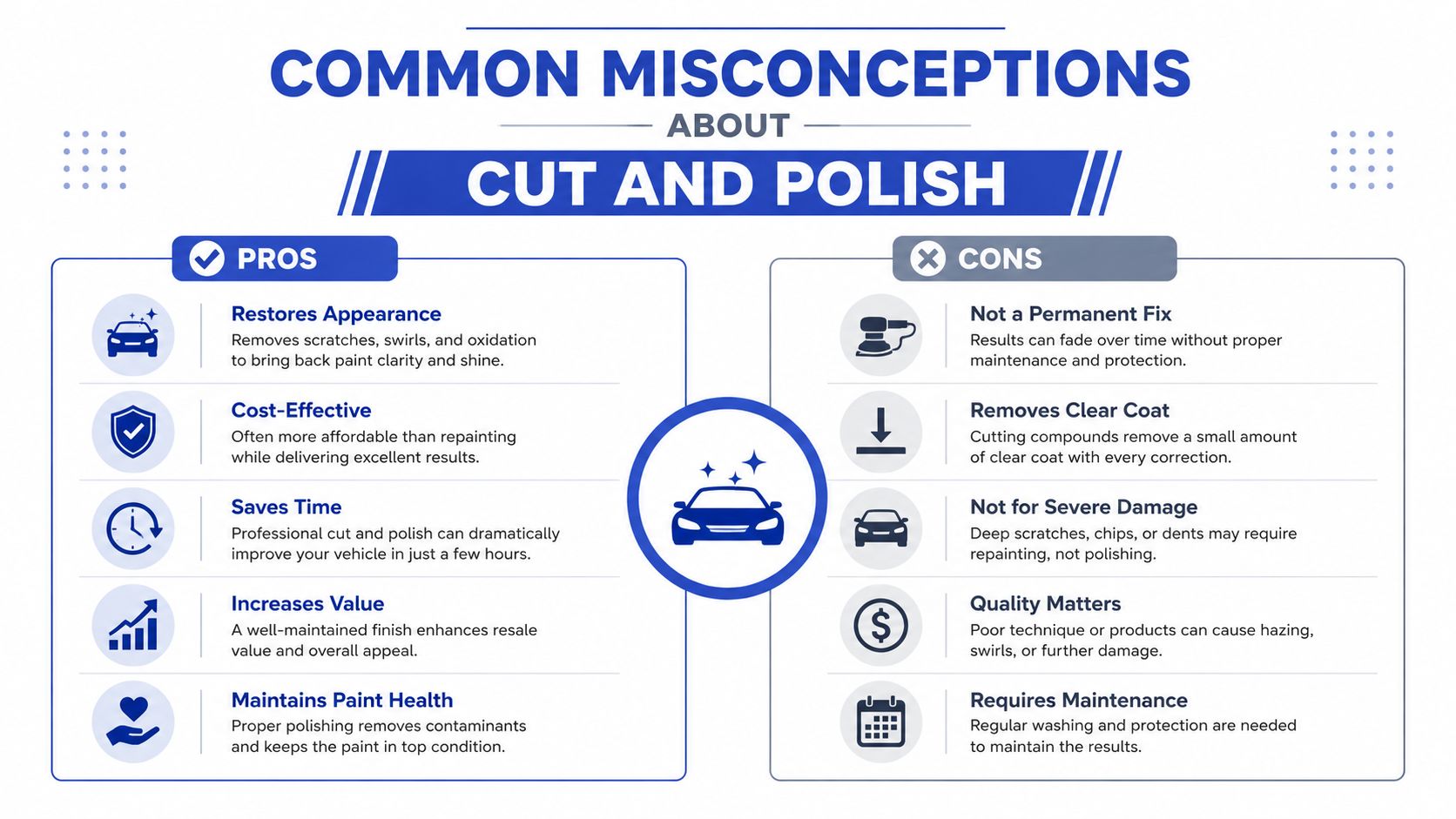
The first misconception is that cut and polish removes every scratch. It doesn’t. Machine correction levels the upper surface of the clear coat, so it can reduce defects that remain within that layer. A mark that has reached the colour coat or primer needs a different repair path, not more polishing.
Some defects also appear to “return” after a few washes because filling products have worn away. That doesn’t always mean the work failed. It may mean the initial service improved the appearance without fully correcting the defect, or that the mark was too deep to remove safely.
Four assumptions worth rejecting
- “The cheapest quote is good enough.” A rushed operator may skip decontamination, use an aggressive pad or leave holograms behind. Correcting poor machine work can cost more than choosing a careful service initially.
- “More cutting always means a better result.” Clear coat is limited. The right operator removes only what the defect and finish require.
- “Ceramic coating replaces correction.” It doesn’t. A coating protects the surface placed beneath it, so applying it over swirls can preserve or emphasise an inferior finish.
- “Cut and polish is permanent.” It isn’t. Safe washing, clean drying tools and sensible maintenance determine how long the improved finish remains sharp.
A good detailer will tell you which defects can be reduced, which should stay for safety and what the quoted stage can achieve.
The correct question isn’t “Can you remove every mark?” Ask, “What percentage of the visible defects can you safely improve, and what will remain?” That answer tells you more about workmanship than a low starting price.
FAQs and Booking With Prime Shine
How far ahead should I book?
Book as soon as you know the vehicle needs correction, particularly if you need the car ready for a sale, lease return or event. Prime Shine Hand Car Wash operates from Westminster and provides online booking, so you can request a suitable appointment rather than relying on a walk-in opening.
Can the work be done in the rain?
Machine correction needs a controlled, clean working environment. Rain affects washing, drying and final inspection, so an in-shop appointment is the sensible choice in wet weather. Prime Shine’s Westminster location allows the work to be completed under a consistent roof rather than leaving the finish exposed during the process.
Is mobile or in-shop service better?
For a basic clean, mobile work can be convenient. For cut and polish, I favour an established shop because lighting, power, shelter, water control and inspection conditions matter. Prime Shine Hand Car Wash handles hand washing, detailing, machine correction and ceramic coating at its Westminster site.
What should a warranty or satisfaction guarantee cover?
Ask what happens if compound residue remains, a panel needs a second finishing pass or the result doesn’t match the agreed scope. A responsible provider should explain the service limits before work begins, including deep scratches that cannot be safely polished out. Don’t accept a vague promise. Get the scope, preparation and aftercare requirements in writing.
What does Prime Shine’s cut and polish include?
Prime Shine lists cut and polish as an exterior service involving a wash, clay-bar or paint preparation, then machine cutting and polishing to reduce swirls and light scratches. The published entry price is $169, while another listed package that includes cut and polish or machine buffing starts from $180. Confirm the current vehicle category and condition-based price before booking.
That entry price is not a universal Perth benchmark. Australian market references place many light services higher, especially when the vehicle is larger, the paint needs more preparation or the quote includes additional correction. Use the starting figure as a conversation opener, then ask for the actual scope.
Prime Shine also provides hand car washing, interior and exterior detailing and ceramic coating under one roof. That makes bundling straightforward when the vehicle needs both paint correction and ongoing protection, but protection should follow a properly prepared surface.
Prime Shine Hand Car Wash provides hand washing, detailing, cut and polish and ceramic coating at its Westminster site, with online booking and itemised service options. Visit Prime Shine Hand Car Wash to request a real quote for your vehicle, confirm the current starting price and book an appointment that matches its size and paint condition.