







Ceramic coating is worth it if you’re keeping the car for several years and you’ll hand wash it every 1 to 2 weeks, but it’s a poor bet if you’re flipping the car quickly or expecting it to replace washing. A $595 package spread over 3 years works out to roughly $199 a year, and that only starts to make sense when you keep the car long enough to use the protection.
You’re probably standing there now, card in hand, looking at a quote that sounds steep for what some mate swears is just fancy paint wax. That’s the wrong way to judge it. In Perth, the key question is whether the coating fits your ownership window, your parking habits, and your patience for proper upkeep under harsh sun and daily dust. If the answer is yes, it can earn its keep. If the answer is no, save your money and keep the car clean another way.
Why Perth Drivers Are Asking This Question Right Now?
A Perth driver at the counter usually hears the polished pitch first. The quote sounds tidy, the paint looks deep, and long-term protection gets thrown around like that settles it. It doesn’t. Ceramic coating is no force field, and it won’t stop rock chips or rescue rough paint. That matters because plenty of cheap jobs skip the prep that decides whether the finish lasts.
The hidden part of the pitch
A bargain job looks good until you look at what’s included. The value sits in the prep, not the bottle. If the paint has swirl marks, oxidation, or contamination, coating over it just seals the flaws in. That is why plenty of Perth owners get stung, they pay for gloss, but they don’t pay for correction first.
Perth makes the decision sharper than most places. Hot sun, harsh UV, dust, and cars parked outside most days push owners towards protection that helps with upkeep and preserves gloss longer. In this city, unprotected paint cops more abuse, and regular washing becomes part of normal ownership.
Here’s the straight test. If you park outside and keep the car for years, you should judge coating on cost per year and cleaning effort, not showroom shine. If you want a rough idea of what that can look like in day-to-day use, compare quotes against a proper outside car wash routine and see whether the upkeep still makes sense.
The resale regret part matters too. Owners who skip protection, then watch the clear coat fade or pick up ugly marks, often wish they had spent the money earlier. If you keep a car long enough, wash it properly, and want the paint to stay easier to clean, the case gets stronger fast. If you change cars often or hate hand washing, save your money and spend it on simple maintenance instead.
Get a Perth paint protection check
What Ceramic Coating Does to Your Paint?
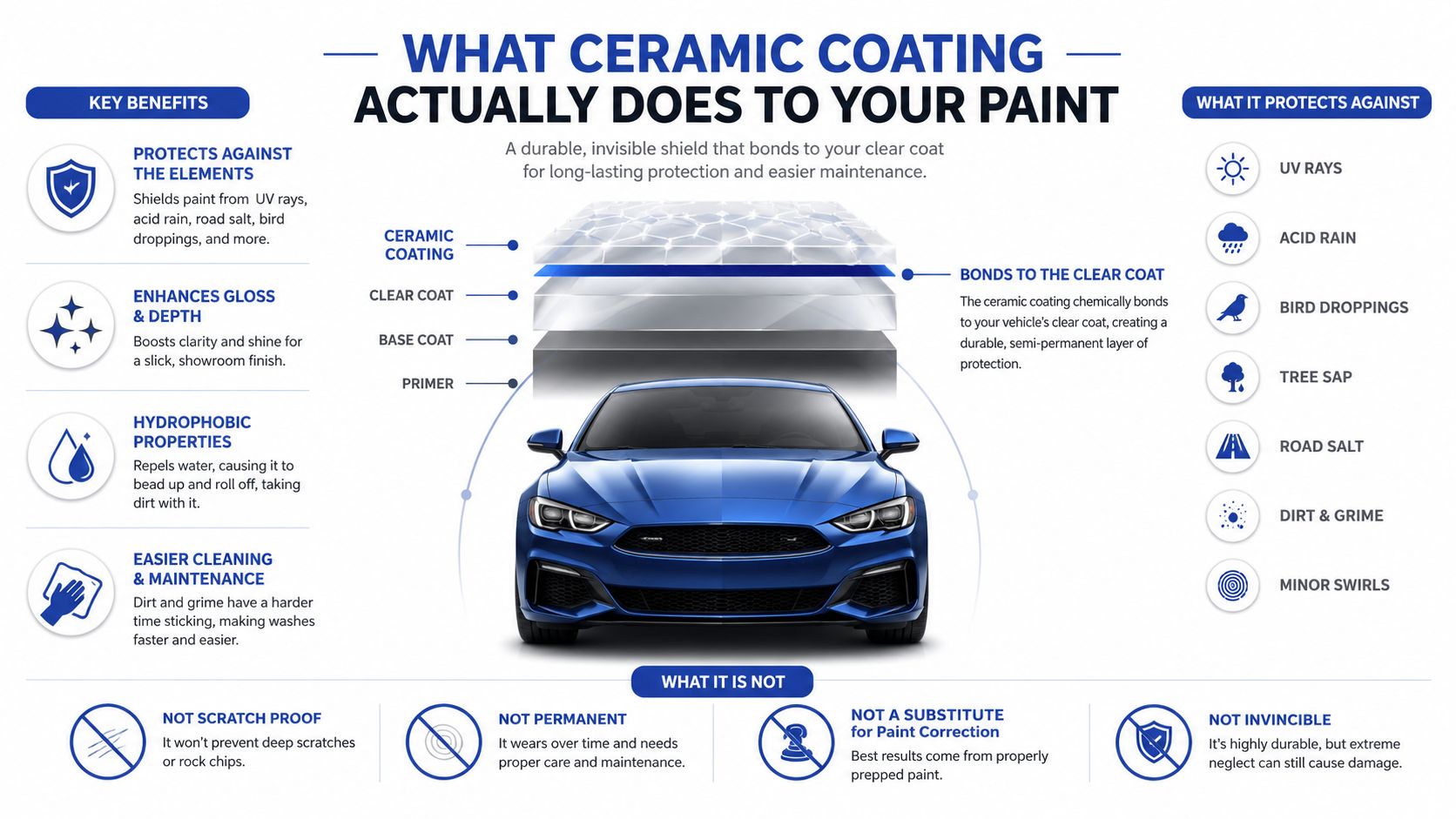
If you want the straight answer, ceramic coating is a thin, glass-like shield over your clear coat. It bonds to the factory finish, cures into a hard layer, and changes how water, dirt, and grime sit on the paint. It does not make paint bulletproof. It gives you more time, easier washes, and better gloss retention.
What changes after it’s on
You notice the water behaviour first. Water beads and sheets off more easily, so washing feels less like dragging grime around the panel. Bird droppings, bug splatter, and road film still hit the car, but they are less likely to grab hold if you clean them quickly.
The finish also stays slicker for longer. That does not mean the car never needs a wash, it means dirt releases with less effort when you do wash it. For a Perth driver who parks outside, that saves time and keeps the paint looking cared for between proper washes.
Ceramic coating also helps slow UV damage on the clear coat, which matters in Perth more than most places. Hot sun, harsh UV, dust, and regular outdoor parking punish paint day after day. Australian guidance treats coating as a UV-resistant barrier that helps preserve gloss and colour over time.
What it does not do
It does not stop stone chips. It does not erase swirl marks already in the paint. It does not replace washing. It also will not hold up properly if you keep hammering it with rough brush washes.
If the paint needs correction before coating, that step matters more than the bottle itself. See Paint Correction for Cars, Stages, Costs, Real Results for what prep work changes.
The honest read is simple. Ceramic coating is a maintenance layer, not a miracle fix. It makes paint easier to live with, easier to clean, and slower to fade, as long as you treat it as part of ownership, not a set-and-forget job.
Learn how coating protection holds up over time
Cost When You Break It Down by Year
Sticker shock is the wrong lens. Cost per year is the number that matters, because it shows whether the coating earns its keep over your ownership window. In Perth, DIY kits usually sit around $80 to $150, pro 1 to 2 year coatings around $400 to $700, mid-tier 3 to 5 year coatings around $900 to $1,500, and premium 5 to 8 year coatings with full correction around $1,800 to $3,000+.
The annual maths that cuts through the sales talk
A $1,500 coating spread over 5 years works out to $300 a year. That is not pocket change, but it is close to what plenty of owners spend on repeated details, waxes, and correction work over the same stretch. A cheaper $400 coating that lasts about 18 months works out to roughly $267 a year, and that is before you add topper products or maintenance washes.
The hidden spend matters too. Paint correction can add $300 to $800 on top, and proper prep often decides whether the coating looks good or just locks in defects. If you skip correction, you can end up sealing swirl marks under the coating for its whole life. That is not protection, that is freezing the problem in place.
Hard truth: if the paint is rough before coating, you are paying to protect rough paint.
If you want to judge lifespan properly, read how long ceramic coating lasts on Perth cars alongside the cost. Lifespan changes the whole equation, because a coating that fades early turns a mid-range spend into bad value fast.
A sensible Australian pricing benchmark sits around $600 to $1,500 for a quality package, with higher rates for bigger vehicles and better grades. That range makes the ownership maths plain. You are not buying a shiny afternoon. You are buying years, if you keep the car long enough.
| Perth Ceramic Coating Cost Per Year | ||||
|---|---|---|---|---|
| Coating Tier | Upfront Cost (AUD) | Annual Cost over 3 yrs | Annual Cost over 5 yrs | Annual Cost over 8 yrs |
| DIY kit | $80 to $150 | $26.67 to $50 | $16 to $30 | $10 to $18.75 |
| Pro 1 to 2 year coating | $400 to $700 | $133.33 to $233.33 | $80 to $140 | $50 to $87.50 |
| Mid-tier 3 to 5 year coating | $900 to $1,500 | $300 to $500 | $180 to $300 | $112.50 to $187.50 |
| Premium 5 to 8 year coating | $1,800 to $3,000+ | $600 to $1,000+ | $360 to $600+ | $225 to $375+ |
The clean way to decide is simple. Multiply the price by the years you expect to keep the car, then ask whether that annual figure beats repeated detailing and the regret of selling a car with tired paint. In Perth, that regret shows up fast on cars parked outside, baked in UV, and washed badly. If you sell before you use the lifespan, you have probably overpaid.
Compare Perth ceramic coating package pricing
How Ceramic Coating Stacks Up Against Wax and PPF
Wax, ceramic coating, and paint protection film solve different problems, and Perth drivers feel the difference fast. Wax gives quick gloss and cheap short-term protection. Ceramic coating sits in the middle. Paint protection film is the heavy hitter for impact protection, but you pay a lot more for it.
The three-way trade-off
Wax is the easiest to understand. It looks great for a short stretch, but it needs redoing often, especially through summer. Ceramic coating lasts much longer, resists chemicals better, and makes regular washing less painful. PPF does something else entirely. It absorbs physical abuse better, which is why people use it where stone chips are a real threat.
That’s why some Perth owners mix the two. Full-front PPF on the bonnet, bumper, mirrors, and leading edges, then ceramic coating over the rest of the vehicle. That setup makes sense if you do a lot of highway kilometres and still want the whole car easier to clean.
Good split: PPF for impact zones, ceramic for the rest of the car.
| Ceramic Coating vs Wax vs PPF in Perth Conditions | ||||
|---|---|---|---|---|
| Protection Option | Typical Lifespan | UV & Chemical Resistance | Approx. Perth Cost | Maintenance |
| Wax | Short-term | Basic | Low | Frequent reapplication and regular washing |
| Ceramic coating | Multi-year | Strong for UV and chemical exposure | Mid-range | Hand washing and periodic decontamination |
| PPF | Long-term physical film | Strong against impact, different behaviour on surface contaminants | Higher | Careful washing, film-specific upkeep |
The chemical side matters more than many owners realize. Ceramic coating handles bird droppings and grime better than wax does, while wax usually loses its edge quickly in harsh weather. PPF wins when the main fear is chip damage, but it is a bigger spend and not the same kind of gloss solution. For Perth owners, ceramic coating is the middle ground that makes the most sense when you want easier maintenance without paying film money across the whole car.
If you want the broader protection comparison for local drivers, this guide is the right companion read: Paint Protection Vs Ceramic Coating Perth Drivers Guide
See which paint protection option suits your car
Which Perth Drivers Get the Most Out of It
The best way to judge ceramic coating is by the type of car it lives on. Same product, different outcome. A daily driven car under trees gets one answer. A garaged weekend toy gets another. A high-kilometre rideshare car gets a third.
Daily commuter under open sky
The Perth commuter who parks under gum trees and lives with sap, dust, and bird droppings every week gets strong value. The hydrophobic finish cuts wash effort, and the chemical resistance helps slow the marks that would otherwise linger if the car sat dirty. For that driver, the answer is yes, provided they’ll keep up with the wash routine.
Weekend car in the garage
A garaged MX-5 or similar toy is a cleaner fit still. It dodges the worst UV load, sees less fallout, and usually gets washed before grime has time to bite. That means the coating can run close to its intended lifespan, which is where the per-year maths starts to look tidy. For this owner, the answer is a strong yes.
High-kilometre work car
A Corolla or Camry doing heavy weekly kilometres benefits in a different way. The coating won’t make the job car indestructible, but it will make frequent cleaning less punishing and help the finish stay presentable for longer. That matters if the car is part of your income or business image. For this driver, the answer is yes, but only if they’ll budget for proper upkeep.
Australian guidance also notes that coated vehicles still need regular care, with hand washing usually every 1 to 2 weeks and decontamination on a set cadence. That’s the catch. The coating helps, but it doesn’t remove the job.
For a short version of the decision, use this rule. If the car is parked outside, driven often, and kept for years, the coating earns its place. If the car is a low-use second vehicle with sheltered parking, you can still buy it, but you’re buying comfort more than necessity.
Find the best ceramic coating match for your vehicle
The Maintenance Routine That Decides If It Lasts
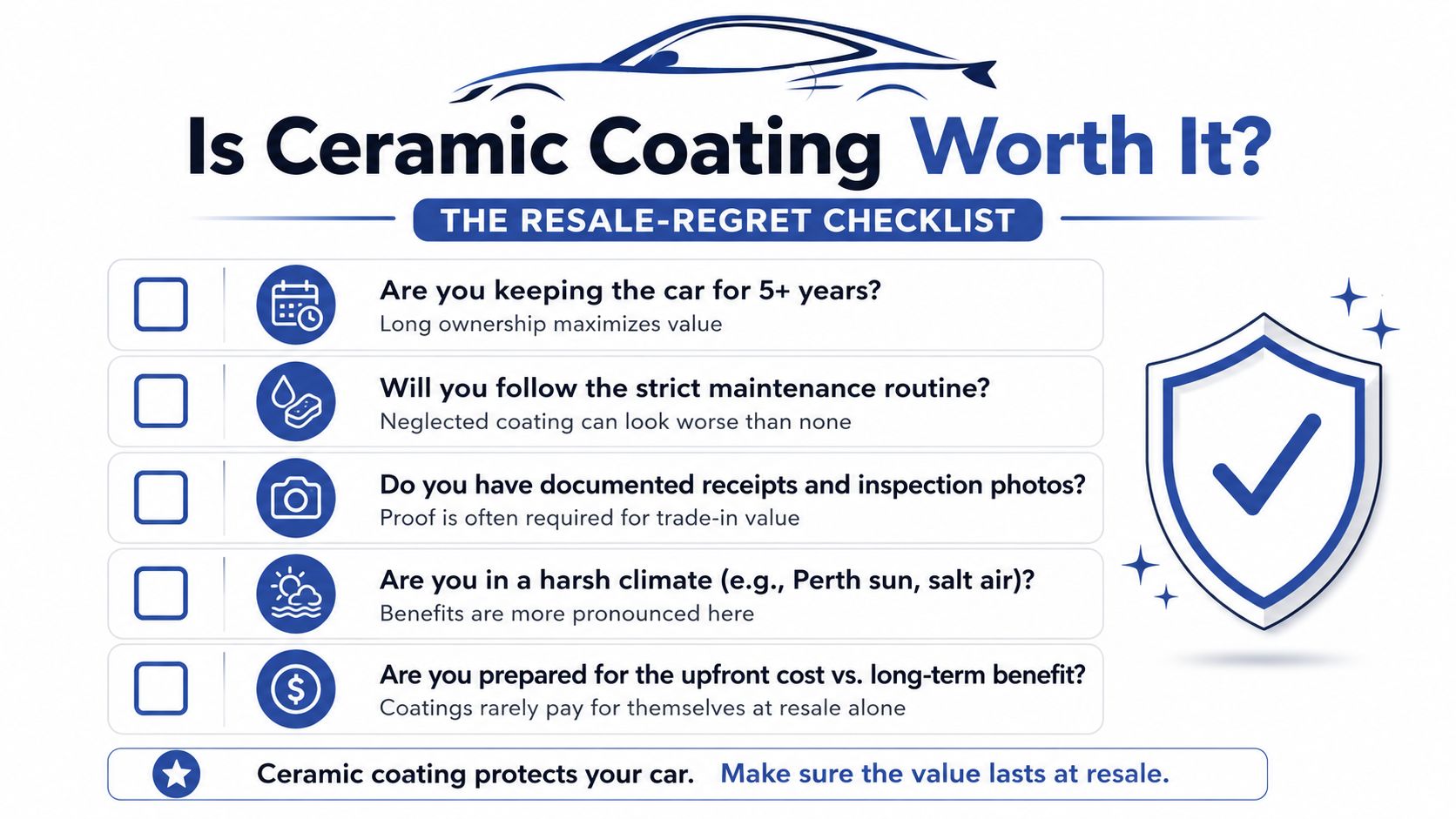
Ceramic coating life in Perth comes down to discipline. The people who get the full run out of it wash properly, decontaminate on schedule, and keep the surface free of the junk that kills hydrophobic behaviour. The people who don’t usually blame the coating when the actual problem is neglect.
The routine that actually works
Wash the car by hand every 1 to 2 weeks with a pH-neutral shampoo, a soft microfibre mitt, and a proper drying towel. That keeps mineral spotting and road film from choking the surface. Automated brush washes are a bad habit if you care about the coating, because they hammer the finish and wreck the slick feel fast.
Add a silica-based topper spray every 3 months if you want to refresh the water behaviour. Do a decontamination wash every 4 to 6 months, and use iron fallout remover on the schedule that fits your driving. If you commute near heavy traffic or brake dust, that step matters more than people think.
Park in shade when you can, and deal with bird droppings fast. Perth heat and local tree mess are not forgiving, and letting contamination sit is how a coating starts to feel tired long before its time.
Best practice: clean contamination early, because a coating that looks fine can still be clogged.
Safe products are straightforward. Use pH-neutral soaps, ceramic topper sprays, microfibre wash mitts, and drying towels. Avoid aggressive degreasers, abrasive polishes, and most quick-detailer sprays that load the surface with the wrong residue. Those products can strip or suppress the coating’s performance.
Here’s the rhythm worth screenshotting.
- Every 1 to 2 weeks: hand wash and dry properly.
- Every 3 months: apply a topper spray.
- Every 4 to 6 months: decontaminate the paint.
- Twice a year: clay-mitt treatment if the surface feels rough.
- Always: rinse droppings and sap as soon as you spot them.
If that sounds like too much, that’s the point. Ceramic coating is worth it when you’re willing to maintain it. If you’re not, a simpler protection plan will suit you better.
Book a coating-safe hand wash service
When Ceramic Coating Is Not Worth It for Your Car
A lot of regret comes from the resale side, not the coating itself. A nationally representative survey found 20% of Aussie motorists regretted paying for paint protection (WhichCar). That tells you exactly where the pain sits. If you’re treating coating as a trade-in magic trick, you’re setting yourself up to be disappointed.
The clear no-go cases
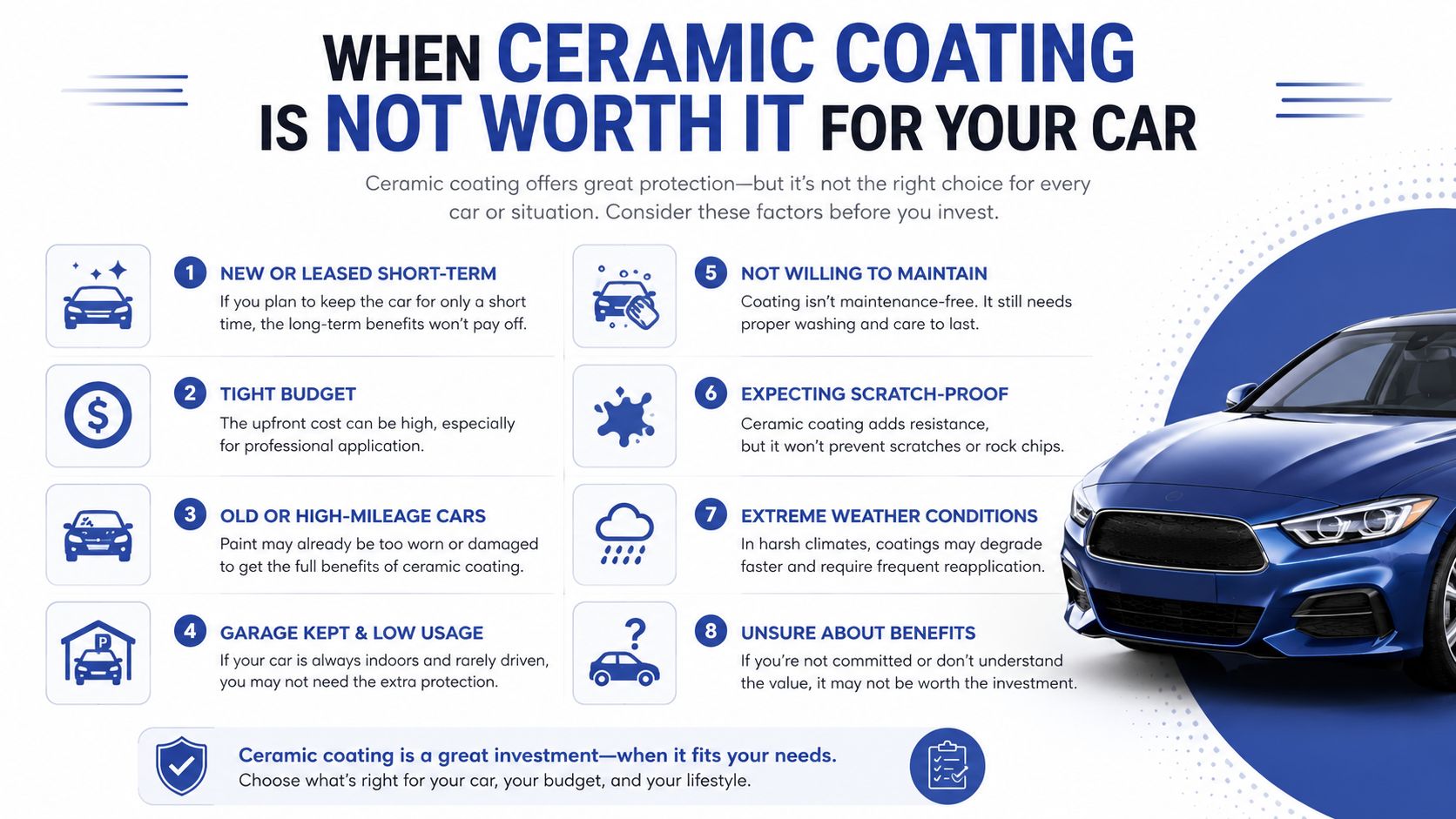
If the car is on a finance lease and heading back at 36 months, the value case is weak unless you’re keeping the paint condition spotless for yourself. If it’s a second vehicle that only does a few thousand kilometres a year, you’re unlikely to use enough of the lifespan to justify the spend. If the paint is already swirled, oxidised, or neglected, correction work becomes part of the bill before the coating ever helps.
The same goes for drivers who lean on automatic drive-through washes. Those habits fight the coating every week, and you’ll feel the loss in water behaviour and surface feel long before the calendar says the coating should be done. That’s not a product failure. That’s a usage mismatch.
The clear yes cases
Keepers are the right fit. So are garaged weekend cars, dark colours parked under Perth sun, rideshare cars doing heavy kilometres, and owners who don’t mind washing by hand. If you’re planning to hold the vehicle for years and you want the finish to stay easier to live with, the case is strong.
Use this quick check before you book.
- Will you keep the car for 5+ years?
- Will you hand wash it regularly?
- Is it parked outside in harsh sun?
- Is the paint already corrected or ready for correction?
- Are you expecting it to replace washing, not support it?
If you answer “no” to most of those, don’t buy the coating just because the quote sounds premium. Save the money for proper washing, paint correction, or a simpler protection plan that suits how you drive.
If you want straight advice, proper hand washing, and paint protection work that matches real Perth ownership rather than brochure promises, book with Prime Shine Hand Car Wash. They handle hand wash, detailing, paint correction, and ceramic coating from their Westminster site, so you can get the car assessed properly before you spend a cent.