




You’ve washed the car, dried it carefully, and enjoyed that sharp, wet-looking gloss for a few days. Then Perth’s sun, dust, road film and regular washing take their turn. The paint still looks clean, but the shine feels flatter and water no longer gathers into neat beads. You’re left wondering whether the liquid car wax failed, whether it was applied incorrectly, or whether the bottle’s durability claim was too optimistic.
That confusion is understandable. “Liquid wax” describes a format, not a guaranteed level of protection. One product may be designed for a quick refresh, while another uses a more durable resin or polymer system. The result also depends on preparation, parking conditions, washing habits and whether the car already has ceramic protection.
This guide separates three things that are often treated as one: gloss, water beading and true paint protection. You’ll learn what liquid wax does, how it compares with paste and spray products, how to apply it safely, and when it makes sense for a Perth vehicle. You’ll also see why the right choice for an older, unprotected car may be the wrong choice for a vehicle with an existing coating.
Introduction Why Does Liquid Wax Confuse So Many Drivers
A freshly waxed car can look excellent even when the underlying paint needs more preparation. The product may add slickness and reflections immediately, so the owner reasonably assumes the paint has received a strong, long-lasting shield. Yet visible gloss can fade before the remaining protective film has disappeared, while water beading can weaken faster still.
The bottle and the driveway tell different stories
Australian guidance commonly places wax protection in the short-to-medium duration range, with many products lasting around one to three months and a practical starting point of reapplication every four to eight weeks. That guidance is discussed in Australian wax care advice, but it doesn’t mean every vehicle will follow the same timetable.
A car parked outside near the coast, washed frequently with strong detergents and exposed to Perth’s intense sunlight will ask more from its wax than a garaged weekend vehicle. Dust can also settle into a surface that wasn’t properly cleaned, leaving the wax sitting over contamination rather than bonding evenly to the clear coat.
A useful way to think about wax: judge the car, not just the calendar. Watch how the surface behaves after washing, especially its slickness and water response.
What this guide will help you decide
Liquid wax is often a sensible maintenance product for older or unprotected paint. It can improve the finish, make the surface feel smoother and add temporary water repellency without the preparation or cost associated with more permanent paint protection systems.
It isn’t a universal answer, though. If the paint has embedded contamination, heavy swirl marks or an existing ceramic coating, applying another product may not solve the actual problem. By the end, you should be able to decide whether to wax at home, change the preparation routine or book a professional reset.
What Is Liquid Car Wax and How Does It Protect Paint?
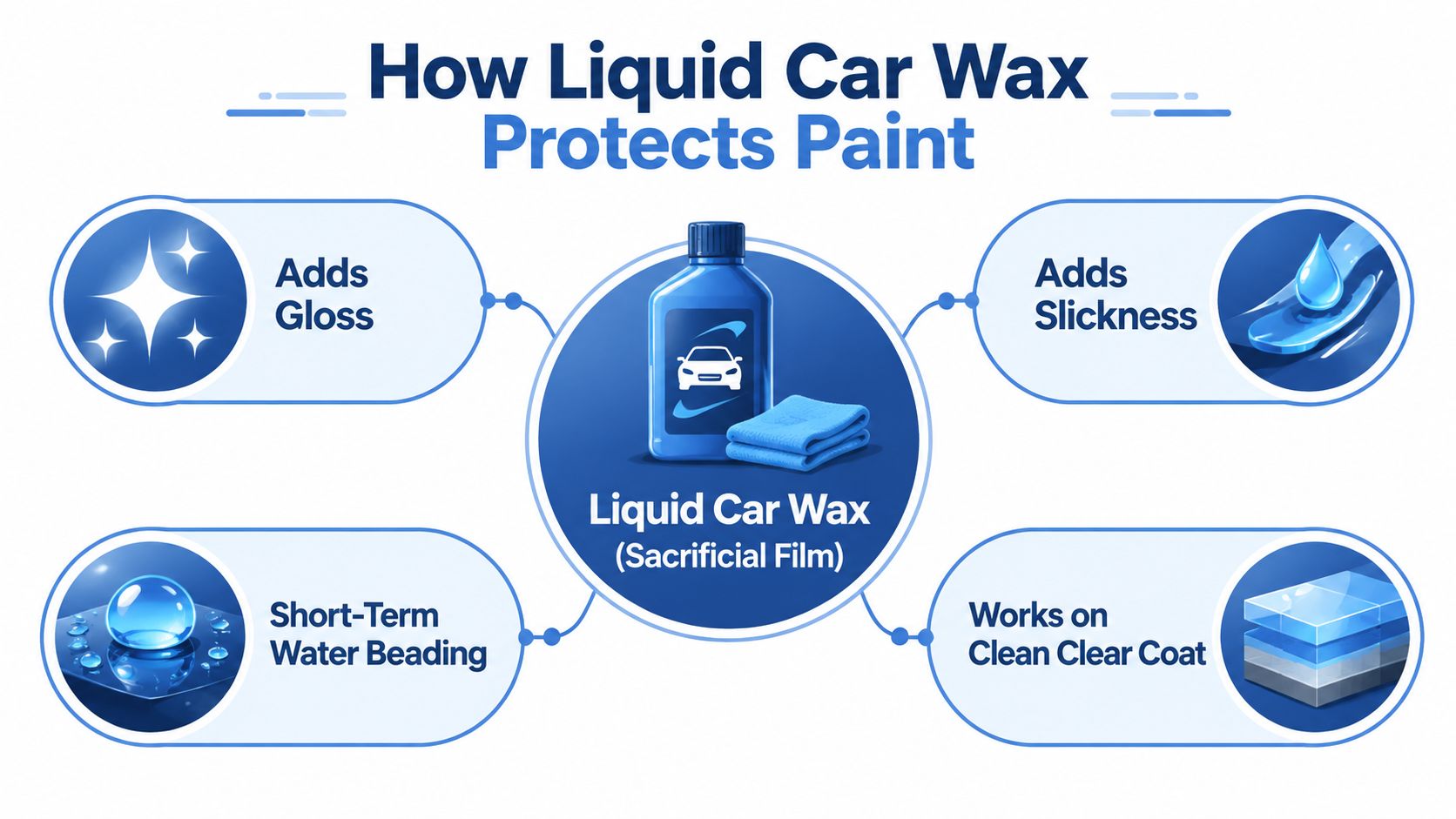
Liquid car wax is a spreadable protectant designed to leave a thin film over clean painted surfaces. Think of it as sunscreen for the clear coat, though the analogy has limits. Sunscreen is designed for skin and must be reapplied according to its own directions. Liquid wax creates a sacrificial layer that can improve gloss, slickness and short-term water behaviour, but it doesn’t replace proper washing or provide permanent protection.
What the film does
A clean clear coat gives the product a more consistent surface to spread across. Once cured according to the label, the film can produce a smoother feel and encourage rain or dew to gather into beads rather than lying as a broad sheet. The finish may also appear deeper because the product changes how light reflects from the surface.
That visual improvement is real, but it shouldn’t be confused with paint correction. Wax can sometimes make minor dullness less obvious, yet it won’t remove swirls, scratches or oxidation. If the paint needs correction, the surface must first be assessed and prepared rather than covered indefinitely.
Why formulations behave differently
The word “liquid” tells you how the product is handled. It doesn’t tell you exactly how durable the finished layer will be. Australian professional-care products demonstrate how broad the range can be. One spray wax is listed with up to one month of environmental protection and an acidic pH of 4, while another Australian retail wax claims up to 12 months of protection and strong water repellency. These examples are documented in professional vehicle-care product information and should be read as product-specific claims, not a promise for all liquid wax.
The important variables include the resin or polymer system, surface preparation and chemical compatibility. A clean, decontaminated panel gives the wax a better chance of forming an even layer. Embedded traffic film, iron particles, sap or old residue can reduce the real-world result well below the headline claim.
The simplest rule: liquid wax improves and protects a prepared surface. It can’t turn neglected paint into corrected paint.
Check Paint Preparation Options
How Does Liquid Car Wax Compare to Paste and Spray Options?
A Perth owner washing the car every week usually wants three things: a glossy finish, visible water beading and protection that fits the next wash. Liquid, paste and spray wax can all help, but they do not deliver those benefits in the same way. Gloss is the appearance. Beading shows how water behaves. Protection describes how well the layer helps shield paint from contamination and Australian UV exposure.
Liquid wax is generally the most balanced option for a first-time owner. It spreads more easily than firm paste, works well by hand in a thin coat and suits a planned wash-and-protect session. Paste wax can give a richer-looking finish for owners who enjoy careful preparation, though spreading and buffing require more control. Spray wax favours speed. It works well as a maintenance layer or quick refresh, but its protection may be lighter depending on the formulation.
| Format | Ease of Use | Typical Durability | Best For |
|---|---|---|---|
| Liquid wax | Straightforward hand application and thin spreading | Short-to-medium duration, depending on formulation and conditions | Older or unprotected paint needing a practical balance |
| Paste wax | More hands-on, with careful spreading and buffing | Often positioned as a richer, longer-lasting wax option | Enthusiasts who prioritise finish and enjoy detailed preparation |
| Spray wax | Fast application, often during or after washing | Usually a lighter maintenance layer, though claims vary | Quick refreshes between more thorough protection sessions |
Why spray products are attracting attention
Spray waxes and ceramic spray coatings appeal to Australian drivers because they reduce the time needed for a protection top-up. That convenience matters when a vehicle is washed frequently or sits outside in strong Perth sunlight. Faster application does not automatically mean stronger protection. It means the owner is more likely to maintain the surface consistently.
Liquid wax can offer a useful middle ground. It is quicker to handle than paste while usually giving more deliberate coverage than a fast spray application. Product claims still need context, because surface preparation, wash chemicals, heat and exposure can shorten the result. Sap, traffic film or old residue can reduce the actual result on the panel.
Where liquid wax still fits
Liquid wax suits unprotected paint when the owner wants visible gloss and water beading without committing to a longer-term coating. It is also a practical choice for a vehicle that receives regular hand washing. Use a thin layer, allow the product to haze or cure as directed, then buff with a clean microfibre.
Existing ceramic protection changes the decision. Liquid wax may add gloss or alter water behaviour, but it should be compatible with the coating and should not be treated as a replacement for that protection. For a clearer comparison of liquid and spray car wax, match the format to the vehicle’s current surface, Perth’s UV exposure and how often you will maintain it. A product that is easy to use regularly can outperform a richer option left unused.
Which Surfaces Benefit and How Should You Apply It Safely?
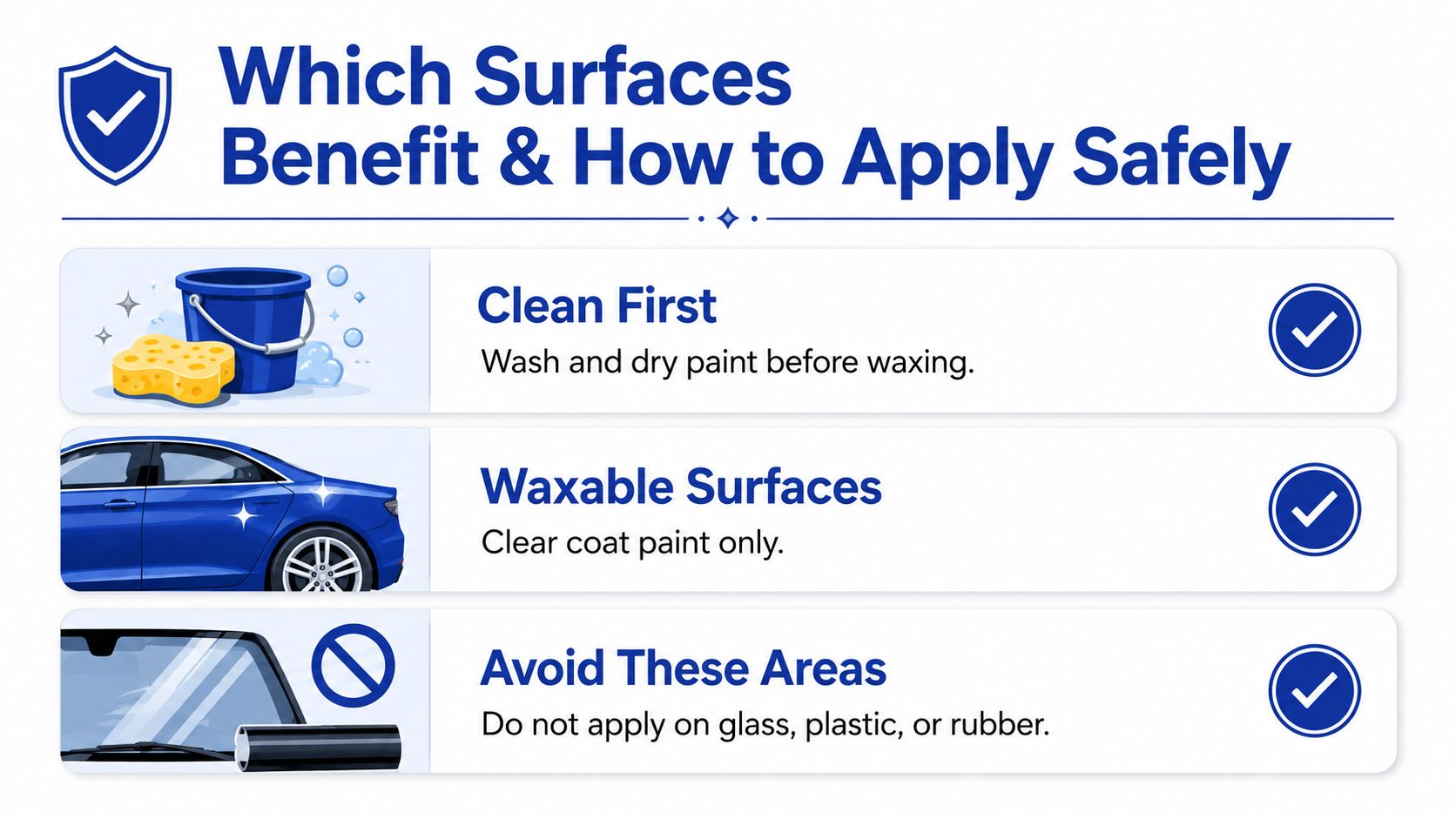
Liquid wax belongs on clean, prepared painted surfaces, particularly the clear coat. It doesn’t belong everywhere that looks shiny. Glass, textured plastics, rubber seals and interior materials can respond poorly, leaving smears, residue or an unwanted slick finish.
The preparation stage matters because wax is only as consistent as the surface underneath it. A panel covered with bonded grime or old product residue may feel smooth in one area and rough in another. The new layer then spreads unevenly and wears unpredictably.
A safe application sequence
-
Wash the exterior first. Remove loose dirt before touching the paint with an applicator. Dry the panels fully, because trapped water can dilute the product and make removal uneven.
-
Check the paint by feel. If the surface feels gritty after washing, it may need further decontamination before waxing. A paint-cleaning treatment can help identify and address residue that ordinary washing leaves behind. See car paint cleaning treatment guidance if the panel feels rough or looks heavily filmed.
-
Work in shade. Direct heat can make liquid wax flash or haze before you’ve spread it properly. Apply a small amount to a clean applicator and cover a manageable panel with a thin, even film.
-
Keep the product off non-painted areas. Avoid windscreens, side glass, black textured trim, rubber and porous plastics unless the product specifically states compatibility.
-
Buff with a fresh microfibre. Follow the label’s instructions for haze, removal or curing. Turn the towel regularly so you’re not spreading removed residue back across the panel.
Why thin coats work better
A thick coat feels reassuring, but extra product doesn’t automatically create extra protection. It can make removal harder, increase smearing and leave an uneven film. A thin application usually gives you better control and a cleaner finish.
Practical rule: if the paint still feels rough after washing, stop and prepare it. Don’t use more wax to compensate for contamination.
Cars with existing ceramic coating or other paint protection need a separate compatibility check. An Australian manufacturer FAQ warns that polish and wax products shouldn’t be used on protected vehicles in some circumstances, and doing so may affect warranty terms. If your vehicle has a coating, follow the installer’s maintenance instructions before reaching for a conventional wax.
How Long Does Liquid Car Wax Really Last in Australian Conditions?
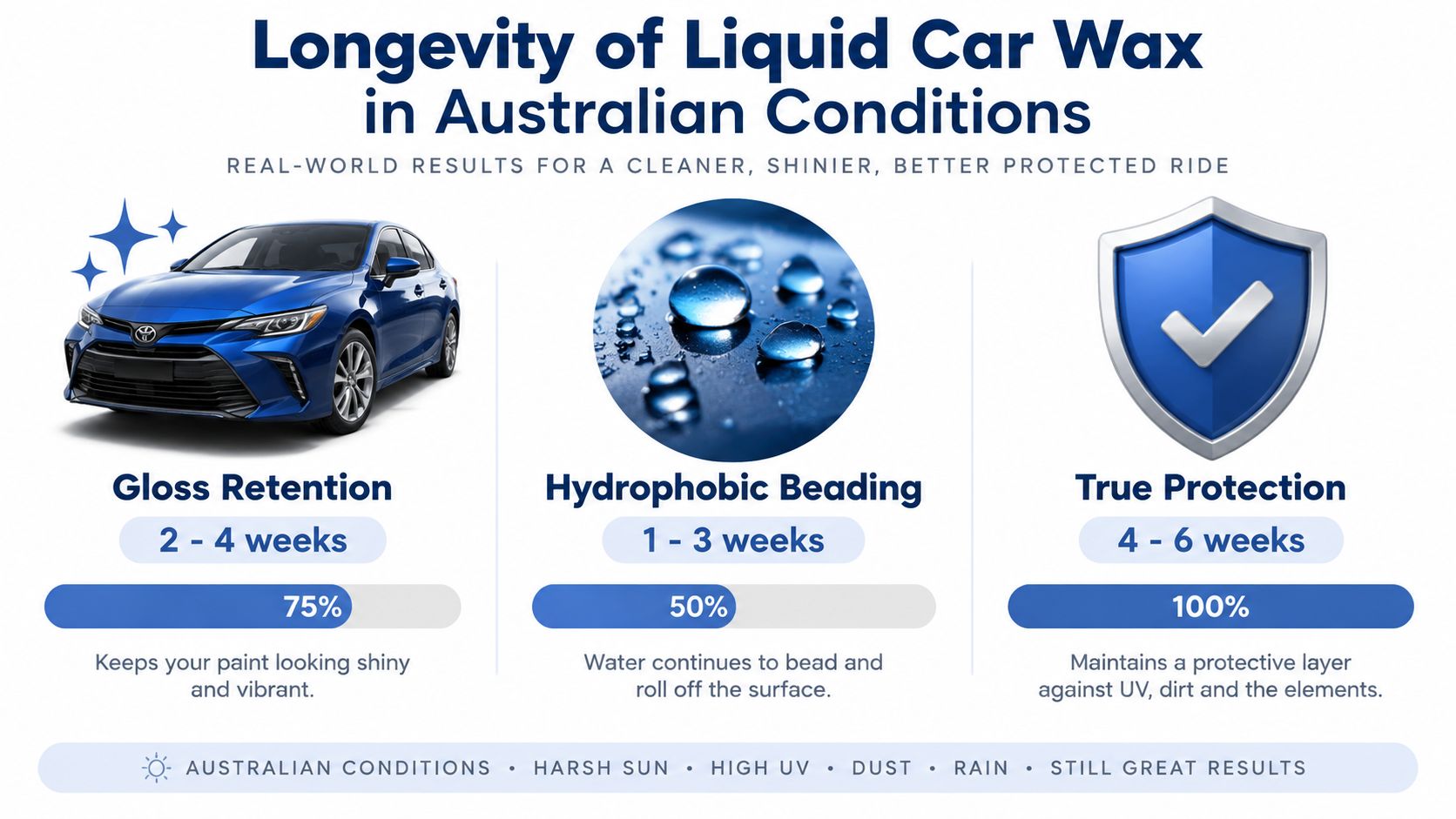
Durability becomes clearer when you separate three different outcomes. Gloss retention describes how long the paint continues to look freshly finished. Hydrophobic beading describes how water gathers and moves. True protection refers to how much of the protective film remains effective against everyday exposure.
Those signals don’t always decline together. A car may lose some visual sharpness while still carrying a useful film. Beading can also weaken after detergent exposure even though some protection remains. That’s why a bottle’s maximum claim shouldn’t dictate your exact reapplication date.
What Perth conditions change
High UV, heat, dust, coastal salt and frequent washing all place pressure on a wax layer. A car parked outdoors near Perth’s coast may need more attention than a vehicle kept under cover and washed gently. Weekly washing can also remove or thin a product faster than occasional maintenance, particularly when the wash chemistry is aggressive or the vehicle is scrubbed while dirty.
Australian detailing guidance recommends waxing every three to four months under normal conditions, and every two months in harsh climates involving high UV, coastal salt or extreme heat. These recommendations appear in Australian automotive care guidance. For many Perth drivers, the shorter interval is a sensible planning point, not a guarantee.
The Australian wax market also contains very different product claims. One AU retailer markets a liquid wax as delivering paint protection, water beading and dirt repellency for up to 12 months after one application, as shown in this liquid wax product listing. Treat that as the stated claim for that product, not as a universal expectation for liquid wax.
Use the wash as your test
After washing and drying, feel the paint with clean fingers through a microfibre. Watch how water behaves on a clean panel, then compare the result with the finish immediately after waxing. When both slickness and beading have clearly weakened, the film is telling you it needs attention.
An AU wax FAQ gives product-specific durability examples, including up to six months for one high-definition wax, up to four months for one gloss protection product and up to two months for one rapid aqua wax. The ranges are listed in Australian wax durability guidance. These examples reinforce the main lesson: product chemistry and conditions matter more than the word “liquid”.
If you’re comparing wax with longer-term protection, don’t use wax intervals as a substitute for coating guidance. Ceramic coating maintenance depends on the specific system and installation, as explained in this guide to how long ceramic coating lasts.
Learn About Longer Lasting Protection
How Do You Choose the Right Kit or Product for Your Needs?
Choose a kit around the car’s condition, where it lives and how often it gets washed. A family vehicle carrying food, school bags and muddy shoes needs a different routine from a lightly used car kept indoors. A rideshare or delivery vehicle usually benefits from repeatable washing and interior care, rather than a complicated one-off process.
Match the product to the driver
Families should look for a gentle exterior cleaner, washable microfibres and an interior protectant suited to the cabin materials. Liquid wax can help unprotected painted panels stay easier to clean between washes. It adds gloss and water beading, but those effects are separate from long-term paint protection.
Pet owners need to remove hair, dirt and fabric contamination before chasing shine. Vacuuming, a pet-hair tool and suitable fabric cleaning will make a larger difference than waxing over a dirty surface. Keep exterior wax away from interior trim, seats and carpets, where it can leave residue without providing useful protection.
Rideshare and delivery drivers need a process they can repeat without creating extra work. A spray protectant may suit a quick maintenance wash, while liquid wax fits a slower wash where the paint can be prepared and the product hand-applied. In Perth, frequent sun exposure and regular washing can wear down the visible beading sooner than a sheltered vehicle would.
Luxury and enthusiast owners should check the finish and existing protection first. Ceramic protection is a different system from wax, so follow the installer’s approved maintenance advice rather than layering on an unknown product. On unprotected paint, a carefully applied liquid wax can supply the gloss and slick feel many owners want, without changing the vehicle’s basic protection approach.

Read the label beyond the word “wax”
Check the compatible surfaces, application temperature, curing or buffing instructions and stated durability. A bottle may contain wax, a polymer sealant, a spray coating or a blended protectant. Those categories behave differently, especially when the paint already has ceramic protection. Clear instructions are more useful than a broad promise of shine or protection.
Use this checklist before buying:
- Paint status: Is the clear coat unprotected, coated, rough, dull or visibly swirled?
- Routine: Will you wash weekly, occasionally or only before special events?
- Exposure: Is the car garaged, parked outdoors, near coastal air or driven through dusty areas?
- Application time: Do you want careful hand application or a quick post-wash refresh?
- Compatibility: Does the label support your existing protection system?
- Tools: Do you have clean microfibres, an applicator and a shaded place to work?
Australian supply depends heavily on overseas producers, while local formulation and packaging capacity is more limited. That supply-chain situation makes label clarity and suitability more important than assuming every locally sold bottle has the same formula. For Perth owners, also match the product to UV exposure and wash frequency. A product that gives attractive beading may still need regular renewal, while a coated vehicle may need only compatible maintenance rather than another wax layer.
When Should You Book a Professional Detail Instead of DIY?
DIY liquid wax works well when the paint is already reasonably clean, the surface is smooth and you’re comfortable maintaining it. It won’t remove persistent swirls, bonded contamination, deep interior stains or embedded pet hair. It also won’t correct a surface that needs machine polishing before protection.
Book a professional detail when the car has:
- Persistent swirls or light scratches that remain after washing.
- Rough, contaminated paint that doesn’t respond to normal cleaning.
- Pet hair, stains or built-up interior residue requiring targeted tools and cleaning.
- A dull finish before sale or lease return, where preparation matters more than adding quick gloss.
- Existing ceramic protection that needs compatible maintenance rather than conventional wax.
A professional service can reset the surface through careful washing, paint preparation, clay treatment or machine correction before applying an appropriate protectant. Prime Shine Hand Car Wash in Westminster provides hand wash methods, interior and exterior detailing, cut and polish, ceramic coating and wax-related services. Its full car detailing service is suited to vehicles that need more than a quick wash and wax.
For a well-maintained, unprotected car, liquid wax can then act as a practical maintenance step between deeper details. For a neglected car, preparation should come first. The best result comes from matching the product to the paint’s actual condition, Perth’s exposure and the owner’s willingness to repeat the care routine.
Visit Prime Shine Hand Car Wash in Westminster for careful hand washing, interior and exterior detailing, paint correction, wax services and ceramic coating options. Book online when your car needs a proper surface reset, or arrange a maintenance wash when you want to keep your liquid wax finish looking clean and cared for.