






You’ve just washed the paintwork, stood back, and the car still looks unfinished. The wheels give it away. Brown dust is sitting inside the spokes, the barrel behind them looks grey and gritty, and the tyre sidewalls have gone flat and dry. A quick hose over the face didn’t shift any of it, because a rinse isn’t built for bonded brake metal, tyre rubber, and road film. That’s where a proper wheel cleaning service earns its place, not as a cosmetic extra, but as the step that removes what’s stuck to the wheel and protects the finish afterwards.
What Does a Wheel Cleaning Service Include and How Is It Done?
Start with a checklist you can hold up against any quote. A complete wheel cleaning service should name six things: a low-pressure pre-rinse, iron fallout removal from spokes and barrel, brake dust and road film removal from the face and lip, barrel and caliper cleaning, tyre dressing, and rim protection. If a quote only says wheel clean, you’re guessing which of those you’re buying. The difference matters because each step removes a different layer. A face wipe can make a wheel look better under petrol station lights. It won’t clear embedded particles behind the spokes, and it won’t protect the finish from the next round of film and water spotting.
Choose a wheel clean that names every step upfront, so you know exactly what’s included.
Core Wheel Cleaning Steps and What Each One Does
| Step | What it removes or protects | Method |
|---|---|---|
| Pre-rinse | Loose grit and dust | Low-pressure rinse before any tool touches the wheel |
| Iron fallout removal | Embedded metallic particles from brake dust | Iron-reactive cleaner, dwell time per product label, then rinse |
| Brake dust and road film removal | Brake residue and road film on the face and lip | Dedicated non-abrasive wheel cleaner with soft brushes |
| Barrel and caliper cleaning | Residue deep inside spokes and behind the barrel | Long-handled brushes and high-volume rinse |
| Tyre dressing | Dry, faded sidewalls | Water-based dressing applied with an applicator |
| Rim protection | Film and water spotting on the finish | Spray wax or sealant applied after drying |
At Prime Shine Hand Car Wash, those steps sit inside packages rather than leaving you to assemble them yourself. The Outside Car Wash starts from $29 and bundles a wheel clean and tyre shine with a hand wash, rinse and quick dry for the rest of the exterior. The Inside & Outside Car Wash starts from $55 and adds interior and boot vacuuming plus dusting of the dash, console and trims on top of the same wheel clean and tyre shine. Full Car Detailing goes further again, covering windows, door jambs, wheels and tyres as part of a deeper inside-and-out reset. If you want to see how the exterior package fits together first, read what’s included in an outside car wash before you compare quotes.
Choose the Outside Car Wash if your paint and wheels both need a reset, and we’ll handle them together.
How a Good Technician Works Through the Wheel
Order matters more than effort here. Scrubbing harder in the wrong sequence spreads grit, bakes cleaner onto hot metal, and leaves the barrel untouched. The table above shows what each step does. What separates a careful job from a fast one is the technique inside each step: temperature, dwell time, and sequencing.
- Let the wheels cool in shade before anything touches them. Hot wheels flash cleaner dry before it can work, and dried cleaner can mark the finish. Touch the face first. If it’s warm, wait.
- Keep the pre-rinse pressure low. The point is lifting loose grit off the surface, not blasting it into the barrel or across the face where a brush will drag it.
- Watch the clock on dwell time. Iron remover needs long enough to dissolve embedded metallic particles, but no longer than the label allows. The colour change tells you it’s reacting. If it dries on the surface, it can stain.
- Match the cleaner’s strength to the finish. Clear-coated alloy, painted, polished and lacquered rims don’t all tolerate the same chemistry. A milder product with a second pass beats one aggressive application on a delicate finish.
- Use the right brush for each zone. A soft face brush handles the visible surface. A long-handled barrel brush reaches behind the spokes where deposits collect out of sight, and it takes a different angle than the face brush allows.
- Rinse from the top down at high volume. Downward rinsing carries loosened residue away instead of pushing it back into clean areas, and the barrel needs the most water because that’s where residue hides.
- Dry fully before you dress or seal anything. Applying sealant or tyre dressing over damp surfaces traps moisture and leaves a patchy finish, so the wheel should be dry and inspected under light first.
Ask any detailer to inspect your spokes and barrels under light before quoting, so the method matches your wheel finish.
Where Wheel Cleaning Goes Wrong
Two slips account for most disappointing results. The first is cleaning hot wheels straight after driving, which bakes cleaner on and shortens dwell time to almost nothing. The second is skipping the pre-rinse and going straight in with a brush, grinding loose grit into the clear coat.
Practical rule: If a wheel tool touches brake dust, it never touches paintwork. Separate buckets, separate brushes, no exceptions.
There’s also a trade-off worth naming. Stronger chemistry works faster, but it carries more risk on polished, painted or lacquered finishes, especially if it dwells too long or dries out. A pH-balanced, acid-free iron remover takes a little more patience and agitation, yet it gives you control on finishes that punish mistakes. Speed suits a standard factory alloy with light film. Control suits anything coated, machined or already showing staining. I would always trade a few extra minutes for control on a delicate finish, because you can’t reverse chemical damage with another wash.
Got polished or coated wheels? Book a hand clean so we can match the chemistry to your finish, not the other way round.
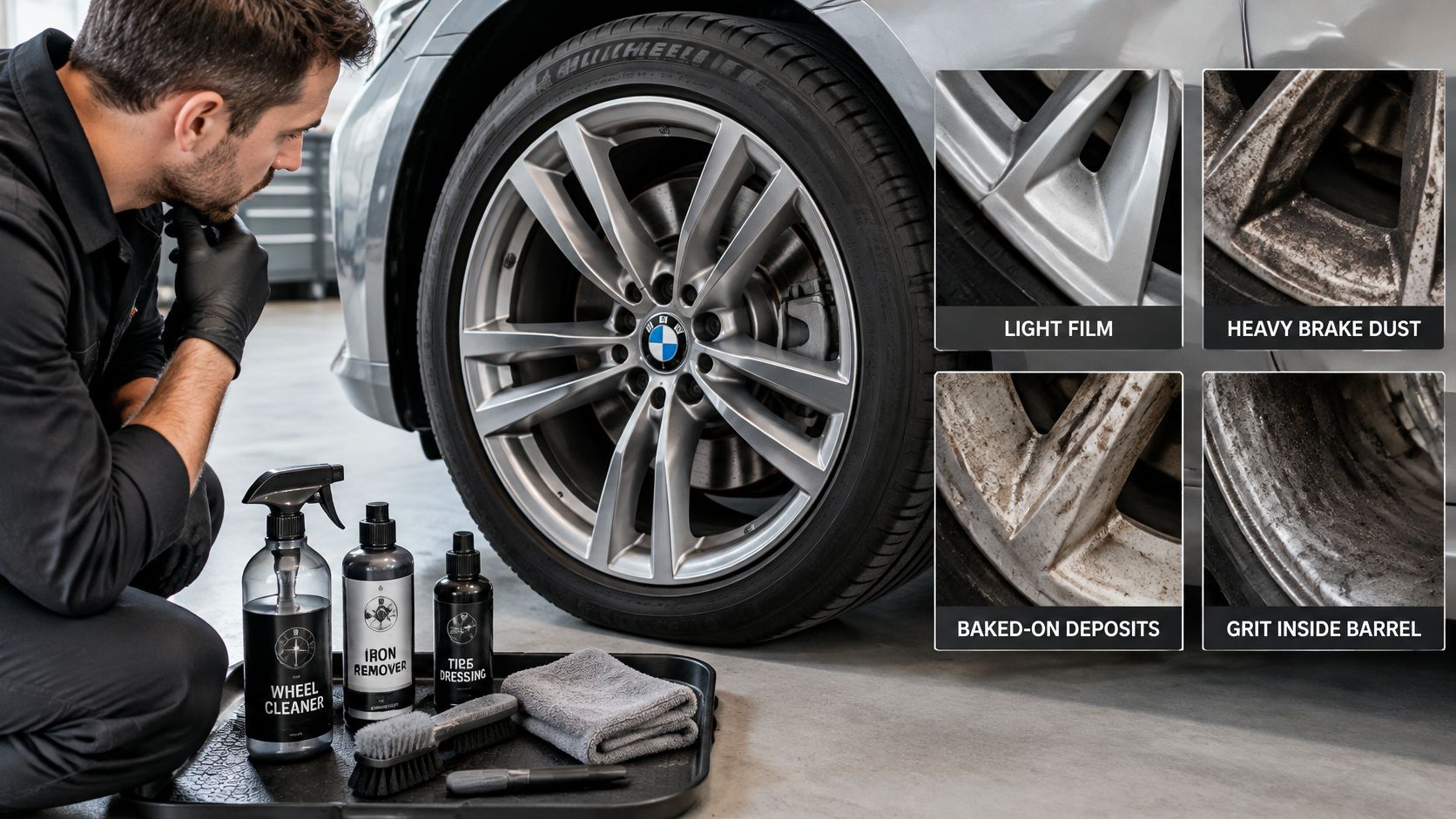
It’s also worth checking the wheels yourself before work starts. Some marks are removable deposits sitting on the surface. Others are permanent clear-coat damage, corrosion or kerb scuffing that no cleaner should chase aggressively. A photo on your phone and a straight answer from the detailer about what cleaning can and can’t fix will stop a compromised wheel being over-treated, and stop you paying for a result that cleaning alone can’t deliver.
A properly cleaned wheel gives you a simple test. Run your eye over the face under good light and you should see no haze, no brown tint in the corners of the spokes, and no gritty feel if you run a fingertip lightly inside the barrel. The tyre should look evenly dressed rather than wet or patchy, and water should sheet or bead off the protected finish instead of spotting it. If the face looks clean but the barrel still feels rough, you’ve paid for a face wipe when you needed a wheel cleaning service.
Why Do Wheels Need More Than a Quick Rinse?
Wheels sit closest to the road surface, so they collect what the rest of the car mostly avoids. Every trip lays down road film, dust, tyre rubber, and brake residue, and Australian vehicles cover serious distance doing it. The Australian Bureau of Statistics Survey of Motor Vehicle Use estimated 19,768,518 vehicles in operation and an average of 12,100 kilometres per vehicle over the 12-month survey period. That’s a lot of kilometres for contamination to build, bake on, and bond.
If your wheels still look brown after a rinse, book a proper clean before the deposits bake on further.
The chemistry explains why rinsing fails. Australian urban-road research published in ScienceDirect found road dust containing approximately 164 µg/g copper, 487 µg/g lead, and 523 µg/g zinc, with brake material itself reported at about 66,000 µg/g copper. Mix those metals with water, road salts, and brake heat on the wheel face and behind the spokes, and you get bonded grime that can stain clear coats if it’s left alone. Tyre and road wear particles add vulcanised rubber, carbon black, and mineral dust on top, which is why deposits need staged removal rather than dry scrubbing that just redistributes grit.
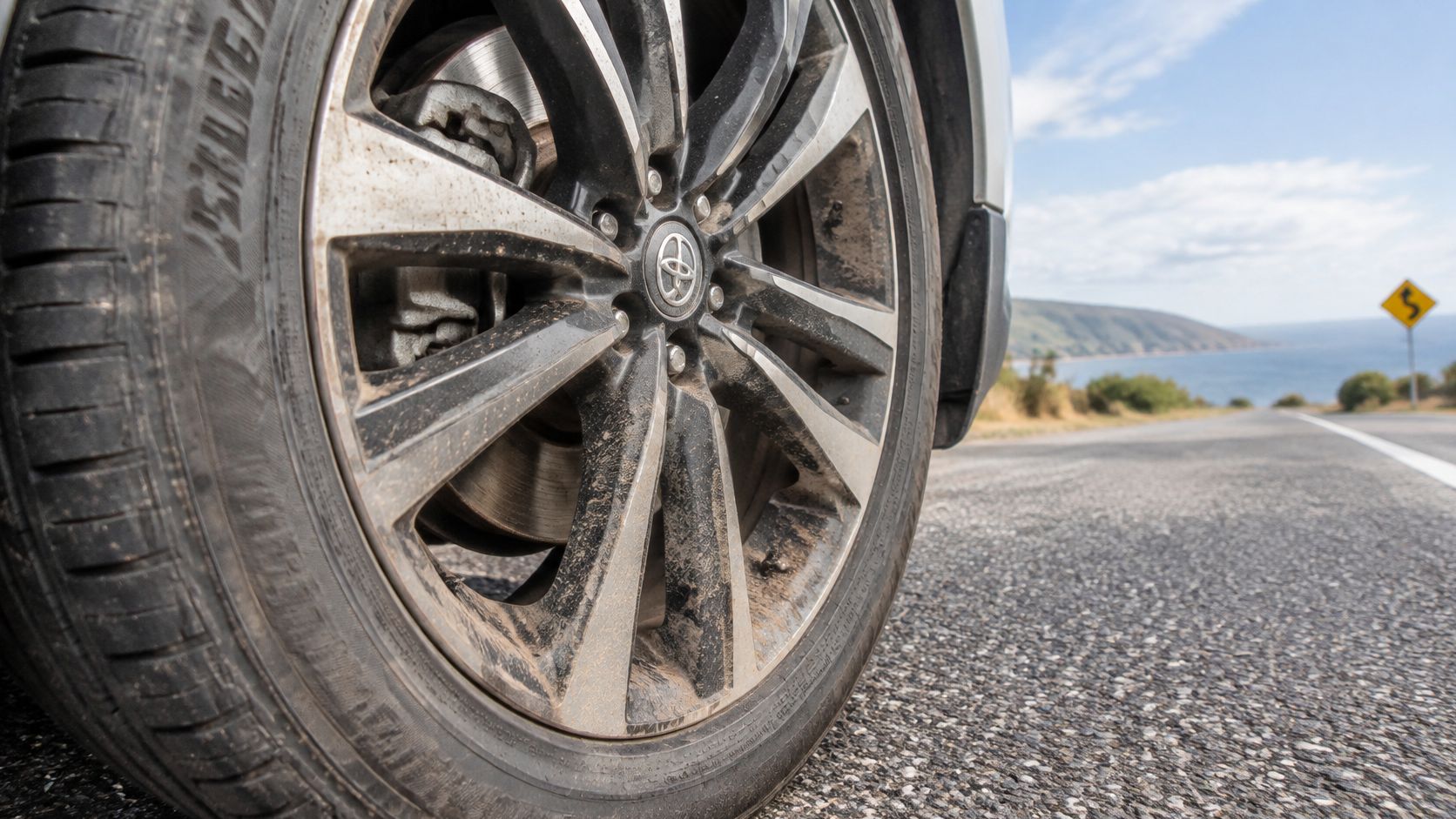
Say you’re a Perth commuter in stop-start traffic. You’ll build a visible film within a week, because repeated braking feeds fresh dust onto warm wheels daily. A highway driver brakes less often, so the face may stay cleaner longer while the barrel slowly accumulates grit. Electric and hybrid drivers sit somewhere in between. Regenerative braking reduces friction brake wear, so EV wheels may collect less brake dust, but tyre particles, road film, and iron-containing deposits from occasional friction braking still build up. Less brake dust doesn’t mean no contamination.
Check inside the spokes and behind the barrel every fortnight. Brown dust or a gritty feel means the wheel needs attention, whatever you drive.
Bring your car in for an inspection-based wheel clean and we’ll tell you honestly whether it needs a light wash or a deep barrel clean.
Explore wheel cleaning options
What Drives the Cost of a Wheel Cleaning Service?
Price follows package, vehicle size, and wheel condition, in that order. Basic wheel work sits inside the exterior wash tiers, so the larger jumps come when contamination has bonded to the wheel or when the vehicle moves up a size class.
Starting Prices by Package and Vehicle Size
| Package | Sedan | SUV/Wagon | 4WD/7 Seater |
|---|---|---|---|
| Outside Car Wash | from $29 | Quoted at booking | Quoted at booking |
| Inside & Outside Car Wash | from $55 | Quoted at booking | Quoted at booking |
| Premium Car Wash | from $85 | from $95 | from $105 |
| Mini Car Detailing | Quote on request | Quote on request | Quote on request |
| Full Car Detailing | from $349 | from $369 | from $399 |
| Cut & Polish | from $249 | from $269 | from $299 |
| Ceramic Coating | Quote on request | Quote on request | Quote on request |
Cells marked as quoted are set by vehicle size and condition rather than a published starting price. The step from wash work to detailing is where labour changes most: light surface film releases quickly, while embedded brake metal and rubbery road film need dwell time, agitation, and a slower pass around spokes, barrels and calipers. If you’re weighing that kind of reset against a wash, what changes full detail pricing in Perth shows what moves the bigger figure.
Final price depends on vehicle size and wheel condition, and is confirmed at booking.
Five factors move the final number. Vehicle size sets the baseline, since a 4WD carries bigger wheels and more surface than a sedan. Wheel condition is the variable, because baked-on residue takes more chemical dwell and brush time than a weekly film. Wheel finish matters too, since polished or lacquered rims need gentler chemistry and slower work. Barrel and caliper access changes the labour, especially on tight multi-spoke designs. Every car is hand-washed only, with no machine brushes touching the paint, so access and contamination translate directly into minutes.
Common add-ons include tyre dressing, hand wax and polish, pet hair removal, and headlight restoration. My rule is simple: an add-on pays off when the condition in front of you justifies it. Skip rim protection for a wheel that still needs decontaminating, and skip heavy fallout treatment when the wheels carry only light film.
Tell us your vehicle size and how your wheels look today, and we’ll confirm the package and total at checkout.
How Long Does a Wheel Cleaning Service Take?
A sedan carrying light surface film can be in and out quickly. A 4WD with months of baked-on brake dust is a different job, because embedded iron particles and tyre rubber residue have to be chemically released before any contact work starts. The ranges below are typical estimates, and wheel condition plus vehicle size decide where your booking lands inside them.
Typical Time on Site by Service
| Service | Typical time on site (estimate) |
|---|---|
| Outside Car Wash | Roughly 20 to 40 minutes, wheel clean and tyre shine included |
| Inside & Outside Car Wash | Roughly 45 minutes to an hour and a half, interior vacuum and dusting add time |
| Mini Car Detailing | Roughly an hour and a half to three hours, includes wheel arches, door jambs and chamois dry |
| Full Car Detailing | Roughly four to eight hours, set by vehicle condition |
| Cut & Polish | Roughly four to eight hours, set by the correction required |
| Ceramic Coating | Most of a day, plus curing time before the first wash |
Pick your vehicle and add-ons online, choose a date and time, and review the total before you check out.
Mini Car Detailing runs longer than a wash because door jambs, wheel arches and a chamois dry are hands-on finishing steps that take operator time on every panel. Ceramic coating sits at the far end entirely. After application the car should stay untouched for a day or more before its first wash, so plan it as a drop-off rather than a wait-while-you-watch job. For a fuller picture of how package times build up, see how long car detailing takes in Perth.
Condition drives the gap. Light film on alloys rinses and wipes away fast, while baked-on brake dust needs an iron fallout treatment with proper dwell time, then agitation and a second rinse, and tight multi-spoke designs or deep barrels stretch that further. Shortening the dwell to save time is the shortcut that fails, because the embedded metal stays in the surface and keeps staining. Rideshare drivers and fleet operators working around shifts should pick a date and time that leaves slack at both ends, since a heavily contaminated wheel loses exactly the stages that make the clean last when it gets rushed.
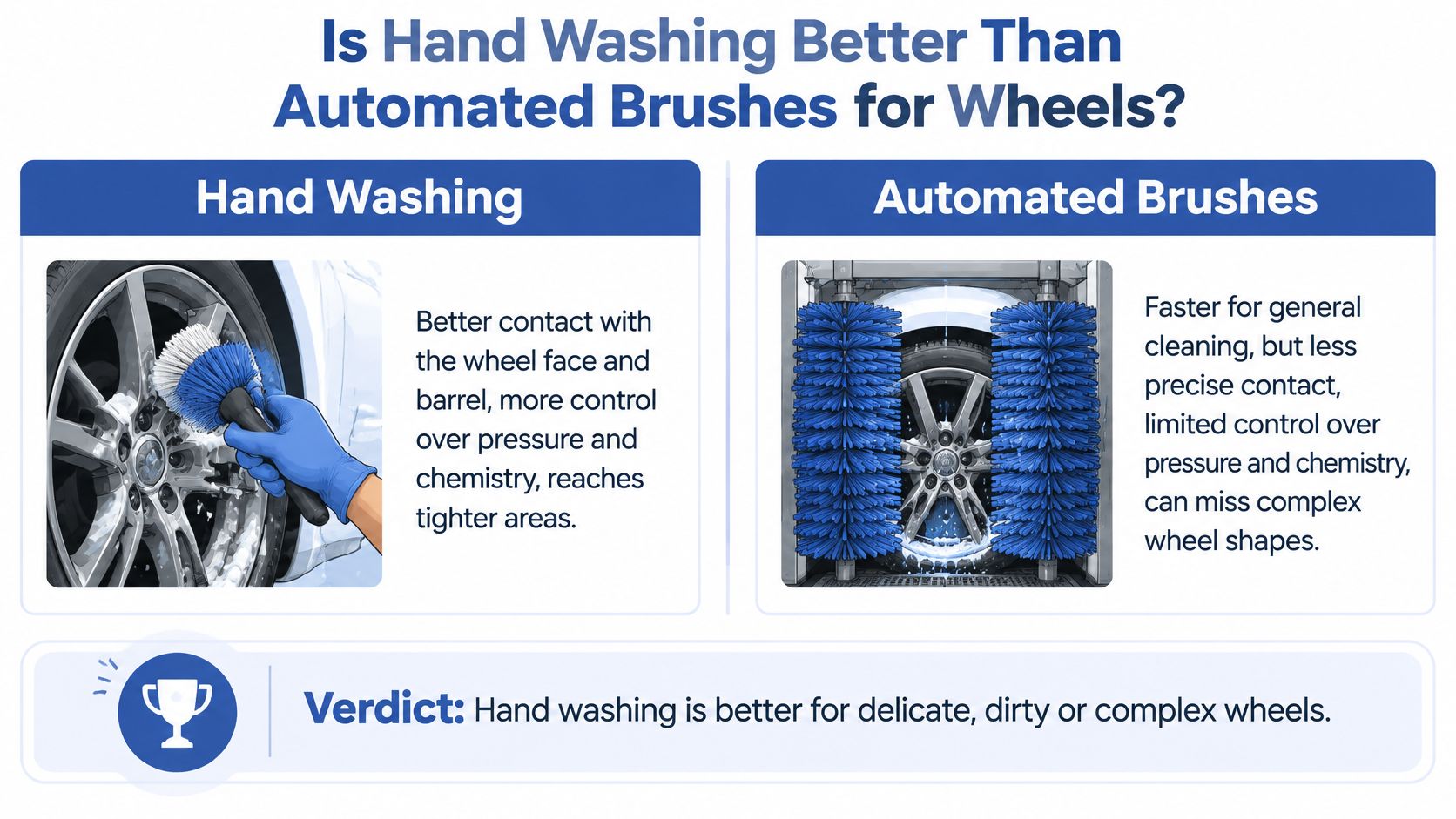
Is Hand Washing Better Than Automated Brushes for Wheels?
For wheels, yes. Wheel contamination is chemical as much as mechanical. Brake pads shed hot metallic particles that embed in the finish and oxidise in place, and tyre rubber bonds to the barrel where airflow never rinses it free. A fixed automated programme treats every wheel the same. Hand washing lets the operator match the tool, the product and the dwell time to what is bonded on.
Hand Wash Versus Automated Brush for Wheels
| Criterion | Hand wash | Automated brush |
|---|---|---|
| Contact with wheel faces | Dedicated soft tools at controlled pressure | Brushes or cloths pass over every car |
| Reach into spokes and barrel | Targeted brushing and rinsing | Limited, deposits may be missed |
| Chemistry control | Product and dwell time chosen for the wheel finish | Fixed programme for all vehicles |
| Grit carry-over | Tools rinsed between stages and kept separate from paint | Brushes can carry embedded grit from earlier cars |
| Water and runoff control | Operator controls volume and direction | Set by site design and system |
| Speed and cost | Slower, priced per service | Faster, usually lower cost per car |
The grit row is where automated systems lose the argument. Shared brushes pick up embedded metal particles from the cars ahead of you and drag them across your wheel face at pressure. A hand wash starts with clean tools, rinses them between stages and keeps wheel tools away from the paintwork. Chemistry works the same way: a polished or coated rim needs a gentler product and a longer dwell on baked deposits than a fixed programme will ever allow, and tight spokes need a brush that can physically get behind them.
We work hand-wash only. Every car is hand-washed only, with no machine brushes touching the paint, and every step of the Premium Car Wash is done by hand, not by machine. The wider case is laid out in our guide to the Outside Car Wash and why hand washing wins.
Choose hand washing if your wheels are coated, polished, or carrying heavy brake dust in the barrel.
The method also decides where the contamination ends up. The NSW Environment Protection Authority guidance on wash water states washing should occur in a designated wash bay, with wastewater kept out of stormwater and directed to a collection pit and then to sewer under an approved trade-waste arrangement. EPA Victoria’s car wash enforcement report shows the stakes, with an operator facing a $4,070 fine after wax, soap, solvent and vehicle grime entered a stormwater system. Requirements differ between states, but the practical answer is the same everywhere: keep brake-laden wash water under control. Hand washing does that directly, because the person holding the hose controls both the volume and the direction on the wheel where the residue is most concentrated.
The honest trade-off is speed. A conveyor cleans a car in minutes and usually costs less per visit, which suits a daily driver that only needs loose film rinsed off between proper cleans. I would still choose hand washing for delicate finishes, complex spoke designs or wheels carrying bonded deposits, because those jobs fail at exactly the points where automation is weakest: chemistry, reach and grit control.
Book a hand wheel clean and skip the shared brushes entirely. Your finish will thank you at resale time.
Which Wheel Cleaning Service Suits Your Car?
Decide in three moves. First, read the condition. After the car has sat overnight, run a finger inside the barrel: grey film that wipes away is ordinary road grime, while black grit that stays put is ferrous brake dust already bonded to the surface. Second, match the clean to what you find. Third, decide whether the rest of the car needs work at the same visit. We clean sedans, SUVs, wagons, 4WDs, seven-seaters and specialty vehicles, so size is no barrier. Condition drives the choice.
A daily-driver sedan carrying light film suits the Outside Car Wash. From $29 it covers a hand wash and rinse, wheel clean and tyre shine, and a quick dry. The wheels get cleaned and dressed, and you’re not paying for interior work you don’t need this week.
A rideshare or delivery SUV is a different case. Constant braking lays down fresh ferrous dust every shift, and passengers judge the whole vehicle at a glance. An Inside & Outside Car Wash from $55 adds the interior and boot vacuum plus dash, console and trim dusting that cabin duty calls for, while a Premium Car Wash from $85 finishes with a hand wax and polish for gloss and paint protection.
A lease-return car needs Full Car Detailing. Assessors check wheels closely, and baked-on deposits in the barrel, stained faces and neglected tyres read as wear-and-tear charges even when the paint presents well. From $349 for a sedan, $369 for an SUV or wagon and $399 for a 4WD or seven-seater, the detail brings wheels and tyres up to the same standard as the windows and door jambs.
Multi-vehicle households can plan this across cars rather than one at a time. The Australian Bureau of Statistics 2021 Census QuickStats records 36.3% of occupied private dwellings with two registered motor vehicles. Staggering wheel cleans between two cars beats letting both reach bonded condition, because each round of heat cycling bakes the particles in deeper.
Before you book, confirm two things on the quote: that barrel cleaning and rim protection are named, and that the work is hand-only. Booking is direct. You select the vehicle and add-ons, enter the registration, choose a date and time, then review the total and complete checkout.
Your wheels carry the heaviest contamination on the car, so they need more than a passing rinse. At Prime Shine Hand Car Wash in Westminster, every wheel is cleaned by hand, from the face and lip through to the barrel and wheel arch, then the tyres are dressed and the finish protected so the result lasts between visits. Book your wash or detail online today at Prime Shine Hand Car Wash and hand the car back with wheels that pass the same inspection the paint does.