





Cloudy headlight restoration wipes can make a car look sharper fast, but in Perth they're usually a short-term fix unless they leave a UV-protective finish. Without that protection, results are often measured in months, while a proper professional restoration with ceramic coating can last years.
You can see why that matters the first time you pull out of a dim car park on a wet evening and realise the front of the car looks tired and the beam doesn't feel as clean as it should. In Western Australia, that isn't just cosmetic vanity, it's a visibility issue, a roadworthiness issue, and a durability issue all at once. The question isn't whether the lenses can be made clearer. It's whether that clarity survives our sun, salt air, and heat long enough to be worth the effort.
| Factor | DIY Restoration Wipes | Professional Restoration |
|---|---|---|
| Upfront effort | Quick, hands-on, and simple to apply | Booked service, done for you |
| Durability in harsh sun | Shorter-lived without UV protection | Longer-lasting when sanding and coating are part of the process |
| Best use case | Light haze, maintenance, temporary improvement | Heavier oxidation, roadworthiness concerns, longer ownership |
| Finish quality | Can improve clarity, but depends on the system | More complete correction and protection |
| Repeat work | More likely to need reapplication | Less frequent repeat attention |
Why Cloudy Headlights Matter More Than You Think?
A lot of Perth drivers notice the same thing in the driveway or under the shopping centre lights. The headlights that once looked clear now sit there with a yellow film, and the easy answer is to wipe them, polish them, or ignore them until next service. That works as a short-term emotional fix, but it doesn’t change what the lens is doing on the road.
This is a visibility problem before it’s a cosmetics problem
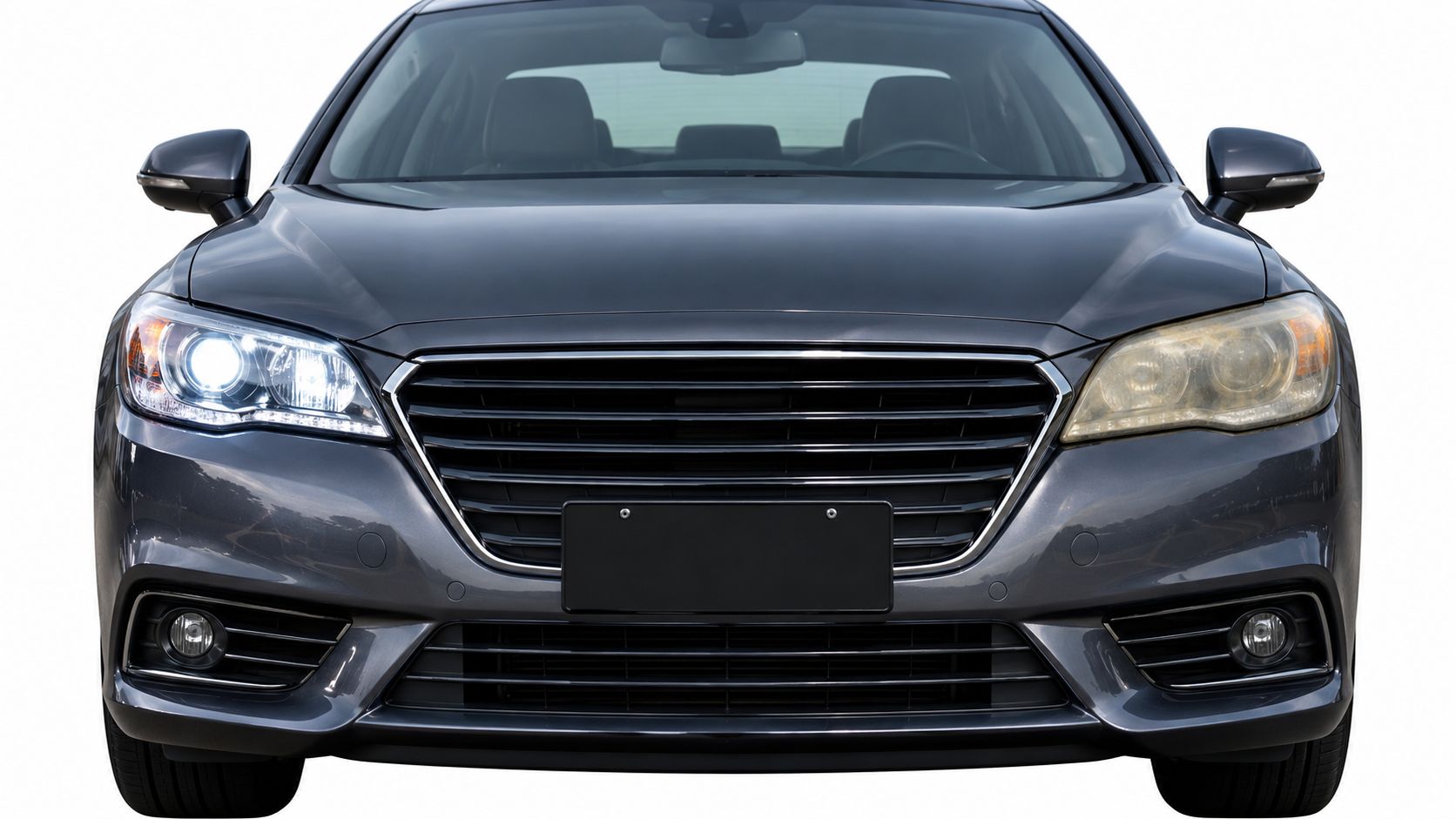
Australian guidance ties headlight condition to inspection and lighting performance. Queensland safety guidance says clouded or discoloured headlights can cause a vehicle to fail a Safety Certificate Inspection, and Australian road rules cited in a local article state that a low-beam headlight must illuminate the road ahead for at least 25 metres and a high-beam headlight for at least 50 metres (HF Car Detailing). Once the outer polycarbonate starts oxidising, the lens stops sending light forward cleanly and starts scattering it.
That matters more in Perth because the failure mode creeps in slowly. A car can look only a bit hazy for months before the beam pattern starts feeling dull at night. Then the driver compensates without realising it, driving a little slower, using high beam more often, or accepting less usable light than the car should give.
Practical rule: if the lens is cloudy enough that you can notice it in daylight, don’t treat it like a purely cosmetic issue.
Perth conditions punish weak protection
UV exposure is the main reason polycarbonate turns cloudy over time, and coastal salt doesn’t help. The lens can look fine after a quick clean, then go back to haze because the damaged surface was only temporarily improved. That’s why a wipe that cleans without sealing is really a maintenance step, not a lasting repair.
For Perth drivers, the practical takeaway is simple. If the car lives outside, works in traffic, or spends time near the coast, the method matters as much as the result. A quick cosmetic improvement can still be useful, but it shouldn’t be mistaken for protection that survives the season.
View Perth headlight restoration options for local drivers
Book Headlight Restoration in Perth
DIY Restoration Wipes Versus Professional Restoration Compared
The choice usually comes down to speed versus durability. DIY wipes promise convenience, and they do deliver that. Professional restoration takes longer to organise, but it usually adds the mechanical correction and protective layer that cheap fixes skip.
What each approach really gives you
Australian consumer coverage has shown that restoration kits are still being actively reviewed in the market, including a 2024 CHOICE article that described a multi-step wipe-and-clean process rather than a simple cosmetic spray (CHOICE review). That lines up with what you see in the workshop. Wipes are useful, but they’re only one part of a complete outcome.
The difference becomes clearer when you compare the end result, not the packaging.
| Factor | DIY Restoration Wipes | Professional Restoration |
|---|---|---|
| Surface correction | Cleans and improves clarity on the visible layer | Can address heavier oxidation and deeper haze |
| Protection | Depends on whether the system includes a UV step | Usually includes sanding, polishing, and a protective coating |
| Durability | Best treated as shorter-term maintenance | Better suited to lasting results |
| Time input | Fast for the owner | Requires a booked service |
| Skill demand | Low to moderate | Handled by a trained operator |
| Best fit | Light haze, quick refresh, temporary improvement | Daily drivers, older lenses, long-term ownership |
Where DIY wins and where it falls short
DIY wipes make sense when the lens is only lightly dull and you want a fast improvement without committing to a full correction. They’re also useful when you’re preparing a vehicle for sale and want the front end to present better straight away. But they fall short when the lens has gone properly opaque or when the car spends its life in strong sun.
A professional approach is different because it’s layered. The surface gets corrected, then sealed. That distinction matters in Perth more than in a milder climate, because clarity without protection is just borrowed time.
Read the practical cost difference between restoration approaches
Compare DIY vs Professional Restoration Costs
How Headlight Restoration Wipes Actually Work?
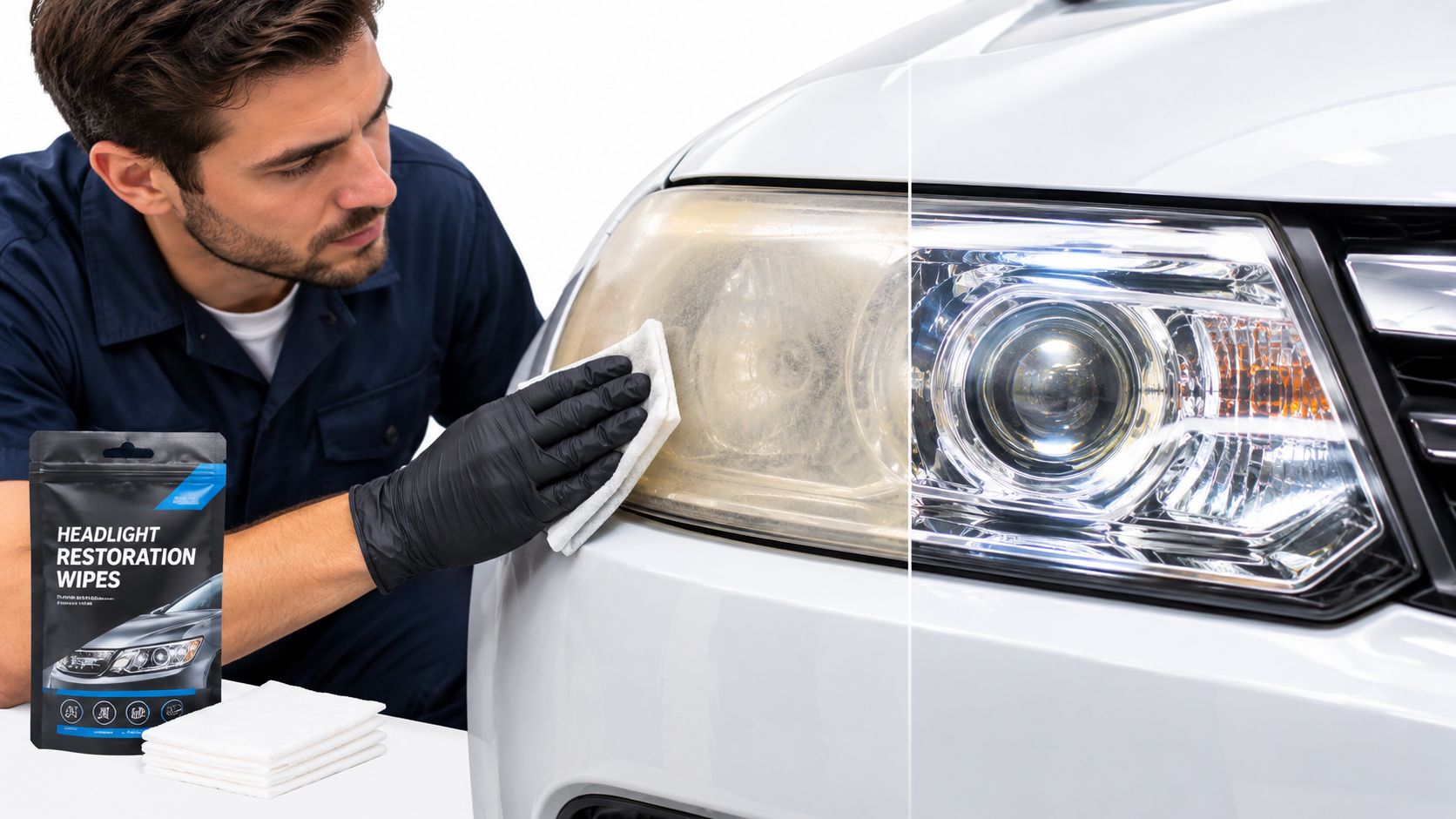
Wipes are often considered single-step cleaners, but the better systems work in stages. First they remove oxidation, then they clean the surface, then they leave behind protection. That final part is the one people skip in their heads, even when it’s included in the pack.
The three-stage logic behind the product
Repco’s Australian guidance notes that proper headlight restoration usually ends with a sealant or polish that provides UV protection (Repco guidance). That’s the critical bit. If the lens is restored and left naked, the same sun that caused the haze starts the process again.
Some products, such as wipe-based systems marketed around lens reconditioning, aim to chemically convert degraded lens surfaces back towards clarity. The mechanism can be useful, but the outcome still depends on the last layer. Without a UV-resistant finish, the polycarbonate is exposed again.
Workshop rule: the wipe is the correction, the sealant is the insurance.
What to expect when using them properly
A good wipe system usually feels simple because it is simple to use, not because it does everything on its own. You clean, remove residue, and finish with protection. If the instructions call for a final protective step, that step isn’t optional. It’s the thing that makes the result survive.
That’s why these products are best understood as a maintenance tool. They can refresh a lens and buy time, but they don’t change the fact that polycarbonate ages under UV. Treat them as a repeatable upkeep method, not a once-and-done restoration, and you’ll judge them more accurately.
How a headlight restoration spray fits into a longer-term maintenance plan
See How Restoration Products Fit a Maintenance Plan
The True Cost of Headlight Restoration Wipes Over Time
The cheap pack looks attractive because the first job is easy to price. The hidden cost shows up when the lens starts fading again and you need to repeat the process. That’s where a lot of DIY value disappears.
The real comparison is cost per clear period
If a wipe system gives you a short window of improved clarity, the relevant question becomes how often you’re willing to redo it. In Perth, where the sun is hard on exposed plastic, the repeat cycle matters more than the initial purchase. A product that needs frequent reapplication can stop being the bargain it first appeared to be.
TorquePress described an Australian-market kit that used multiple stages, including oxidation-removing wipes, sanding discs in two grits, and two ceramic coating wipes. That kind of layered design tells you something important. Durable outcomes usually come from combining correction and protection, not from a single cleaning pass.
Time cost is part of the bill
There’s also the weekend factor. A wipe kit may save money upfront, but if you keep revisiting the same headlights, you’re paying in attention and time as well as product. That matters for daily drivers, family cars, and work vehicles that can’t afford to look neglected for long.
A sensible way to think about it is this.
- Short-term spend: lower with wipes, especially for a quick refresh.
- Repeat spend: higher if the protection layer is weak.
- Labour spend: yours with DIY, someone else’s with professional work.
- Result value: strongest when the finish lasts long enough to justify the effort.
For Perth owners, the break-even point isn’t only about money. It’s whether the headlights stay clear long enough that you stop thinking about them.
Understand the Long-Term Cost of Restoration
When Professional Headlight Restoration Makes Sense?
Some headlights are still good candidates for DIY. Others have already crossed the line where a wipe is just a temporary tidy-up. The difference usually shows in how the lens looks under direct sun and how the car is used every day.
The cases where professional work earns its keep
Heavily oxidised lenses usually need more than surface cleaning. If the haze is deep, the plastic has aged for years, or the headlight is already dull enough to affect night visibility, a proper restoration is the safer bet. That’s especially true if the car must present well for inspection, sale, or regular commuting.
A professional service is also sensible for vehicles that live outside in Perth conditions. UV exposure, heat, and coastal air all work against simple fixes. If you want the result to last, the process needs to include correction and protection, not just cleaning.
When DIY still makes sense
DIY is still a good call in the right situation. Light haze on a car you don’t plan to keep long-term can be handled with wipes if you accept the need for maintenance. The same goes for a quick cosmetic refresh before selling, or for a vehicle that already gets sheltered parking and mild use.
Prime Shine Hand Car Wash in Westminster lists headlight restoration as an add-on service on its menu, which makes it one option for owners who want the work done as part of a broader detailing visit. That kind of setup suits people who’d rather hand over the job than keep redoing it themselves.
If the lens is only mildly cloudy, DIY can be sensible. If the haze is baked in, the lens is older, or you care about lasting protection, professional restoration starts to make more sense.
See the full headlight restoration service guide
Explore the Full Headlight Restoration Service Guide
Making Your Headlight Restoration Decision with Confidence
Start with the lens, not the product. If the headlights are only lightly hazed and you want a fast refresh, restoration wipes can be a practical choice as long as you accept that the finish depends on UV protection. If the lenses are heavily oxidised, the car lives outdoors, or you want the result to last through Perth conditions, professional restoration is the stronger option.
Use this simple filter.
- Choose DIY wipes when the haze is minor, the goal is short-term improvement, and you’re happy to repeat the process.
- Choose professional restoration when the lens has aged badly, the car needs to look right for inspection or sale, or you want the work to hold up longer.
- Choose protection over appearance alone when the vehicle sits in harsh sun, near the coast, or in constant daily use.
The main mistake is buying on convenience alone. A wipe can make a headlight look better today, but only the right protective step tells you whether it will still look better next season.
If your headlights are cloudy and you want the job done properly, Prime Shine Hand Car Wash can help with headlight restoration as part of its detailing menu. Visit Prime Shine Hand Car Wash to check the current service options, book a time, and choose the level of restoration that fits how long you plan to keep the car.