








You’re standing in the driveway or carpark, looking at paint that used to pop in the sun and now just looks tired. The swirls are there, the dust won’t quite shift, and every search result for polishes near me seems to treat “closest” and “right for the car” like they’re the same thing. They’re not.
In Perth, that mistake costs people money. Greater Perth holds 2,143,000 people out of Western Australia’s 2,656,156, which is about 80.7% of the state’s population, so the local polishing market is crowded where the cars are, not evenly spread across WA (ABS 2021 Census data referenced in the supplied brief). Add Australia’s 19.8 million registered motor vehicles, including 12.3 million passenger vehicles, and you’ve got a huge, active fleet that keeps detailing demand moving (ABS motor vehicle release). The right move isn’t hunting for the nearest listing. It’s matching the service to the paint.
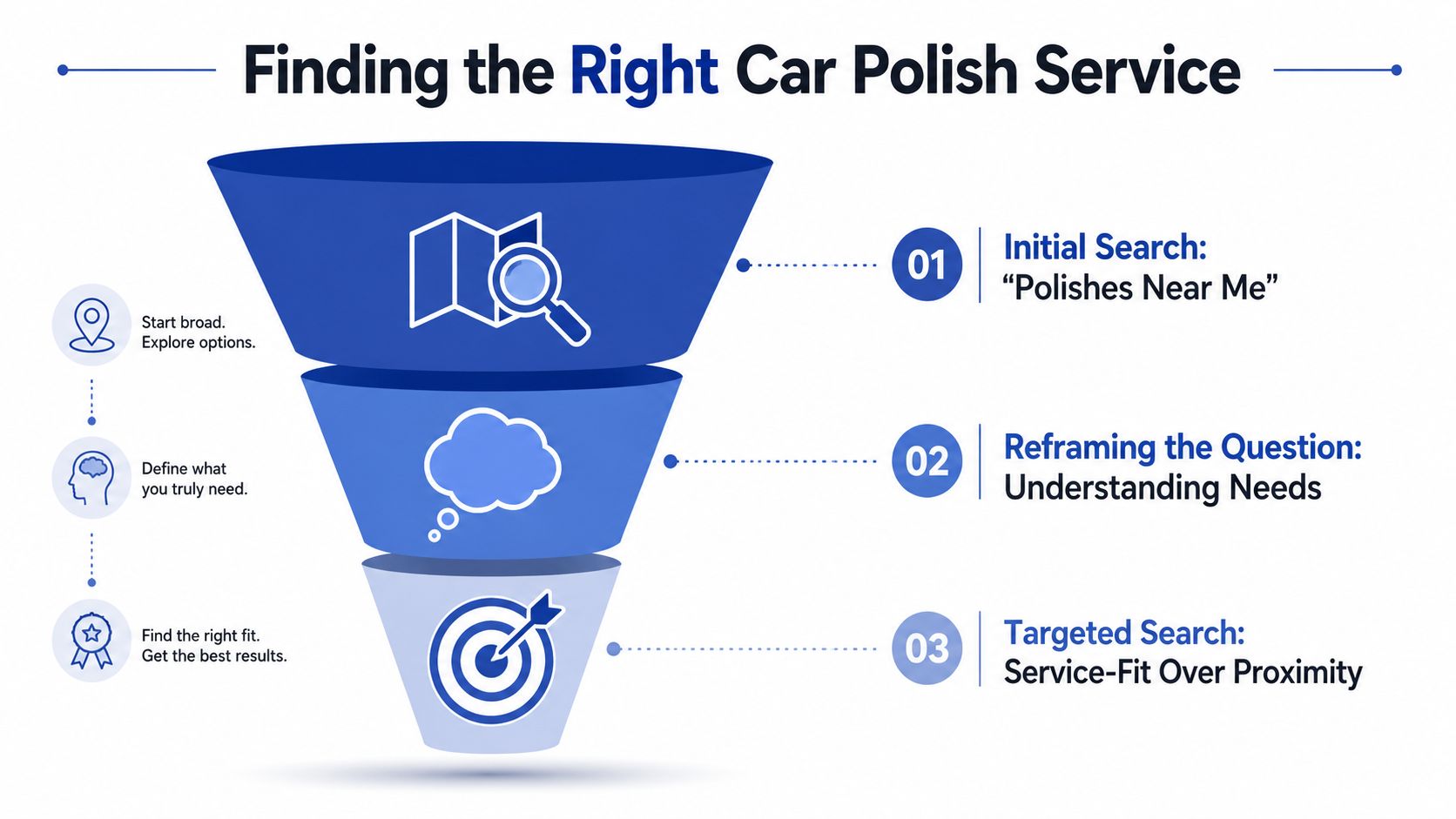
Why “Polishes Near Me” Is the Wrong Question to Start With
A Perth driver usually types polishes near me because the car looks flat in daylight and they want it back to gloss fast. Fair enough. But the key decision starts with the paint condition, not the postcode. A daily-driven SUV with light swirl marks and a film of road grime does not need the same treatment as a black sedan with etched water spots and dull clearcoat.
Practical rule: if you can still see gloss but the reflections look cloudy, start with a light polish conversation, not a heavy correction quote.
That matters more in Perth than in a lot of places because the local market is concentrated and busy. Most same-day convenience demand shows up in the metro corridor, where commuting, parking exposure, and regular vehicle use keep the work coming. In other words, plenty of operators can take the booking, but not every operator is quoting for the same job.
Many people end up in the wrong lane because they search for “near me” and land on the nearest generic polish listing. That’s how you get one of two bad outcomes. Either the car gets under-treated and still looks tired, or the shop sells you more machine time than your paint needs. The smarter question is simple, what does the paint need to look right, and what’s the least aggressive way to get there?
By the end of this guide, you should be able to separate a hand polish, a cut and polish, and a paint correction booking without guessing. You’ll also know what fair local pricing usually looks like in service terms, and how to book a Westminster hand-wash and detailing operator without getting pushed into an upsell you don’t need.
Polish Products vs Polish Services Explained
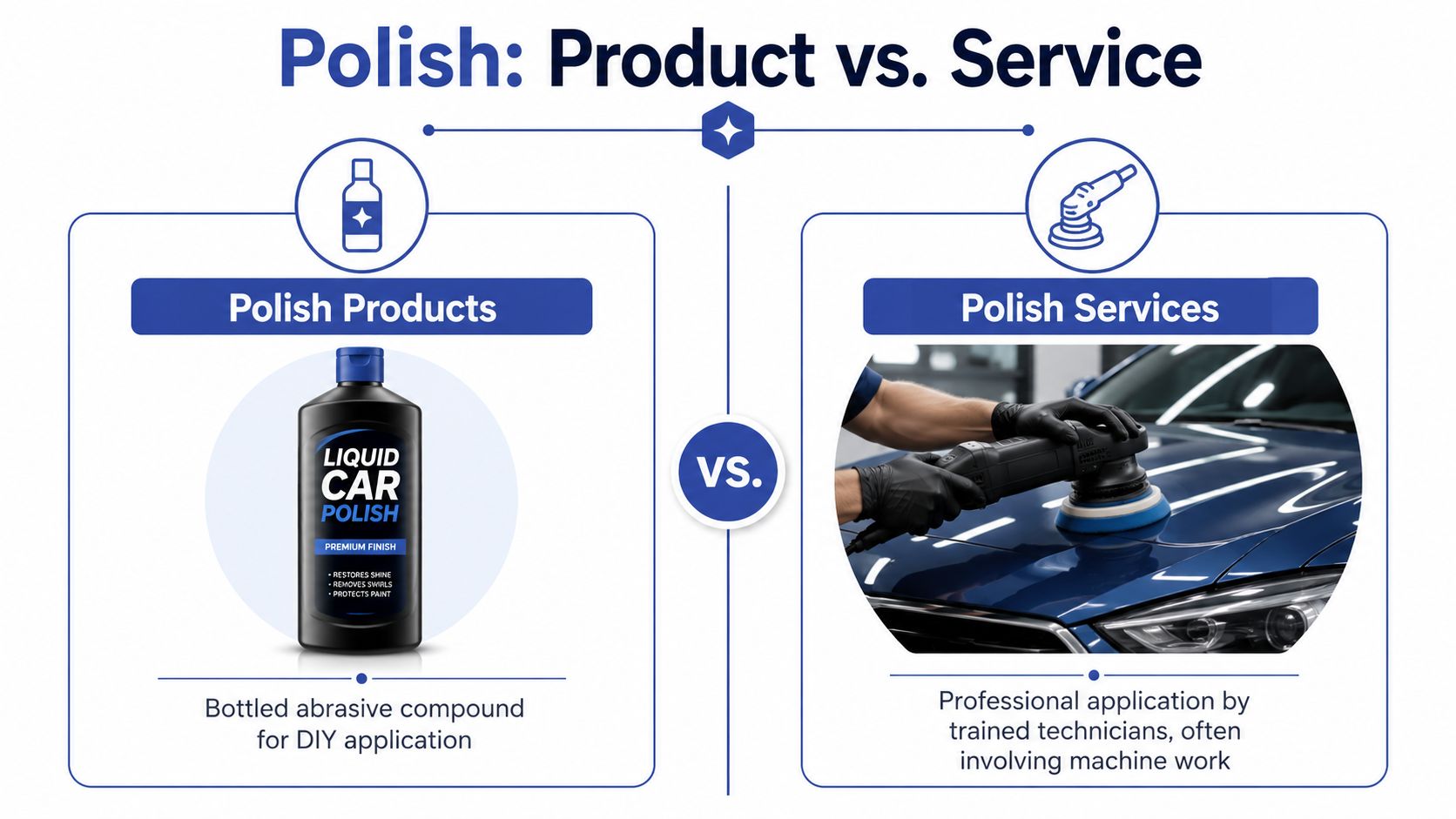
The word polish gets used for two completely different things, and that’s where buyers get caught. A polish product is the liquid or cream you put on paint, usually a compound, finishing polish, or wax. A polish service is the labour, machine time, pad choice, inspection, and cleanup that a detailer performs for you. Same word, very different bill.
Consider it similar to haircare. The bottle is the shampoo. The service is the trained stylist who knows how much to use, where to work it, and when to stop. A cheap product can still be useful in the right hands, and a professional service can be wasteful if the paint only needs a light pass. The buyer’s mistake is assuming the product label tells the whole story.
The technical side matters. A polishing product sold into Australia and New Zealand style markets can have a specific gravity of 0.962 ± 0.01, non-volatile content of 23.2 to 23.3%, and VOC not exceeding 475 g/L (technical sheet). Those numbers tell you the chemistry isn’t the whole job. How it flashes, how much residue it leaves, and how many passes it takes all change the result on paint.
If you’re comparing menus, ask one blunt question. “Am I paying for a bottle, or am I paying for the process?” That one question cuts through a lot of vague marketing.
Hand polish and waxing basics matter here because a lot of drivers don’t need a full correction, they need the right finish applied properly.
Common Polish and Detailing Services Explained Side by Side
Once you know the difference between product and service, the menu becomes easier to read. A wash resets the surface. A hand wax maintains it. A cut and polish renovates it. Ceramic coating locks in protection for longer. That’s a clear progression, and it’s the one Perth drivers should use.
Polish and Detailing Services at a Glance
| Service | What It Fixes | Best For |
|---|---|---|
| Outside hand wash | Road film, loose grime, dust | Cars that mainly need a clean reset |
| Inside and outside wash | Exterior dirt, cabin dust, boot mess | Daily drivers that need both ends tidied |
| Premium wash with hand wax | Light dullness, basic gloss loss | Owners who want maintenance, not correction |
| Mini detail | Freshening up, door jamb grime, fuller reset | Cars between major cleans |
| Full detail | Heavy buildup inside and out | Vehicles needing a proper refresh |
| Cut and polish | Swirls, light scratches, reduced gloss | Paint that looks tired but still has repairable clearcoat |
| Ceramic coating | Longer-term protection, easier washing | Cars you plan to keep looking sharp |
The machine behind the job matters too. For automotive paint correction, a dual-action, or eccentric, polisher is usually the safer call because it spreads friction more evenly and reduces hologram risk compared with forced rotation. A typical benchmark in the supplied technical data is an 18 V eccentric polisher with a 6 mm orbit and 2500 min-1 rotation speed, which fits moderate-cut work on clearcoat when paired with a foam pad and medium-cut compound (machine specification).
That doesn’t mean every car needs machine work. It means the operator should explain why a service is being chosen, not just sell the biggest job on the menu.
This cut and polish guide for Perth drivers is useful because it frames the service as defect removal, not just “making it shiny.”
How Perth Driving Habits Shape Your Polish Schedule?
Perth driving changes the way paint ages. Long travel distances, regular sun exposure, and car-heavy daily routines mean the exterior cops more abuse than a garage-kept weekend car. That’s why a “near me” search in WA should be read as a maintenance question, not just a convenience question.
Greater Perth’s population concentration matters here because most vehicle care demand sits inside that metro belt. When roughly four out of five Western Australians are living in the Perth area, the local market becomes very active, and the cars in that market are used often, parked outside often, and exposed to road grime often. That’s why polishing schedules in Perth don’t behave like they do in slower, less car-dependent places.
A paint surface that sees daily use needs regular correction thinking, even if you only book light work.
The practical takeaway is straightforward. Sun, bird droppings, brake dust, and road film all leave different marks, but they push the same result, paint that starts to look flat and uneven. You don’t need to panic about every mark, but you do need a service that matches how hard the car is living. A Westminster operator that uses hand-only methods and shows its process is usually a better fit than the closest kiosk that can’t explain what it’s doing.
That’s the core Perth angle. The car is a daily-use asset, not a decorative object. Choose the shop that understands that and the paint will stay in better shape for longer.
When a Hand Polish Beats a Cut and Polish?
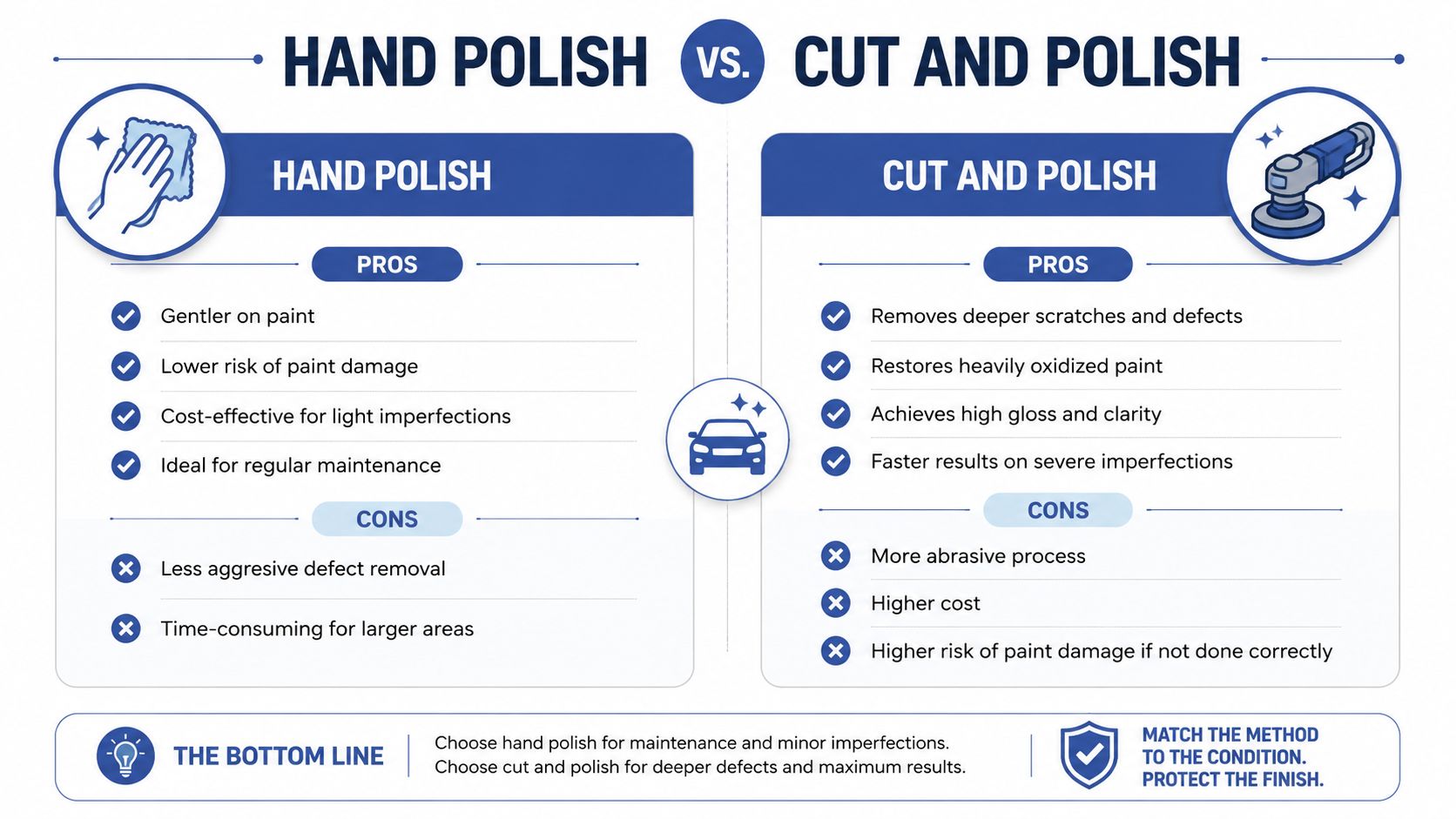
A lot of drivers book the heavy option first because they assume every polish means machine cutting. That wastes time and money when the paint only needs a lighter touch. If the car is newer, has minor swirls, or has been looked after properly, a hand polish or a one-stage machine pass is usually the smarter call. Use the least aggressive process that clears the actual defect.
Over-cutting is where people get burned. Every aggressive pass takes a little more clearcoat, and once it’s gone, it’s gone. A decent operator checks the paint under workshop light before talking up a deeper correction, because you are not there to grind away healthy paint. You want just enough removal to fix the surface, nothing more.
What to ask for first
- Ask for a one-stage option first if the paint still has gloss and the defects are mostly light swirls.
- Ask for inspection under strong light if you can see haze, etching, or random scratches in daylight.
- Ask what’s being removed if the quote jumps straight to a full correction.
If the car is a newer daily driver or a sale-prep vehicle, stay with the lighter service unless the inspection proves you need more. That keeps the bill down and lowers the chance of holograms or patchy finish marks. If the paint is dull, swirled, and visibly etched, a cut and polish has a proper job to do.
A cut and polish is for paint that needs real defect removal. A hand polish suits cars that mainly need gloss back, a cleaner finish, and a tidy presentation without the extra bite of heavier machine work.
What to Pay and How Long It Takes?
The price should match the paint condition, not the sales pitch. A hand polish on top of a wash is usually a shorter job. A cut and polish takes longer because the machine work and inspection take more time. A full correction with protection can stretch into an overnight or two-day booking. A proper quote should make that difference clear before you book.
A quick diagnostic before you book
-
How old is the clearcoat?
Older paint usually needs more care and a closer inspection before anyone starts polishing. -
How deep are the defects?
Light swirls point to a lighter service. Dullness and etched spots point higher up the ladder. -
How long do you plan to keep the car?
If you’re keeping it, protection makes sense. If you’re selling soon, focus on gloss and presentation.
Australian consumer law still applies. Services must be provided with due care and skill, within a reasonable time, and be fit for the specified purpose, as set out in the Australian Government consumer guarantees guidance. GST also matters at the booking desk. The ATO’s GST registration threshold for most businesses is A$75,000 annual turnover, with A$150,000 for not-for-profit entities, as noted in the ATO GST threshold reference in the supplied brief. A serious Perth operator should quote cleanly, state whether GST is included, and explain timing before the car is dropped off.
If you want a practical sense of how long the job should take, this Perth timing guide sets the benchmark. A polished result is as much about booking the right block of time as it is about the finish.
Check Polish Timing and Pricing
Booking a Polish Near You Without Getting Burned
The booking desk is where most bad decisions get locked in. Don’t let that happen. Start by checking whether the operator publishes its process, itemised services, and transparent starting prices. If the shop won’t explain what a polish fixes, that’s a bad sign. If it can explain the steps in plain English, you’re in better shape.
Prime Shine Hand Car Wash at 9/436 Wanneroo Rd, Westminster uses online booking with date, time, and staff assignment, which is exactly the sort of booking flow a Perth driver should want when the job involves paint work. The point isn’t flashy branding, it’s accountability. You know who’s doing the job, when it starts, and what service tier you selected.
Before you hand over the keys, ask three direct questions.
-
Single-stage or two-stage?
You need to know how much cutting is being done. -
What pad and compound are you using?
That tells you whether the shop is aiming at light correction or heavier defect removal. -
Is ceramic coating being paired with the polish?
If so, know whether it’s part of the quote or an add-on.
At drop-off, clear the cabin, point out known defects, and ask for a paint-inspection note if the shop documents them. At pickup, inspect the car in direct light, run a clean towel lightly over the panel if needed, and check whether water is beading after any protection step. If the result doesn’t match the quote, ask for the explanation in writing. Consumer guarantees back you up, and a transparent operator won’t mind that conversation.
Browse the cut and polish tag here if you want to compare how that service is presented before you book.
Book With a Trusted Local Detailer
The Right Polish Booking Comes Down to One Decision
Use this rule and you’ll book smarter every time. If the car is daily-driven, lightly swirled, and under five years old, book a hand polish or one-stage machine polish. If the paint is dull, swirled, and marked by sun or water spotting, book a cut and polish. If it’s a keeper or you’re sick of constant washing, add ceramic coating.
That’s the filter. Not “what’s closest,” but “what fits the paint.” In Perth, where the market is busy and the cars are used hard, process beats postcode every time. A place like Prime Shine Hand Car Wash can handle the hand-wash baseline and the cut-and-polish tier in one booking flow, which makes it easier to match the service to the car instead of guessing at the counter.
Before you pay, make sure the quote says whether GST is included and get the expected turnaround in writing. That turns a vague polish booking into a properly scoped service, which is exactly what you want under Australian consumer-guarantee rules.
If your paint needs a proper reset, book with Prime Shine Hand Car Wash and ask for the service tier that matches the defects, not the upsell. Their hand wash, detailing, paint correction, and paint protection options give Perth drivers a straightforward way to choose the right polish job and keep the finish honest.
“””