





You’ve probably seen it happen after a beach day, a school run, or a week of Perth dust. The seats feel a bit tacky, the cabin smells stale, and you’re wondering if a steam clean car service will fix the mess, or just make the surface look better for a day.
Steam has a real place in interior detailing, but only if you use it for the right job. It’s a controlled high-temperature process that can be safe on car interiors when it’s applied correctly, yet the practical trade-off is simple, short targeted passes with towel capture and immediate drying reduce the risk of heat and moisture damage, while oversaturation raises the chance of mould growth, adhesive failure, and trim distortion (Australian safety guidance).
What Steam Cleaning a Car Interior Means?
A steam clean car service is a controlled way to lift grime from interior surfaces without flooding them. It uses low-moisture, high-temperature vapour on fabric, leather, vinyl, plastics, vents, and other hard surfaces, then follows with a quick microfibre wipe before the moisture can settle into the material. The point is simple. The steam loosens surface dirt so the towel can remove it.
Detailers treat steam like a precision tool, and that mindset matters in Perth cabins that have seen sunscreen, dust, and hot weather build-up. Australian material for steam-cleaning providers notes that dry steam units can run very hot, with one local source saying machines can exceed 170°C, and another Australian technical brochure saying dry steam can remove more than 99.999% of bacteria and pathogens when used correctly (Australian technical overview). Used well, that makes steam useful for seats, carpets, vents, and other high-touch areas where hygiene is a concern.
What it removes
Steam is best for surface oils, light stains, sticky residue, and odours sitting in the fibres. It also helps with the dusty, sun-baked interiors Perth drivers know well, where sunscreen, fine grit, and everyday grime cling to touch points. It does not pull deep soil out of padding on its own.
A hand-held domestic steamer can help with quick maintenance. A commercial unit gives steadier heat and pressure, which matters when a full cabin needs consistent cleaning. The goal is to loosen contamination without driving moisture deeper into seat foam or trim glue.
Practical rule: if the surface still feels damp after the wipe, the process was not controlled well enough.
Steam works best as one part of an interior clean. Heavy carpet loading still calls for extraction or shampoo, while spot treatment is better for isolated marks. That choice matters, because moisture management inside Australian cars is often the difference between a clean finish and a damp interior that takes too long to dry.
How the Steam Cleaning Process Works Step by Step?
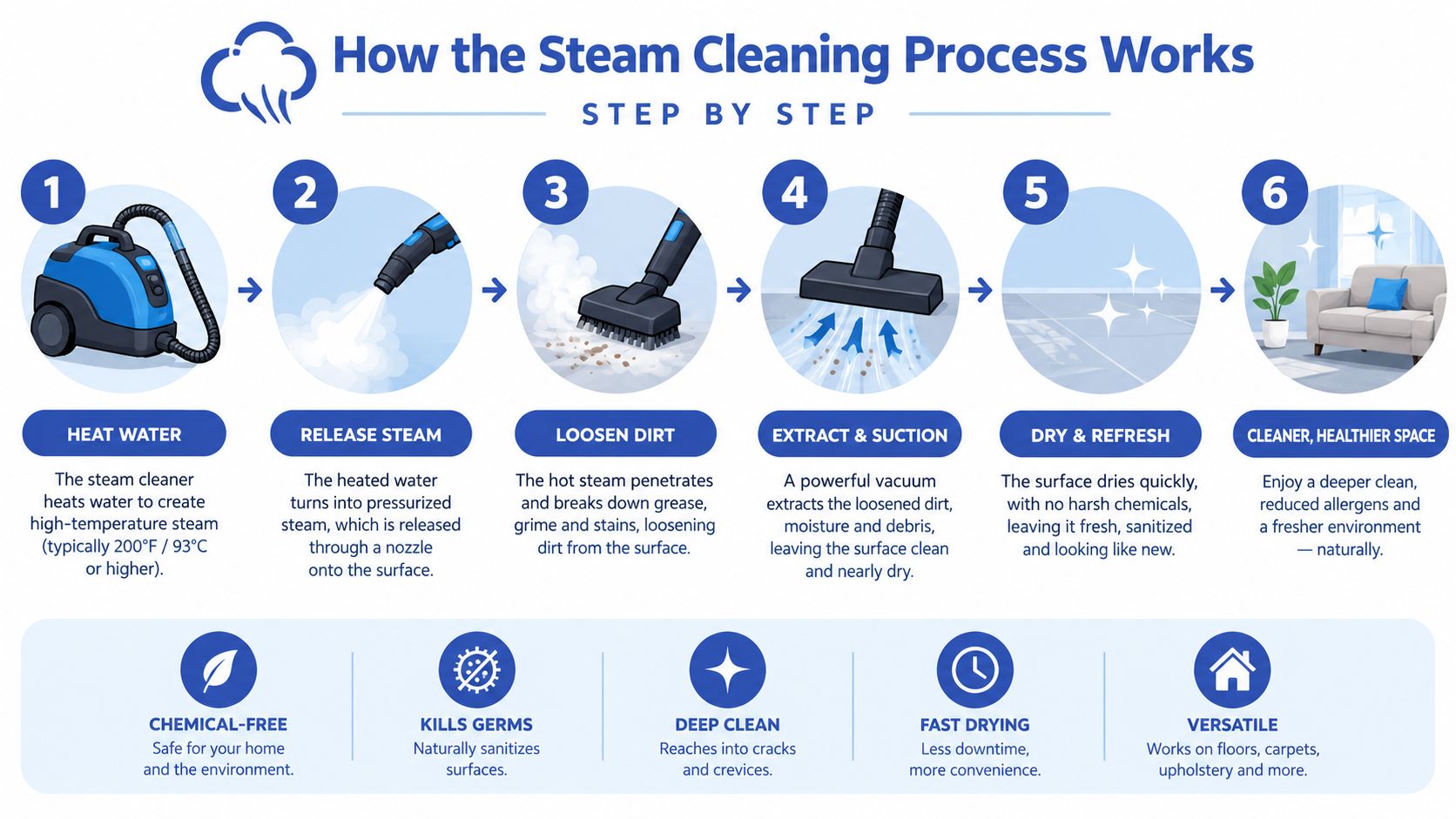
The process starts before any steam touches the car. A proper detailer vacuums first, because loose grit turns into muddy smear if you hit it with heat and moisture. After that, the cabin gets a quick inspection so heat-sensitive spots, like infotainment panels, aftermarket tint, and delicate trim, are identified before the nozzle comes out.
The working sequence
- Vacuum the loose debris. Sand, crumbs, and dry dust need to come out first, otherwise the steam just pushes them around.
- Check sensitive areas. Screens, leather finishes, and fragile trim get flagged before cleaning starts.
- Apply steam in short passes. The nozzle moves steadily, with only brief dwell time so the heat can break down oils without soaking the surface.
- Capture the residue immediately. A clean microfibre towel lifts the loosened dirt and moisture before it travels into foam or stitching.
- Wipe plastics and vents. Textured trim and air outlets need a clean follow-up wipe, because steam loosens grime from creases.
- Air the car out. Open doors and let dampness leave before the interior is fully reassembled or closed up.
The important bit is the timing. Steam needs enough contact to work, but not enough to overheat adhesives or wet the foam underneath. Australian technical material says commercial dry steam units can be extremely hot, so the operator has to control distance, dwell time, and drying rather than just “holding it on the stain” (Australian technical overview).
Why the towel matters
A lot of DIY jobs fail because the user stops after spraying steam and watching the dirt shift. That dirt still has to go somewhere, and if it isn’t wiped away immediately, it settles back into seams, stitching, or carpet pile. The towel is not an afterthought, it’s part of the cleaning system.
On leather, the process gets even more conservative. The surface should be wiped and dried quickly, then handled separately if conditioning is needed later. That keeps the finish from taking on too much heat at once.
See How Interior Surfaces Are Cleaned
Real Benefits of a Steam Clean Car Service
Steam earns its place because it does a few jobs very well. The strongest one is sanitisation, especially on seats, carpets, door handles, and other high-touch surfaces where people want a cleaner cabin feel without soaking everything in detergent. When steam is hot enough and used correctly, it can be a very effective hygiene step for family cars, rideshare vehicles, and work utes that get used hard.
It also helps with odour control. Smells from food, sweat, damp pets, and sunscreen often sit in the top layer of the material, attached to oils and residue. Steam loosens that residue so the smell doesn’t keep coming back as strongly after the cabin warms up again.
Where steam really shines
- Fabric seats and carpets, because surface grime lifts without heavy chemical saturation.
- Door cards and cup holders, because steam can get into small seams and textured plastic.
- Vents and stitching, because a cloth can’t reach those narrow edges properly.
- Light stains, where the mark is still sitting near the surface instead of being ground into the backing.
The key advantage is that steam uses very little water compared with wet shampooing, so drying is usually quicker when the operator does the job properly. That matters in Australia, where a damp cabin can turn into a smell problem if the car is shut up too soon.
| Benefit | How Steam Achieves It | Best Interior Surface |
|---|---|---|
| Sanitisation | High heat contacts the surface briefly and disrupts bacteria on contact | Seats, touch points, vents |
| Odour lift | Heat loosens oily residue that holds smells in place | Fabric seats, carpets, door cards |
| Light stain release | Vapour breaks down surface grime so it can be wiped away | Cloth upholstery, plastics |
| Detail access | Nozzle reaches seams, vents, and stitching | Consoles, vents, seat edges |
That said, steam isn’t a deep shampoo. If the carpet is loaded with embedded soil, or if the foam underneath has been contaminated, you still need extraction and proper drying. The benefit is real, but only when the method matches the mess.
Risks and Limits You Should Know Before Booking
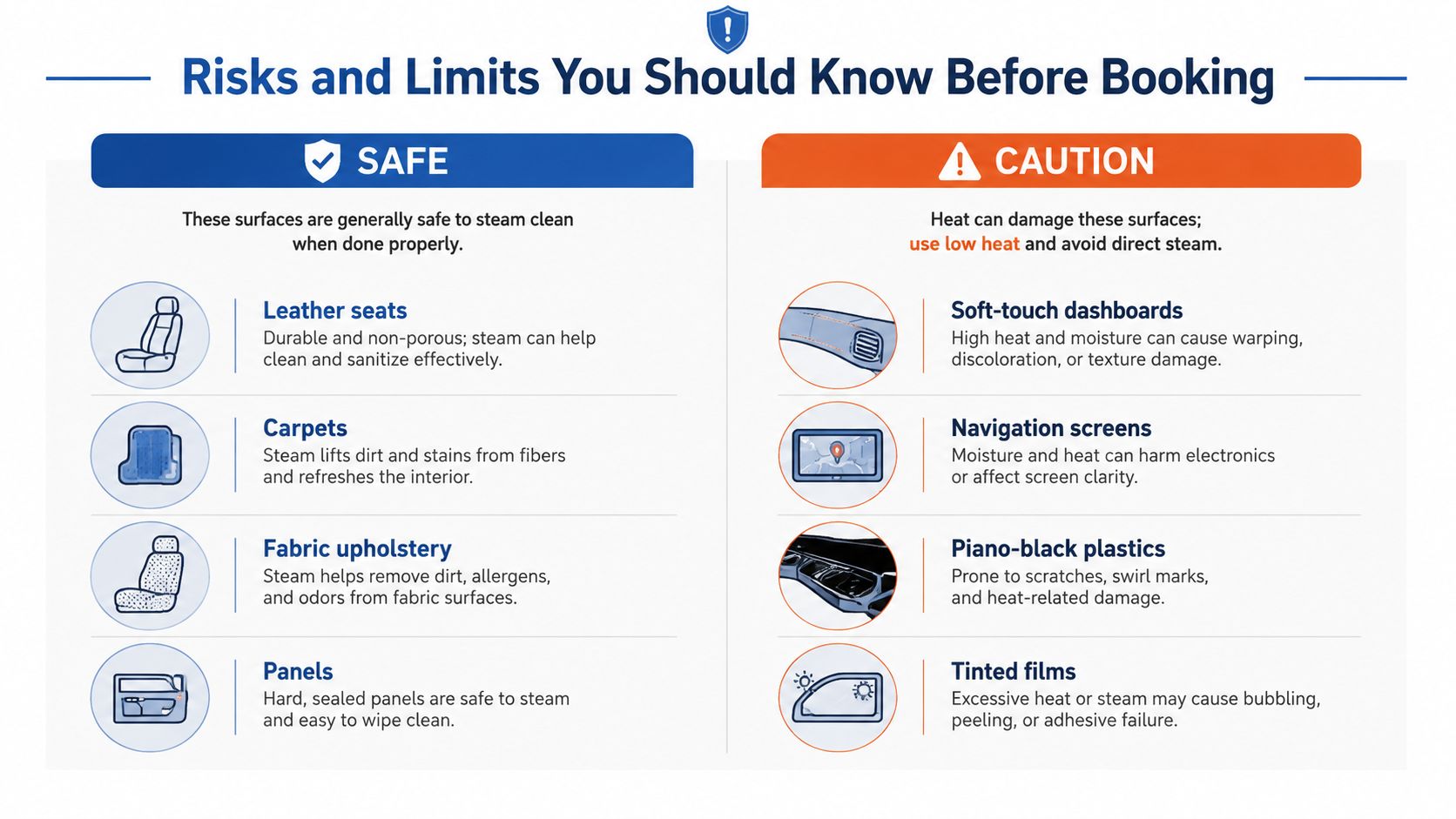
The first mistake is treating every surface as heat-safe. Electronics, headliners, delicate leather, screens, loose trims, and damaged finishes all need caution, because Australian safety guidance warns that heat and moisture can create more trouble than they solve if they are applied carelessly (Australian safety guidance).
Where the risk sits
Soft-touch dashboards and piano-black plastics mark more easily than many owners expect. Infotainment screens and window switches need distance, not direct blasting, because they involve sensitive components and hidden wiring. Leather is another surface that can show spotting or dryness if it is overworked or left damp for too long.
Headliners need the lightest touch. The glue layer behind the fabric can be affected if the surface gets too wet or too hot, and that is the sort of repair nobody wants after a basic clean. Loose trims are also a concern, because heat can make a weak clip or tired adhesive fail sooner than it otherwise would.
Steam is safest when the operator thinks in seconds, not minutes.
Cheap handheld machines create a different problem. They often deliver uneven heat and weak pressure, so the user keeps hovering longer in one spot to make up for it. That is how overheating, soaking, and streaking begin.
Moisture management matters just as much as heat. If steam is used carelessly on foam-backed materials and the car is shut up quickly, trapped dampness can lead to mould growth, adhesive failure, and trim distortion. The risks outlined above apply regardless of machine quality. The question is whether the operator knows where steam helps, where it needs to stay back, and when extraction or spot treatment is the smarter call.
A competent Perth detailer will not treat steam as a cure-all. They will choose less heat for sensitive surfaces, extraction for dirt that has gone deep, and gentle spot treatment for marks that need more targeted work.
Check Interior Detailing Costs
Which Interior Problems Steam Fixes and Which It Does Not?
The simplest way to judge steam is to match the problem to the method. Steam is strong on surface contamination, but it loses ground when dirt has moved deep into fibres, padding, or pet-hair tangles. That’s why the method should be chosen for the job, not sold as a one-size-fits-all interior reset.
| Interior Problem | Best Method | Steam Rating |
|---|---|---|
| Light grease on door cards | Steam plus microfibre wipe | Good |
| Cup holder residue | Steam and detail brush | Good |
| Ground-in sand in footwells | Vacuum and extraction | Fair |
| Heavy mud in carpet pile | Extraction and spot treatment | Poor |
| Pet hair in velour | Agitation plus extraction | Fair |
| Smoke odour | Deep clean and odour treatment | Weak |
| Leather body oil | Leather-specific clean and condition | Fair |
Steam does well on light grease, sticky cup holders, and the general film that builds up on high-touch surfaces. It can also freshen fabric seats and lift some odour from the top layer of the material. But sand in footwells, pet fur woven into velour, and smoke smell in a neglected cabin usually need a more aggressive approach.
If the contamination is inside the material, steam alone usually won't finish the job.
That's where extraction matters. It pulls liquid and loosened soil out of the carpet pile instead of leaving it behind in the backing. Spot treatment matters too, because a specific stain often needs a specific chemistry, not just heat.
For pet hair-heavy interiors, a dedicated removal process is usually needed before any steam work begins, which is why a complete guide to pet hair removal for cars makes sense as part of the booking conversation. Steam can help after the bulk of the hair is gone, but it doesn't replace the first pass.
The red flag is the detailer who uses one method on every surface. That usually means the finish depends on convenience, not judgment.
Solve Pet Hair and Deep Interior Mess
DIY Steam Cleaner vs Professional Steam-Assisted Detailing
A DIY steamer can be fine for light maintenance if the interior is only slightly dirty. The problem is consistency. Cheap handheld units often struggle to hold the heat and pressure you need for a full cabin, so the result is patchy cleaning, wet spots, and a lot of extra wiping.
What changes with a pro setup
A professional steam-assisted detail brings more than just a stronger machine. It brings process control, which is the part many underestimate. The operator knows how long to dwell on a stain, how quickly to move the nozzle, and when a surface needs a towel pass instead of more steam.
The price difference reflects that difference in workflow. A DIY rental may look cheaper at first glance, but it can become poor value if the finish is uneven or the moisture management is sloppy. A professional interior service in Perth that includes steam work is commonly positioned as a broader detail, not just a single clean, and the quoted price is usually tied to the car's condition, size, and add-ons.
| Factor | DIY Steam Cleaner | Professional Steam-Assisted Detailing |
|---|---|---|
| Machine quality | Inconsistent heat and pressure | Stable output and controlled application |
| Skill required | High, because mistakes are easy | Handled by trained operator |
| Moisture control | Depends on the user | Managed with towel capture and drying |
| Finish quality | Can be uneven | More consistent across surfaces |
| Problem coverage | Light maintenance | Interior reset with add-ons available |
If you’re trying to decide whether to do it yourself, ask one question. Is the job small enough that a mistake won’t bother you? If the answer is no, a professional is usually the safer bet.
For a broader sense of how steam fits into a cabin service menu, the interior dashboard care guide at how to clean inside of car dashboard is useful because it shows how trim, vents, and touch points are handled as part of a full clean.
Book Professional Interior Cleaning
Add-Ons That Pair With Steam for a Deeper Interior Reset
Steam works best when it’s sequenced with other tasks, not dropped into the middle of a dirty cabin and expected to solve everything by itself. The usual order is straightforward, vacuum first, remove pet hair and dry debris, steam the surfaces, then extract or condition where the material needs more than surface cleaning.
What pairs well with steam
- Deep extraction shampoo. This is the right follow-up for carpet pile and heavy soil that steam has loosened but not removed.
- Pet hair removal. Rubber tools and agitation come first so embedded fur doesn’t get damp and pushed deeper.
- Leather clean and condition. Steam can sanitise the surface, but leather still needs moisture balance afterwards.
- Headliner spot treatment. Light treatment only, because the adhesive layer is sensitive.
- Trim protectant. Useful after cleaning when dashboards and plastics need a finished, even look.
That sequence matters more than people think. If you steam before vacuuming, the loose debris gets sticky. If you skip extraction after a dirty carpet has been steamed, the contamination can remain in the backing and reappear later. And if leather is left bare after cleaning, it can feel drier than it should.
A transparent detailer explains which add-ons are bundled and which are line items. That matters because interior work is often priced by condition, not just by car size, and a quote may change after inspection if the car has heavy staining, thick pet hair, or child seats that need to be removed and refitted. A clean menu with clear starting prices usually signals a more trustworthy process than a vague package that hides the actual work.
Prime Shine Hand Car Wash offers interior add-ons that include seat and carpet steam cleaning as part of a wider detail, and its interior protectant information at car interior protectant complete guide 2026 is useful if you’re comparing post-clean finish options.
Explore Interior Protectant Options
Booking a Steam Clean Car Service in Perth
When you book a steam clean car service, describe the mess, not just the model. Say whether the car has beach sand, food spills, pet hair, sunscreen residue, or a musty smell, because those clues tell the detailer whether steam alone is enough or whether extraction and spot treatment should be added.
Photos help more than people expect. A quick shot of the driver’s seat, rear seats, footwells, and boot gives the detailer a better idea of condition than a generic “needs a clean” message. If the car has child seats, heavy pet hair, or very dirty mats, mention that upfront so the quote reflects the actual work.
What to ask before you book
- What’s included in the interior clean. Steam, vacuuming, extraction, and drying aren’t always bundled together.
- Whether the car needs to be empty. Personal items slow the process and make surface access harder.
- How long the cabin needs to dry. Moisture management is part of the result, not a side note.
- Whether extra charges apply. Pet hair, heavy staining, and child seat removal can change the scope.
- Whether the service is drive-in or mobile. The setup affects containment, drying, and turnaround.
For price context in Perth, it helps to read a local breakdown like how much does it cost to detail a car in Perth, because steam is often one part of a larger interior package rather than a separate standalone task. A small hatch with light interior dirt is a very different quote from a large family SUV with sand, pet hair, and stained seats.
Prime Shine Hand Car Wash is based at 9/436 Wanneroo Rd, Westminster, WA 6061, and it offers online booking, transparent starting prices, and interior services that can include steam as part of a full reset. If you want the cabin cleaned properly, with the moisture managed instead of guessed at, book the interior work, ask for steam where it fits, and be clear about the surfaces that need extra care.
Prime Shine Hand Car Wash handles interior and exterior detailing for Perth drivers who want a careful reset without guesswork. If your cabin needs steam on the right surfaces, plus the drying and add-ons that make the result last, visit Prime Shine Hand Car Wash and book the interior service that matches your car’s condition.