
















You notice it on the drive home first. The road looks darker than it should, the signs don’t light up early enough, and in rain or on poorly lit suburban streets your headlights seem to disappear into the bitumen. In Perth, that usually isn’t your imagination. It’s the lens.
Yellowing and haze on modern headlights aren’t just cosmetic. They change how the beam travels, how far ahead you can see, and how quickly you pick up hazards at night. That matters whether you’re commuting on the freeway, doing school drop-off before sunrise, or trying to keep an older car presentable without paying for replacement headlight assemblies.
Are Your Headlights Failing You on Perth Roads?
A common Perth scenario goes like this. Your car still starts, drives well, and looks decent from a distance, but at night the headlights feel weak. In dry conditions they’re disappointing. In rain, they can feel borderline unsafe.
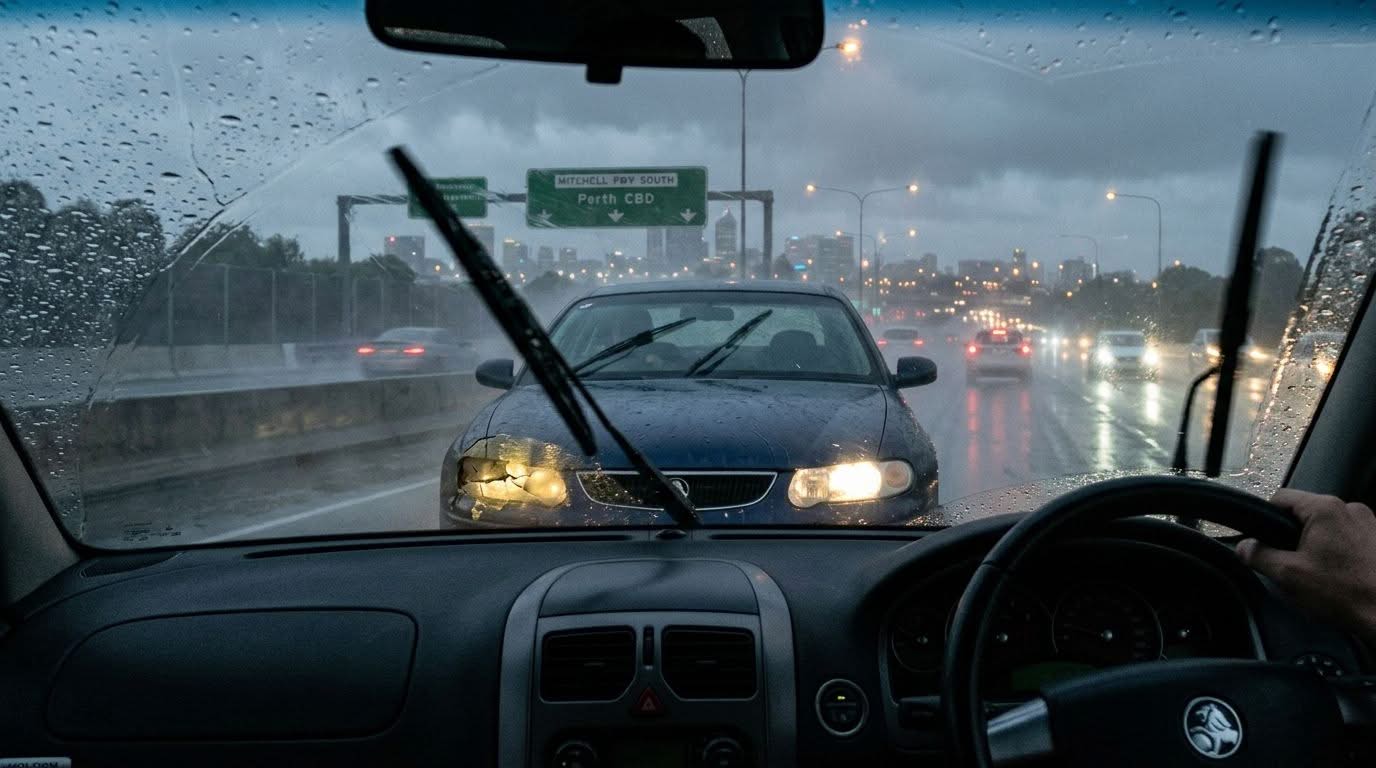
Perth is especially hard on plastic headlight lenses. UV-induced oxidation of polycarbonate lenses breaks down the protective topcoat after 12–18 months of exposure to Western Australia’s high UV index, often exceeding 11. That damage creates micro-pitting that can scatter up to 70% of emitted light and reduce beam throw by 30–40 metres at 100 km/h, which directly affects what you can see ahead on the road under Australian Design Rule 15/02.
Book a headlight check in our Brand Colour CTA
That’s why headlight restoration Perth drivers ask for shouldn’t be treated like a quick shine-up. If the lens surface has oxidised, washing the car won’t fix it. A trim dressing won’t fix it. Even a basic hand polish often only makes the lens look better for a short time without addressing the damaged layer.
What Perth drivers usually see first
- Colour change: The lens starts turning yellow or milky.
- Patchy beam pattern: Light output looks uneven on the road.
- Dull finish in daylight: The front of the car looks older than it is.
- Night driving strain: You lean forward more because you’re trying to see further.
Practical rule: If your headlights look cloudy in full daylight, they’re already affecting night-time performance.
For local drivers, restoration sits in the same category as tyres, brakes, and wipers. It’s maintenance with a strong cosmetic upside, not just a cosmetic service with a safety story attached.
The Science Behind Restoring Your Headlights
Headlight restoration only works when the damaged surface is removed. On Perth cars, that matters because UV exposure cooks the factory coating hard enough that a quick polish can improve the look for a short time without restoring clear light transmission for long.
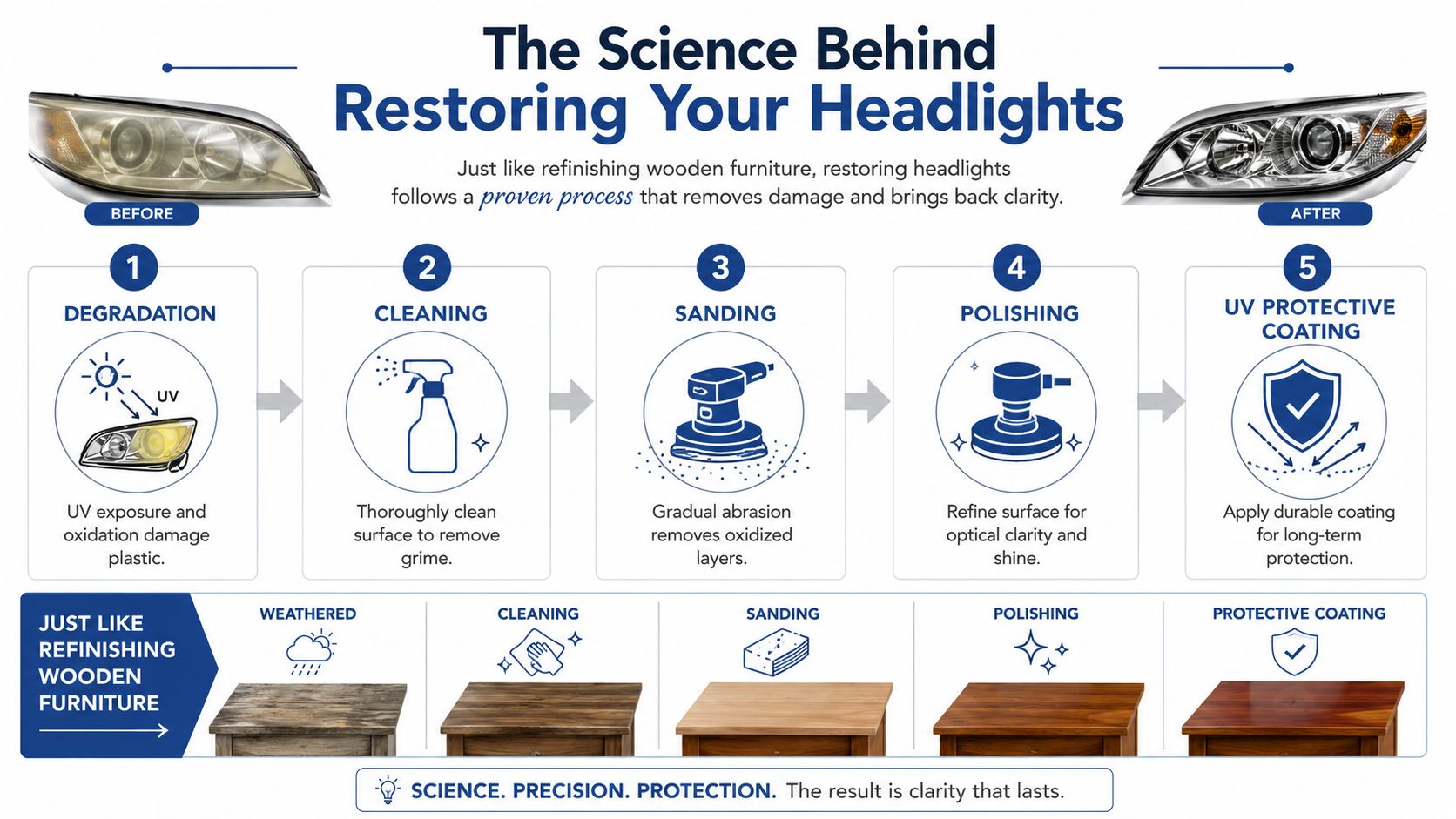
A polycarbonate lens starts with a protective outer layer. Once that layer breaks down, the surface becomes chalky, pitted, and uneven. Light still leaves the bulb, but the lens stops directing it cleanly. That is why a headlight can look switched on yet still perform poorly on a dark road.
Professional restoration is a surface correction job. The oxidised layer is cut back in controlled stages, the lens is refined until it is optically clear again, and a UV-resistant sealant is applied to slow the same failure from returning too quickly. It is the same principle behind controlled scratch removal on automotive surfaces. You are correcting damaged material, not hiding it.
What’s actually happening to the lens
Perth heat, UV, road grime, and washing wear all attack the lens surface. Once the original protection is gone, the bare plastic degrades fast. Yellowing is part of the problem. The bigger issue is the fine surface damage you cannot always judge properly from a quick look in the driveway.
A clear lens transmits light in a controlled beam. A damaged lens scatters it.
That bottleneck sits at the front of the headlight, so changing bulbs will not solve the underlying issue if the lens itself is failing.
The process in plain terms
- Clean the surface so contamination does not interfere with sanding and polishing.
- Sand off the failed layer in measured stages, using the right grit progression for the level of oxidation.
- Refine the surface to remove coarse sanding marks and level the lens evenly.
- Machine polish to restore clarity and improve how light passes through the plastic.
- Seal the lens with proper UV protection suited to Perth conditions.
The last step is where cheap results usually fall over. A lens can look dramatically better straight after correction, but without a quality sealant, fresh plastic is exposed to the sun again and the haze returns much sooner.
Ask About Our Restoration Process
The Great Debate DIY Kits vs A Professional Service
A DIY kit can improve a lightly faded lens if the owner is patient, careful, and realistic about the result. That part is true. The problem in Perth is that many headlights are past the “quick tidy-up” stage by the time the haze becomes obvious.
Once UV has cooked the outer layer hard enough, you are no longer just polishing away a bit of dullness. You are correcting failed plastic, leveling the surface evenly, and then protecting it again so the finish lasts through more sun, heat, and daily exposure. That is the point where the difference between a generic DIY kit from an auto parts store and a professional service becomes clear.
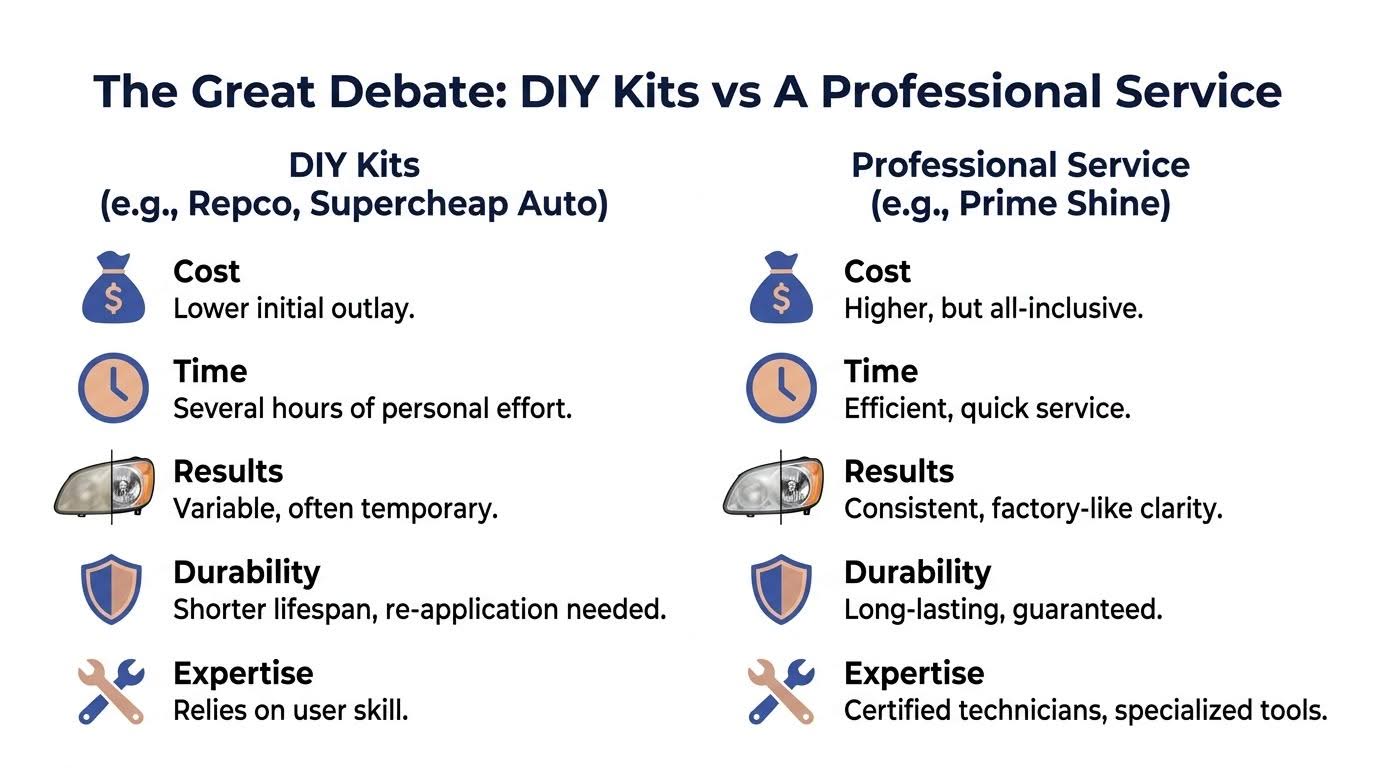
DIY vs Professional Headlight Restoration
| Feature | DIY Kit | Professional Service (Prime Shine) |
|---|---|---|
| Cost | Lower initial outlay | Higher upfront, but includes proper correction and protection |
| Time | Several hours of your own effort | Done for you |
| Skill required | Technique matters more than the packaging suggests | Carried out with dedicated tools and process control |
| Result consistency | Varies widely, especially on badly faded lenses | More even finish across the full lens |
| Protection | Usually limited by the final wipe-on coating | Better suited to a proper UV-resistant finishing stage |
| Risk | Uneven sanding, edge damage, haze returning quickly | Lower when handled correctly |
Where DIY usually falls short
- The lens gets judged by colour alone: Some headlights look “just yellow,” but the underlying issue is uneven surface failure and pitting.
- The sanding stage is too light or too aggressive: Too light leaves failed material behind. Too aggressive leaves distortion and visible marks.
- Edges get missed or overworked: That is where many home jobs end up patchy.
- The final protection is weak: The lens may look clear for a short time, then fade again once Perth sun hits bare plastic.
There is a similar pattern with other surface correction jobs. Mild defects can respond well to careful home work, but visible damage punishes poor technique. That same principle shows up in this guide to DIY scratch removal in Perth.
A professional service usually makes better sense for family cars, work vehicles, sale prep, and anything driven regularly at night. Better beam clarity matters. So does not having to do the job again in a few months.
How We Restore Headlights at Our Westminster Workshop?
At our Westminster workshop, headlight restoration is handled as surface correction, not as a quick add-on wipe. The job starts with inspection under direct light, because the way a lens looks in shade can hide the severity of oxidation and pitting.
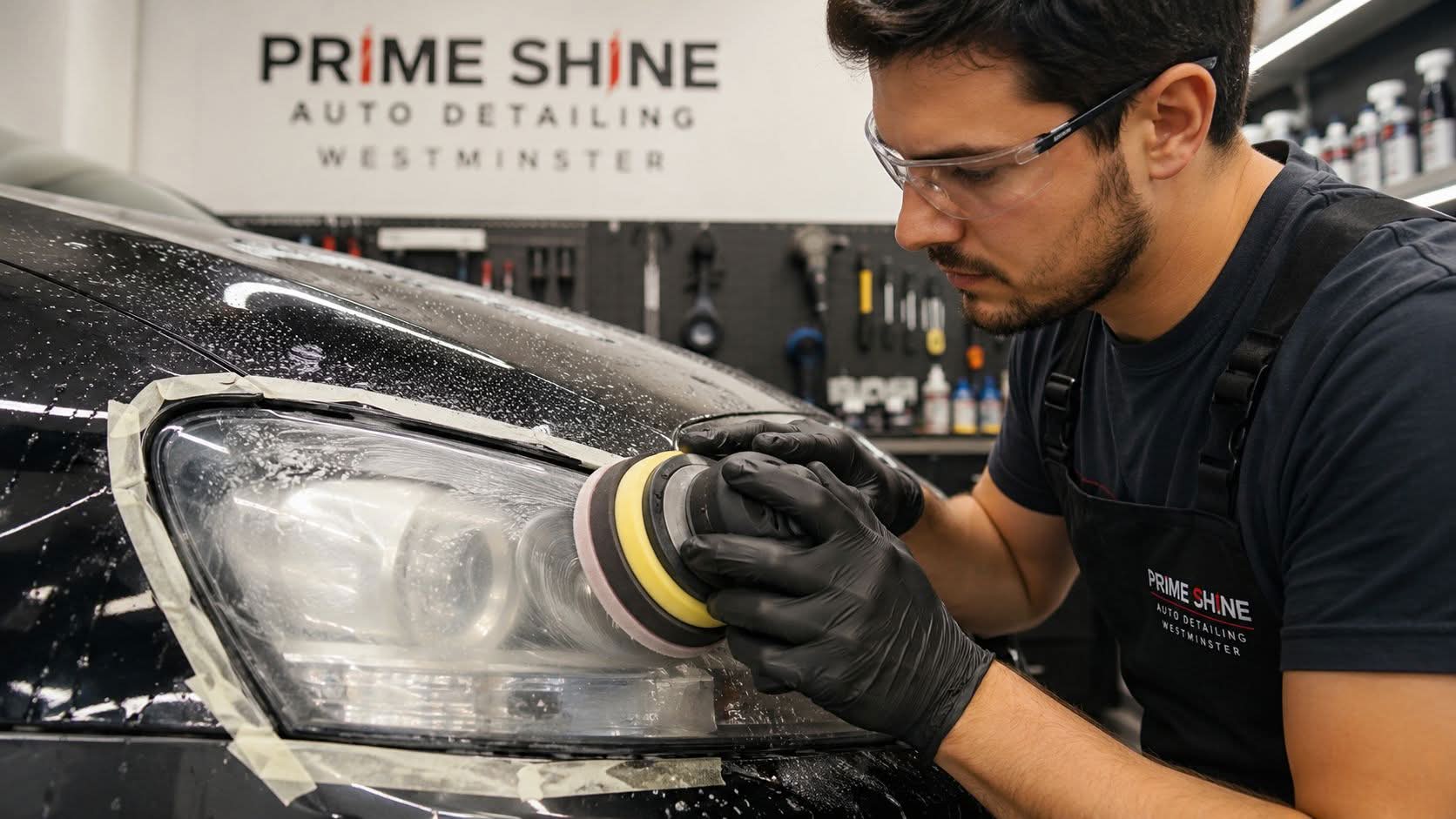
Masking goes on before any abrasive step. That protects paint edges and trims around the lamp. Then the lens is cleaned and assessed for how aggressive the first sanding stage needs to be.
The correction stage
For heavier oxidation, effective restoration in Australia requires wet sanding with 800–1000 grit to remove 15–25 microns of degraded polymer, followed by 1500–2000 grit refinement and machine polishing with 5–10 micron abrasive compounds. It also needs a UV-stable ceramic or polyurethane protective coating afterwards to resist rapid re-oxidation in Perth’s climate, based on this Perth-specific discussion of multi-stage headlight restoration methods.
That sounds technical, but the idea is simple. The first stage removes failure. The later stages remove the marks left by the first stage. Polishing then restores clarity rather than just reducing haze.
One practical advantage of having the work done at a fixed site is process control. The same workshop setup used for other vehicle care services, including our Westminster hand car wash and detailing work, makes it easier to keep the correction stages consistent.
Book your headlight restoration in our Brand Colour CTA
Why the final coating matters so much
Without protection, freshly corrected plastic is vulnerable. Perth sun doesn’t give you much margin for half-finished work. A good coating is what turns a restored lens into a usable long-term result rather than a short-lived improvement.
Here’s a closer look at the process in action.
A clean-looking lens isn’t the target. A clear, even optical surface with proper UV defence is the target.
The best jobs don’t scream for attention. They just make the front end look right again and the headlights behave as they should.
Increased Safety Resale Value and Curb Appeal
Restored headlights pay you back in three ways, and each one matters to a different kind of owner.
Safety for daily driving
If you drive at night, early in the morning, or through winter rain, clear lenses help you read the road earlier and with less strain. That’s the benefit most owners feel immediately. The car becomes easier to place, easier to trust, and less fatiguing to drive after dark.
For families, that matters more than appearance. A school-run SUV with cloudy headlights may still look serviceable in the driveway, but night-time visibility is where its full cost shows up.
Value when it’s time to sell
Headlights sit high in a buyer’s field of view. If they’re yellow and tired, the whole front of the vehicle looks neglected. If they’re clear, the car looks better maintained before the buyer notices anything else.
That’s why headlight work often pairs well with broader presentation prep such as full car detailing. Clean paint, a tidy interior, and clear headlights create a much stronger first impression than any one of those jobs alone.
Restore safety and presentation with our Brand Colour CTA
Appearance for pride of ownership
Even on an older vehicle, fresh headlights sharpen the front end. The bonnet line looks cleaner, the grille looks newer, and the car stops wearing that chalky, sun-beaten look.
- For rideshare and delivery drivers: Cleaner headlights support a more professional presentation.
- For enthusiasts: They stop one dull detail from dragging down the whole car.
- For everyday owners: They lift the look of the vehicle without replacing parts.
Clear headlights don’t just improve one component. They change how the whole front of the car is read.
Your Headlight Restoration Questions Answered
How long does headlight restoration last in Perth?
Perth is hard on headlights. Strong sun, heat, and daily outdoor parking wear down the factory UV coating faster than many owners expect, so lifespan depends less on how clear the lens looks after polishing and more on what protects it afterwards.
A quick cut and polish can improve appearance for a while, but it usually fades early in local conditions. A proper multi-stage restoration followed by a quality sealant or coating lasts longer because it removes the failed layer evenly and adds real protection back onto the lens. Exact life varies with storage, kilometres driven, and how often the car sits outside, but the final protection stage is what makes the job worth paying for in Perth.
Is the process safe for my paintwork?
Yes, if the job is done with care.
Paint around the headlight needs to be masked properly before any sanding starts. The operator also needs to control pressure, keep abrasives consistent, and finish the edges cleanly. The problems I see usually come from rushed prep or uneven sanding, not from the restoration itself.
Is it worth restoring instead of replacing?
Usually, yes, if the issue is oxidation on the outer lens.
Restoration is often the better spend when the lens is cloudy, yellow, or patchy but the housing is still sound. Replacement makes more sense if the lens is cracked, the mounting points are damaged, or there is moisture or failure inside the unit. The practical difference is simple. Surface damage can often be corrected. Structural damage usually cannot.
How do I book it?
The easiest way is to review the headlight restoration service packages and pricing and choose a booking time that suits you. If you are unsure whether your headlights need a lighter correction or a full restoration, book the closest option based on their condition and have them checked on arrival.
Check Availability & Book Online
If your headlights look dull in the driveway and weak on the road, deal with them before a wet night drive makes the problem obvious. Prime Shine Hand Car Wash provides headlight restoration from its Westminster workshop, with clear package options so Perth drivers can choose the right level of work for the condition of the lens.