




You’ve just washed the car, stepped back in the driveway, and the paint still looks a bit flat. The water’s gone, the dirt’s gone, but the panels don’t have that crisp, slick finish you were hoping for, and a few patches still hold onto water in awkward beads. That’s usually the moment people start wondering whether liquid spray car wax is worth the extra few minutes or just another bottle promising too much.
For Perth drivers, that question’s practical. Between strong UV, heat, dust, and the difference between bore water and scheme water, a quick gloss product has to earn its place in the routine, not just look good on the shelf. The smart way to think about it is simple, liquid spray car wax is a finishing layer, not a wash replacement, and not a miracle coating.
Why Your Car Still Looks Dull After a Wash?
You can scrub a car clean and still feel underwhelmed when you walk away from it. That’s because a wash removes grime, road film, and dust, but it doesn’t leave behind the kind of finish that makes paint look wet and glassy. A good hand wash is the reset, a spray wax is the step that starts changing how the surface behaves after the rinse.
If the panel dries in patchy beads and the colour still looks muted, the surface probably needs a finish layer rather than more soap. That’s where liquid spray car wax earns attention. It’s designed to leave a thin hydrophobic film, so water sheets better and the paint reads as cleaner, sharper, and more reflective.
A lot of first-time buyers confuse shine with protection. They’re related, but they’re not the same thing, and that’s why the second step matters after a proper wash. If you’re already hand-washing carefully, as explained in this outside car wash guide, spray wax is the simple add-on that makes the result last longer between washes.
Practical rule: if the car is clean but looks visually flat, you probably don’t need another wash. You need a finish layer.
The easiest way to judge it is by behaviour, not by marketing. Dirt may be gone, but if water still clings unevenly and the paint doesn’t seem to “pop”, the surface is telling you it wants a wax layer. On a daily driver, that’s often the difference between “clean enough” and looking detailed.
Want that freshly detailed finish without the extra guesswork?
What Liquid Spray Car Wax Is?
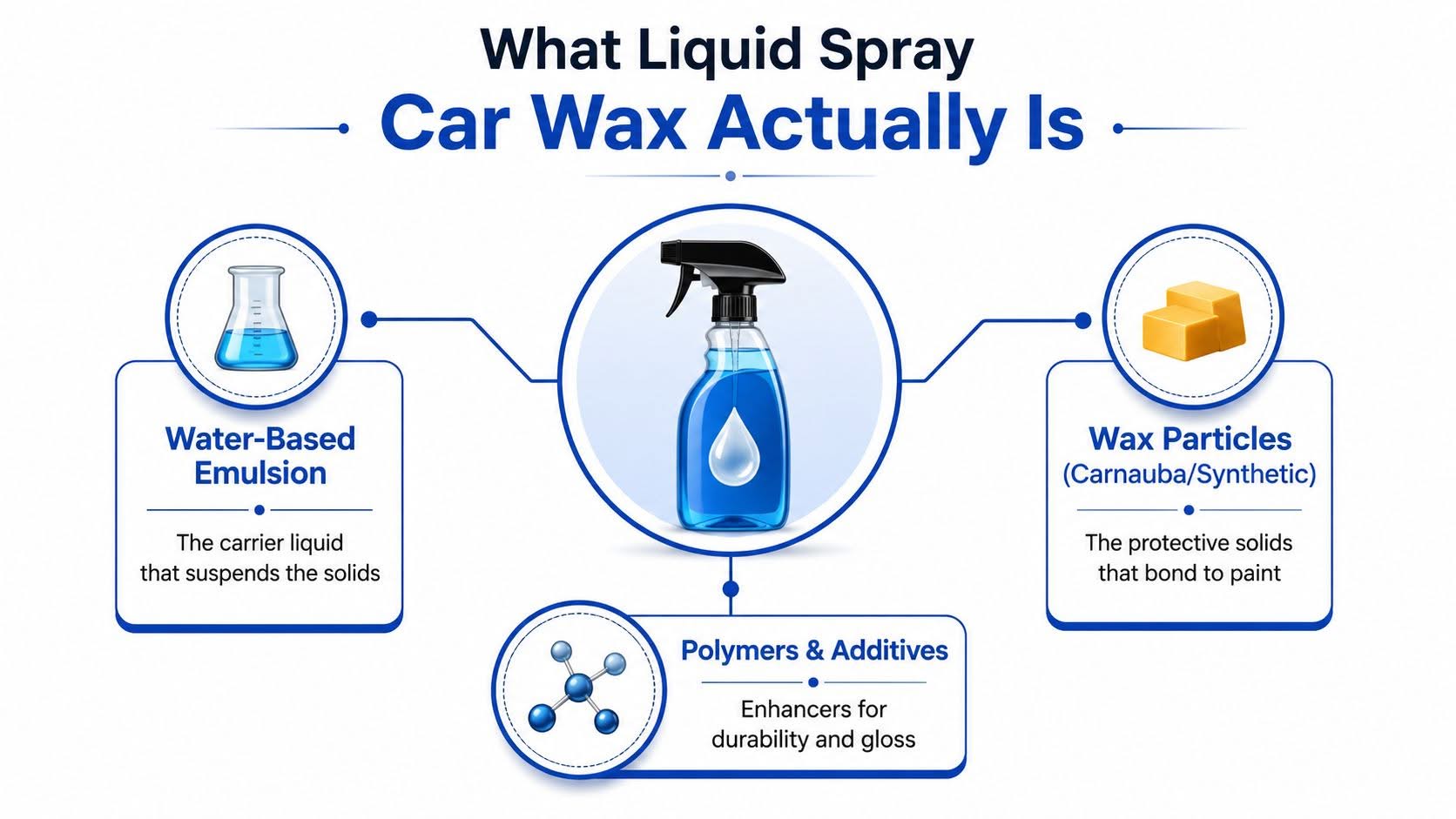
Liquid spray car wax is a water-based emulsion or microemulsion that carries wax particles and polymers onto the panel. It is made to spread fast, leave a very thin hydrophobic layer, and buff off before it turns into a mess. It works like a raincoat mist for paint, not a heavy blanket you spread with an applicator.
Why the chemistry matters
Some wash-bay products are engineered as water-based, cationic or emulsion-based concentrates with tight use parameters, including a typical pH of 7.0, viscosity of 2,000 cP at 20°C, specific gravity of 1.0, and a standard 1:200 metering dilution etowahchemicals.com. Those details matter because they show why the product can spread evenly in a rinse stage instead of sitting in streaks on the panel.
Other spray-wax formulas are intentionally much thinner. A 3M quick-wax datasheet lists the product as a liquid with pH 8.5 to 9.2, viscosity 1 to 20 cps, and specific gravity 0.985 to 1.0 3M quick-wax datasheet. That low-viscosity profile is what lets it spread quickly and wipe clean with less effort.
The practical point is simple. Liquid spray car wax is built for speed and uniformity, not heavy film build. In Perth, that matters because strong UV and dusty roads punish a weak finish quickly, while bore water and scheme water can both leave different marks if the surface has no protection at all. That is why it suits maintenance work, fleet wash bays, and quick driveway detailing so well.
A thin product that spreads well often performs better than a thicker product that fights you on the towel.
In plain terms, the bottle is doing three jobs at once. The water carries the product, the wax particles create the visible finish, and the additives help with gloss, wipe-off, and surface behaviour. Once you understand that, the trade-off is clear, you are buying easy application and fast gloss, not a long cure time.
If you want the hand-applied version of that finish, see hand car wax polish.
Need a faster way to add gloss and water beading?
Spray Wax vs Paste Wax vs Ceramic Coating
The easiest way to place liquid spray car wax is to stop treating it like it has to beat every other protection product. It doesn’t. It sits in a different lane from paste wax and ceramic coating, and once you see the job each one is built for, the confusion drops away.
What each format is really doing
Paste wax is the old-school choice when someone wants a thicker feel, a longer process, and more time on the panel. It rewards patience. Liquid spray wax is the opposite end of the scale, fast, thin, and easy to refresh. Ceramic coating sits in a separate category again, because it’s about long-term paint protection rather than a quick gloss boost.
Here’s the cleanest way to compare them.
| Format | Effort | Durability | Gloss Depth | Best Use |
|---|---|---|---|---|
| Spray Wax | Low | Short-term | Light to good | Fast maintenance and top-ups |
| Paste Wax | Higher | Longer than spray wax | Rich, warm gloss | Enthusiast hand finishes |
| Ceramic Coating | Professional prep | Long-term | Sharp, modern finish | Drivers who want less frequent upkeep |
The durability gap is the key thing people miss. A peer-reviewed table in PubMed Central lists a Spray Wax Quick Coat with average paint protection time of 6 weeks, while another liquid wax in the same table is listed at 48 weeks PubMed Central table. That lines up with the real-world pattern, spray wax is a short-term maintenance layer, not a stand-in for a long-duration coating.
Where ceramic coating changes the question
A ceramic coating changes the routine because you’re no longer asking how often to top up wax. You’re asking how much protection you want to build into the paint itself. If you’re comparing that choice locally, this Perth ceramic coating guide is the right reference point.
Decision shortcut: choose spray wax when you want easy upkeep, paste wax when you enjoy the process, and ceramic coating when you want to reduce how often you think about protection at all.
For Perth drivers, that distinction matters because of the climate. A quick gloss product can be brilliant for regular upkeep, but it’s not the same job as a coating, and it shouldn’t be judged like one. If you want the least effort between washes, spray wax is convenient. If you want to stop repeating the routine so often, coating is the more structural answer.
Not sure which protection option fits your car best?
How to Apply Liquid Spray Car Wax in Your Driveway?
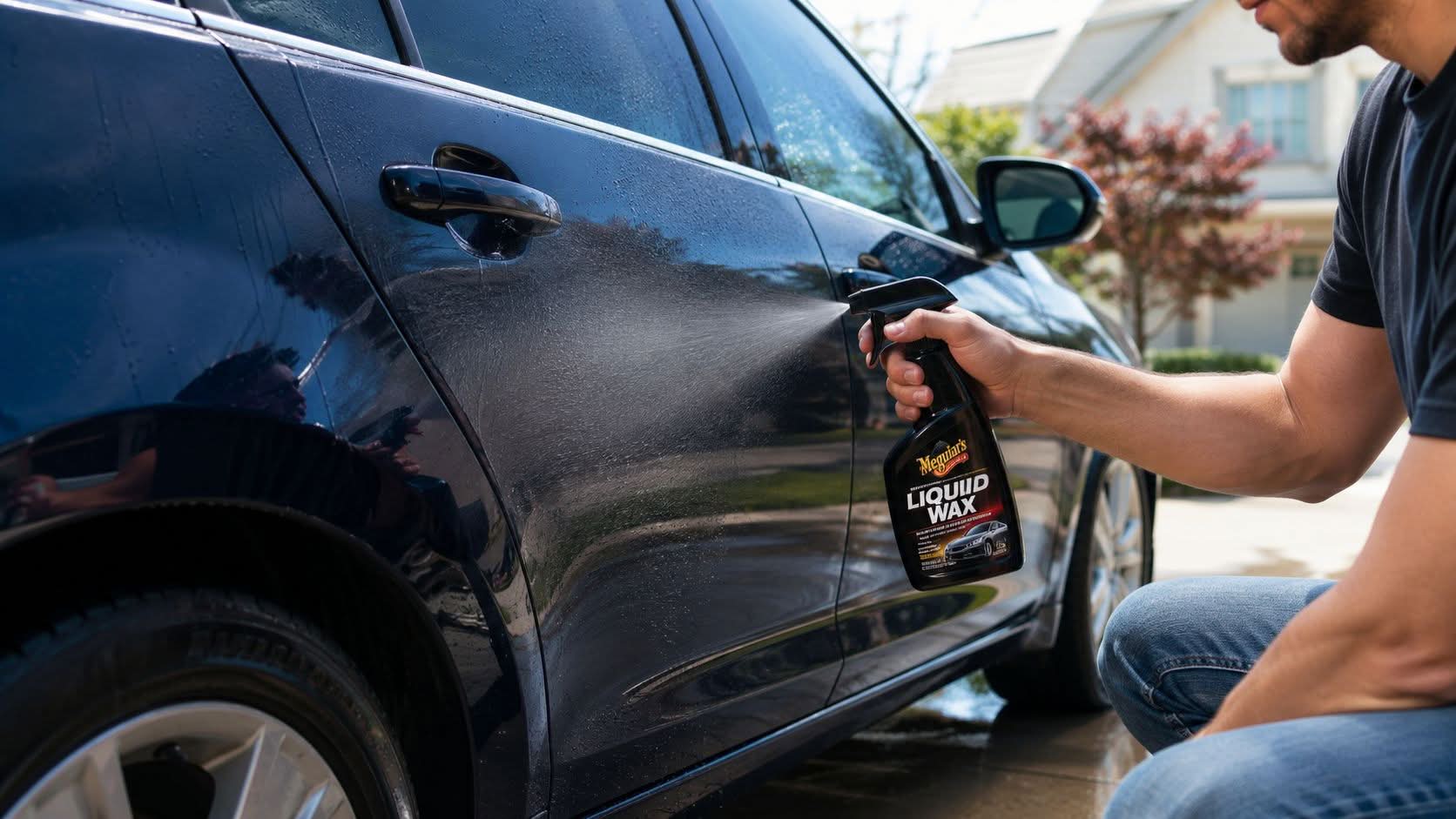
The product only works cleanly if you treat it like a finishing step, not a spray-and-pray shortcut. Start with a washed car, then work on a cool, shaded panel with the surface mostly dry. A damp panel is often better than a fully dry one because the product can spread more evenly before you buff.
The order that keeps the finish even
Work from the roof down, then bonnet, upper doors, and finally the lower panels. That keeps dirtier sections from contaminating your clean towels too early. Use a light mist, not a soak, because too much product is the fastest way to create haze and high spots.
A good driveway routine looks like this:
- Wash first. The panel needs to be clean, otherwise you’re sealing in grit and film.
- Mist lightly. One or two controlled sprays is usually enough for a small panel.
- Spread with one microfibre. Use straight, overlapping passes instead of random circles.
- Buff with a second clean towel. This is the step that removes residue and levels the finish.
- Check the panel in angled light. Any smear is easier to fix immediately than after it flashes.
Don’t apply it in direct sun if you can avoid it. Heat speeds up drying, and that’s when streaks start showing up.
What usually goes wrong
Most bad results come from three mistakes. The first is overapplication, because a thick pass leaves more residue than the towel can remove. The second is skipping the second buff, which leaves the panel looking oily rather than glossy. The third is rushing hot panels, especially on darker paint where the product flashes faster.
The nice part is that the fix is simple. Use less product than you think you need, keep the towels clean, and move panel by panel. That’s how liquid spray car wax ends up looking like a professional finish instead of a rushed one.
Prefer a streak-free finish done for you?
How Often to Reapply and What Actually Wears It Off?
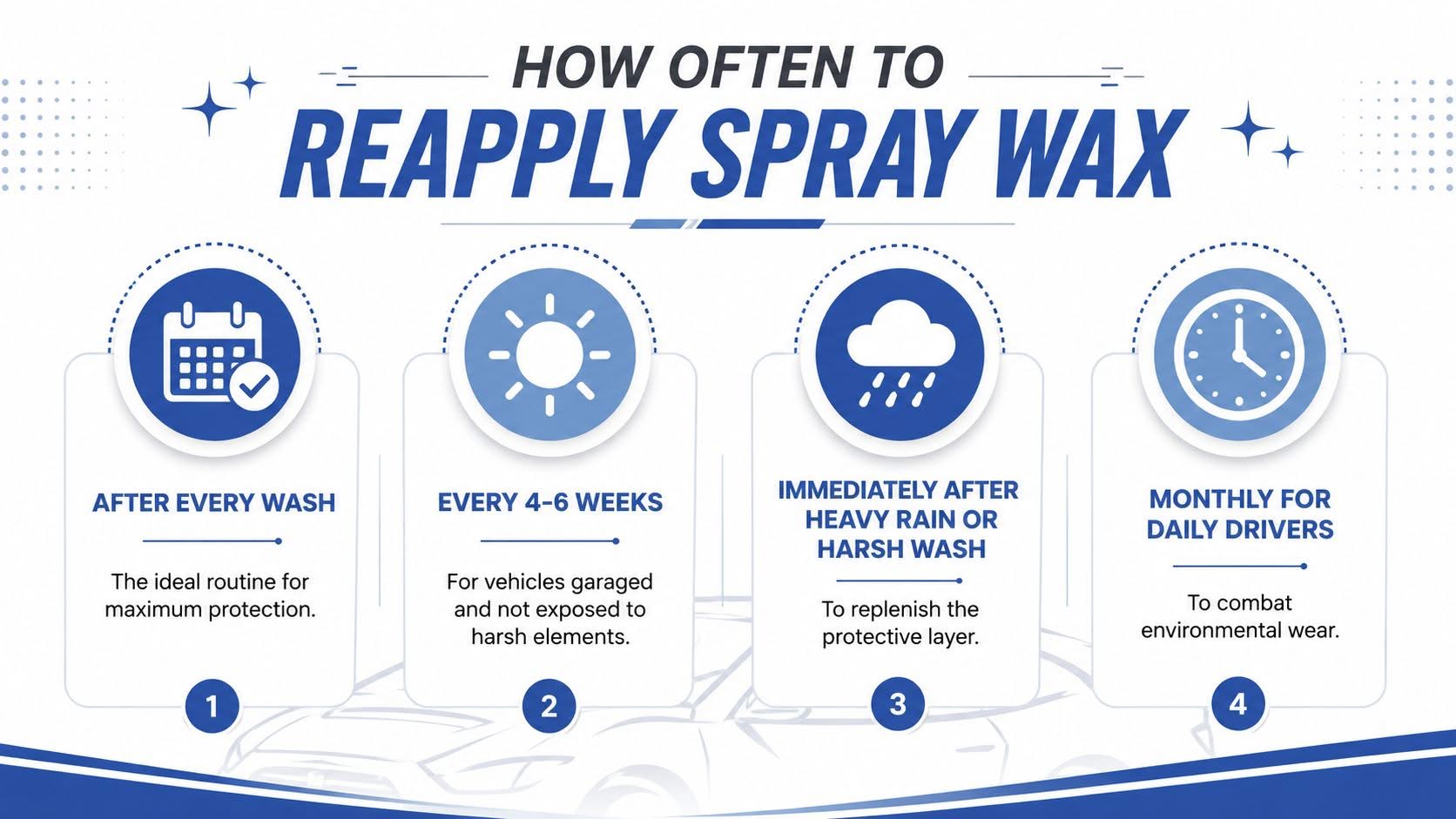
Spray wax makes sense only if you treat it as part of the wash rhythm. It’s a maintenance layer, so it gets refreshed as the car gets cleaned, not once and forgotten. In Perth, that matters even more because sun, heat, dust, and local water quality all chip away at the finish in different ways.
What “lasting” really means
A lot of generic advice talks about wax as if it has a single lifespan. That’s not how it works in a real driveway. A garage-kept car sees less UV and less airborne contamination than one parked in the open, so the finish hangs on differently even when the product is the same.
The right question is less “How long does it last?” and more “How often do I want to re-top it?” For a daily driver in WA, the answer is usually tied to your wash interval, because the wash itself removes some of the surface layer and resets the look. A vehicle that lives outside will usually need attention sooner than one that spends most of the week under cover.
The things that wear it off fastest
- Sun exposure: strong UV and heat break down the fresh finish faster on street-parked cars.
- Wash method: harsher washing and aggressive drying shorten the life of the layer.
- Water quality: bore water and hard water can leave residue that dulls the result.
- Road grime: dust and film build up faster on high-mileage cars and reduce the wax’s visible effect.
For Perth use, don’t trust a long durability claim unless the car is garaged and the wash routine is gentle.
Independent guidance frames spray wax as a shorter-term protectant that usually needs frequent reapplication, and Australian car-care advice also points out that sun, heat, and dirty wash water can affect waxing results AAA Magazine car waxing tips. That’s why a “top up at the end of each wash” habit makes more sense than chasing a calendar date alone.
Want help keeping your shine consistent between washes?
When a Professional Add-On Is Worth the Money?
There’s a point where the question stops being “Can I spray wax myself?” and becomes “Is the car worth the extra finish step today?” That’s where a professional add-on starts to make sense. It’s especially useful after paint correction, because freshly refined paint benefits from a clean protective layer before it sees road dust again.
A paid add-on also makes sense when the car is about to be seen by other people, such as before a lease return, a sale, or a big event. That’s not vanity. Presentation changes how the car reads, and a fresh wax layer helps the paint look cared for rather than merely clean. It can also be the sensible choice for vehicles parked outside full-time, where a DIY top-up routine falls behind quickly.
Where the paid options fit
Prime Shine offers a liquid spray wax add-on for customers who already have a clean wash base and just want that finishing layer applied professionally. It also offers hand wax and polish as part of the Premium Car Wash, which suits drivers who want a fuller gloss step built into the service. For cars that need the paint reset first, the professional cut and polish service is the logical prep before any longer-lasting protection.
If you’re trying to choose between routine gloss and deeper protection, the answer usually depends on how often you want to come back and repeat the same step.
A spray wax add-on is a good match for maintenance. A ceramic coating is the better answer when you want to change the routine itself. In Perth, that’s often the dividing line, whether you’re happy to keep topping up, or you’d rather invest once and think about protection less often.
Ready to upgrade from a basic wash to a better finish?
Booking the Right Service at Prime Shine
The simplest booking decision is to match the service to the outcome you want. If you want a clean car with a bit more gloss, the Premium Car Wash already includes hand wax and polish, so that’s the easy all-round option. If the paint needs correction first, Cut & Polish is the step that prepares the surface before any longer-term protection goes on.
If your goal is to reduce how often you need to think about wax at all, Ceramic Coating is the next level up. If you already wash somewhere else and just want a professional finish boost, the liquid spray wax add-on is the lighter, more targeted booking. The choice comes down to whether you want a one-off shine lift or a change in routine.
Prime Shine Hand Car Wash also works well for drivers who prefer a proper hand wash before adding protection. It’s a Perth-based site at Westminster, with hand-wash and detailing services that suit regular maintenance and heavier paint-care work. For a quick top-up, a full refresh, or a longer-term protection plan, the right service is the one that matches how you use the car.
If your paint’s clean but still lacks that finished look, book a wash and protection step that fits the way you drive. Prime Shine Hand Car Wash can handle the hand wash, the gloss boost, and the longer-term options in one place, so you’re not guessing between products every time the car needs attention.