















You notice it in a supermarket window on a bright Perth afternoon. The car looks clean, but the reflection seems hazy, with fine spider-web marks radiating across the bonnet and doors. You wash it again, perhaps add a quick polish, and the marks remain. That’s the point where paint correction for cars becomes relevant, because the problem is no longer dirt sitting on top of the paint. It’s damage within the upper clear coat.
A proper correction isn’t a rushed gloss treatment. It’s a measured process that inspects, cleans, levels, refines and protects the finish. The right result depends on what the paint can safely give up, what the defects are, and how the vehicle is maintained after the work is complete.
When Paint Correction Becomes Necessary?
The first distinction is simple. A wash removes contamination from the surface, while paint correction reduces defects in the clear coat. Road film, dust, mud and loose grime can make paint look dull, but they usually need proper cleaning rather than machine polishing. Swirl marks, light scratches, haze, water-spot etching and early oxidation affect how light reflects from the clear coat.
A dark hatchback may look fine after a brush wash under soft light. Park it in Perth’s afternoon sun, and circular marks appear around each reflection on the bonnet. Focused workshop lighting produces the same reveal. Diffuse light hides defects that direct light exposes.
A quick surface check
Wash and dry a small area with clean materials, then inspect it from an angle in strong light. If a blemish disappears when you gently pass a clean microfibre over dry paint, it was likely residue or loose contamination. If it remains in the same place, the clear coat has probably been disturbed.
The result does not call for the most aggressive correction available. It shows that another ordinary wash is unlikely to remove the visible problem. An inspection and test section can establish what the paint will safely accept before any larger job begins.
Practical rule: If the mark remains after safe washing and changes with the light, have the paint assessed before choosing a package.
Why Perth light exposes the problem
Perth’s strong sunlight makes surface defects easy to see. It separates a clean panel from one with a level, even finish, especially on black, navy, red and other darker colours. A car can look glossy in shade while fine defects continue scattering light across the panel.
Consider correction when the paint repeatedly looks grey, hazy or webbed after washing, or when water marks remain despite proper cleaning. It can also suit a vehicle prepared for sale, lease return or long-term protection, provided the defects are shallow enough to address safely.
For the practical first step, a careful local hand wash at Prime Shine Hand Car Wash can remove surface contamination before the paint is assessed. That helps separate a cleaning problem from a correction problem, particularly when Perth sun makes the difference obvious.
How Paint Correction Works and What Each Stage Does
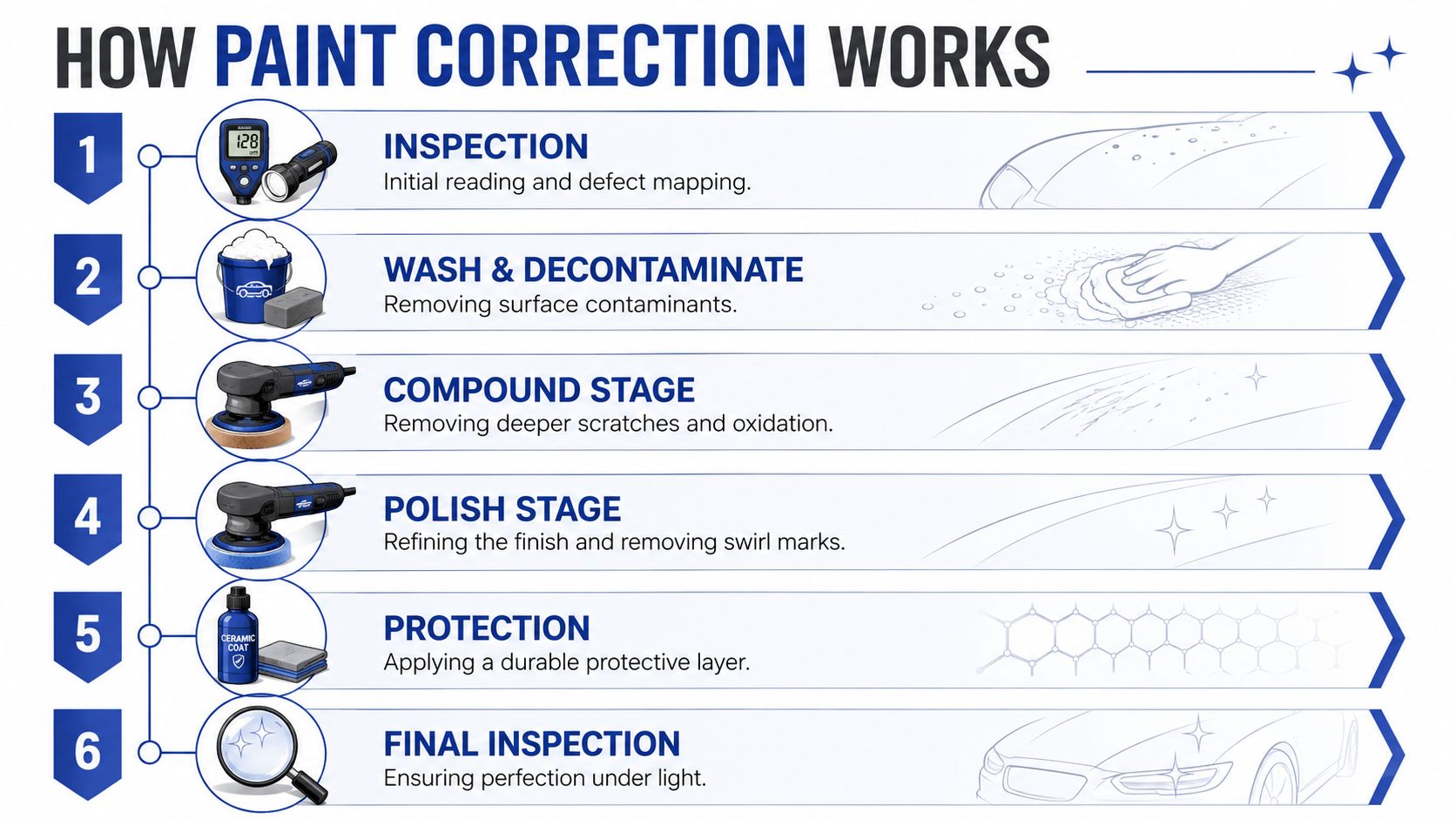
Under Perth’s hard sun, a panel can look glossy in shade yet show webs, haze and uneven reflections as soon as it faces direct light. Paint correction is controlled machine polishing that reduces defects instead of hiding them. The technician levels a very thin amount of damaged clear coat, then refines the surface so light reflects more evenly. The usual workflow covers decontamination, inspection, paint-thickness checking, test-section polishing, cutting, polishing and a final panel wipe, as outlined in this Australian paint correction process guide.
The work in sequence
-
Inspect and measure. Under a focused torch or LED, the technician maps swirls, scratches, oxidation and earlier repairs. A paint-thickness gauge helps show how much material may be available for polishing. Factory automotive paint is typically about 100 to 180 microns overall, while the clear coat is commonly around 35 to 50 microns, according to Australian paint-thickness guidance. That limited margin is why a test spot matters more than a package label.
-
Wash and decontaminate. A careful two-bucket hand wash removes loose grit. Chemical decontamination addresses bonded fallout, while a clay bar lifts particles that could drag beneath the polishing pad and leave fresh marks.
-
Compound. The heavy-cut stage uses a machine, compound and suitable pad to level the raised edges of shallow defects. It is not sanding the whole car flat. It removes a controlled micro-layer, reducing the peaks that scatter Perth sunlight.
-
Polish. Compounding may leave haze or faint pad marks. A finer polish and pad refine the surface, so dark paint looks clearer rather than grey or cloudy.
-
Finish. A final jewelling-style pass focuses on gloss, depth and consistent reflections. A full correction may use up to three polish-and-pad combinations, progressing from heavy cutting through fine cutting and finishing, as explained in this machine-polishing sequence.
-
Panel wipe and protection. An isopropyl-alcohol panel wipe removes polishing oils, allowing the technician to inspect the genuine finish. Wax, sealant or ceramic protection belongs after that check. This Perth cut and polish guide explains the preparation sequence in practical terms.
A typical Stage 2 correction removes only 2 to 5 microns when carried out correctly, according to the cited Australian measurement guidance. The aim is the clearest visible improvement while preserving the clear coat, not chasing every mark. For a local practical starting point, Prime Shine Hand Car Wash can complete the careful hand wash that prepares the vehicle for assessment.
Which Defects Paint Correction Can and Cannot Fix?
Under Perth sun, a shallow swirl can look like a web of white lines across otherwise sound paint. A deeper gouge shows a different problem. It may have cut through the clear coat and colour, so polishing cannot replace the material that is missing.
The defects that respond well
Paint correction commonly reduces light to moderate swirl marks, shallow wash scratches, mild oxidation, water-spot etching that remains within the clear coat, holograms and general haze. The result depends on paint hardness, defect depth and how much clear coat can be removed safely. Industry service benchmarks often describe stronger removal as the process moves from one-step to multi-stage correction, but those figures are not a promise for every panel. The aim is a visible improvement while preserving the finish, as outlined in this Australian correction overview.
A test spot gives the technician a controlled answer. If a mild pad and polish noticeably clear one section in the Perth light, further refinement may be worthwhile. If the improvement is limited, chasing the last marks could create more risk than benefit.
The defects that need another solution
Deep gouges, stone chips exposing primer or metal, bird-dropping burns etched beyond the clear coat, and peeling or flaking clear coat sit outside a standard correction promise. They may require touch-up work, spot repair, panel repair or a respray.
Run a clean fingernail lightly across the mark. A noticeable catch suggests that the damage is too deep for polishing alone to remove. For one isolated scratch, this car paint scratch repair guide helps explain the difference between a surface defect and damage that needs paint repair.
| Defect | Can Correction Fix It? | Recommended Action |
|---|---|---|
| Light swirls and wash marring | Often, yes | Test spot and staged machine polishing |
| Shallow scratches | Often, partially or substantially | Inspect depth, then correct conservatively |
| Mild oxidation and haze | Usually, if the paint is sound | Decontaminate, polish and protect |
| Water-spot etching | Sometimes, if it remains within the clear coat | Test correction, escalate if etched deeply |
| Deep gouge that catches a fingernail | No, not fully | Touch-up, spot repair or panel repair |
| Stone chip exposing primer or metal | No | Repair and refinish the damaged area |
| Peeling or flaking clear coat | No | Professional paint repair or respray |
The sensible answer may be a smaller repair rather than a full correction. Prime Shine Hand Car Wash can assess the vehicle after a careful hand wash, helping separate marks that can be improved from damage that needs another trade. That assessment matters because Perth glare can make minor defects look severe, while a deep cut remains visible even after the surrounding paint is polished.
Paint Correction Compared to Wax and Ceramic Coating
Many owners assume these services overlap, but they address different problems on the paint surface. Correction reshapes the upper paint layer to reduce suitable defects. Wax and sealant add a temporary surface film, while ceramic coating bonds to properly prepared paint. None of these protective products can erase defects already sitting underneath.
Correction uses abrasive machine polishing to refine shallow clear-coat damage. Under Perth sun, that can turn broken reflections and visible wash marks into a clearer, more even finish. Wax adds gloss, a smoother feel and some protection, but it cannot flatten a scratch. A sealant follows the same principle, using a synthetic protective film intended to last longer than traditional wax.
What each option contributes
| Feature | Paint Correction | Wax | Ceramic Coating |
|---|---|---|---|
| Main purpose | Reduce or remove clear-coat defects | Add gloss and surface protection | Add a bonded protective layer |
| Removes swirls | Yes, when safely within the clear coat | No | No |
| Changes water behaviour | Not by itself | Yes, temporarily | Yes, with hydrophobic behaviour |
| Requires preparation | Inspection, wash and decontamination | Clean paint | Thoroughly corrected and panel-wiped paint |
| Best use | Restore the substrate | Budget-friendly shine | Longer-term protection and easier maintenance |
The choice changes what you see and how you maintain the vehicle. Correction gives the surface clearer reflections, which is especially noticeable beneath strong Perth glare. Wax or sealant then helps shield that finish from daily exposure. Ceramic coating can make washing and water behaviour more convenient, but it preserves the condition beneath it. If swirls remain, coating over them keeps those marks inside a more expensive protection system.
A practical buying rule
Visible marring usually calls for correction before protection. A clean, clear surface may only need a protective layer. Wax suits a simpler, budget-conscious gloss treatment. Ceramic protection suits owners seeking a longer-term maintenance approach and willing to prepare and care for the coating properly.
Prime Shine Hand Car Wash can help assess the finish after a careful hand wash, so the next step matches what the paint needs. The preparation principle is explained in this Perth guide to paint protection and ceramic coating. A coating works best as the final protective layer after the substrate has been corrected, cleaned and prepared.
Compare Paint Protection Options
How Long Paint Correction Takes and What It Costs in Perth?
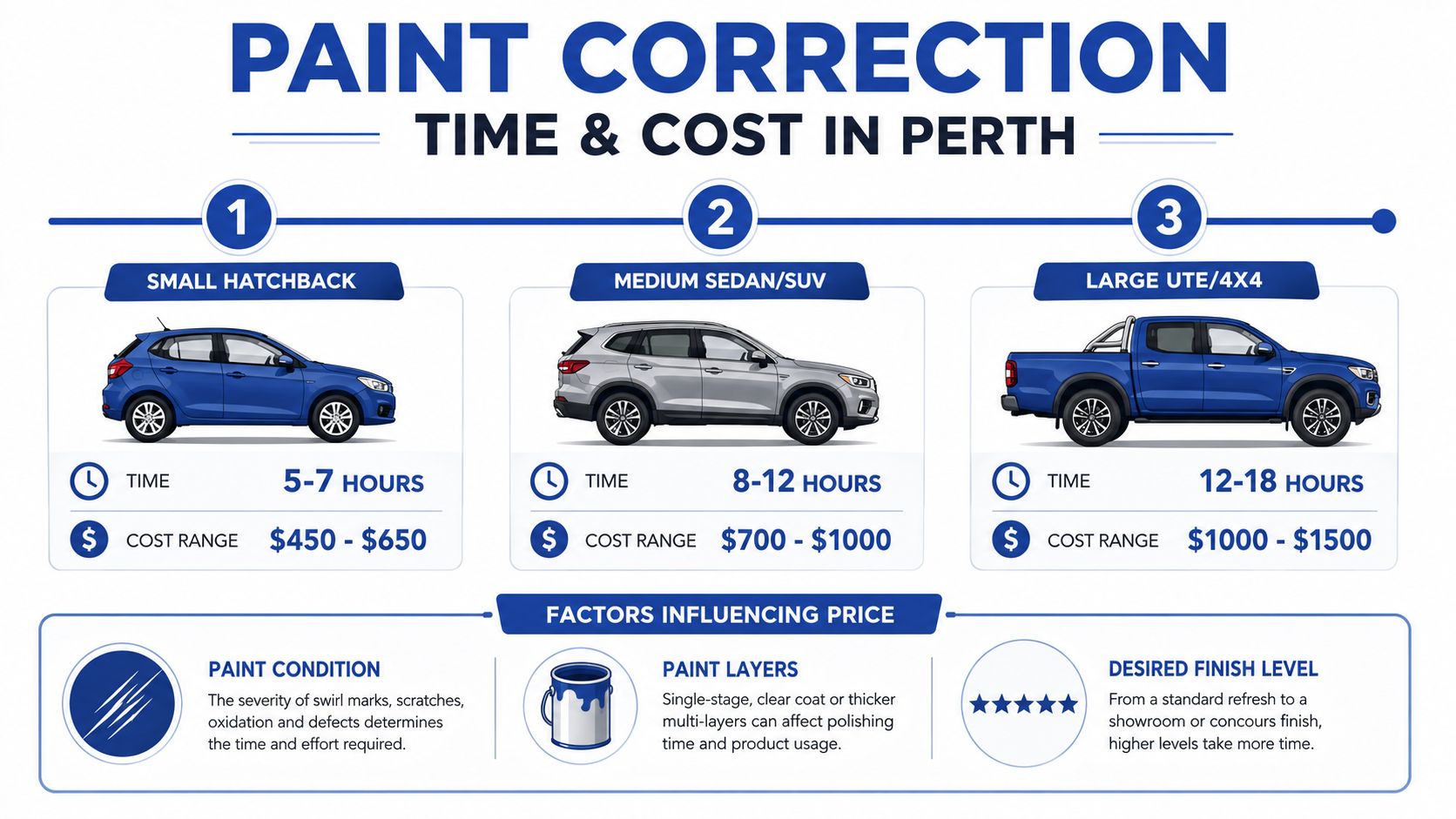
A car can look polished from the driveway yet reveal a different story under Perth sun. Strong glare shows wash marks, haze and uneven reflections, so paint correction takes far longer than a quick polishing pass. The technician must wash, decontaminate, measure, test, mask, polish, refine and inspect each panel. Vehicle size, paint condition, hardness, colour, previous repairs and the desired finish all change the workload.
Australian detailing providers commonly allow about 4 to 7 hours for single-stage correction, 7 to 12 hours for two-stage work, and 1 to 2 full days for show-car-level correction, as outlined in this paint correction timing guide. These ranges are useful planning benchmarks, not promises. A higher-correction job is treated as specialist restoration rather than a routine wash add-on.
Why the quote changes
A small hatch with light swirls may need a relatively direct enhancement. A large SUV or 4WD has more paint to inspect and work, while a dark, neglected vehicle can need extra cutting and refinement because Perth light makes remaining haze easier to see. Hard and soft paint also respond differently, and a previously repainted panel may behave unlike the factory panels beside it.
Published Perth pricing gives a broad guide. Basic correction listings begin at A$290 for a car, A$340 for an SUV and A$370 for a 4WD. Higher-correction tiers range from A$550 to A$699 and from A$880 to A$1,100, depending on vehicle type and service depth, as shown on this Perth paint correction pricing page. Protection add-ons listed at A$99 to A$150 show why correction and protection are often quoted separately. The correction restores the surface. Protection is the follow-up choice.
Why cheap polishing can cost more
A low quote can mean less preparation, a rushed inspection or an aggressive process chosen without a test section. The result may be holograms, patchy gloss or damage around thin edges. Under direct Perth sunlight, those faults can stand out more clearly, turning a cheap job into another correction or paint repair.
Ask what the quote includes, whether the work is one-stage or multi-stage, how the finish will be checked and what protection follows. Prime Shine Hand Car Wash can explain the practical next step after assessing the vehicle’s condition, so the time and cost match the finish you want.
What a Real Correction Looks Like at Prime Shine?
A Westminster customer arrives with a white sedan that looks clean from several metres away. Under direct light, the bonnet shows scattered wash marks and a faint veil over the reflections. The first useful step isn’t a machine. It’s a controlled hand wash and decontamination process that reveals what is in the paint.
At Prime Shine Hand Car Wash, the workflow can begin with hand washing, wheel cleaning and paint preparation, followed by clay-bar decontamination where needed. Once the surface is clean, the technician can measure paint depth, inspect the panels under LED lighting and test a small section with a selected pad and compound before committing to the rest of the vehicle.
Panel by panel, not guess by guess
The correction then develops in stages. Compounding addresses the more pronounced swirls and sun-dulled areas, while a finer polish restores clarity after the heavier work. Trim is taped, microfibre cloths are rotated before they become contaminated, and the finish is checked panel by panel rather than judged from one flattering angle.
Progress photographs can help the owner understand what changed. The final inspection under LED lighting matters because Perth sun will expose unevenness that softer indoor light can disguise. A careful customer walk-around also confirms the result and identifies any marks that are too deep to promise away.
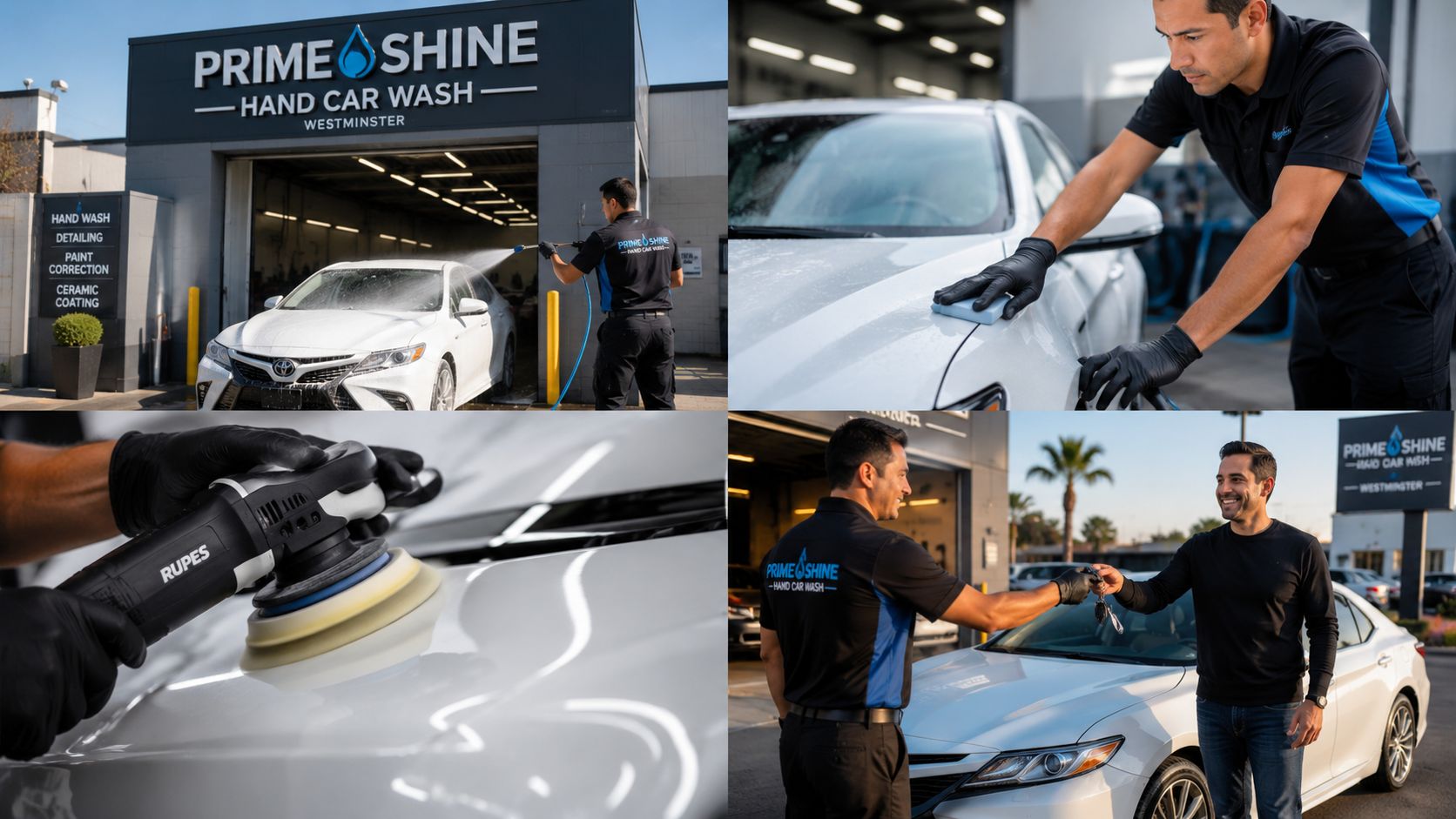
The finished car shouldn’t only look impressive under a studio lamp. It should look cleaner in the school-run queue, show sharper reflections on the freeway and be easier to maintain after a beach weekend. The practical advantage of a combined hand-wash and detailing workflow is continuity, with pre-correction cleaning and post-correction maintenance handled through the same local contact. You can view examples in the Prime Shine photo gallery.
Pre and Post Correction Care and Booking Your Next Step
Good preparation starts before the vehicle reaches the studio. Bring it reasonably clean if possible, remove personal items, and point out the areas that concern you most. Tell the technician about bird droppings, tar, stone chips, touch-ups, repainted panels and previous polishing, because that history can change the safest approach.
You don’t need to perform a full detail at home. The useful preparation is communication. A bonnet with heavy water spotting, a door with a deep scratch and a roof that has already been resprayed shouldn’t be treated as identical surfaces.
The first days after correction
Freshly corrected paint needs sensible handling while the chosen protection is applied or settles. For the first 72 hours, avoid automatic car washes, abrasive towels and unnecessary contact, and keep the vehicle under cover where possible. Those care measures protect the newly refined surface from immediate wash marring and contamination while the finish is being finalised.
Don’t add random products immediately. Ask which sealant, wax or ceramic system was applied and when the vehicle can be washed safely. The right maintenance method depends on the protection selected, but the basic rule remains constant: clean tools, gentle hand washing and no dragging grit across dry paint.
Make maintenance part of the result
Perth sun, road dust, salt air and frequent driving will keep testing the finish. A corrected car needs safer maintenance than the washing routine that created the swirls in the first place. Regular hand washing, clean drying towels and prompt removal of bird droppings or sap help preserve the clarity you paid to restore.
Book an assessment rather than choosing a correction stage from a photograph alone. The technician can inspect the paint, identify which defects are correctable, recommend restraint where repair is more appropriate and match protection to how you park and use the vehicle.
Prime Shine Hand Car Wash offers hand washing, interior and exterior detailing, cut and polish, paint correction and ceramic protection from its Westminster location. Visit Prime Shine Hand Car Wash to book a paint assessment or schedule a careful follow-up wash that helps protect your corrected finish.