







A Perth daily driver with mild swirls usually needs a one-stage enhancement, not a heavy multi-stage correction: clear coat is commonly 30-50 microns thick, and aggressive compounding uses up some of that finite layer. The best cut and polish is the least abrasive process that delivers the improvement you want while preserving paint for the future.
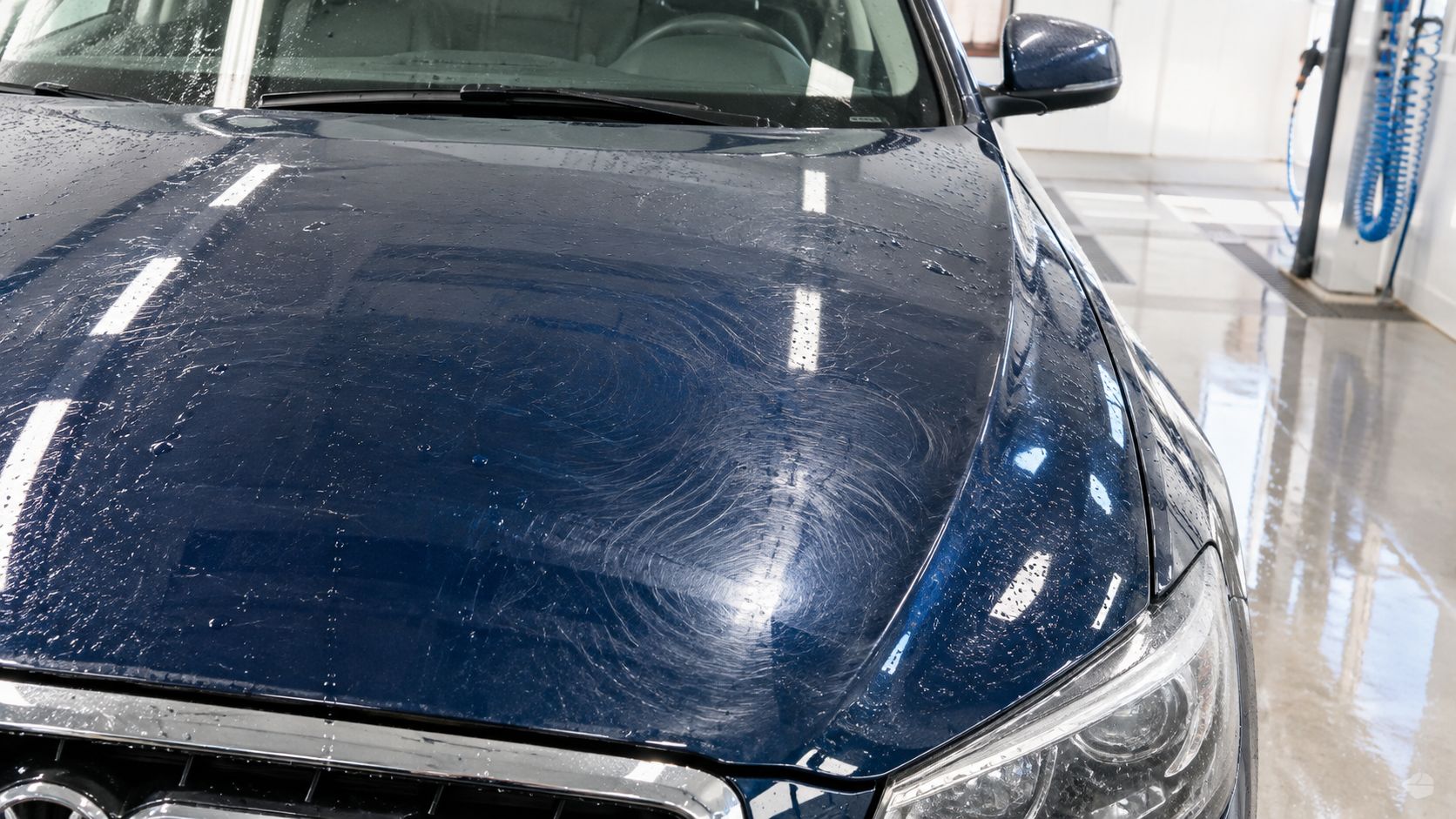
You might notice the problem when you pull into a Westminster wash bay and catch the bonnet in the light. The car looks clean, yet the reflections seem hazy, crossed by fine marks, or dull in patches. Before choosing a service, the useful question isn't “Which compound is strongest?” It's “What's causing the dullness, and how much correction does this paint safely need?”
| Paint condition and goal | Sensible starting point | Main trade-off |
|---|---|---|
| Light wash marks, otherwise sound paint | One-stage enhancement | Conservative correction, but deeper marks may remain |
| Noticeable haze or heavier swirls | Test spot, then consider two-stage correction | More correction and refinement, with more clear coat used |
| Deep scratch, stone chip, peeling clear | Skip polishing that defect | Requires repair or refinishing, not more abrasive polishing |
| Sale or lease presentation | Gloss enhancement and suitable protection | Prioritises appearance without chasing every defect |
Why Your Car’s Paint Looks Dull in the First Place?
Dull paint rarely has a single cause. On a Perth daily driver it usually builds up over years: fine wash marks, bonded contamination, oxidation and small scratches that each scatter light a little differently. The combined effect is a finish that still looks hazy in full sun, even straight after a wash.
Gritty wash mitts, automatic brushes and wiping dust off dry paint all leave fine circular scratches in the clear coat. Strong sun and regular outdoor parking make fading and oxidation more visible, while road film and bonded contamination stop the surface reflecting cleanly. Each defect is shallow on its own; together they flatten the reflection enough to make the whole panel look tired.
Fleet data backs up what detailers see on the hoist. A 2017 Australian Automobile Association report found passenger vehicles averaged 9.8 years of age and light commercial vehicles around 10.4-10.5 years, with the average age of the light-vehicle fleet broadly static for about 10 years (Australian Automobile Association fleet-age report). An older daily driver has had more time to accumulate wash marks, oxidation and contamination, so dullness is more likely on an ageing fleet. Age itself never decides whether polishing is appropriate; the condition of the surface does.
Before choosing a cut: identify whether the problem sits on the surface, within the clear coat, or deeper in the paint. A compound won’t safely fix every defect.
The sensible starting point is inspection. A proper wash removes loose grit, chemical or mechanical decontamination lifts bonded material, and only then can the defects be assessed accurately. That process turns “my car needs a polish” into a diagnosis: cleaning and a light enhancement, a measured correction, or a defect that needs repair work instead.
How Clear Coat Sets the Limits of What’s Possible?
A typical factory paint system measures approximately 90-120 microns thick, and the clear coat that polishing works on is commonly around 30-50 microns (paint-thickness overview). That clear layer supplies much of the paint’s gloss and UV protection. It also never grows back, which is why every correction decision starts with how much of it a panel can afford to lose.
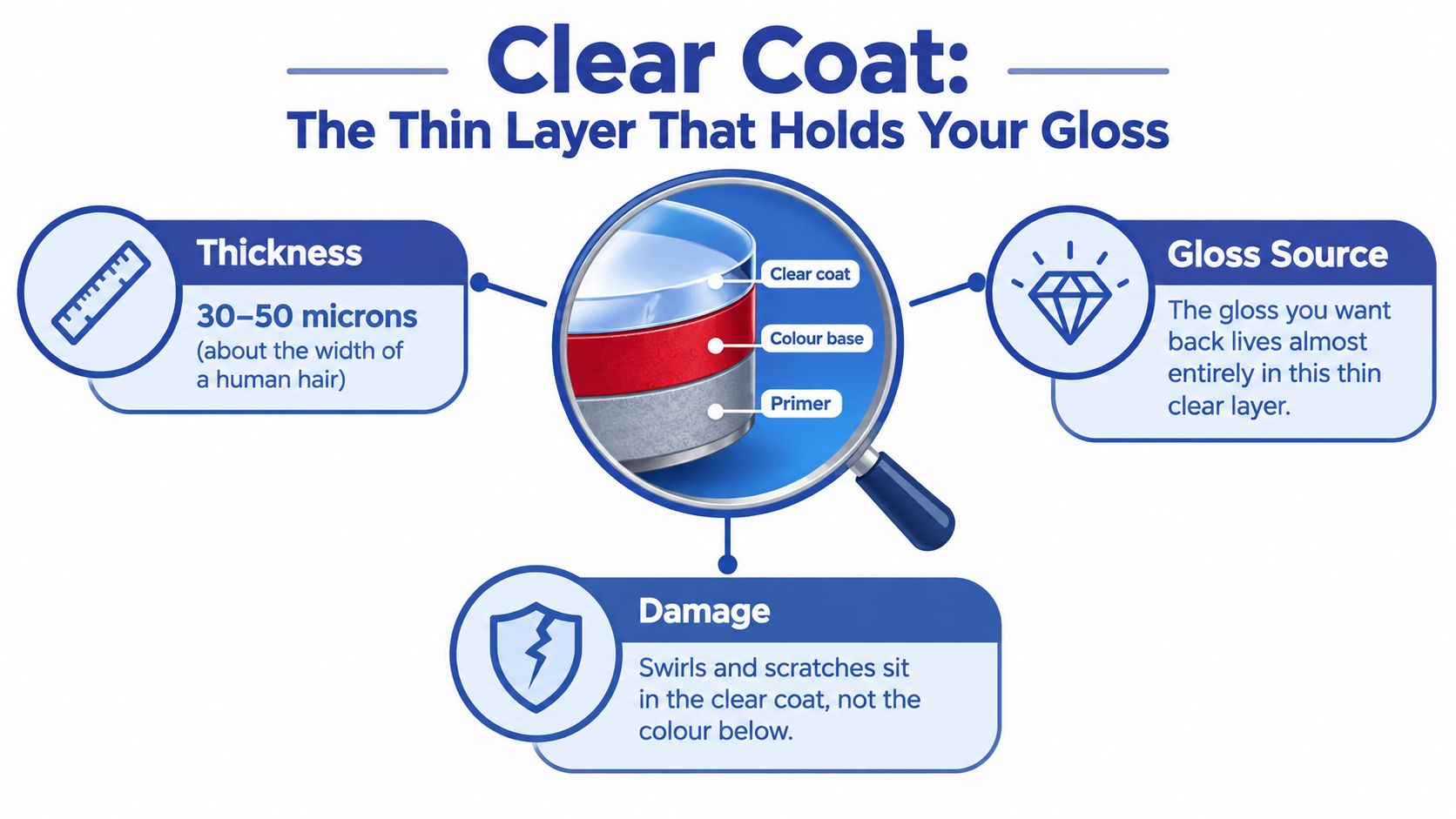
Each pass of a cutting compound levels a small amount of that clear layer, and the car never gains any back. Light swirls, haze and superficial water marks sit near the surface and usually respond well. A scratch that catches a fingernail, a stone chip, exposed primer or peeling clear sits beyond what polishing can safely reach. Chasing that kind of damage with repeated cutting removes healthy material around the defect while the defect itself stays.
The safe call comes from the condition of the panel rather than the name on the package. Paint-thickness readings help an operator understand what a panel has left, particularly after repairs or previous polishing, yet a number alone doesn’t clear a panel for aggressive work. A responsible detailer inspects the finish under proper lighting, tests a small area first, and stops when the last few percent of improvement would cost more clear coat than the result justifies.
Australian vocational training treats buffing and polishing as a defined refinishing skill. The AUR32420 Certificate III in Automotive Refinishing includes unit AURVTP020, “De-nib, buff and polish vehicle painted surfaces”; Charles Darwin University lists it as a 20-hour component covering preparation, tool selection, defect identification, polishing and workplace documentation (Charles Darwin University qualification document). The pattern that training teaches is the same one worth expecting from any workshop: diagnose first, choose the least aggressive method that works, then inspect the result.
For a fuller walkthrough of preserving the finish, see how to do paint correction without damaging clear coat. Some scratches sit deeper than polishing can safely go, and honest advice will say so before the machine ever touches the panel.
Matching the Level of Correction to What Your Paint Actually Needs
The choice isn’t hand polishing versus machine polishing. It’s whether the method suits the paint and defect, and whether the expected improvement justifies the clear coat used. Hand work can help with very light defects or small areas, but it’s slower and often less effective across a whole car, particularly on harder clear coat.
A dual-action machine is a practical starting point for many modern vehicles because its movement balances correction with control. A rotary machine can cut more strongly, but it demands more operator skill and can leave marks that need further refinement. Neither machine makes deep damage safe to remove.
| Method | Best for | Approx. clear coat removed | Risk level |
|---|---|---|---|
| Hand polishing | Very light defects or small areas | Not specified; depends on technique and product | Low, but limited correction |
| One-stage dual-action enhancement | Light swirls, haze and daily-driver refresh | Roughly 0.5-1 micron | Lower when tested and controlled |
| Two-stage correction | More measurable defects needing a cut and refinement | About 1-3 microns | Higher because it uses more clear coat |
| Rotary-led correction | Heavy defects requiring experienced machine work | Varies with paint and technique | Higher; needs careful control and refinement |
The removal estimates come from published Australian detailing guidance and are approximate, not promises for any particular vehicle (3M Australia paint-finishing guidance). Actual removal depends on the pad, abrasive, pressure, speed, paint hardness and operator technique.
A one-stage enhancement uses a compatible pad and polish to reduce light defects while refining gloss in the same process. It’s often the more sensible choice when a daily driver looks tired but doesn’t need every mark chased. A two-stage correction separates defect removal from optical refinement: the cutting stage reduces heavier wash marring or oxidation, then a finer polish clears remaining haze or micro-marring.
For a practical explanation of the choices, read what paint correction is and whether it’s worth it. Ask the detailer to show a test spot and explain what will likely improve, what may remain, and why. A package should follow the paint’s needs, not the other way around.
What a Professional Cut-and-Polish Workflow Looks Like?
A responsible service starts before the polisher is switched on. The quality of the result depends on clean preparation, a sensible test, and honest inspection between stages. A fast machine pass over dirty or poorly assessed paint can create more marks instead of solving the original ones, and every unnecessary pass spends clear coat the car won’t get back.
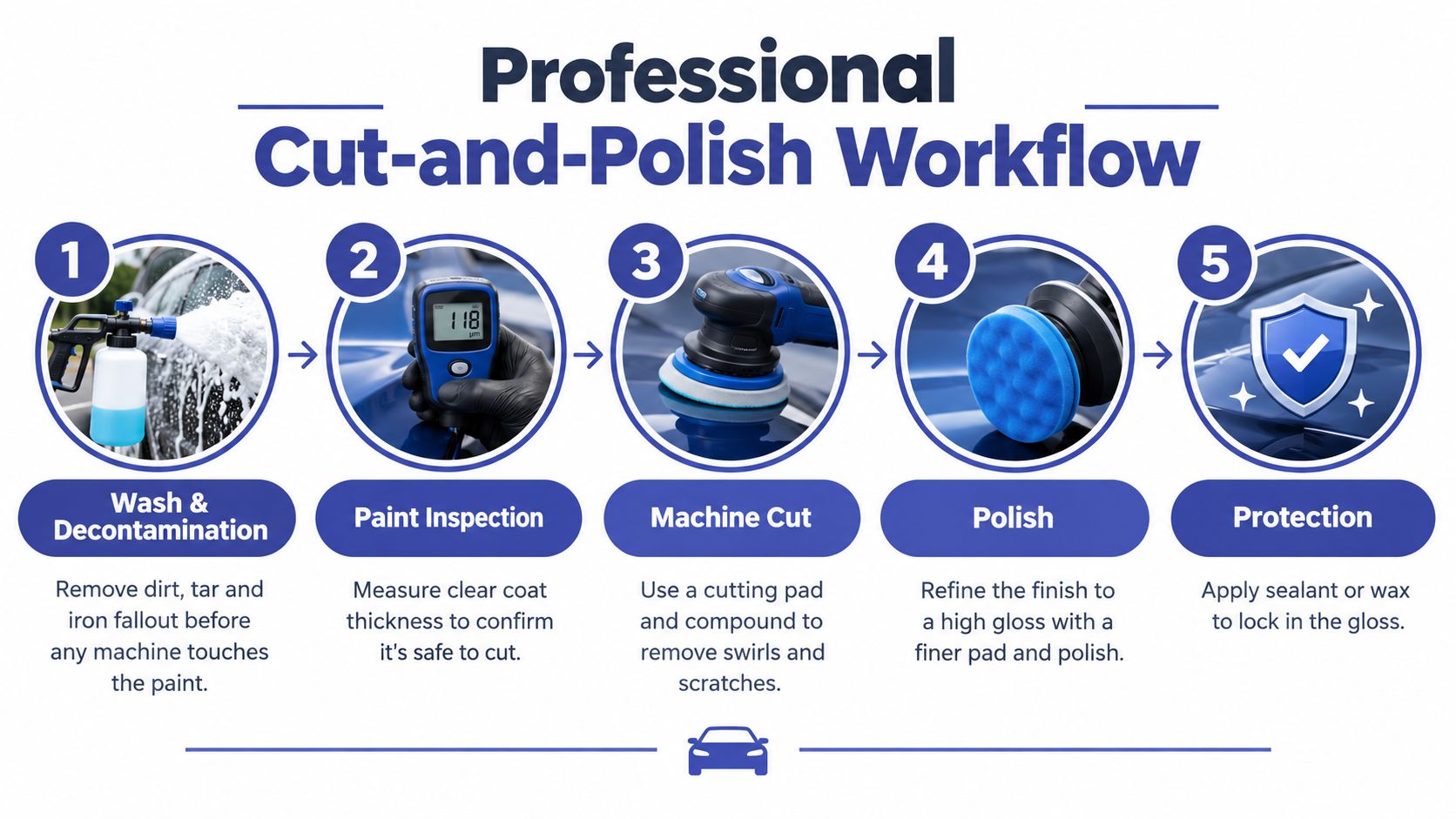
- Wash and decontaminate. Remove loose dirt, then use suitable chemical or mechanical preparation for bonded contamination. Compounding over grit risks adding scratches.
- Inspect the paint. Identify defects and check the panel’s history and condition. Use a paint-thickness assessment where available, especially on repaired or previously corrected panels.
- Test a small area. Try the least aggressive suitable pad-and-polish combination. Inspect under strong lighting before deciding whether a stronger cutting step is justified.
- Correct and refine. Work on cool panels with controlled machine passes. A two-stage job separates the cutting step from finer polishing; a lighter job may need only an enhancement.
- Wipe down and protect. Use an inspection spray or panel wipe to remove residue and check the true finish. Apply a compatible wax, sealant or coating if appropriate.
The inspection wipe matters because polishing oils can temporarily mask swirls. A panel that looks clear immediately after residue is removed may reveal haze or remaining defects once it’s wiped down and checked again under a light. A careful operator inspects each stage rather than relying on gloss alone.
Look for a test spot before the full correction. It shows how the paint responds and gives both customer and detailer a realistic basis for discussing the rest of the vehicle.
As noted earlier, Australian refinishing training treats buffing and polishing as a documented skill with defined preparation and inspection steps. That standard shows up in what a process-led service can explain: the test spot result, the pad-and-polish combination chosen, and why the cut level suits each panel. A bonnet with older paint and a door with recent respray shouldn’t get identical treatment. If the same package is being applied to every panel regardless of condition, the workflow is following the price list rather than the paint.
Choosing the Right Service for Your Situation
The right service level follows the paint in front of the detailer. Package names say little about what a particular car can safely take, so it helps to think in terms of three common situations.
A well-kept hatchback with light wash marks usually doesn’t need a heavy correction. If the paint is generally healthy and the owner wants sharper reflections, a one-stage enhancement is a sensible starting point. Ask whether the detailer will test the bonnet or another representative panel, and whether the expected result is reduced swirls rather than complete defect removal.
A work ute with heavier marks and a previously polished bonnet needs more caution. The roof may show oxidation, while the bonnet’s history raises questions about remaining clear coat. A measured two-stage correction may be appropriate if the test spot supports it, but the operator should be willing to leave deeper marks rather than cut blindly. Ask how the service accounts for panel differences and what defects may remain.
A sale-prep or lease-return vehicle often needs a tidy, even appearance rather than maximum correction. A controlled enhancement followed by suitable protection can improve presentation without spending clear coat on defects a buyer may barely notice. Ask for a clear explanation of what the work will improve and whether any visible damage needs a separate repair quote.
Older vehicles often carry more accumulated defects, but how much correction an individual car can safely take comes from the actual paint condition, defect depth, previous work and the owner’s goal.
Whichever scenario applies, ask the detailer to name the test-spot result before agreeing to the full job, and get the expected remaining defects in writing. There’s no reliable universal promise of perfection. A good recommendation sets an improvement target and identifies the defects that are likely to remain. If the answer is “we’ll remove everything,” ask how the detailer plans to handle scratches that extend beyond the clear coat.
Why Gentle Correction Wins on Perth Daily Drivers?
For a daily driver, maximum defect removal isn’t automatically the best result. Perth vehicles face strong sun, heat and outdoor parking, and sunlight can make remaining haze, holograms and uneven gloss easy to see. Repeatedly chasing bonnet and roof marks with aggressive compounding can spend clear coat that the car may need for future maintenance.
A test section gives the operator a chance to see whether a mild pad-and-polish combination is enough. If it brings back the clarity the owner wants, there’s little reason to move to a heavier cut across every panel. If the test shows persistent defects, the next step should still be based on paint condition and a sensible trade-off, not an assumption that every mark must vanish.
A one-stage enhancement often suits routine maintenance or light swirls. A deeper correction is better reserved for defects that justify the added work and clear-coat removal, with sufficient paint depth and a finish that can be refined afterward. Scratches that reach the colour coat or primer can’t be safely polished away; trying to chase them may sacrifice UV protection without removing the underlying damage.
After correction, a compatible wax, sealant or ceramic coating can help reduce future contamination and washing abrasion. It can’t restore clear coat already removed or repair peeling paint. For a straightforward overview of wax’s role, see what liquid car wax does and when to use it.
The sensible booking question is not “Can you remove every mark?” It’s “What’s the least aggressive approach that will give this car the finish I want?”
How to Judge the Result Before You Pay?
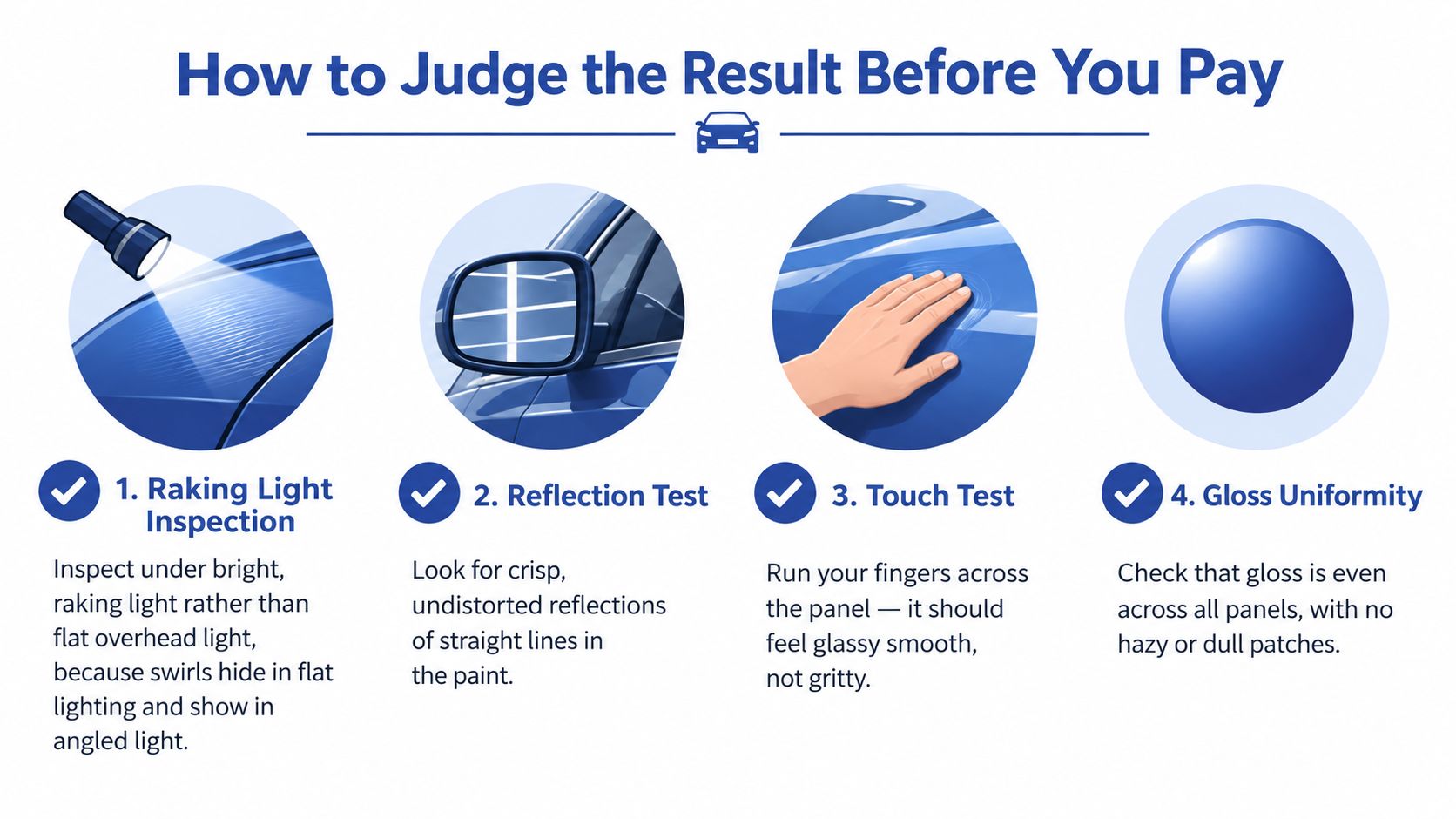
Look at the paint under bright, angled light, not only under flat overhead lighting. Swirls can disappear in even light and show clearly when a beam crosses the panel. Check the bonnet and other exposed panels, then compare their reflections with doors and guards for changes in gloss or haze.
Before work starts, ask to see the test spot and confirm it has been wiped down for inspection. That helps reveal whether the correction has reduced the defects or whether polishing residue is making the finish look clearer than it is. Also ask how bonded contamination was removed; polishing a gritty panel can create the very swirls the service is meant to reduce.
At handover, use this checklist:
- Raking light: Check the surface with a bright light held at an angle.
- Reflections: Look for clear, undistorted reflections of straight lines.
- Surface feel: If invited to check, use clean fingers and notice whether the paint feels smooth or gritty.
- Gloss consistency: Compare panels for hazy or dull patches as well as overall shine.
The wash process matters beyond the finish. Western Australian environmental guidance says vehicle wash-down should take place on a contained, impervious pad that drains to wastewater detention or treatment, and that wash water mustn’t enter stormwater drains without written approval (WA mechanical-equipment wash-down guidance). The vehicle-washpad guideline describes containment, drainage, suitable detergents and treatment for contaminated water (WA vehicle-washpad design guideline). A controlled wash setup is a good sign that the operator takes preparation and runoff seriously, not just the final shine.
Where Cut and Polish Stops and Other Services Begin?
Cut and polish improves paint that can be safely corrected. It isn’t body repair. If a scratch catches a fingernail, exposes primer or metal, or is part of a stone chip, polishing won’t restore missing paint. Peeling or failing clear coat also needs a repair assessment, not another aggressive pass.
Take care around edges and high points where paint may already be thin, particularly on a vehicle with an unknown correction history. If a detailer finds signs that the finish has been polished through or is failing, the safe decision may be to stop. A request for more cutting shouldn’t override the condition of the paint.
Ceramic coating doesn’t replace correction either. It protects the finish beneath it, so it won’t erase swirls or level scratches. If defects are sealed in, removing them later may require polishing through the coating and using more clear coat. Read whether ceramic coating is worth it for Perth drivers before treating protection as a substitute for paint assessment.
A useful booking conversation distinguishes the goal from the limits: “I want the paint clearer and glossier, and I understand some deeper marks may remain.” That gives the operator room to choose a conservative method, explain when a panel needs repair, and avoid chasing damage that polishing can’t safely fix.
Visit Prime Shine Hand Car Wash in Westminster to discuss whether your car needs a light enhancement, a more measured correction, or a different repair. The team offers hand washing, cut and polish, paint correction and paint protection, with an inspection-led approach to reducing swirls and light scratches.