






You’ve just brought home a clean car, parked it in a Perth driveway, and by the weekend there’s a fresh stone chip on the bonnet, dust along the guards, and bird droppings baking on the roof. That’s the moment most owners start asking about car film paint protection. Is it worth paying for film instead of more polishing? Will it stop chips? And what happens if your paint has already been repaired? Those last two questions matter more than the sales pitch, because film only works well when the paint underneath is sound and the warranty terms suit how you drive.
Not sure if your paint is ready for film? Book a hand wash and paint check before you commit.
What Does Car Film Paint Protection Cost in Australia?
Ask three Perth installers to quote a full-front kit on the same mid-size sedan and you will get three different numbers. That spread is normal. Film pricing works like a painter’s quote on a house: you are buying area, preparation and finish quality, not a boxed product. A full-front kit is the mid-range option most owners weigh, a partial front sits below it, and full-body coverage costs several times the front kit. Panel size, film series and edge finishing move the final figure more than any headline band does.
What does each coverage level include?
| Coverage | Panels included | Typical cost | Best suited to |
|---|---|---|---|
| Partial front | Part bonnet, lower bumper, mirrors | Below a full front kit | Highway commuters with stone-chip risk |
| Full front end | Bumper, bonnet, guards, mirrors, A-pillars | The mid-range benchmark other quotes are measured against | Rideshare, regional and gravel driving |
| Full body | Every painted panel including roof | Several times a full front kit | Show cars, new vehicles, resale-focused owners |
| Removal of old film | Strip and clean existing film | Quoted per panel after inspection | Vehicles with film older than several years |
The table shows why quotes can’t be compared on price alone. One installer might count a partial bonnet as front coverage, while another includes the full bonnet, guards, and A-pillars. You’re paying for square metres of film plus fitting time, so two quotes at the same price can cover very different amounts of panel.
Comparing quotes? Get your panels washed and inspected first so every quote covers the same area.
What moves the price up or down?
Vehicle size is the first driver. A large SUV has more painted area and taller, flatter panels that take longer to align than a small hatch. Complex curves on bumpers, mirror caps, and bonnet edges also add labour, because the installer has to stretch, heat, and seal film without leaving tension marks or lifting corners.
Film grade is the second driver. Standard clear film costs less than self-healing film, and matte, satin, or colour-change finishes usually sit above both.
Paint condition is the third driver, and the one owners underestimate. Film can’t bond cleanly over flaking clearcoat, so a quote can grow once the installer prices in paint correction first. Resprayed panels raise a different problem: fresh repairs are a common warranty exclusion, and film laid over weak paint tends to lift at the edges, which means paying for coverage the film maker may refuse to back. Removal of old film sits outside most headline prices too, because aged adhesive can take far longer to strip and clean than fresh film, and the installer can’t judge that until they test a corner.
A quote well below the usual band usually means cheaper film, a smaller covered area, or shortcuts in edge finishing. Ask what’s been left out before you celebrate the saving.
Before you pay, ask four direct questions. Which film brand and series will be fitted, not just what the film is called in the brochure? Which panels are included, panel by panel, in writing? Does the warranty require fitting by an authorised installer, and is this workshop authorised for that series? Are repaired or resprayed panels excluded from the claim terms? Clear answers protect you more than a discount does.
Bring your quote questions to a paint inspection. Book a hand wash and get honest advice on your panels.
Book a hand wash before comparing film quotes
What Is Paint Protection Film and Why Does Perth Paint Need It?
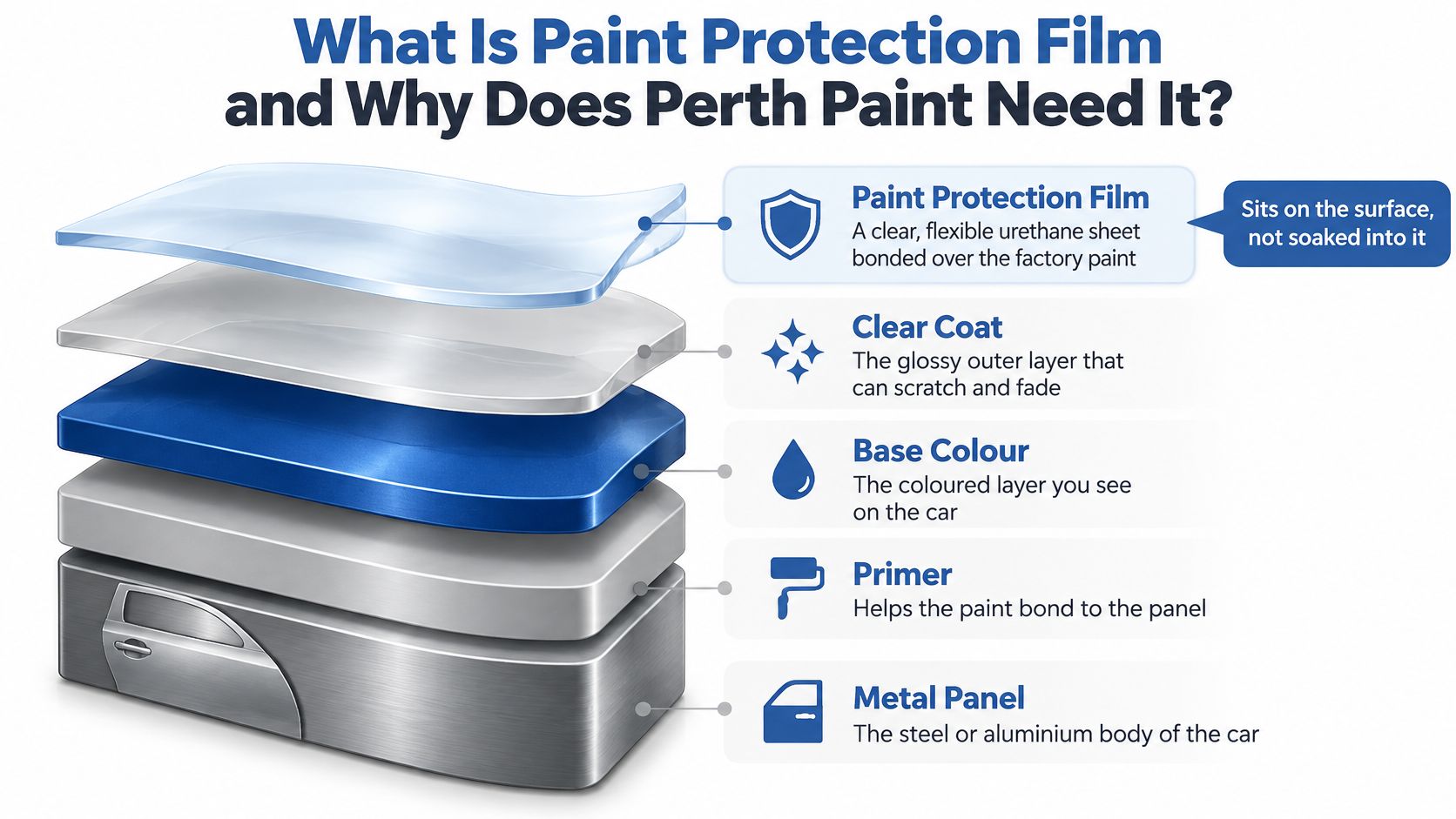
A stone flicks up off the freeway at highway speed and lands on your bonnet. Where that energy goes depends on what sits on top of the paint. Paint protection film, or PPF, is a clear, flexible urethane sheet that bonds to the panel as a separate, sacrificial layer. It takes the impact, the scuff, and the stain, and when it finally wears out you replace the film rather than the paint.
Your paint underneath is already a stack. Metal sits at the bottom, primer helps the colour bond to the panel, the base coat carries the colour itself, and clearcoat on top provides gloss and chemical resistance. That clearcoat is thin, thinner than a human hair, and once it wears through there is nothing left to polish. Repair means a respray, and a resprayed panel changes what film can safely do later.
Want to see your clearcoat condition up close? Book a wash and paint assessment this week.
The CSIRO coatings and materials testing service identifies the combined effects of ultraviolet radiation, heat, and moisture as important mechanisms in coating and polymer degradation. Clearcoat fights back with ultraviolet absorbers and, in some formulations, hindered amine light stabilisers that filter UV energy and slow the chemical reactions behind fading, embrittlement, cracking, and chalking. Weathering wears those additives down along with the clearcoat itself, so factory paint is a finite protective system. Its condition on fitting day matters more than most owners expect, because film locks in whatever sits underneath and warranty assessors look at the paint first when a claim comes in.
Why does Perth wear paint faster?
Perth stacks the odds against clearcoat: intense summer sunlight, high panel temperatures, dry airborne dust, and coastal salt. A car parked outside in Westminster or near the coast gets UV through the day, panels that expand in the heat and contract overnight, and fine dust that settles into wash mitts if it is left unrinsed. Each factor alone is manageable. Together, they shorten the time before gloss drops and the surface looks tired.
Perth sun is already working on your paint. Book regular hand washing to slow dust and salt build-up.
Film changes what takes the hit. Stone chips strike the urethane first. Insects, road tar, bird droppings, and fluid stains sit on the film rather than directly on clearcoat, and the film limits UV reaching the paint where it is installed. Coverage has hard edges, though. An uncovered roof gets no benefit from a filmed bonnet, and film stretched too far or trimmed short can lift at the corners, letting dust and moisture work under the edge. Claims also tend to fail where damage traces back to the paint underneath rather than to the film itself, which is why the state of your panels shapes both the result and the cover.
Paint correction is different work. Correction levels existing swirls and light defects by polishing the clearcoat, so it improves how the car looks today while the next stone still lands on paint. Applying film over a repainted panel carries its own risk, because resprayed clearcoat can lift away with the film if it is ever removed. Use this simple test. If your goal is stopping physical damage, film is the relevant answer. If your goal is gloss and easier washing across the whole car, a coating may be enough.
Deciding between correction and protection? Book an inspection and we’ll walk through what your paint can support.
Explore hand washing and detailing
Which Type of Paint Protection Film Suits Your Car?
Four categories cover most Perth enquiries, and they solve different problems. A ute doing the daily freeway run needs a different answer to a weekend car that lives under cover. Choosing by finish alone is where owners go wrong. Start with how and where you drive, then pick the film that matches that exposure.
Across these categories, typical consumer films sit in a similar band of roughly 0.15 to 0.20 mm thick, with exact specs set by each product line. The bigger differences are in surface behaviour, finish, and warranty fine print.
| Film type | What it does well | Trade-off |
|---|---|---|
| Standard clear film | Impact and stone-chip protection with a glossy finish | No self-healing, wash marks build up over time |
| Self-healing clear film | Fine wash marks relax when warmed (0.19 mm in the example below) | Needs heat to work, deep cuts stay |
| Matte or satin film | Changes the finish without repainting | Harder to clean, stains show differently |
| Colour-change or tinted film | Custom look and colour change | Can affect resale, check warranty cover before buying |
Standard clear film is the straightforward option for a daily driver. It keeps the factory gloss look and puts a physical layer between stones and clearcoat on high-impact panels. Its limit shows up in washing. Fine marks from mitts, drying towels, and dust don’t disappear on their own, so careful hand washing matters from day one.
Wash marks adding up? Book a careful hand wash that won’t add new swirls to your film.
How Self-Healing Film Works
Self-healing film uses an elastomeric surface layer that can flow or relax after minor damage once it’s warmed. A light swirl left on a bonnet by a dusty week and a quick wash can level out after the car sits in the sun. 3M Australia’s Series 100 film documentation describes this heat-activated self-healing and lists a 0.19 mm film thickness with a 7-year consumer warranty.
Don’t oversell that feature to yourself. Self-healing is intended for fine marks only, and deep cuts, punctures, impact craters, and damage that reaches the paint all stay put. A stone at freeway speed is stopped mainly by the film’s thickness, tensile strength, tear resistance, and correct installation. Warmth won’t rebuild film a sharp stone has torn through. The same goes for edges that lift around badges, handles, or panel gaps, where dust creeps under the film and no surface layer can pull it back.
Clear distinction: Self-healing repairs the look of light wash marring. Thickness and strength handle impacts. Each one does a different job.
Want self-healing film on the panels that cop the most? Ask us which areas are worth covering first.
Matte or satin film changes a gloss car to a flat or low-sheen finish without repainting, and it can also protect factory matte paint that can’t be polished like gloss paint. The trade-off is cleaning. Oils, water spots, and stains read differently on matte surfaces, and you can’t machine polish a mark out without changing the sheen. Owners who love the look usually accept stricter washing habits.
Thinking about a matte finish? Ask about matte-safe hand washing before you change your car’s look.
Colour-change or tinted film combines protection with a new colour or tone. It’s appealing if you want a custom result while keeping original paint underneath. Check two things before buying. First, a bold colour can narrow your resale audience even if the film is removable. Second, warranty cover for colour stability and finish defects may differ from clear film, so read the exclusions rather than assuming clear-film terms apply.
Choose film for the driving your car really does. Highway, regional, gravel-road, and rideshare cars get the most measurable value from clear film on high-impact front surfaces, because that’s where stones land. A daily-driven sedan washed every weekend in Perth sun is where self-healing earns its keep, since mitt marks accumulate fastest on exactly that kind of car. Owners choosing matte or colour-change finishes should budget for more careful upkeep and get the warranty exclusions in writing before committing. Covering a low-risk roof before a bumper spends money where damage rarely happens.
Tell us how you drive and we’ll help you prioritise panels. Book a paint check today.
Book a hand wash before choosing film
Is Your Paint in Good Enough Condition for Film?
A used sedan can come back from a dealer detail looking showroom-glossy while hiding a resprayed quarter panel underneath. Film adhesive works like tape on a painted wall: it grips whatever surface it touches, and it can pull away whatever was already loose. When the surface below is weak, repaired, or poorly cured, the failure tends to arrive years later, the day the film comes off and takes paint with it. Gloss alone tells you nothing about that.
Run through this checklist before anyone quotes you a full job:
- Original factory paint: Fully cured original-equipment paint gives the most predictable bond.
- No hidden respray: Prior repairs and aftermarket paint may not bond or release the way factory paint does.
- Intact clearcoat: Peeling, heavy oxidation, or flaking clearcoat needs repair before film goes on.
- Suitable surface type: Matte finishes, vinyl wraps, primer, and textured unpainted trims need specific assessment.
- Painted plastics confirmed: Bumpers and mirror caps should be painted panels; bare textured plastic needs a different approach.
Unsure if a panel has been resprayed? Book an inspection wash and check panel condition under good light.
Why do warranties care about repainted panels?
Film makers cannot control paint they did not supply, and their fine print says so. The ZR Films paint protection film warranty is an Australian example: cover may be restricted to fully cured, original-equipment paint, with repainted, aftermarket-painted, and vinyl surfaces explicitly excluded. Aged paint, damaged clearcoat, previous repairs, primer, and non-OEM surfaces appear repeatedly on the same kind of exclusion list, and each one can turn removal into a job that needs professional assessment.
Removable doesn’t mean risk-free. Removal can expose weak adhesion, poorly bonded paint, or a repair defect that stayed invisible under the film. The film may perform exactly as designed while the paint below fails, and a material warranty can cover the film without covering that substrate problem. That gap between film cover and paint cover is where claims get refused.
If you’re weighing correction work before film, our guide to paint correction stages, costs, and real results explains what polishing can and cannot fix on damaged clearcoat. Correction improves gloss on sound paint. It cannot restore adhesion to a poorly repainted panel, which calls for panel repair before any film goes on.
Before you seal defects under film, book a wash and correction assessment to see what’s fixable.
Three habits protect you at claim time. Ask for a test panel in a low-visibility spot if there is any doubt about a repair. Photograph every panel in good light before work starts, including existing chips and edge damage. Keep a written record of which panels the installer judged suitable and which carried warnings. Those photos separate film defects such as bubbling, cracking, or delamination from pre-existing paint failure if you ever make a claim.
Used-car buyers and owners preparing a car for resale face the sharpest version of this risk, because a dealer polish can deliver gloss while repaired panels sit underneath. Inspect first, document second, choose film third. Skipping the first two steps turns a protection product into a gamble.
Just bought a used car? Book a full wash and panel inspection before you spend on film.
Explore wash and detailing options
Which Installation Method Is Right for You?
The fitting method decides how complete your coverage is and where it fails first. Four options cover the market, from a roll of film in your garage to a hand-cut wrap in a specialist bay.
| Installation option | How the film is fitted | Indicative cost | Main risk |
|---|---|---|---|
| DIY roll film | Cut and applied by hand with squeegee and heat | Material only, lowest outlay | Bubbles, misalignment and edge lifting |
| Pre-cut kit | Vehicle-specific pattern fitted by owner or installer | Mid-range | Gaps on complex curves |
| Plotter-cut professional fit | Computer-cut pattern fitted by a specialist | Mid-range to high | Warranty may depend on installer authorisation |
| Hand-cut full wrap | Each panel cut and fitted by hand on the car | Highest | Quality depends on the craftsperson, takes longest |
Where do patterns struggle?
Pre-cut and plotter-cut patterns are drawn from vehicle templates, which makes fitting faster and more repeatable on flat panels. Trouble starts on complex curves. Bumper corners, mirror caps, and deep bonnet contours can leave small gaps at edges if the pattern runs short, and exposed edges collect dust and lift earlier. A good installer adjusts patterns or extends coverage where geometry allows rather than accepting every template line.
Film edges lifting on your car? Book a gentle hand wash and edge inspection before they worsen.
Hand-cut work solves the gap problem differently. The installer lays film on the car and trims each panel to suit, wrapping edges where the panel shape permits. In skilled hands, coverage is excellent. In average hands, you can get uneven tension, visible trim lines, or knife risk near paint. You’re buying a person’s judgement as much as a product, so recent examples of their work matter.
DIY has an honest place. A mirror cap, door cup behind a handle, or a small sill strip is a reasonable weekend job with a squeegee, slip solution, and patience. A full bonnet or bumper is a different proposition. Once dust or a bubble is trapped under a large sheet, lifting and relaying the film usually stretches it and makes alignment worse, not better.
What does a good job look like?
Check the finish in daylight before you drive away:
- Sealed edges: No corners already lifting or left short of a panel edge without explanation.
- No visible gaps: Coverage meets trims and panel breaks cleanly.
- Smooth surface: No trapped dust specks, stretch marks, or clusters of bubbles.
- Clean fitting bay: A low-dust workshop tells you how seriously contamination is managed.
New film fitted? Book your first care wash with a hand-wash team that respects fresh edges.
Ask whether the installer is authorised by the film brand, whether your warranty depends on that authorisation, and how edges and corners are wrapped or sealed on your model. Also ask for the cure window before the first wash in writing. Until that window passes, avoid automatic washes, high-pressure cleaning, and picking at small moisture pockets that often settle as adhesive cures. A full front end takes real workshop time, so book a proper slot rather than squeezing the job into a same-day rush.
Planning a film booking? Wash and inspect the paint first so fitting day has no surprises.
Book a pre-installation hand wash
How Long Does Film Last and What Does the Warranty Cover?
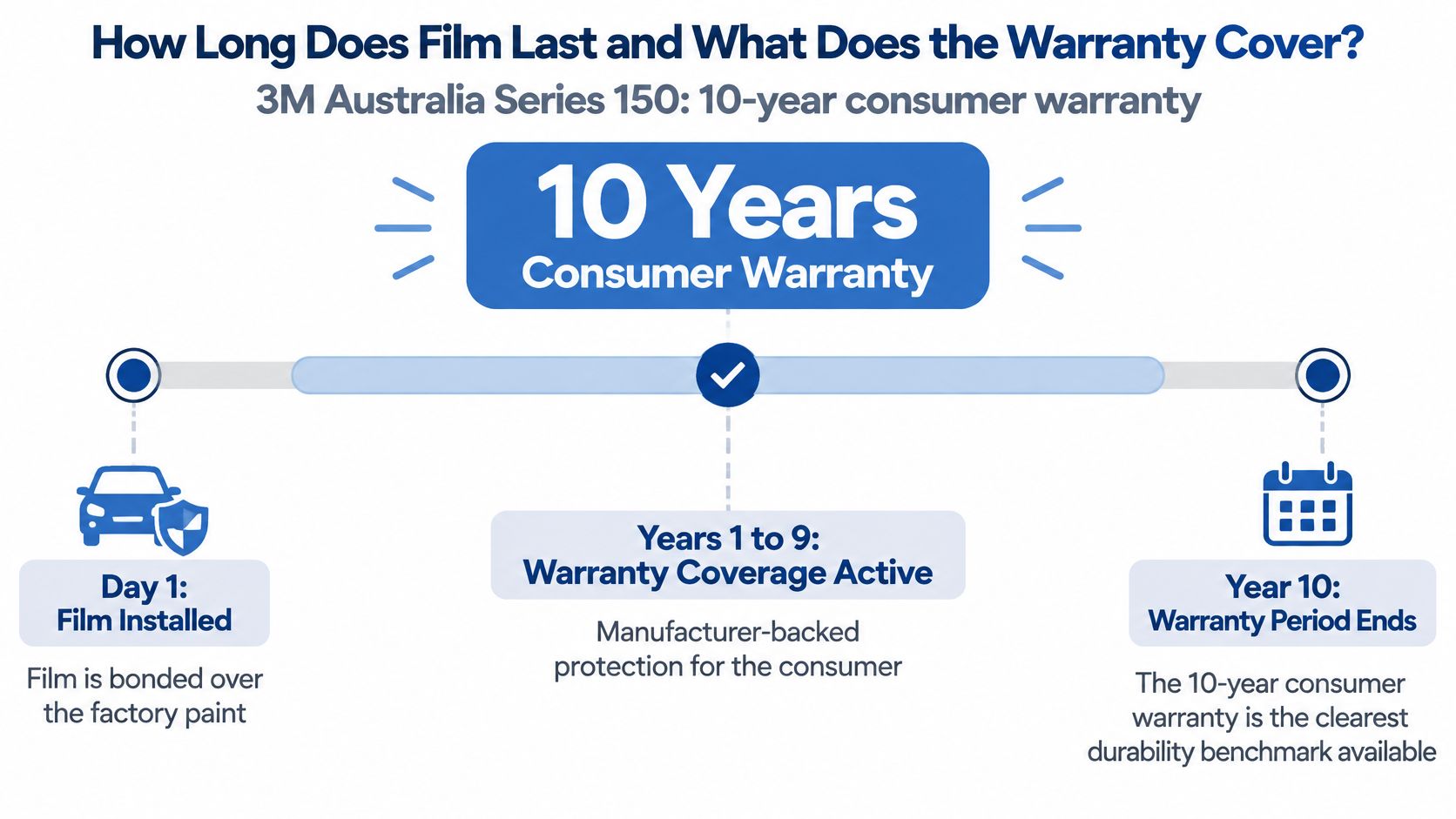
The clearest durability benchmark you can check is a manufacturer-backed warranty period. 3M Australia’s Paint Protection Film Series 150 is supported by a 10-year consumer warranty. That’s a product-warranty period, not a promise that every piece of film lasts exactly ten years. Real service life still depends on film quality, installation, exposure, and care.
Wear lands unevenly across a car. A front bumper cops stones, insects, and road spray on every freeway run. A roof panel mostly cops sun. Both panels can carry the same film and age at different rates, so a single lifespan number for the whole car will mislead you. Our explainer on how long ceramic coating lasts makes the same point for coatings, where exposure and washing habits move the result as much as the product name.
Want your protection to last? Book regular hand washes and keep a simple care record.
What does the warranty cover?
A warranty covers defined film defects, subject to its terms, installation requirements, and maintenance conditions. Picture a raincoat guarantee: it covers the seams failing, not the barbed-wire fence you walked through. Typical covered defects include:
- Yellowing: Discolouration of the film beyond the stated tolerance.
- Bubbling: Adhesive or material failure that lifts the surface.
- Cracking: Splitting of the film that isn’t impact damage.
The exclusions column is where most warranty disappointment lives. Australian warranty documents commonly exclude or limit stone-chip damage and abrasions, collision damage, chemical damage, gradual tone change from UV exposure, ordinary wear from normal use, and damage linked to improper maintenance. That last clause is the one that catches owners out, because edge lifting traced back to poor washing technique reads to an assessor as owner neglect rather than a film fault. A stone that tears your bumper film has done the job film was bought for by taking the hit instead of paint, but replacing that torn section is often your cost.
A long warranty is a promise about defined material defects. Stone chips, crash repairs, and resprayed panels stay with you or your insurer.
Claims carry paperwork. Expect to show proof of purchase, warranty registration, photographs of the defect, and an inspection, and the film generally needs authorised installation. The repaint question deserves attention before it happens: if a panel is repaired after a crash, refilming it may fall to you or your insurer under some protection agreements, and a fresh respray can sit outside the original coverage entirely. Tell your insurer the car carries film and keep the installer’s invoice with your policy documents.
Keep your warranty valid with correct care. Book a film-safe hand wash and monthly edge check.
Use this rule when comparing headline years. Ask what is covered, what is excluded, who must fit it, and what proof a claim needs. A shorter warranty with clear defect cover from an authorised installer can outweigh a longer number attached to vague terms. The years get your attention. The exclusions decide your outcome.
Reading warranty fine print? Bring your questions to a paint inspection and talk them through first.
Explore gentle hand-wash options
How Do You Maintain Film Through Perth’s Sun, Dust and Salt?
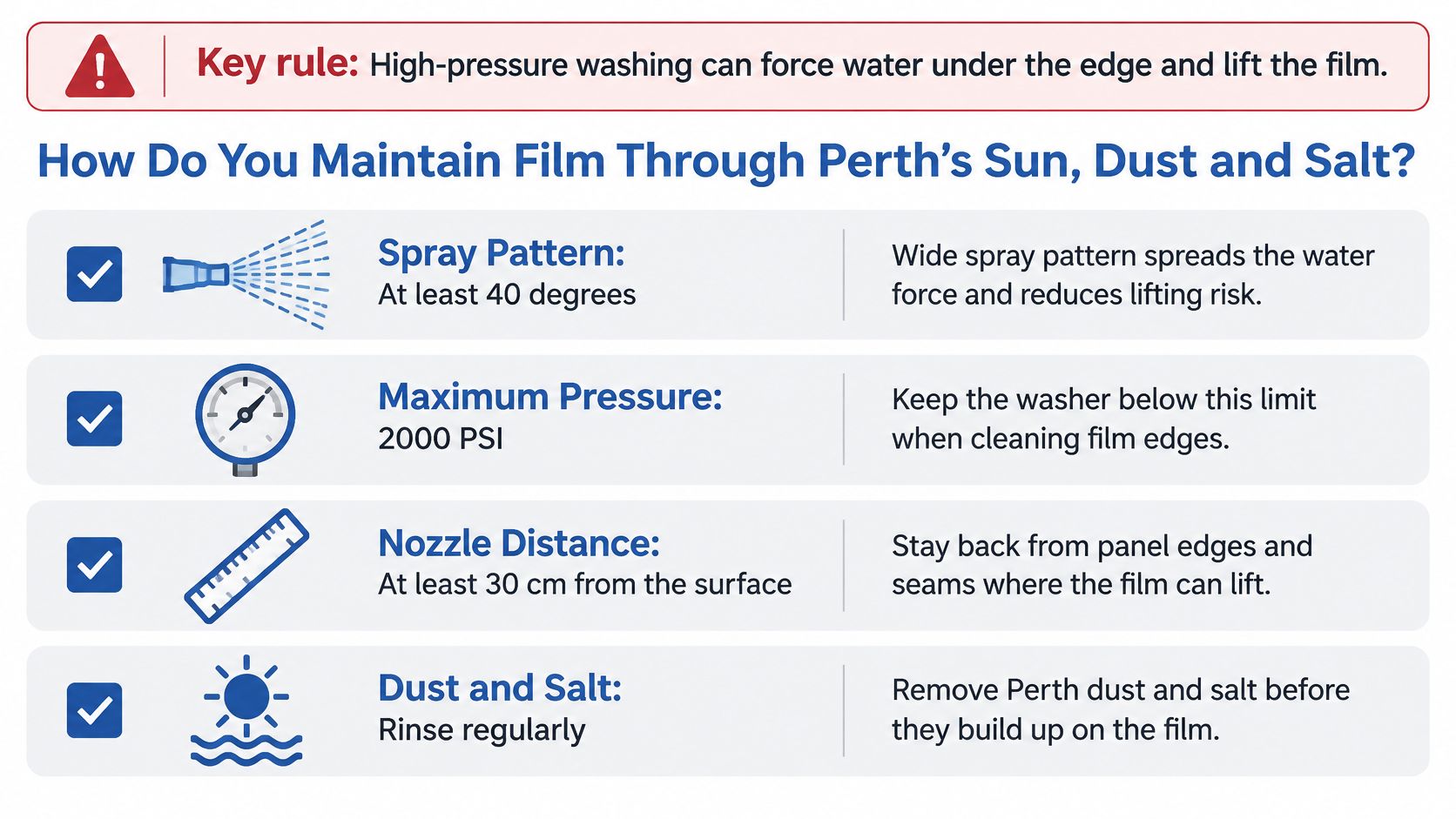
One rule prevents most film failures. Keep high-pressure water away from film edges. Excessive pressure can force water beneath the film, weaken the adhesive bond, and cause lifting or curling that starts as a tiny corner and grows with every wash.
3M Australia’s protection wrap film guidance specifies a spray pattern of at least 40 degrees and maximum pressure of 1,200 psi, or 80 bar. The same guidance recommends washing in shade or under cover and drying immediately to reduce hard-water spots and chlorine stains. Aim the fan across the panel, never into a seam.
Don’t risk lifting your edges at home. Book a film-safe hand wash in Westminster.
What does a film-safe wash routine look like?
Use pH-neutral shampoo, a clean microfibre mitt, and plenty of rinse water. Rinse dust off before the mitt touches paint, especially after windy Perth days when fine grit sits on horizontal panels. Skip abrasive brushes and aggressive polishing on film, because both can dull or damage the top surface you’re paying to keep clear.
Dry the car straight after washing with a clean microfibre towel. That single habit reduces hard-water spots and chlorine staining, which show upfast when a wet car sits in summer sun. In hot months, wash early in the morning or under cover so shampoo doesn’t dry on panels mid-wash. Our local guide on how often you should wash your car in Perth sets out sensible intervals for coastal and inland driving.
Dust and salt building up along your film edges? Book a hand wash before grit works underneath.
Perth adds three prompt jobs. Remove bird droppings and insects as soon as you notice them, because chemical dwell time stresses the film’s topcoat. Soften road tar with a film-safe remover rather than scrubbing it. After beach trips or coastal drives, rinse salt from lower panels and wheel arches instead of leaving it until the weekend. Hand-wash-only services help here because no automated brushes drag grit across the surface. Prime Shine Hand Car Wash in Westminster is one example of a hand-wash provider for this routine care, while film fitting itself belongs with a film specialist.
Once a month, walk around the car in good light. Look for lifting corners, cracks, bubbles, and any patch where gloss has changed compared with the panel beside it. Catching a lifting edge early gives an installer a chance to address a small area. Ignoring it lets water and dust work further under the adhesive until replacement is the only tidy option.
Spot a lifting corner or bubble? Book a wash and inspection now, not after the next road trip.
Should You Choose Film, Ceramic Coating or Both?
Your paint’s condition and the warranty fine print decide this before your budget does. Film earns its cost on the panels that take the most hits, while ceramic coating earns its cost on paint you want glossy and fast to wash. Where an installer approves the pairing, film covers the high-impact panels and coating goes over the rest of the car, including over the film itself.
| Option | Impact and chip protection | Gloss and washing | Typical life | Indicative cost |
|---|---|---|---|---|
| Paint protection film | Strong within film thickness | Keeps original finish, gloss depends on film type | Warranties from 7 to 10 years on Series 100 and 150 examples | Priced by coverage area and panel count |
| Ceramic coating | Doesn't stop chips or scratches | Strong water beading and easier washing | About 2 to 5 years | From about AUD 1,000 professionally applied |
| Wax or sealant | Minimal | Temporary gloss | Weeks to a few months per application | Lowest, product plus application time |
Typical life and cost figures for ceramic coating follow NRMA guidance on protecting your car from the sun.
Ceramic coating still needs honest limits. Professionally applied ceramic or graphene-style coatings give stronger chemical protection than basic wax and make routine washing easier, but they don’t make paint scratch-proof. They also keep needing maintenance washes, occasional top-ups, and periodic recoating, so the coating line in your budget is recurring rather than one-off.
Considering ceramic coating instead of film? Book a paint inspection and compare both options properly.
A coating bonds chemically to clearcoat and helps protect its existing UV inhibitors from oxidation and degradation. It isn’t an indefinitely UV-blocking shield, and it won’t absorb a stone. If contamination or oxidation is sealed under it because preparation was rushed, you’ve preserved the problem. Our Perth reality check on whether ceramic coating is worth it works through that preparation question in detail.
Which option fits your driving?
Highway commuters and gravel-road drivers should put money into film on the front end first, because chips are their main cost. Rideshare and delivery drivers suit film on the front and bonnet with ceramic coating on remaining panels, balancing impact cover with fast, repeatable washing between shifts. Show and enthusiast cars often suit ceramic coating across the whole car, with film reserved for sills, bumper, and other strike zones. A car being prepared for sale calls for paint correction plus ceramic coating, because buyers judge gloss and cleanliness in the first minute of an inspection.
Preparing a car for sale or daily work? Book detailing that matches your goal, not a generic package.
For the coating, correction, and hand-washing side of that plan, Prime Shine Hand Car Wash at 9/436 Wanneroo Rd, Westminster handles ceramic coating, paint correction, and hand washing, while film fitting needs a dedicated film specialist. That split is normal. Good detailers prepare and maintain paint, and authorised film installers fit and warrant film.
Take three next steps in order. Inspect the paint and document every repair or patch of weak clearcoat, because film over a compromised panel is where edge lifting starts and where warranty claims get refused. Get an itemised quote that names the film series and every panel. Confirm installer authorisation and warranty terms in writing before you book. Car film paint protection earns its cost when those three steps happen first. Without them, you’re buying a headline warranty and hoping the fine print never matters.
Ready to start with step one? Book your paint inspection and hand wash today.
If your paint needs correction, ceramic coating, or careful hand washing before or after film fitting, Prime Shine Hand Car Wash in Westminster can inspect your panels, explain what your paint can safely support, and maintain the finish without automated brushes. Book online today and get a clear, itemised plan for your car before you spend anything on film.