






Your car looked showroom-new when you bought it. Now you park outside, step back in the Perth sunlight and see fine circular scratches across the bonnet. Washing removes the dirt, but those marks stay put. The paint still has colour, yet its reflections look cloudy rather than crisp.
Paint correction before and after should show a genuine reduction in surface defects, not scratches temporarily hidden beneath oily fillers. A detailer carefully levels polishable defects, then refines the finish so it reflects light more evenly. Results depend on paint condition, defect depth and available clear coat, not how aggressive the compound is. The scenarios below pair different finishes with appropriate treatments, from lightly swirled black metallic to matte paint that shouldn’t receive conventional polishing. They’re practical examples of achievable outcomes, not documented customer case studies or promises that every vehicle will respond identically.
Start with an assessment at our Westminster site so the treatment matches your paint, rather than choosing the heaviest correction by default.
1. Can Black Metallic Regain Its Gloss Without Heavy Cutting?
Black metallic makes ordinary wash damage conspicuous. Say a commuter hatchback looks grey around reflected sunlight, with circular swirls across the bonnet and fine scratches down the doors. The useful result is clearer reflections and more consistent metallic sparkle, not necessarily removal of every isolated scratch.
Preparation starts with a careful hand wash, followed by iron removal and targeted decontamination. Use lubricated clay only where bonded contamination remains, because unnecessary claying can add marring. Dry the paint, inspect it under a focused light and test a fine polish with a suitable finishing pad before increasing the cut.
Bring your dark-coloured vehicle in for an assessment of the swirl pattern before committing to aggressive correction.

What should change under the inspection light?
Before treatment, fine scratches scatter the light into a halo. Afterwards, that halo should be less prominent and the reflected highlight more defined. RACV’s swirl-removal guide explains why clear-coat swirls respond to controlled polishing, while deeper scratches need different expectations.
For an older daily driver, a restrained enhancement often makes more sense than chasing perfection. Keep panels cool, clean pads frequently and inspect after removing polishing residue. Our guide to removing swirl marks from car paint explains how to distinguish wash damage from marks that need closer assessment.
- Choose the stopping point: Leave deeper isolated scratches if removing them would demand unnecessary clear-coat loss.
- Maintain the improvement: Use clean wash media and soft drying towels rather than rubbing dusty paint.
Learn About Black Paint Swirls
2. How Can White Pearl Look Clearer Without Losing Its Character?
A white pearl hatchback can look clean from across the driveway while showing dull patches around door handles and mirrors. Under stronger lighting, fine scratches interrupt otherwise smooth reflections. Correction should improve the transparent surface above the pearl effect, not alter the underlying colour or sparkle.
Pearl paint isn’t automatically softer or thinner than other finishes. Assess the actual paint system, repair history and panel readings instead of choosing abrasives by colour alone. A conventional paint-depth gauge generally measures the coating stack over a compatible substrate, so its reading doesn’t automatically reveal the remaining clear-coat thickness.
Arrange a pearl-paint assessment at Westminster before deciding how much defect reduction is appropriate.

Improve the reflection, not the pearl layer
For a family hatchback with light contact marks, mask vulnerable trim and test a mild polish-and-pad combination. Compare the treated area in diffuse daylight and under a directional light. A successful result looks more continuous along the body line, without haze introduced by the polishing process.
Remove polishing residue with a paint-compatible inspection product before judging the result. Masking tape creates a useful comparison boundary, but masking residue doesn’t tell you whether a scratch remains. Australian guidance on correction technique describes the important trade-off: improved optical clarity requires controlled material removal.
Practical rule: Don’t increase the cut simply because white paint makes the remaining scratches harder to photograph.
Pay particular attention to edges, creases and previously repaired sections. An even, lightly refined finish is preferable to an aggressively corrected patch beside a panel that no longer has the same safety margin.
Explore Cut & Polish for Pearl Paint
3. Can a Red Sports Car Recover Richer Colour With a Single Polishing Stage?
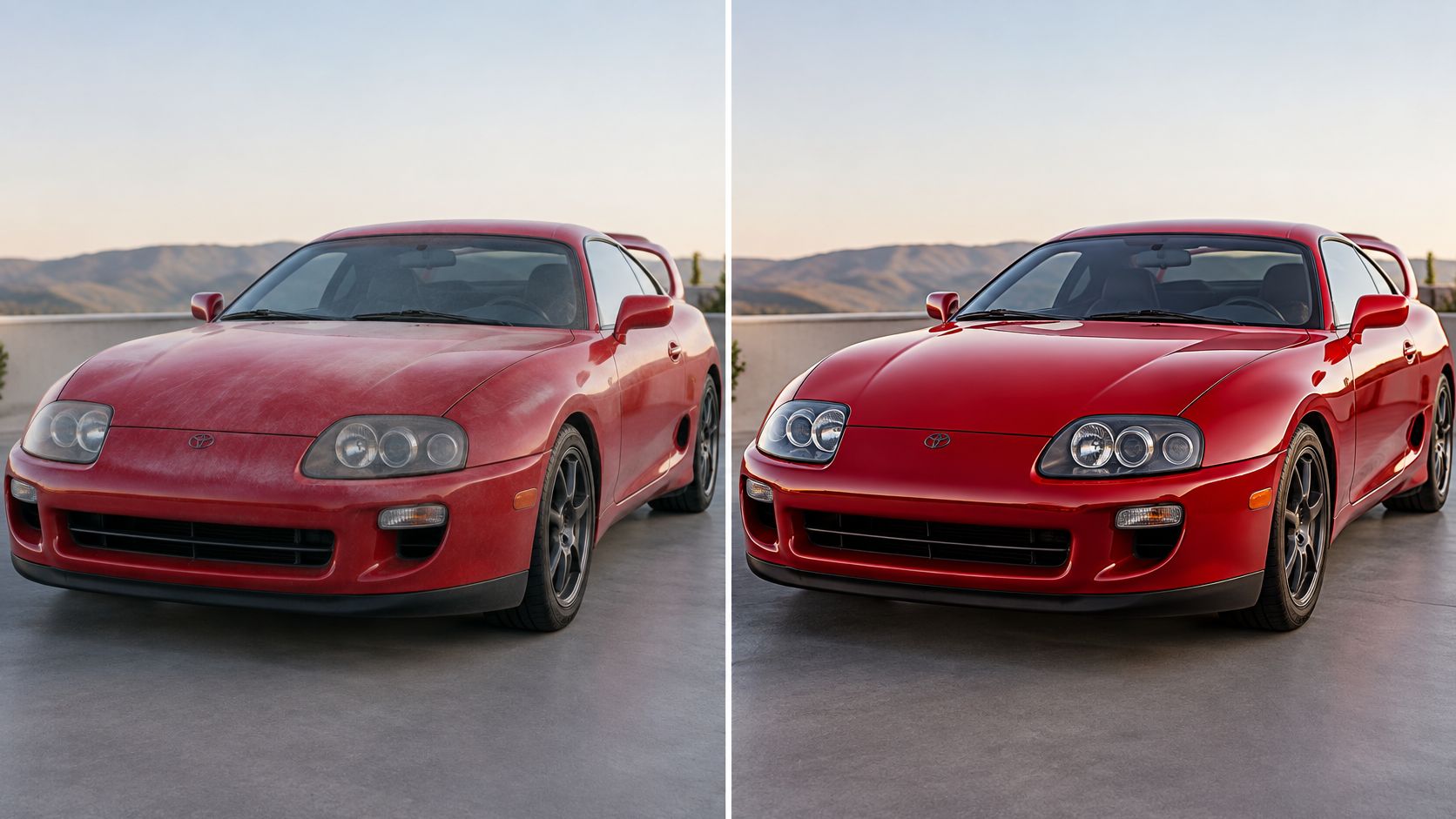
A red coupe with circular wash marks and a tired-looking bonnet can show a striking improvement without a show-car correction. First identify whether it has a clear-coated finish or a single-stage paint system. The apparent colour recovery comes from treating the weathered surface, not uncovering fresh red paint beneath a healthy clear coat.
Perth’s exposure makes this assessment important. Selleys’ automotive-care guide identifies Western Australia among Australia’s particularly UV-exposed regions and explains how UV contributes to fading and oxidation. Polishing can improve suitable surface deterioration, but it can’t reverse failed paint chemistry or restore missing coating.
Bring your red vehicle in for a condition assessment before treating faded paint as a straightforward polishing job.
What does a single stage actually involve?
A single polishing stage uses a selected abrasive-and-pad combination to balance defect reduction with finishing quality. A separate cutting pass followed by finishing polish is a staged process, not the same treatment under another name. Our explanation of paint correction versus buffing helps clarify those terms.
Work on cool, fully prepared panels and inspect each test section after wiping away residue. For a lightly swirled roadster, the sensible outcome may be richer-looking colour and cleaner reflections, with deeper scratches left alone.
- Watch the paint response: Unexpected colour transfer on a supposedly clear-coated panel warrants reassessment.
- Avoid heat build-up: Keep the machine moving and allow warm sections to cool.
- Prepare before protection: Remove incompatible polishing residue before applying the chosen protective product.
Explore Cut & Polish for Red Paint
4. What Makes Silver Sedan Reflections Look More Uniform?
On a silver luxury sedan, the difference may be subtle until you follow a reflected window frame along the doors. Fine marring makes the line appear fuzzy; uneven polishing can leave alternating clear and cloudy sections. The valuable improvement is consistency across the car, rather than brightness in an isolated photograph.
Consider a sedan being prepared for private sale. Cosmetic presentation matters, but correction shouldn’t be sold as a guaranteed financial return. A Victorian Government review of motor-car trading reported 2,324,805 used-vehicle sales across Australia in 2024, which gives presentation work a substantial resale context without proving that polishing increases an individual vehicle’s sale price.
Have your silver paint assessed before sale photographs so the work addresses visible defects rather than unnecessary polishing.
Judge the whole panel
Wash away road film, remove bonded contamination where necessary and inspect the bonnet, doors and boot under consistent lighting. Work in manageable sections with overlapping passes, then compare adjoining areas after residue removal. Silver can conceal fine damage, so change the inspection angle instead of assuming an apparently bright panel is finished.
Correction can reduce wash marring, but it won’t straighten a dent or remove underlying panel waviness. If a reflected line bends around a depression, more polishing isn’t the answer.
- Keep photographs comparable: Use the same lighting, position, distance and exposure before and after.
- Inspect curved sections: Door shoulders and bonnet contours can hide missed haze.
- Separate repair from refinement: Chips, dents and scratches through the colour layer need their own assessment.
For lease-return preparation, document what remains as carefully as what improves. A glossy finish doesn’t prove compliance with a lease provider’s condition requirements.
Book a Silver Paint Assessment
5. Can a Matte-Painted SUV Improve Without Becoming Glossy?
Matte paint is the exception to conventional paint correction. Its deliberately textured finish scatters light, so abrasive polishing can create a shiny patch rather than a successful repair. A matte SUV with water marks or an isolated scuff needs identification and cautious cleaning before anyone reaches for a machine.
Start by confirming whether the surface is factory matte paint, satin paint, a wrap or a protective film. Use the manufacturer’s approved cleaning approach, a matte-compatible shampoo and separate soft wash tools. Test any targeted contaminant remover discreetly, then inspect the dry surface before deciding whether the mark is contamination or permanent damage.
Request a finish assessment before any abrasive treatment on a matte or satin vehicle.
Cleaning can be the correct before-and-after result
Say a matte-finished ute has pale water deposits across its bonnet. If compatible cleaning removes those deposits while preserving the original sheen, that’s a useful improvement. It doesn’t need to become glossy to count as a successful treatment.
A scuff within the finish is different. Don’t assume a tiny polishing area makes abrasion safe, because even a small glossy spot can remain conspicuous. Correction also can’t replace missing paint or repair peeling clear coat, a distinction explained in this Australian paint-correction guide.
A successful matte-paint result preserves the original sheen. More shine can mean more damage.
Avoid ordinary gloss-enhancing waxes, abrasive cleaners and dressings that aren’t approved for the finish. Choose matte-compatible protection only after confirming suitability. If the defect remains after safe cleaning, accepting it or obtaining a specialist repair assessment may be better than creating a permanent polished patch.
Ask About a Matte Finish Assessment
6. When Does a Grey Performance Coupe Need Multi-Stage Refinement?
Dense swirls, scattered scratches and polishing haze can justify more than a light enhancement when the paint’s condition allows it. On a grey performance coupe, a cutting stage reduces the main defect pattern, followed by finer polishing to remove the haze that cutting may leave. Each stage needs a reason, not merely a place in a package.
Start with coating measurements where suitable, a conservative test section and inspection lighting that exposes both scratches and machine haze. Assess the test result after removing residue. If a milder combination achieves the required improvement, there’s no benefit in automatically using a heavier compound.
Discuss your preferred finish and the paint’s condition at an assessment before committing to extensive refinement.
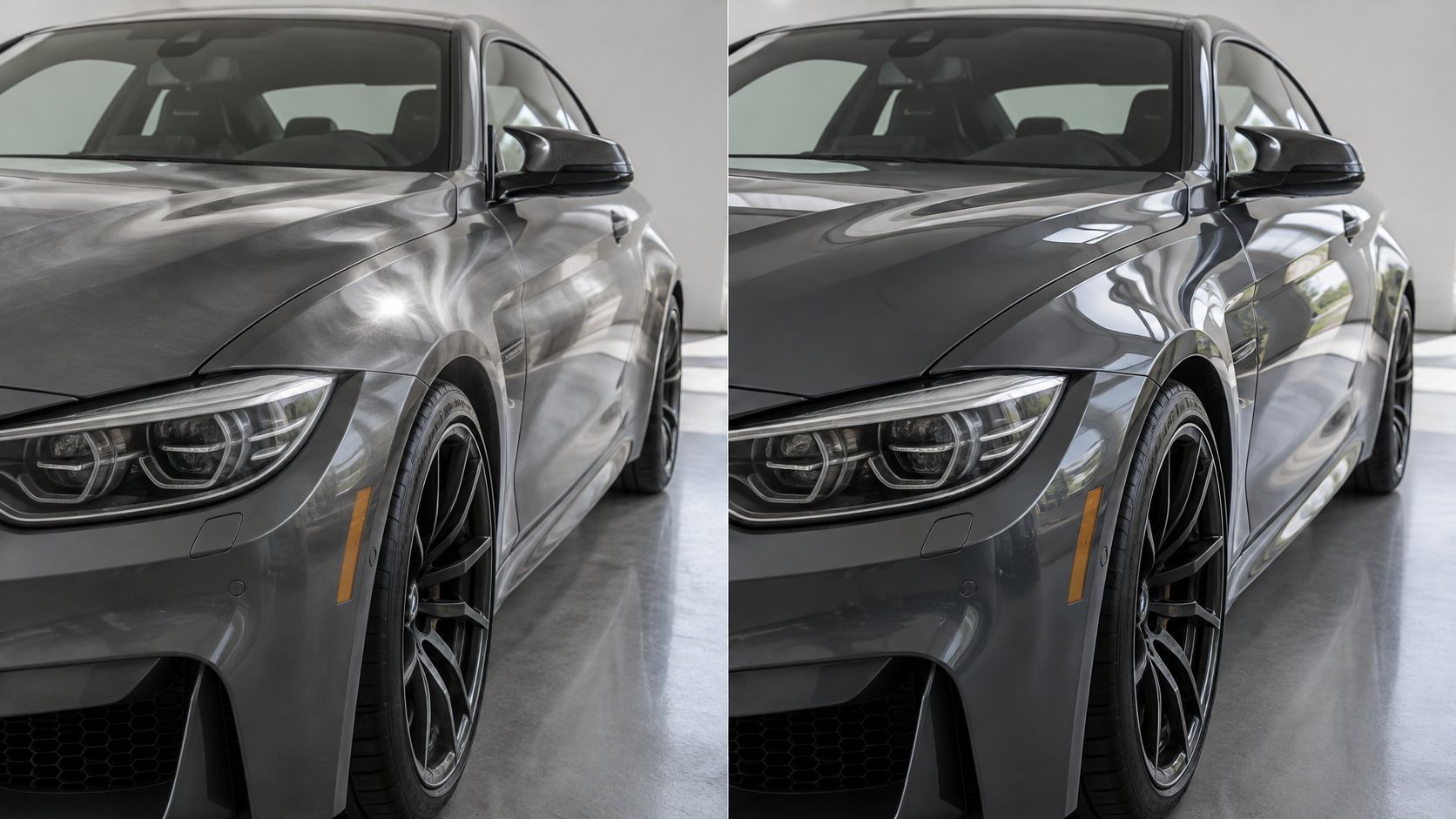
Separate defect removal from finishing quality
For a healthy clear-coated grand tourer, cutting may remove dense wash marring while leaving faint pad haze. Refinement should improve that haze without restarting aggressive defect removal. Clean pads regularly and change them when contamination, saturation or wear compromises their behaviour.
Protection comes after inspection and suitable surface preparation. A technical explanation of ceramic protection describes a coating bonding with the prepared paint surface, but coating isn’t a substitute for correcting defects or repairing failed paint.
- Set the finish target: Decide whether the priority is daily-driver improvement or more demanding optical refinement.
- Check between stages: Don’t conceal unfinished haze beneath polishing oils.
- Budget by condition: Compare the work involved, not just the stage label, using our Australian paint-correction cost guide.
A strong after photograph should show reduced defects under revealing light, not merely attractive reflections in shade.
Compare Paint Correction Costs
7. Can Previously Corrected Paint Improve Without Further Damage?
A car can look glossy across the driveway yet show micro-scratches, haze or pinholes under directional lighting. Those signs don’t prove the clear coat is thin or reveal how often it has been polished. Unknown history calls for restraint, not an automatic return to cutting compound.
Map visible defects, note repaired areas and take suitable paint-depth readings before testing. Ordinary gauges don’t directly isolate the clear coat, and some substrates require different equipment. Pinholes, cracking and other coating defects need diagnosis rather than repeated polishing in pursuit of a smoother photograph.
Bring any available paintwork and detailing history to your assessment so previous treatment can inform the next step.
Improvement isn’t the same as clear-coat restoration
For a previously polished black vehicle with light haze, a fine finishing polish may improve clarity while leaving deeper scratches untouched. On another vehicle, cleaning and protection may be the more sensible outcome. Polishing cannot rebuild clear coat that has already been removed.
Our guide to paint correction without damaging clear coat explains why safe enhancement matters more than complete defect elimination. Avoid treating each remaining mark as an instruction to keep cutting.
- Improved: Fine haze responds to a conservative test.
- Partially improved: General clarity increases, but deeper marks remain.
- Not safely correctable: Failed coating, missing paint or uncertain remaining material makes further abrasion inappropriate.
Preservation first: Leaving an isolated scratch can be the technically better result.
Don’t confuse the immediate glossy appearance with durable protection. Once the finish is assessed and appropriately treated, careful washing remains essential. Repeated heavy correction should never become a substitute for fixing the maintenance habits that introduce new marks.
Read About Clear-Coat-Safe Correction
Paint Correction Examples at a Glance
| Example | Paint Type | Main Defects | Correction Approach | Best For |
|---|---|---|---|---|
| Black Metallic Daily Driver | Black or dark metallic | Fine swirls, haze, oxidation, light scratches | Gentle polish or single-stage enhancement after decontamination | Daily drivers needing better gloss without aggressive correction |
| White Pearl Hatchback | White pearl | Fine scratches, dull patches, uneven reflections | Conservative machine polishing with careful paint assessment | Pearl finishes needing defect reduction while preserving their character |
| Red Sports Car | Red | Fading, swirls, oxidation, light scratches | Controlled one-stage correction with cutting and finishing | Red paint needing a noticeable boost in colour depth and gloss |
| Silver Luxury Sedan | Silver metallic | Fine swirls, oxidation, cloudy or uneven reflections | Consistent panel-by-panel machine polishing | Long body panels needing uniform, clear reflections |
| Matte-Painted SUV | Matte | Contamination, water spots, isolated scuffs | Matte-safe cleaning and selective spot treatment; avoid conventional polishing | Matte finishes where preserving the low-gloss appearance is essential |
| Grey Performance Coupe | Grey | Dense swirls, light scratches, dull reflections | Multi-stage cutting and refinement with repeated inspection | Healthy clear coat needing maximum optical clarity |
| Previously Corrected Paint | Previously polished; colour unspecified | Haze, micro-scratches, pinholes, potentially thin clear coat | Paint-depth assessment and gentle refinement; prioritise preservation | Thin or stressed clear coat that needs cautious enhancement |
Which of These Results Matches Your Paint?
Paint type, defect depth and remaining coating determine the result. Black metallic often makes swirl reduction obvious, while pearl and silver finishes benefit from clearer, more continuous reflections. Red paint needs its paint system and deterioration identified first; matte finishes need sheen-preserving care, not conventional polishing.
Start your own assessment after a careful wash and dry. Look at the paint in daylight and under a focused light, then distinguish surface contamination from scratches, haze and missing paint. A scratch that catches a fingernail deserves caution, but that simple test isn’t a complete diagnosis.
Bring your clean-paint concerns, maintenance routine and preferred outcome to our Westminster team for a condition-based assessment.
Before authorising correction, establish what should improve, what will remain and why. Ask how the finish will be inspected, what measurements can establish and whether a test section supports the proposed treatment. A responsible recommendation may be light refinement, staged correction, cleaning alone or referral for paint repair.
Afterwards, separate appearance from protection. Polishing reduces existing defects; it doesn’t prevent new scratches, contamination or environmental damage. An Australian guide to weather and paint protection explains why exposure and maintenance influence ongoing paint condition.
Keep the result practical for daily use
Use gentle, regular hand washing with pH-neutral car shampoo and soft microfibre towels. Avoid automatic brushes, abrasive cleaners and wiping dust from dry panels. Outdoor family cars and high-use work vehicles need an upkeep routine suited to their exposure, not a promised correction lifespan.
At Prime Shine Hand Car Wash, we hand-wash every vehicle with no machine brushes touching the paint, and use professional-grade products. Our Cut & Polish service includes exterior washing, clay bar or paint preparation, and machine cutting and polishing. We operate from 9/436 Wanneroo Rd, Westminster, with online booking available seven days a week.
Arrange your Westminster assessment and choose an achievable improvement that preserves the paint you have.
Prime Shine Hand Car Wash offers hand washing, paint correction and paint protection for Perth drivers. Visit Prime Shine Hand Car Wash to explore the available services and book an assessment of your swirls, scratches or dull paint before choosing a correction approach.