





You’ve just climbed into a car that’s been sitting in the Perth sun. The cabin feels hot enough to sting, there’s dust on the dash, and the seat bolsters already show the usual mix of body oils, sunscreen and everyday grime. That’s exactly the moment people start asking whether Car Interior Ceramic Coating: Leather, Fabric & Plastics is a real solution, or just another detailing term that sounds better than it performs.
The honest answer is that it can be useful, but only if you treat it as a material-specific maintenance layer. It doesn’t replace cleaning, it doesn’t make the cabin heat-proof, and it doesn’t behave the same way on leather, fabric and plastics. In Australia, that distinction matters because the vehicle fleet is large, the average vehicle is older, and interior surfaces have had years of exposure to heat, dust, abrasion and repeated cleaning (ABS vehicle fleet data).
What Car Interior Ceramic Coating Is?
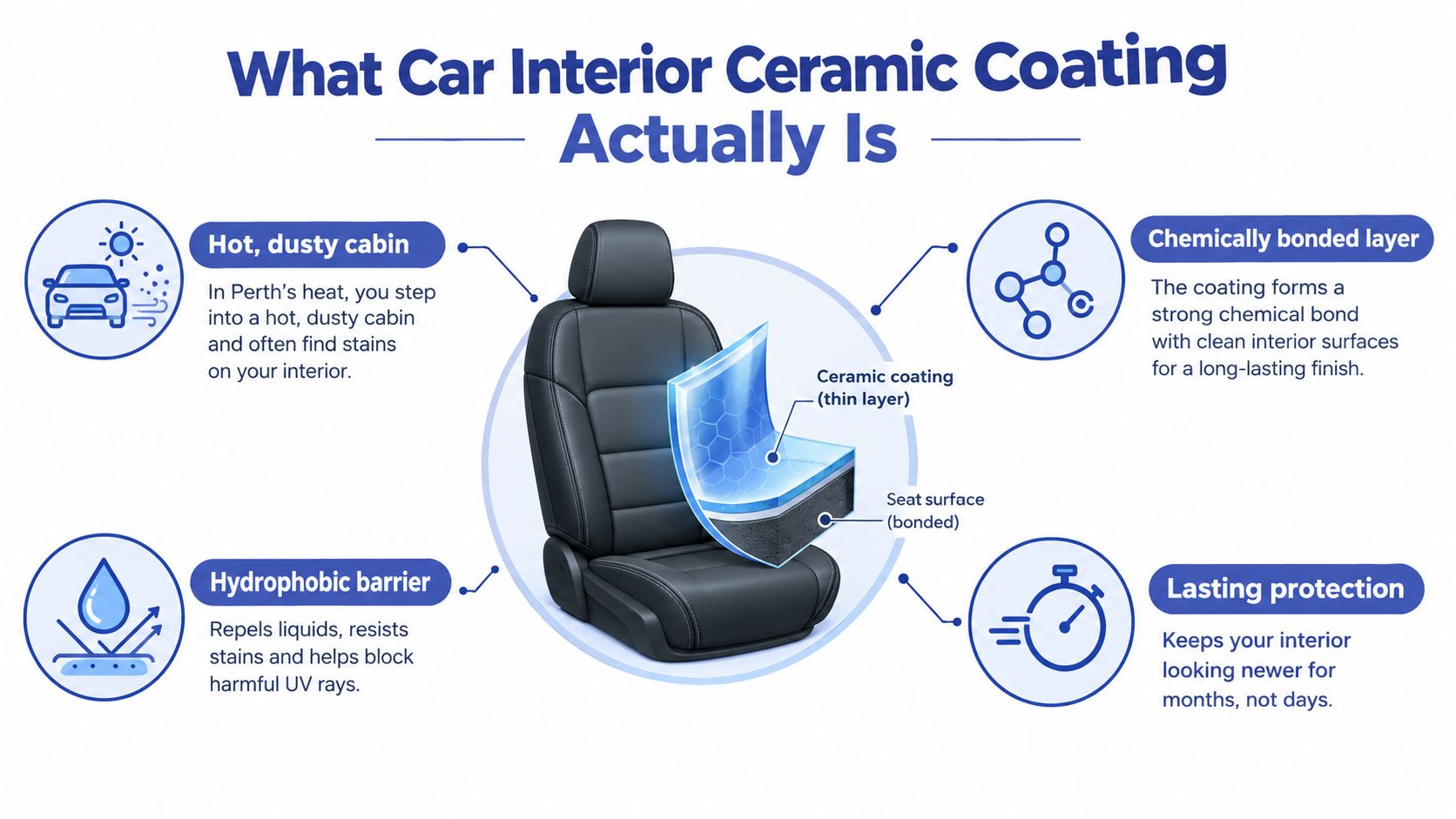
A ceramic interior coating is a thin protective layer applied over a properly cleaned surface. It changes how that surface behaves, so spills are less eager to soak in, grime is less willing to cling, and wiping becomes easier. It is not a shortcut around cleaning, and it is not a universal sealant that performs the same way on every cabin material.
Start with the surface, not the bottle
The most common mistake is assuming the coating does the cleaning for you. It does not. If the leather is oily, the fabric is loaded with residue, or the plastic still carries old dressing, the coating has little to bond to and the finish can turn out patchy.
Practical rule: if a surface does not feel clean enough to touch comfortably before the coating goes on, it is not ready yet.
That is why the process starts with vacuuming, wiping, degreasing and, where needed, extraction. Only after that preparation does the coating become useful. On leather and synthetic leather, the aim is to keep a clean, natural finish. On plastics, it is to reduce the sticky feel that dust loves. On fabric, it is to help liquids sit on the fibres long enough to blot.
How it differs from exterior coating
A paint coating is usually sold around gloss and wash durability. An interior coating is about touch, contamination control and material compatibility. Inside the cabin, the finish has to feel right, stay visually consistent and avoid changing the way the material wears.
The practical value comes from how it supports maintenance in a car, not from a showroom effect. For a closer look at that balance, see what ceramic coating does for a car.
Inside a Perth cabin, that difference matters. Heat, UV and dust put constant stress on trim, so a coating needs to suit the surface it is being used on, not just promise protection in general. A leather seat, a fabric insert and a dashboard vent panel all need different handling, because each one reacts differently to cleaning, friction and the local climate.
Learn More About Ceramic Coating Benefits
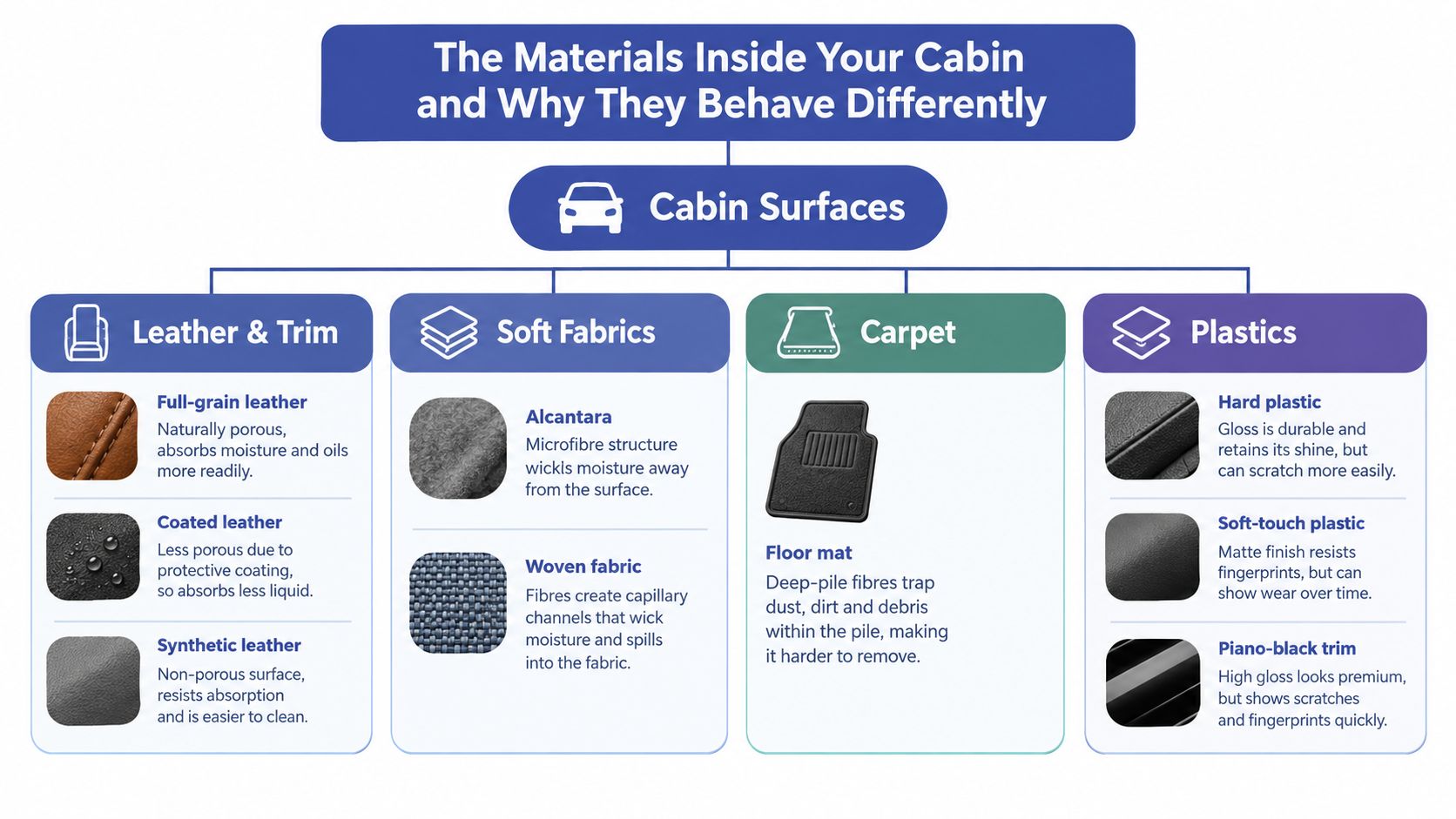
The Materials Inside Your Cabin and Why They Behave Differently
A cabin looks like one space from the driver’s seat, but it’s really a collection of different materials with different reactions to heat, friction and cleaners. That’s why one product can feel perfect on leather and wrong on fabric, or look great on a hard dash but too shiny on a soft-touch panel.
Leather, synthetic leather and suede-style surfaces
Leather and synthetic leather are usually the easiest surfaces to misunderstand. They’re common, they look premium, and they’re not all built the same. Some are coated, some are more absorbent, and some are closer to delicate specialty materials that don’t like heavy dressing or aggressive solvents.
Suede-style trims and Alcantara-like surfaces are even more sensitive. They’re chosen for feel, not for easy cleaning, so any protectant has to respect texture and friction. A coating that leaves a slick or glossy film can make those surfaces feel wrong fast.
Fabric, carpet and the plastics around them
Fabric and carpet behave like porous textiles, so the main concern is whether a treatment blocks the fibres or leaves them stiff. The point isn’t to waterproof the seat like plastic wrap. The point is to help liquid bead or sit long enough to blot while keeping normal breathability.
Hard plastics, soft-touch plastics and piano-black trim are different again. Hard plastic usually tolerates protection better, but texture can change if the product leaves residue in the grain. Soft-touch surfaces can look patchy if the wrong formula is used. Piano-black trim shows haze, streaking and micro-marring far more easily than people expect, so it needs restraint rather than heavy application.
Touchscreens and glossy control surfaces are the ones many owners should be most cautious with. They’re high-visibility, high-touch and often covered by manufacturer restrictions. A product that’s fine on a door card can be a poor choice on a screen.
The relevant training guidance in Australia is broader than “leather and plastics” anyway. It includes leather, vinyl, plastic, polycarbonate, fabric, carpet and rubber/composite flooring, which is a good reminder that cabin care should be matched to the exact substrate, not to a vague category (training guidance).
A good detailer protects the material first and the appearance second. If a product alters feel, gloss or friction in the wrong place, it’s the wrong product.
If you’re trying to understand how material choice changes leather care more broadly, this guide is useful context: how to refresh leather car seats without damage.
How the Coating Is Actually Applied?
A credible interior coating job starts long before the bottle is opened. The cabin has to be inspected, vacuumed and cleaned so the coating bonds to the surface itself, not to dust, old dressing or residue. That’s the difference between a tidy-looking result and a durable one.
Preparation comes first
The first pass is simple yet essential. Remove loose debris, vacuum seams and edges, then clean each surface with a method suited to its material. Leather needs a leather-safe cleaner. Fabric often needs extraction or steam cleaning first. Plastics usually need a careful degrease so old film and body oils don’t interfere.
Controlled conditions matter too. An application done in a hot, open car can flash unevenly and leave high spots or streaks. That risk is why many detailers prefer a cooler, shaded environment and test small areas before committing to the full cabin.
Application, curing and restraint
Good practice: apply less product than you think you need, work in small sections, and inspect each area from different angles before moving on.
A correct job on leather is light and even, with no oily residue sitting on the surface. Fabric should be treated in a way that preserves softness, not stiffness. Plastics need a clean, thin application that avoids build-up along texture lines and around switches.
The cure matters just as much as the application. The coating needs time to settle, and the cabin should stay dry during that stage. If the surface gets disturbed too early, the result can be patchy or underperforming.
A professional will also refuse some surfaces if the risk is too high. That’s a strength, not a weakness. A screen, a delicate trim insert or a worn soft-touch panel can be better left untreated than coated badly.
If you want a sense of how a structured professional process differs from a rushed one, this broader guide on ceramic-coating workflow is a useful read: hand detailing for ceramic coats and controlled application.
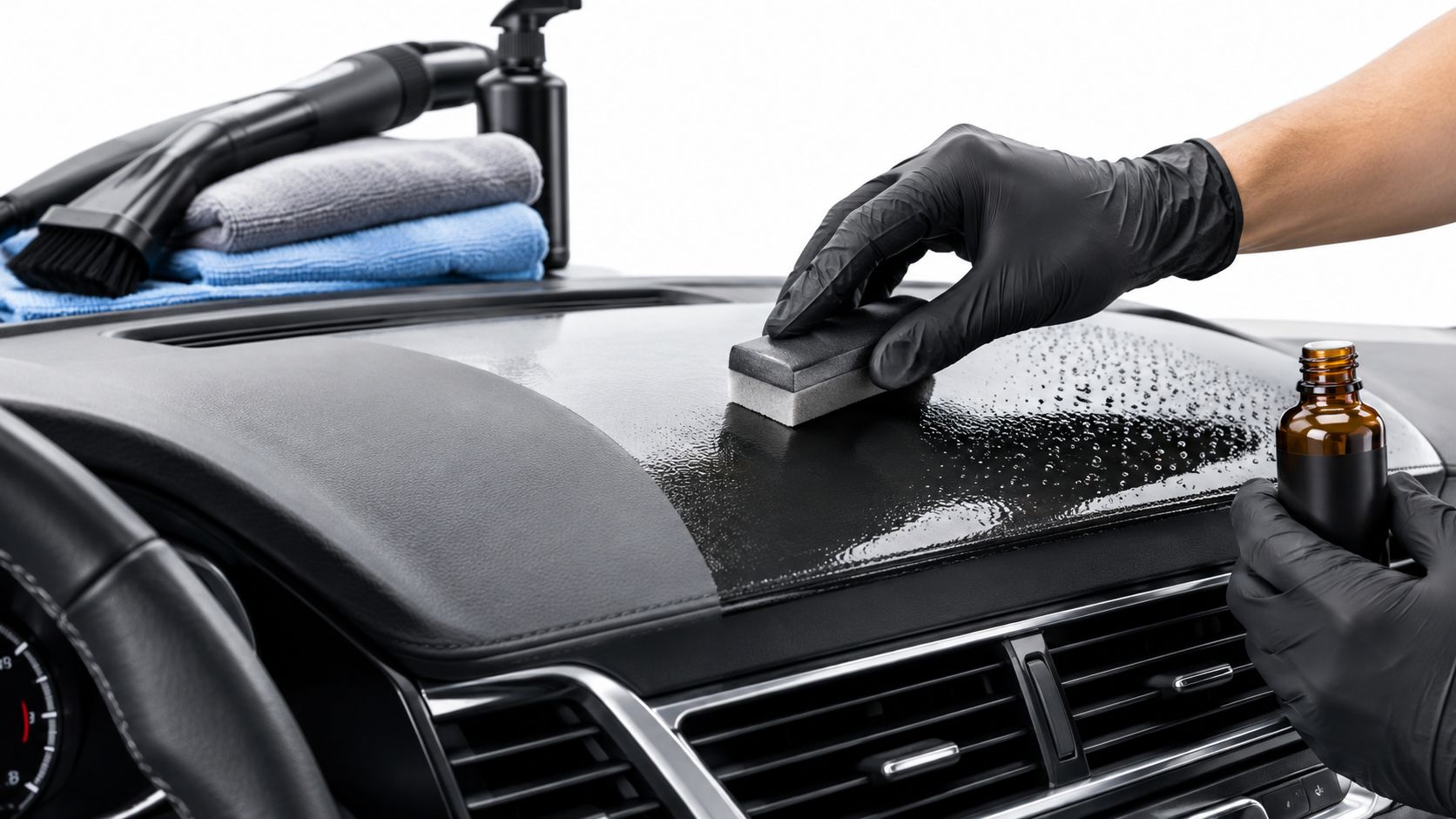
Explore the Professional Coating Process
What a Coating Realistically Does and Does Not Do?
A good interior coating makes daily life easier, but it doesn’t turn a worn cabin into a new one. The practical gains stand out. Spills usually wipe away more easily, grime tends to cling less aggressively, and coloured transfer from clothing is less likely to become an instant problem on a protected, well-prepared surface.
Real benefits people notice
On leather, the main win is easier cleaning and less immediate staining from daily use. On fabric, the value is in delayed absorption, which gives you a better chance to blot before a spill settles in. On plastics, the surface usually feels less grabby, so dust and fingerprints are simpler to remove.
That’s helpful for high-contact areas such as steering wheels, bolsters, armrests and child-seat zones. Those are the places that get touched, rubbed and cleaned again and again, so any improvement in cleanability is worthwhile.
Hard limits you shouldn’t ignore
A coating does not stop UV fading. It does not fix cracked leather, faded fabric, existing pet-hair damage or stains that have already bonded. It also does not replace shade, a window film or a sunshield.
RACV testing has shown cabin temperatures above 70°C within minutes when the ambient temperature was about 30°C (RACV cabin heat testing). At those temperatures, heat keeps working on leather, polyurethane, plastics and trim whether a coating is present or not. The coating can help the surface resist contamination, but it can’t cancel the heat load.
That’s why the honest pitch is maintenance, not miracle. If the cabin is already damaged or heavily neglected, the first job is cleaning and correction. Protection comes after that.
Understand What Ceramic Coating Can Really Do
Coating Versus Conditioner Versus Fabric Guard Versus Dressing
Not every cabin needs the same protection, and not every protection product is trying to do the same job. A leather conditioner, a fabric guard spray, an interior dressing and a ceramic-style coating can all be useful, but they’re solving different problems.
| Option | Primary purpose | Typical feel | Durability | Best fit for |
|---|---|---|---|---|
| Leather conditioner | Supports suppleness and a maintained look | Soft, natural | Shorter-term | Leather that needs nourishing and a cleaner finish |
| Fabric guard spray | Helps repel spills on textiles | Usually invisible if used well | Short to moderate | Fabric seats and carpets that see regular spill risk |
| Interior dressing | Adds appearance and surface slickness | Can range from matte to glossy | Varies widely | Hard plastics and trim when visual refresh matters |
| Ceramic-style interior coating | Helps reduce adhesion and makes wiping easier | Should stay close to the original finish | Longer-term when maintained well | Leather, compatible plastics and selected fabrics |
Choosing by surface, not habit
A family car with child seats and snack spills benefits from a different approach than a weekend car that mostly sees short solo trips. The family car may need fabric protection and frequent cleaning, while the weekend car may only need targeted treatment on leather and plastics that get touched often.
Stronger protection isn’t automatically better. If the finish becomes shiny, slippery or stiff, the product has overreached.
Conditioner is still relevant if the leather needs nourishment. Fabric guard is often the better call where breathability matters most. Dressing has a place on some plastics if the owner wants a refreshed look, but it can also attract dust if it’s too glossy or too wet.
Ceramic-style coating sits in the middle of the decision tree. It’s the better fit when the goal is easier cleaning, more consistent behaviour and a more durable maintenance layer, not a cosmetic overhaul.
Compare Interior Protection Options
Why Perth Heat, UV and Cabin Air Make Interior Protection Different Here?
Perth changes the equation because the cabin isn’t just dirty, it’s hot for long stretches and often parked under intense sun. Bureau of Meteorology climate statistics for Perth Metro show mean maximum temperatures of about 31.4°C in January and 31.7°C in February, based on long-running observations (Bureau of Meteorology climate averages). Those are average maxima, not peak cabin conditions, and the interior can run far above them.
Heat, age and cabin air all matter together
Older vehicles are already dealing with accumulated wear. That matters because the same heat that dries out leather also affects plastics, adhesives and trim. Cabin-air research has also shown that vehicle interiors can contain a wide range of volatile organic compounds, with concentrations influenced by materials, age, temperature, ventilation and humidity (IQAir summary of cabin VOC research).
The practical takeaway is simple. A product used in Perth has to cope with more than appearance. It has to survive heat, dust, repeated contact and a car that may spend a lot of time parked outdoors.
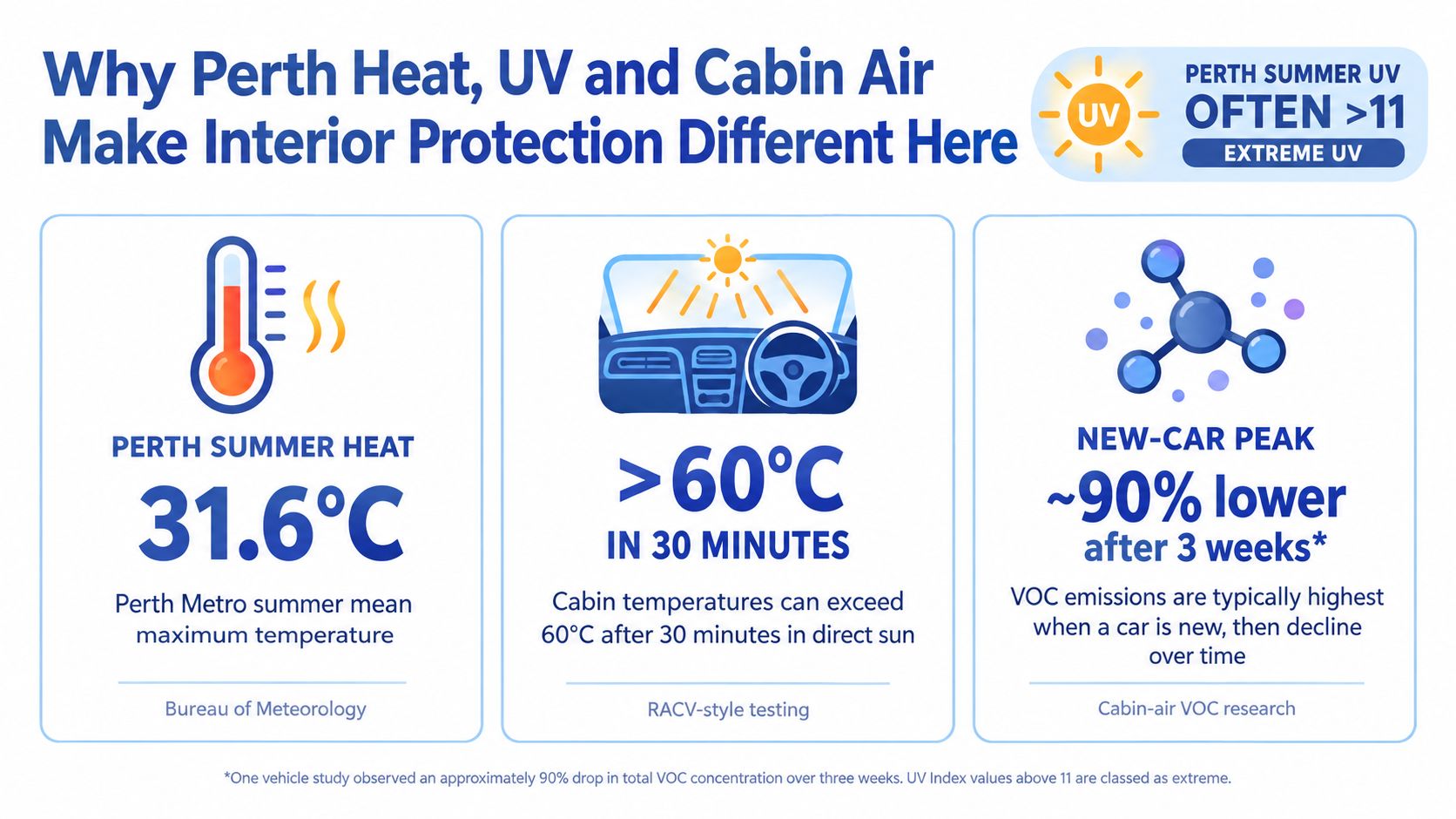
What that means for application and care
Application should happen in a cooled, ventilated cabin, not in a sun-baked one. The vehicle should stay dry while the coating cures, and the first focus should be the highest-contact, highest-radiation zones such as the steering wheel, bolsters, dashboard, door trims and centre console.
Families, rideshare drivers and fleet users usually need a stricter upkeep rhythm than weekend drivers because the cabin gets contaminated more often. That doesn’t mean re-coating constantly. It means inspecting the areas that get touched the most and cleaning them before grime has a chance to set in.
A coating is one part of the solution. Ventilation, shade and sensible parking habits still matter, because no coating removes heat or replaces airflow.
Book Interior Protection in Perth
How to Maintain a Coated Interior So It Actually Lasts?
A coated cabin stays useful only if you keep cleaning it the right way. The maintenance routine should be calm, material-specific and gentle. Heat, bad cloths and harsh sprays can undo the benefit faster than most owners expect.
The cleaning routine that makes sense
Start with a cool, ventilated cabin. Then use a soft microfibre towel and a cleaner that suits the exact material in front of you. Leather gets leather-safe cleaning. Fabric gets textile-appropriate care. Plastics and touch surfaces need products that won’t leave a greasy film.
Avoid bleach, harsh commercial sprays and concentrated alcohol on leather, glossy wood, touchscreens and coated buttons. Those products can strip finish, create haze or leave surfaces feeling uneven. If you’re tempted to use one household cleaner across the whole cabin, stop and check the material first.
A simple wear check helps too. On a concealed textile section, place a small water drop. If it absorbs quickly, the surface may be contaminated or the coating may be fading. If it sits longer before penetrating, repellency is still working.
What to inspect most often
- Steering wheel and bolsters: these collect skin oils and friction first.
- Armrests and door pulls: these show residue and gloss changes early.
- Child-seat and rear-seat contact zones: these get spills, crumbs and rubbing.
- Dashboard tops and console edges: these reveal dust build-up and drying faster than expected.
For a practical Perth-focused maintenance rhythm and product-safe cleaning advice, this guide fits well with the topic: how to maintain ceramic coating for Perth drivers.
Is an Interior Ceramic Coating Worth It for Your Car?
The right answer depends on four things. First, how old the car is. Second, what materials are inside it. Third, how the vehicle is used. Fourth, whether you’ll commit to a maintenance routine after the coating is applied.
A simple decision check
If the cabin is leather-heavy, used daily and regularly exposed to Perth heat, a coating is often a sensible option. If the car has fabric seats, kids, pets or rideshare-style traffic, the value usually comes from easier clean-up and less residue build-up. If the cabin is already heavily stained, cracked or faded, clean and repair it first, then think about protection.
Skip the coating if you want a one-time fix with no follow-up. Wait if the interior still needs a deep clean or a material-specific repair. Go ahead if the cabin is in good condition, the surfaces are compatible and you’re willing to keep up with gentle maintenance.
The most sensible add-ons
A leather clean and condition makes sense when the seats need preparation before protection. A seats-and-carpet steam clean is the right companion when fabric is the bigger issue. An interior protectant can still have a place on specific trims, but it should be chosen for the surface, not for convenience.
If you’ve got a Perth car that lives outside, carries family traffic or just needs a smarter way to stay clean, book the cabin work when the surfaces are ready, not when they’re already damaged. A proper hand wash and detailer can match the treatment to the material, clean the right areas first and protect the parts of the cabin you touch every day. For a professional interior reset and surface-specific care, visit Prime Shine Hand Car Wash.