




Your car looks dusty by Friday, streaked by road film by Sunday, and by the time you finally think about washing it, the choices don’t feel simple. Drive-through. Touchless. DIY. Full detail. Quick vacuum. Wax. Coating. Most drivers aren’t confused because they don’t care. They’re confused because every option claims to be safe, fast, and effective at the same time.
That’s rarely true in practice.
A proper hand car wash isn’t just soap and water. It’s a method. It’s the difference between removing grime safely and dragging it across the paint. It’s also the difference between a car that looks clean from five metres away and one that still feels rough, dull, or tired up close. If you’re trying to protect your paint, keep the cabin presentable, or decide whether your car needs a wash, a wax, or something more serious, the right service depends on what’s on the vehicle and what result you want.
Why Your Car Deserves More Than a Quick Spray?
A common Perth scenario goes like this. The car isn’t filthy enough to feel urgent, but it’s definitely not clean. There’s a grey film over the paint, dust sitting along the boot line, brake dust building on the wheels, and fingerprints around the handles. From a distance it looks acceptable. In direct sun it doesn’t.
That’s the point where many people choose speed over method. They want the dirt gone and the shine back, but they don’t want to make the finish worse. That concern is fair. A cheap wash can leave behind more than disappointment. It can leave missed contamination, patchy drying, or fine marks that only show up later.
A professional hand car wash matters most when the car has surfaces that need judgement, not just force. Tight trims, badges, wheels, piano black plastics, soft paint, neglected interiors, pet hair, and light paint defects all need different handling. One wash menu won’t solve every one of those issues.
A clean-looking car and a properly cleaned car aren’t always the same thing.
The bigger mistake is assuming every “safe” wash is safe for the finish. Some options avoid contact but rely heavily on chemistry and still leave bonded grime behind. Others clean aggressively and create unnecessary abrasion. The right choice depends on whether you’re chasing convenience for today or preserving paint condition over time.
For many drivers, the decision isn’t hand wash versus no wash. It’s choosing between:
- A fast cosmetic clean that improves appearance for a short time
- A careful maintenance wash that protects the paint while removing day-to-day contamination
- A restorative service that tackles neglected interiors, dull paint, or surface defects
- A protection-focused service that prepares the vehicle for wax, polish, or coating
That’s where clarity helps. Once you know what each service can and can’t do, the menu stops feeling like upselling and starts feeling practical.
The Hand Car Wash Method Explained
Pull into a touchless wash with a week of road film on the paint and it will often leave looking cleaner, but not properly clean. The dust is lighter, the gloss comes back a little, and the hard grime around badges, lower doors, and wheels is still there. That gap matters, because what stays on the surface affects how the paint wears over time.
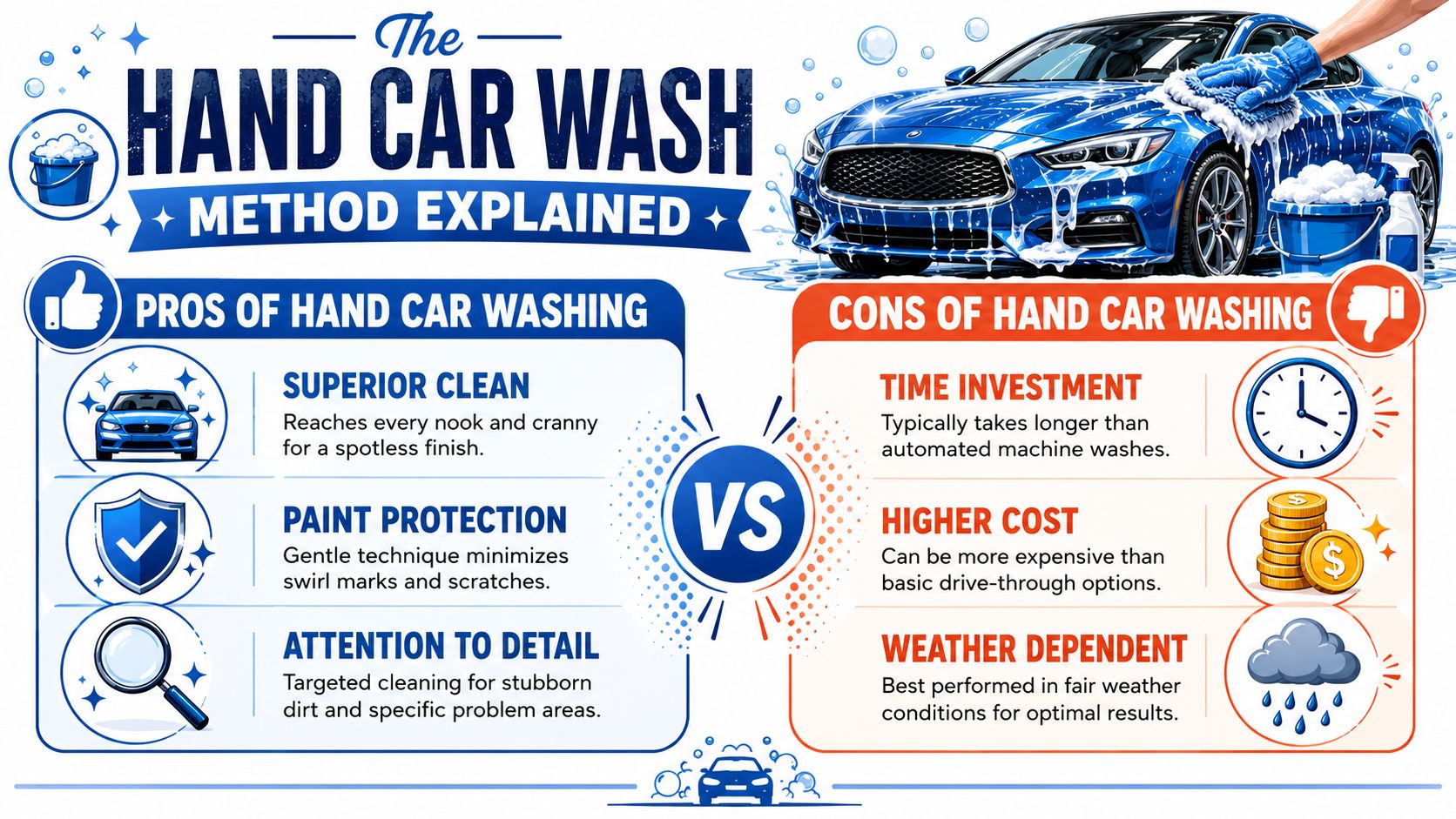
A proper hand wash is built around controlled contact, clean tools, and enough time to remove dirt without grinding it into the finish. The point is not to touch the paint more. The point is to touch it carefully, with lubrication, pressure control, and a method that keeps grit away from the panel.
What a proper wash involves
The starting point is the two-bucket system. One bucket carries the wash solution. The second bucket is for rinsing the mitt after each section so the dirt collected from the lower doors or rear bumper does not get dragged across the bonnet on the next pass.
That sounds simple because it is simple. The discipline is what matters.
A careful wash usually follows this order:
- Pre-rinse first. Loose grit and surface dust are flushed away before the paint is touched.
- Foam or soap application. This softens traffic film and adds lubrication.
- Top-down washing. Cleaner upper panels are washed before the dirtier lower sections.
- Separate tools for wheels and tyres. Brake dust, tyre browning, and road grime should never share a mitt with paintwork.
- Controlled drying. A quality drying towel with light pressure reduces marring far better than hurried wiping.
On a well-kept car, that method is usually enough for safe maintenance. On a neglected car, it has limits. A wash removes loose and some stubborn contamination, but it will not correct scratches, oxidation, or bonded fallout that needs claying, polishing, or more involved paint preparation.
Why touchless is not automatically safer
Touchless washing avoids brushes and mitts, which sounds like the safest option. The catch is how those systems compensate for the lack of physical contact. To break down grime without agitation, they often rely on stronger chemistry and high pressure, yet they still struggle with road film, oily residue, bug remains, and contamination sitting tight to the surface.
That leaves owners with a finish that looks passable from a few metres away but still feels dirty to the hand. In practice, that can lead to more wiping between washes, more aggressive spot cleaning, or protection being applied over contamination. None of that helps the paint.
Hand washing has its own risk. Poor technique, dirty mitts, and rushed drying can mark soft paint. But a skilled hand wash gives the operator something automated systems do not have. Judgement. Pressure can be reduced around piano black trim. A separate mitt can be used for lower panels. Stubborn residue can be re-soaked instead of scrubbed. That is why, before any ceramic coating preparation and protection service, the wash stage needs to be meticulous.
Practical rule: If the paint still feels rough or looks flat after washing, the surface is clean enough to inspect, not finished enough to protect.
There is a cost to doing it properly. Hand washing is slower because careful work takes time. That slower pace is not inefficiency. It is what allows the wash to adapt to the condition of the vehicle instead of forcing every car through the same process.
Decoding the Service Menu From Wash to Coating
Most service menus confuse people because they place very different jobs side by side. A wash, a wax, a detail, a cut and polish, and a ceramic coating all sound related. They are. But they solve different problems.
What each service is meant to do
An outside wash is the maintenance option. It removes visible dirt, cleans the wheels, freshens the tyres, and improves appearance quickly. If the cabin is already tidy and the paint is in decent shape, that may be enough.
An inside and outside wash is the everyday family-car service. It handles the exterior while clearing the usual interior buildup such as crumbs, dust, and boot debris. For a daily driver, that often delivers the best balance between cost and usefulness.
A premium wash usually adds hand wax or polish after the cleaning stage. That doesn’t correct paint. It improves gloss and gives short-term surface protection. It suits cars that are already in reasonable condition and just need a lift.
A full detail goes much deeper. It’s for cars that feel overdue, not just dirty. Interior plastics, glass, door jambs, stubborn grime, and neglected surfaces all need more time and more deliberate work. If you open the door and instantly notice buildup, odour, sand, pet hair, or sticky trims, a basic wash won’t reset the vehicle.
If the surface still feels rough after washing, or the gloss doesn’t return, the issue usually isn’t “more soap”. It’s contamination or paint condition.
Then there’s cut and polish. This is paint correction territory. It’s meant for swirl marks, dullness, and light scratches. It doesn’t replace a wash. It follows proper paint preparation.
Finally, ceramic coating is a protection service, not a cleaning shortcut. It works best when the paint has been washed, decontaminated, and corrected to the level you’re happy with. If you’re looking at longer-term protection, ceramic coating services make more sense after the paint has been properly prepared by hand.
Car Wash Service Comparison
| Service Level | Primary Goal | Key Inclusions | Best For |
|---|---|---|---|
| Outside Car Wash | Improve exterior appearance | Hand wash, rinse, wheel clean, tyre shine, quick dry | Cars with tidy interiors and light exterior grime |
| Inside & Outside Car Wash | General maintenance | Exterior wash plus interior and boot vacuum, dash and trim dusting | Family cars, commuters, everyday upkeep |
| Premium Car Wash | Add gloss and short-term protection | Full wash with interior vacuum plus hand wax and polish | Well-kept cars needing a sharper finish |
| Mini Car Detailing | Quick refresh beyond a basic wash | Exterior wash, chamois dry, door jamb clean | Cars needing a cleaner presentation without a full reset |
| Full Car Detailing | Deep clean inside and out | Comprehensive interior and exterior cleaning, windows included | Neglected vehicles, sale prep, lease return |
| Cut & Polish | Improve paint condition | Wash, paint preparation, machine cut and polish | Swirls, light scratches, dull paint |
| Ceramic Coating | Protect prepared paint | Long-term paint protection | Owners focused on easier maintenance and durable protection |
The most expensive option isn’t always the right one. If the paint is healthy and the issue is just weekly grime, correction work is unnecessary. If the paint is dull and contaminated, wax alone won’t solve it.
The Prime Shine Difference Your Perth Hand Wash Expert
You pull into a wash because the car looks dusty, then notice the wheel faces are still brown, bugs are still on the bumper, and the lower doors still feel gritty. That gap between a quick clean and a careful one is what separates a hand wash worth paying for from a service that only looks good at first glance.
A good hand wash operation is built around inspection, method, and restraint. The car is assessed before work starts. Dirtier areas get different treatment from lightly soiled paint. Wheel and paint tools stay separate. On darker paint, that matters. On soft paint, it matters even more.
Touchless washing gets called the safer option because nothing physically touches the paint. In practice, that claim leaves out two problems. Stronger chemicals are often doing the heavy lifting, and they still struggle with traffic film, bug residue, and road grime that need careful agitation to come off properly. If the wash is too aggressive chemically, it can dry trim, weaken existing protection, and leave the finish looking clean but not well cared for. If it is too mild, contamination stays on the car. A skilled hand wash avoids both extremes by using controlled contact, proper lubrication, and enough time to clean the surface without forcing the job.
That is also why speed should not be the main buying criterion for every car. Some vehicles only need a tidy maintenance wash. Others need someone to notice stained leather, pet hair in the boot, old brake dust on the wheels, or wax residue around badges. Volume-driven processes miss those details because they are designed to keep cars moving, not to respond to condition.
Clear service design is another sign you are dealing with a serious operator. Customers should be able to see the difference between a maintenance wash, a detail, and paint correction without guessing what is included or relying on sales language. Extras should be listed as separate work if they are separate work. Pet hair removal takes time. Steam cleaning is not the same task as a vacuum. Headlight restoration is not part of a standard wash.
Prime Shine Hand Car Wash presents that clearly. The business runs from a single Westminster location, lists distinct wash and detailing packages, and lets customers book a date and time online. That does not guarantee every car needs a top-tier service. It does make it easier to match the service to the car without confusion.
A better hand wash business usually shows a few habits:
- Clear package limits so a maintenance wash is not confused with a deeper reconditioning job
- Condition-based recommendations because a dusty sedan and a heavily used family SUV are different workloads
- Defined add-ons for issues like stains, pet hair, leather care, or headlight haze
- A process built around the vehicle in front of them instead of treating every booking as the same job
A good wash menu should help you choose the right level of work for your car, not push every customer into the highest price.
For Perth drivers, the difference comes down to care that holds up after the car leaves. A proper hand wash does more than remove visible dirt. It protects paint health, treats materials appropriately, and gives owners a more honest result than a quick spray or a chemical-heavy touchless pass.
Which Hand Car Wash Service Is Right for You
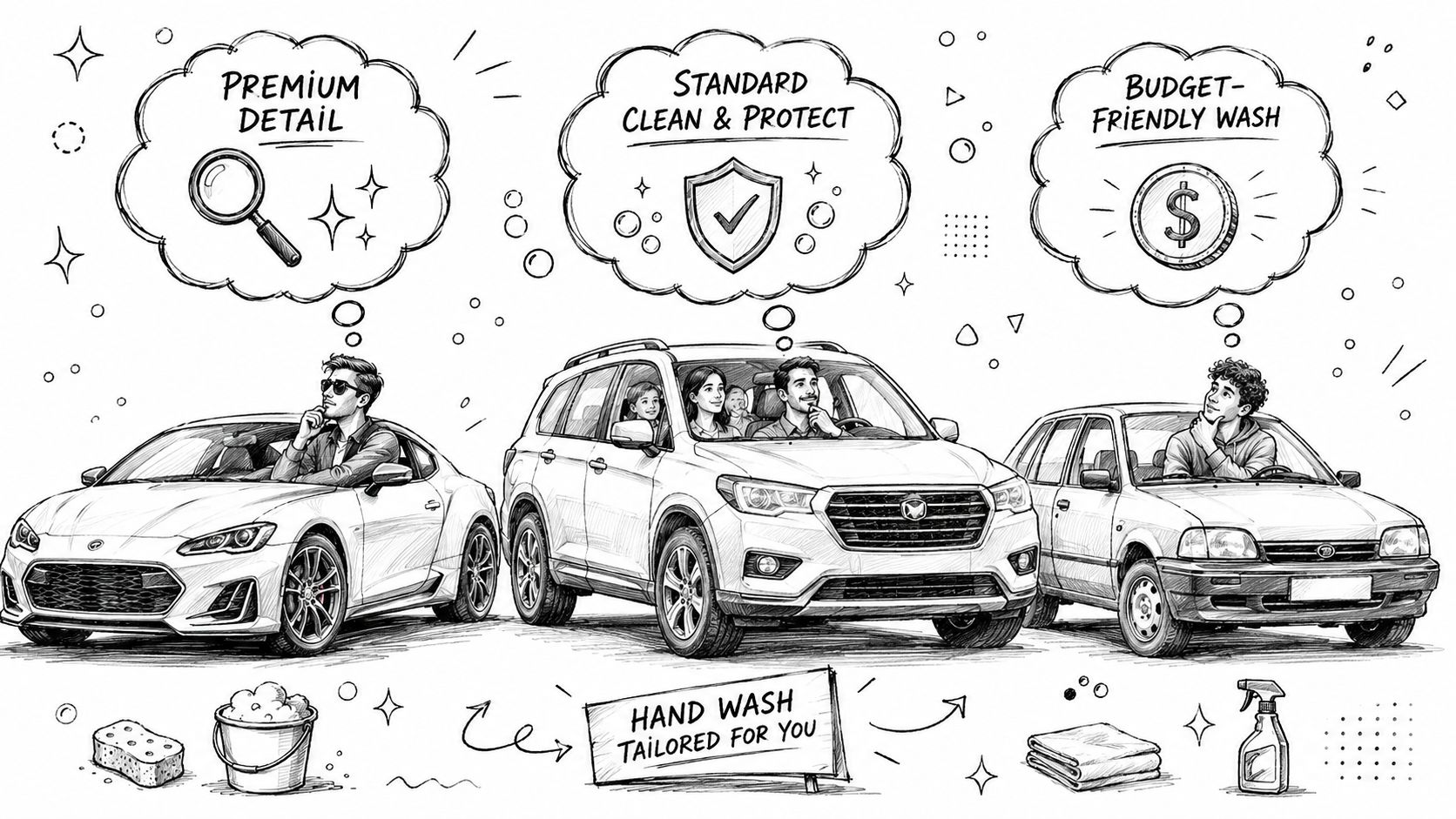
The easiest way to choose a service is to stop thinking in package names and start thinking in use cases. Different drivers wear their cars differently.
Four common driver profiles
The family SUV owner
This car usually needs interior attention as much as exterior cleaning. Dirt comes in from school runs, sport, food, and weekend errands. An inside and outside wash is often the practical baseline, with steam cleaning or pet-hair removal added when the cabin stops responding to simple vacuuming.
The commuter
If the car is used daily and parked outdoors, regular maintenance matters more than occasional big jobs. A standard exterior or inside-and-out hand wash keeps grime from building up on the paint and avoids the cycle where contamination gets baked on and harder to remove later.
The enthusiast or luxury owner
This driver notices gloss, swirls, trim finish, and wheel condition. A basic wash keeps the car tidy, but when the paint starts looking dull or marked, cut and polish becomes the more logical spend. Coating only makes sense once the finish is where you want it.
The seller or lease-return customer
Presentation counts here. Full detailing is usually the strongest fit because it addresses the whole vehicle, not just what’s obvious from outside. Clean glass, tidy jambs, refreshed trim, and a cabin that doesn’t smell tired all help the car feel looked after.
How to choose without overbuying
One of the more practical reasons to choose a professional hand wash in WA is water efficiency. Commercial hand wash operations in Australia use about 40 to 60 litres of water per vehicle, compared with 160 litres used by some automated machines, thanks to targeted high-pressure application, according to this Australian eco car wash water-use reference. For water-conscious drivers in Western Australia, that’s a sensible factor alongside finish quality.
Use these quick decision points:
- Choose a basic wash if the car is generally clean and you just want it presentable again.
- Move to premium wash or wax if the paint still looks flat after cleaning and you want more gloss.
- Book a detail if the vehicle feels tired inside and out, not just dirty.
- Book correction or coating only when you care about paint condition, not just surface cleanliness.
The right service should solve the current problem. It shouldn’t sell you three extra ones.
Maintenance Tips and Frequently Asked Questions
You wash the car on Saturday, park under a tree, do a few school runs, and by midweek the paint already looks tired again. That usually is not because the wash was poor. It is because small contaminants build up fast, and the longer they sit, the more work they create next time.
Good upkeep between visits protects the finish and saves money on heavier correction later. It also helps you get the full benefit from a proper hand wash, instead of letting bird mess, road film, and interior grime undo the result in a few days.
Simple ways to keep the car cleaner between visits
- Remove bird droppings quickly. They can mark paint and trim if they sit in the sun.
- Keep one clean microfibre cloth for interior use only. Screens, piano-black trim, and dash plastics scratch easily with tissues, old shirts, or dusty rags.
- Clear out the boot and door pockets every week or two. Less clutter means faster cleaning and fewer hidden dirt traps.
- Rinse floor mats before dirt turns to mud. Sand and grit wear carpet fibres down over time.
- Do not rely on touchless washes as your maintenance plan. They often need stronger chemicals to compensate for the lack of contact, and they still leave behind traffic film in the areas that matter most.
That last point gets missed a lot. Drivers often assume touchless means safer because nothing brushes the paint. In practice, harsh wash chemicals and incomplete cleaning can be their own problem. If dirt stays on the surface, people wipe it off later by hand at home, and that is where fine scratching often starts. A careful hand wash removes contamination more completely, with less guesswork and less residue left behind.
If you want the finish to hold its gloss better between visits, adding hand wax and polish options can make upkeep easier. Wax will not repair damaged paint, but it can give water, dust, and light grime less to cling to.
Maintenance is cheaper than recovery. Once stains set, trim fades, or contamination bonds to the paint, the labour goes up.
Frequently asked questions
How long will my service take?
It depends on the service and the vehicle’s condition. A standard exterior wash is far quicker than a detail with seat shampooing, pet hair removal, or paint polishing. Heavily neglected cars also slow the process because the dirt is bonded, not just sitting on top.
Do I need to book in advance?
If you want a set time, yes. Booking ahead matters even more for larger vehicles or any service beyond a basic wash.
Will heavily soiled cars cost more?
Often, yes. Extra sand, dog hair, stains, food spills, or caked brake dust all add labour. A good operator should explain that before starting, not after the job is done.
Does wax fix swirl marks?
No. Wax can improve gloss and add short-term protection, but swirl marks are a paint-defect issue. They need proper polishing if you want real correction.
Is touchless enough before ceramic coating?
No, not on its own. Coating needs clean, properly prepared paint. If contamination or film is still on the surface, the coating goes over the problem instead of solving it.
If your car needs more than a quick rinse, Prime Shine Hand Car Wash offers hand washing, detailing, paint correction, and protection from its Westminster location, with online booking available seven days a week.