







You’ve just bought the car, or you’re standing at the finance desk while the dealer slides over one more add-on sheet. The pitch sounds tidy. Protect the paint, keep the car looking newer for longer, maybe help resale. In Perth, that’s exactly where people start asking is paint protection worth it, because the money is real and the roads are not gentle.
My blunt answer is this. Sometimes yes, often no, and the wrong package is worse than doing nothing because you’ve paid for peace of mind you won’t use. If the car lives outside, does highway kilometres, or you plan to keep it long enough for protection to matter, the case gets stronger. If it’s a garage-kept commuter that gets washed properly, a lot of what gets sold as “protection” is just a fancy margin.
Why Perth Drivers Keep Asking If Paint Protection Is Worth It?
A lot of Perth drivers ask this question in the same moment. They’re either sitting in a dealership office with a fresh new car on order, or they’ve just been quoted for detailing and suddenly the word “protection” sounds a lot more expensive than “wash and wax”.
The honest answer starts with your use case, not the sales pitch. A car parked outside in WA sun, driven up the freeway, and exposed to road grit has a different risk profile from a weekend-only hatch that lives under cover. That’s why blanket advice always falls apart.
Practical rule: if the car’s paint is going to take regular abuse, protection has a real job to do. If it isn’t, you’re mostly paying for convenience and appearance.
The second reason people get stuck is that they hear the word “protection” and assume all products do the same thing. They don’t. Some products mainly make the car easier to wash. Others are built to take the hit from stone chips. Those are different jobs, and confusing them is how people overspend.
For Perth owners, the question is usually this. Will the car face enough exposure, over enough years, to justify paying up front now instead of paying later for paint correction or repairs? If the answer is yes, you’ve got a case. If the answer is no, keep the money in your pocket and stick to maintenance that suits the vehicle.
What Paint Protection Means for Your Car?
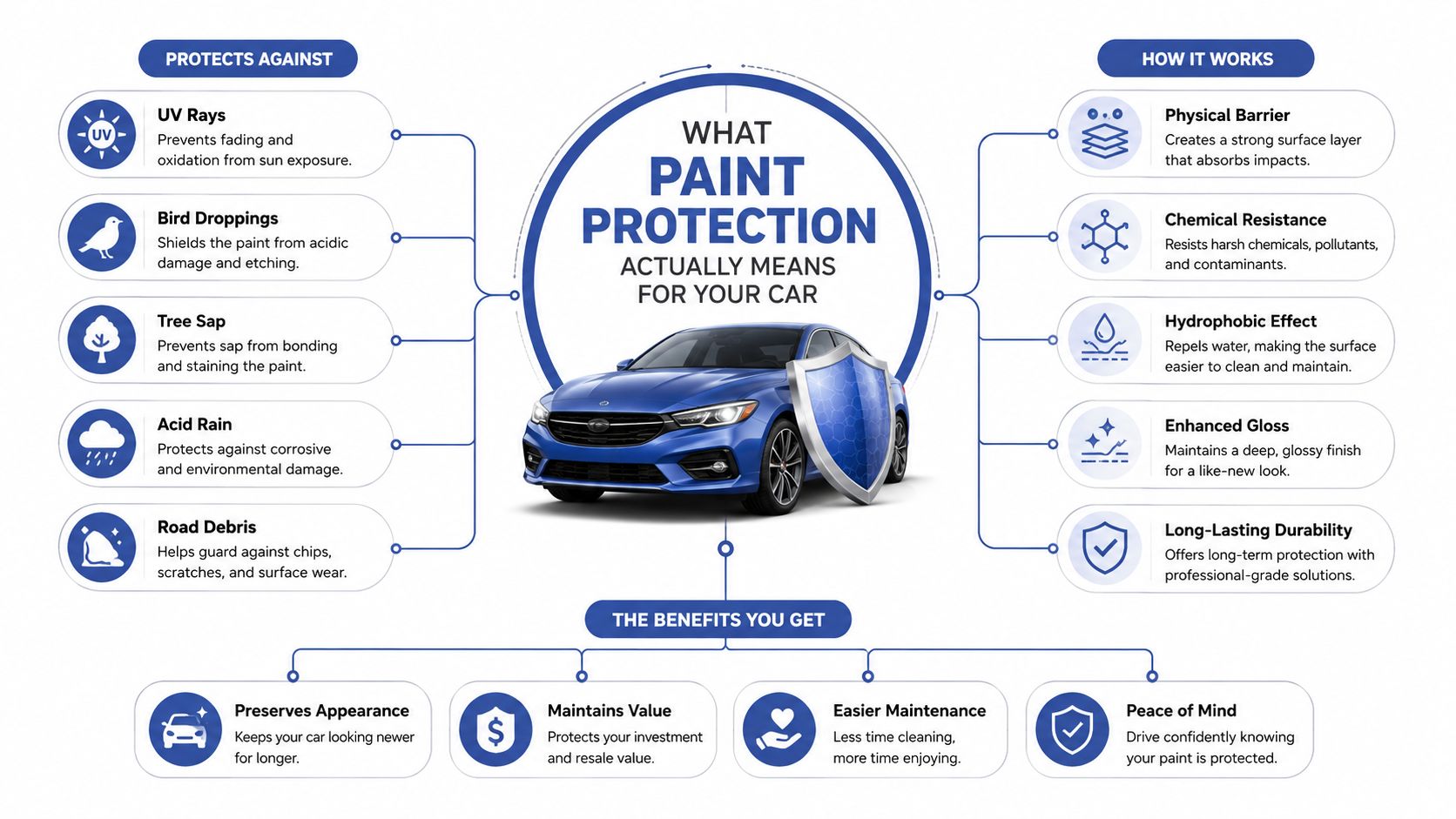
The first mistake is lumping every paint protection product together. They do different jobs. Some sit on the surface and add gloss, some bond more tightly to the clear coat, and some put a physical barrier between the paint and the outside world.
Wax, sealants and ceramic coatings
Wax gives the paint a bit of shine and short-term defence. It sits on the surface like a light raincoat, so it needs regular renewal if you want it to keep doing its job. Synthetic sealants work in a similar way, with a finish that can last a little longer depending on the product and how the car is maintained.
Ceramic coating sits in a different category. It is made to bond to the clear coat, help the surface resist contamination, and make the car easier to clean. That does not make the paint invincible. It will not stop parking damage, and it will not save you from a badly handled trolley. What it does well is keep the paint cleaner and cut down the constant grime cycle.
If you want a deeper breakdown of how ceramic protection is usually packaged for Perth cars, this ceramic coating guide for Perth drivers is the right companion read.
Paint protection film is the heavy-duty option
Paint protection film, or PPF, is the armour layer. It is a clear TPU film applied over the paint so the film takes the hit first. Technical guidance describes typical thickness at about 6 to 8 mils, or 150 to 250 microns, which is why it can absorb impact from rock chips better than a coating alone. The same technical guidance places typical service life at 5 to 10 years under normal conditions (technical guidance on PPF thickness and service life).
PPF is the right conversation when the car is likely to see chip-prone driving. If the car does not face that risk, the film can be overkill.
What it stops and what it doesn’t
Use the right product for the right damage. PPF is built to take rock chips and abrasion better than a coating. Ceramic is better for easier cleaning and routine appearance. Wax is the lightest touch of the three. None of them make a car immune to bad parking, harsh impacts or neglected washing.
The smart move is to ask what problem you are trying to solve before you buy anything. If the answer is “I want less repainting risk”, you are usually looking at film. If the answer is “I want easier upkeep and better gloss”, a coating or regular detailing may be enough.
Explore Ceramic Coating Options
How Long Does Paint Protection Really Last and What Does It Cost?
A good-looking finish on delivery day means nothing if the protection needs constant redoing or the quote leaves out prep work. That is the trap with paint protection. You pay for the product, then find out later what the ownership cost looks like.
The time horizon has to match your ownership
Paint protection film is generally built for 5 to 10 years of service, while ceramic clear-coat protection is often discussed as lasting around 7 years under good conditions (industry source on multi-year protection longevity). If you only keep a car for a short stretch, you are unlikely to use all of that lifespan. If you hold onto vehicles for longer, the value case gets stronger.
That is why the ownership plan matters more than the brochure. A protection product should suit the time you will keep the car, not the time the salesperson wants to talk about. For a ceramic option, if you want a more detailed breakdown of service life, see how long ceramic coating lasts.
What the cost looks like in the real world
The hard cost comparison in Australia is still repair versus prevention. Industry reporting notes that repainting a bumper commonly costs $500 to $1,000, while a larger paint job can run $2,000 or more; vehicle depreciation is often cited at 15% to 20% per year (Australian cost and depreciation context). The same reporting also says bodywork costs have risen nearly 40% more than overall prices since 2005.
Those figures do not mean every car needs protection. They do show why paint damage hurts more now than it used to. One chip, one scrape, or one repair can chew through a decent maintenance budget, especially on a newer car where the finish still matters at trade-in time.
| Protection Type | Typical Lifespan | Relative Cost | Maintenance Needs |
|---|---|---|---|
| Wax | Short-term | Low | Needs regular reapplication |
| Ceramic coating | Multi-year | Moderate | Proper washing still matters |
| PPF | 5 to 10 years | High | Keep clean, inspect edges, avoid rough handling |
Don’t ignore the hidden cost of bad prep
The product matters, but the install matters more. A technical review notes that documented PPF installations can improve resale by 3.2 to 5.7% in the right market context, but poor prep or a failed install can wipe that out (technical review on resale impact and installer quality). So the cost is not just the film or coating itself. It is the prep work, the installer’s standard, and whether the car is worth protecting at that level.
If you want the blunt answer, it is this. Longer-lasting protection only pays off when you keep the car long enough to use it. Otherwise, you are paying for durability that someone else ends up owning.
Which Drivers Actually Get Value from Paint Protection?
Not every car needs the same level of defence. That’s the part people skip because it’s easier to buy a package than to think through how the vehicle is used.
Family cars and daily commuters
For a family SUV or a daily hatch, the value case is usually about keeping the car easier to clean and slowing down visible wear. Kids, car parks, shopping trolleys and sticky hands don’t care about your budget. If the car is still going to be on the road for years, a modest coating or targeted film on high-impact areas can make sense.
If the car is older, already scratched, or gets washed irregularly, spend less on protection and more on correction and cleaning. Protection over poor paint is a waste of money.
Luxury, collector and weekend cars
Protection starts to earn its keep here. High-value paint, rare trims and cars that are treated as assets benefit more from prevention than from repeated repair work. The resale argument also has more weight here, because the car’s appearance has a bigger effect on what buyers are willing to pay.
Leased cars and fleet vehicles
Lease returns and fleet use are different again. The priority isn’t “make it perfect forever”. It’s “reduce avoidable wear and keep the vehicle presentable”. If the vehicle is going back on a schedule, a simpler and more disciplined maintenance routine may beat a heavy upfront package. If it’s on the road hard every day, a coating or film on the front end can still be justified.
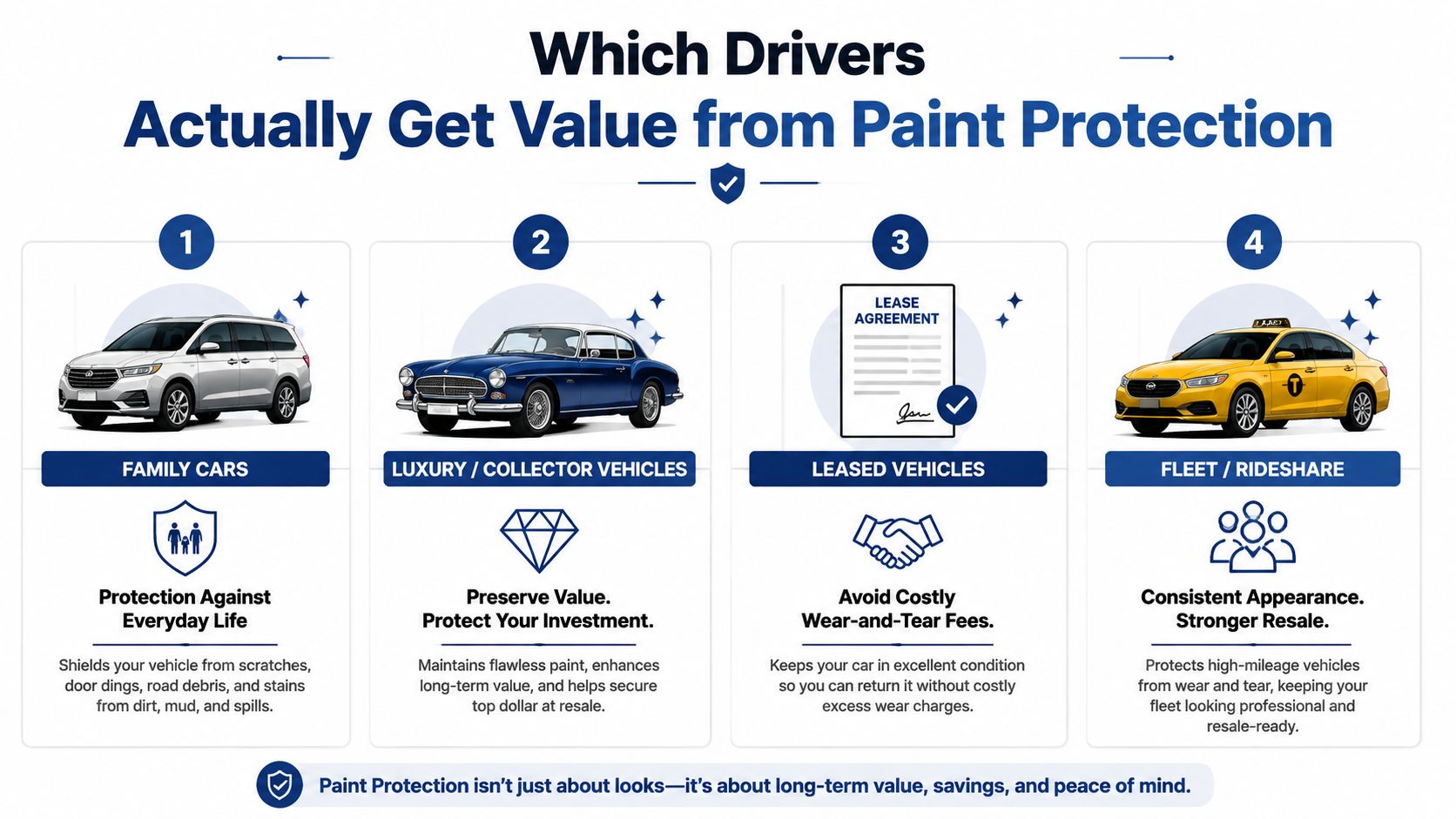
A protection package makes sense when it matches ownership length, exposure and resale value. If one of those three is missing, the deal weakens fast.
A quick decision filter
- Keep it long term: stronger case for coating or film.
- Drive it hard on mixed roads: stronger case for chip protection.
- Garage it and wash it properly: weaker case for expensive add-ons.
- Plan to sell soon: focus on clean paint, correction and presentation.
That’s the lens I’d use before paying for anything. Match the product to the vehicle’s job, not the salesperson’s menu.
Get the Right Protection for Your Car
Are Dealer Paint Protection Packages Worth the Price?
Dealer paint protection is where a lot of buyers overpay for convenience. The package gets sold when you are already committed to the car, the paperwork is in front of you, and the dealer knows you are less likely to walk away.
Why dealers push it so hard
The pitch works because it hits fear and convenience at the same time. You do not want your new car to look tired. You do not want to miss the chance to add protection now. You do not want to hand over a brand-new car and immediately start worrying about the paint. That pressure is emotional, but it is not proof that the package is good value.
Australian advice is openly sceptical here. One industry voice says dealer paint protection is unnecessary and that a good detail every 6 to 12 months gives ongoing protection through polish and wax. Shell Australia also tells drivers to think twice before accepting dealer offerings, because the car already has clear coat and warranty protection, and extra paint protection is often unnecessary for garaged, suburb-driven cars (Shell Australia guidance on dealer offers).
What to ask before you sign
If a dealer package is being sold as a serious product, ask for the facts in plain English.
- What exactly is the product: coating, film, sealant, or a branded add-on with a different label?
- What does the warranty cover: fading, staining, failure, or just marketing language?
- Who manufactures it: if they cannot answer cleanly, that is a bad sign.
- Who installs it: product quality means little if prep is sloppy.
- What condition is the paint in now: protection over contaminated paint is a false start.
Ask those questions before you talk price. If the answers sound vague, the package is built more for margin than for your car.
Independent services often make more sense
A detailer can match the treatment to the car’s condition and how you use it instead of pushing one bundle to every buyer. That matters when you are comparing dealer add-ons with proper paint prep and correction work, especially if you are weighing ceramic coating and paint protection costs for Perth cars against a finance-desk package.
Prime Shine Hand Car Wash offers hand wash, detailing, paint correction and ceramic coating, so the work can start with the paint the car already has rather than assuming it needs a bundled add-on from the dealer. That is a cleaner way to buy protection, because the car gets assessed on condition, use and budget before anyone starts selling extras.
The point is simple. Some dealer packages are overpriced, some are poorly explained, and some are just convenient. If the same money gets you better prep and a better match for your ownership plan elsewhere, the dealer premium is hard to justify.
How Perth Conditions Change the Paint Protection Decision?
Perth changes the equation because the environment is harsher than the average indoor showroom pitch suggests. Strong sun, coastal contamination, bird droppings, and freeway commuting all chip away at paint in different ways.
Sun and contamination matter more here
A garaged suburban car that gets washed regularly has a much softer case for expensive protection. A vehicle parked outside all day, especially near the coast or under trees, gets hammered differently. UV, salt and grime aren’t dramatic in the moment, but they add up in the way the surface ages and how often it needs attention.
Highway and regional driving push the case toward film
If your car spends time on open roads or gravel-prone routes, the front end takes the worst of it. That’s where PPF earns its place, because it’s built as a sacrificial layer. On these cars, film on the nose, mirrors and other high-impact areas can be the sensible compromise between full protection and spending too much.
The local recommendation is simple
If your car mostly does short suburban trips, sits under cover and gets washed properly, stick with good maintenance and maybe a lighter coating. If it lives outside, sees long freeway runs or gets regular contamination, step up to a stronger protection package and focus it where the damage happens.
For Perth owners who want the car assessed properly, car paint cleaning treatment is a sensible starting point before jumping to a full protection sale. That gives you a cleaner surface and a better read on what the paint needs, not what the invoice wants to sell.
Common Questions About Paint Protection Answered
Is paint protection worth it on a used car?
Sometimes, but only if the paint is worth preserving. If the finish is already rough, start with correction and cleaning first. Protection on tired paint is usually the wrong order.
Does it help with resale?
It can, especially when the car is newer and the finish still looks strong. But the value case depends on the vehicle, the market and the quality of the install, not on the sticker price alone.
Will it fix damage later?
No. It helps prevent certain damage and makes maintenance easier, but it won’t repair dents, scuffs or poor preparation.
What’s the safest default for most Perth drivers?
A clean, corrected car with a sensible protection level matched to exposure. That beats a hard sell every time.
If you want straight advice instead of a finance-office upsell, book a proper look at your paint first. Prime Shine Hand Car Wash in Westminster offers hand washing, detailing, paint correction and ceramic coating, so you can match the service to how you drive. Visit Prime Shine Hand Car Wash and get the car assessed before you pay for protection you may not need.