






You’re rushing to get the car looking presentable before an afternoon event, and the paint still has that dull, dusty film after the last wash. In Perth, that happens fast. Sun, road dust, and heat can flatten a finish in a matter of days, which is why Liquid Spray Car Wax has become such a practical add-on for drivers who want gloss without committing to a full detailing session. If you want a deeper reset later, a proper service like full car detailing is still the better play, but for quick maintenance, spray wax earns its place.
Introduction Keeping Your Car Looking Its Best in Perth
A Perth driver usually doesn’t need a lecture about paint care. You wash the car, step back, and the surface looks good for a moment, then dust, heat, and daily driving start wearing down the shine again. That’s where Liquid Spray Car Wax fits in, as a fast maintenance layer that restores gloss and helps water bead without turning the whole process into a half-day project.
For local owners, the appeal is simple. The product is built for repeat use, short application time, and visible results between more involved services. Industry guidance treats spray wax as a short-cycle product, generally lasting about 2 to 4 weeks, while liquid and paste waxes tend to last longer, around 2 to 4 months or more depending on formula and conditions Torquedetail. That makes spray wax a maintenance tool, not a set-and-forget coating.
Practical rule: if you want a quick gloss boost after washing, spray wax makes sense. If you want fewer reapplications, you need a more durable protection plan.
Value for Perth isn’t just shine. It’s convenience in hot, dry weather, and a product that suits regular upkeep on daily drivers, family cars, rideshare vehicles, and cars parked outside. That’s why spray wax keeps showing up in modern car-care routines, especially when the goal is to protect the finish a little, often, rather than a lot, rarely.
What Exactly Is a Liquid Spray Car Wax?
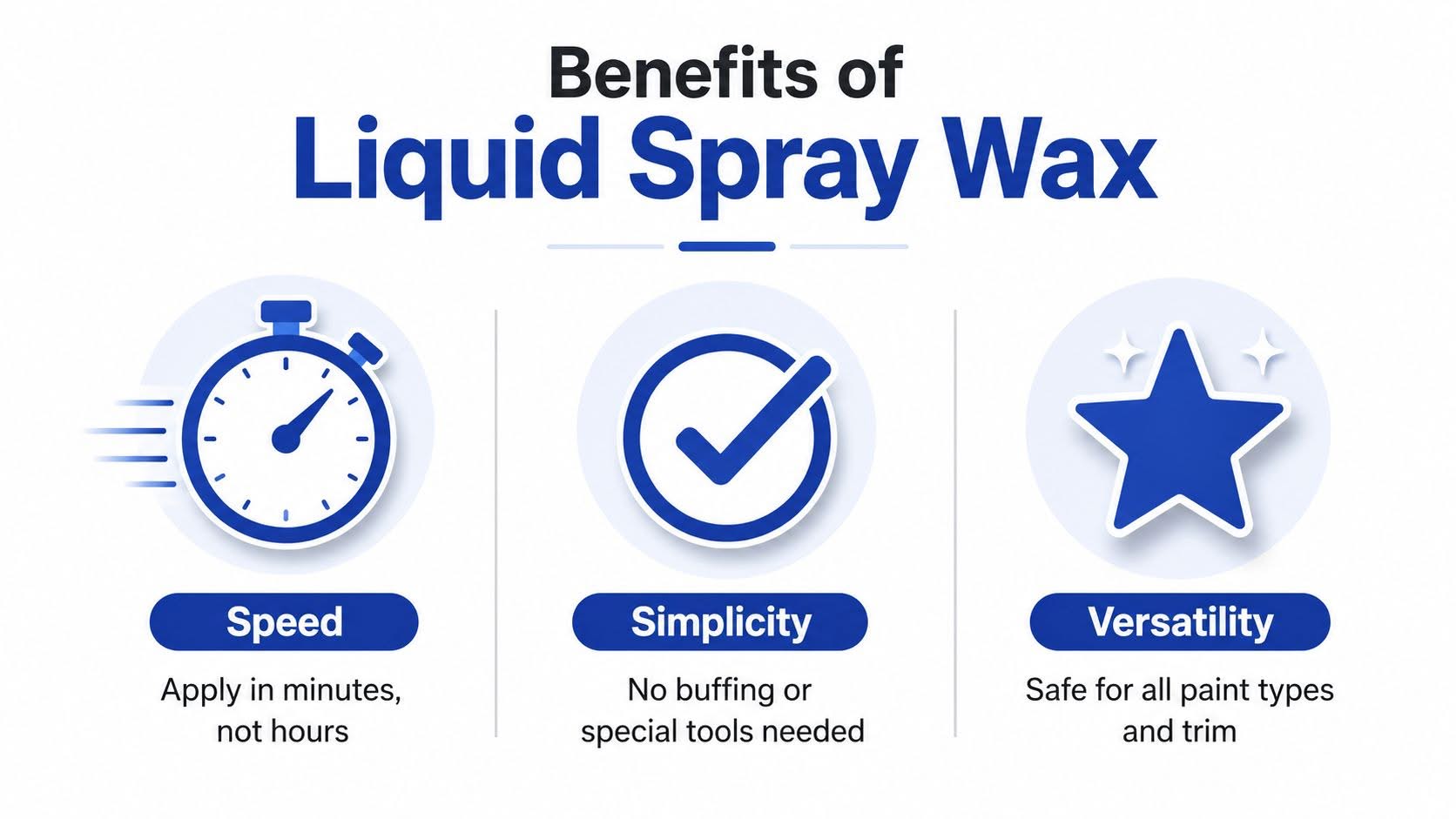
Liquid spray car wax is a quick-application protection product designed to leave a glossy, water-repellent film on paint. Think of it as a lightweight raincoat for the car’s surface. It’s not trying to be a heavy, long-wearing barrier, it’s trying to deliver fast shine, easier maintenance, and a cleaner finish between proper washes.
Why the format matters
Liquid wax is widely used because it’s easier to apply than paste formats and still delivers strong gloss and surface protection. In broader market terms, liquid wax is the dominant wax type because of ease of application, superior shine, and protective properties against environmental elements Global Insight Services. That matters in Australia, where drivers usually prefer products that fit into a regular wash routine instead of demanding long, careful hand application.
Technically, spray wax products are often formulated for a very low-dose workflow. One concentrate specifies a 1:200 dilution rate Etowah Chemicals spray wax concentrate, which tells you the job is about uniform coverage, not heavy product loading. Put too much on and you’re not buying more protection, you’re usually just making wipe-off harder.
The finish comes from a thin, even film. More product doesn’t mean better protection.
That’s the key distinction. Spray wax is meant to level quickly, dry cleanly, and leave a slick surface without the long buffing process associated with thicker waxes. The best results come from thin application, good panel prep, and a microfiber wipe that doesn’t fight the product. That’s why it’s popular for maintenance washes and quick touch-ups, especially when the car already looks clean and only needs a refreshed layer.
What Are the Real-World Benefits of Using Spray Wax?
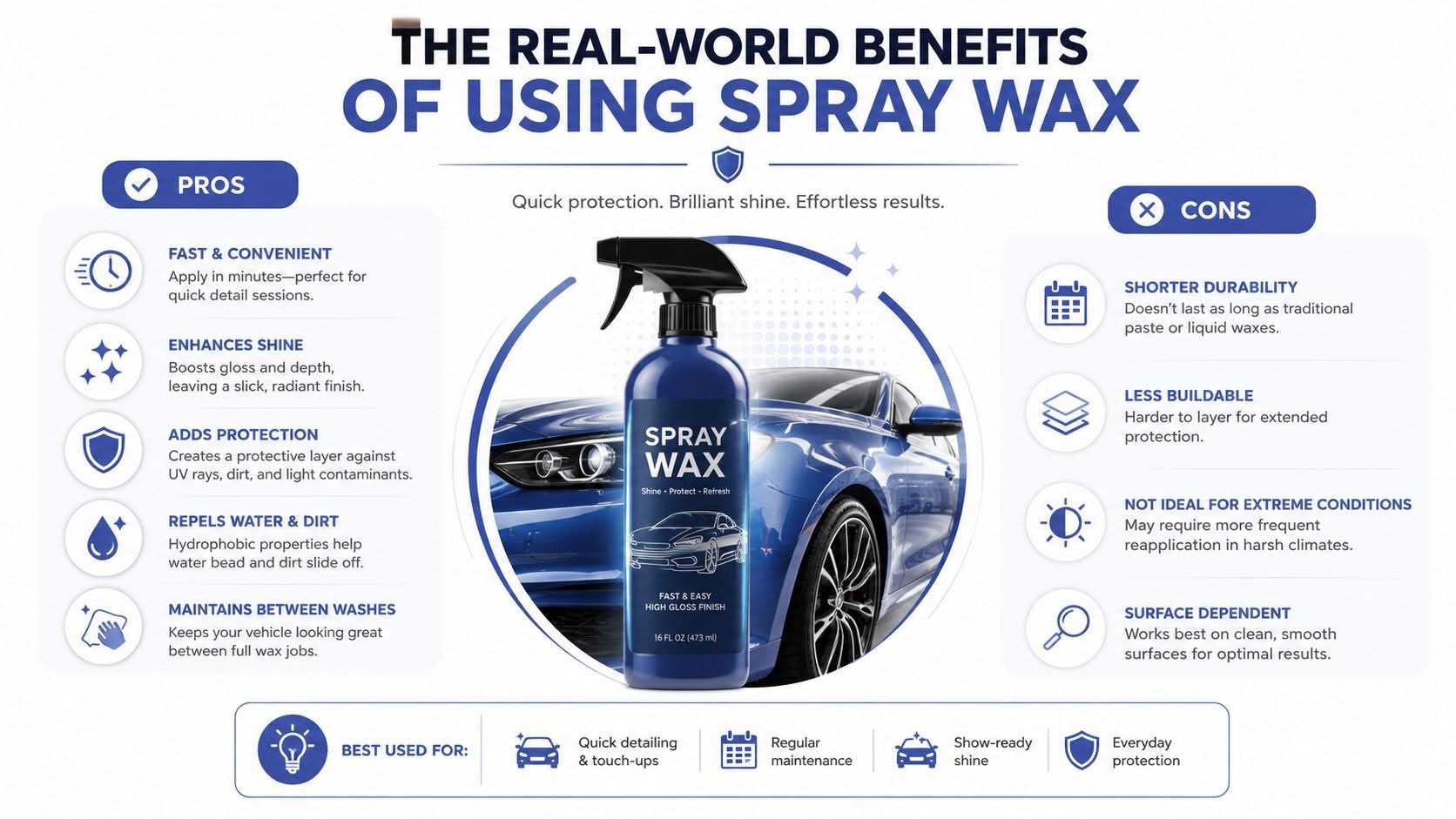
The appeal of spray wax isn’t theoretical. It solves a very specific problem, the driver wants the car looking better now, not after a long detailing session. In practice, that means quicker gloss, easier upkeep, and a product you’ll use often enough to matter.
Speed and simplicity are the headline advantages
Spray wax became popular because it trades longevity for convenience. Industry guidance puts spray wax at roughly 2 to 4 weeks of life, while liquid and paste waxes generally last longer Torquedetail. That shorter cycle is exactly why many owners use it after a wash, not as a once-a-season product.
The upside is that it’s fast to repeat. A driver who reapplies every 2 to 4 weeks could end up using it roughly 13 to 26 times per year Torquedetail. That tells you what the product really is, a maintenance habit, not a long-term coating. For a busy household, that’s useful because it fits into normal washing without adding much labour.
The shine is immediate, but the trade-off is clear
A good spray wax leaves a shiny, streak-free surface and is designed as a preservation layer after washing Kärcher datasheet. For most drivers, the visible benefit is enough. Water sheets off better, paint looks fresher, and trim usually looks less tired when the product is applied correctly.
The trade-off is durability. Spray wax is not the right answer if your main goal is long-lasting protection with fewer reapplications. It shines because it’s easy to live with, not because it outlasts everything else. That’s a fair trade for daily maintenance, and a poor trade for owners who want to park outside, forget about it, and still expect months of protection.
How Should You Apply Liquid Spray Wax for the Best Results?
The easiest way to ruin spray wax is to rush it on a hot panel in direct sun. Perth drivers know how quickly paint heats up, and that heat can cause flashing, streaking, and stubborn wipe-off. The cleaner the surface, the better the result, but the panel temperature matters just as much.
Dry panel or wet panel
There are two common workflows. One is the dry-panel method, where the car is clean, dry, and cool. The other is the wet-panel method, where the vehicle is still damp after washing and the spray wax acts as a drying aid. Neutral guidance says clean, dry, cool surfaces give the best bonding and fewer streaks, while manufacturer directions also support application on a wet vehicle followed by immediate drying and buffing AAA Magazine advice and 3M Quick Wax guidance.
For Perth conditions, the safe choice is simple. If the car has been sitting in the sun, cool it first and work a panel at a time. If you’re using the product as a drying aid after a wash, keep the surface damp, not dripping, and dry immediately with a clean microfiber towel. That approach suits quick maintenance, but it still needs controlled timing.
Practical rule: hot panels and direct sunlight are where streaks start.
A sensible application sequence
- Wash properly first. Spray wax is a finishing layer, not a substitute for removing dirt and road film.
- Work on cool panels. That reduces the risk of premature flashing.
- Apply a thin, even mist. The goal is coverage, not saturation.
- Wipe or dry immediately. Use a microfiber towel and keep the motion light.
- Check reflective surfaces. Plates, glass edges, and trim can catch residue if you’re careless.
For owners who’d rather have a structured process handled professionally, a service such as hand car wax polish sits in a different category. It’s slower and more deliberate, which is exactly why it usually lasts longer and leaves more margin for finish quality.
Explore Professional Wax Application
How Does Spray Wax Compare to Other Protection Options?
Spray wax fills one role very well, and that’s where people get confused. It’s not trying to replace a longer-lasting wax job or a coating. It’s the quick maintenance layer in between those heavier options, and the right choice depends on how often you’re willing to reapply and how much protection you expect.
Where spray wax sits in the lineup
A spray wax concentrate is built around thin-film use and fast turnaround, while a more traditional hand wax or polish is meant to stay on the vehicle longer and usually demands more labour Etowah Chemicals spray wax concentrate, Prime Shine hand wax and polish. This is the dividing line. Spray wax is a maintenance add-on. Hand wax is a fuller protection step. Ceramic coating is a longer-term solution.
A useful way to think about it is this.
| Option | Best use | What you give up |
|---|---|---|
| Liquid spray wax | Quick gloss and frequent refreshes | Long durability |
| Traditional hand wax | More deliberate shine and stronger staying power | Time and convenience |
| Ceramic coating | Long-term protection and easier upkeep | Immediate simplicity and low commitment |
Durability is the biggest separator
Industry guidance says spray wax typically lasts 2 to 4 weeks, while liquid and paste waxes last longer, around 2 to 4 months or more depending on formula and conditions Torquedetail. That gap matters in Perth because strong sun and dusty parking conditions make short-cycle products wear off quickly. The shorter the interval between washes, the more often you'll be back at the bottle.
For drivers looking at longer-term protection, a ceramic coating is positioned as the more durable option, and it's the better fit when you want fewer reapplications and stronger protection between washes Prime Shine ceramic coating guide. Spray wax doesn't compete with that. It complements it at the maintenance level.
Spray wax is for upkeep. Ceramic protection is for owners who want to reduce how often they need to think about upkeep.
Compare Your Protection Options
When Should a Perth Driver Choose Liquid Spray Wax?
Spray wax makes the most sense when you already wash the car often and just want to keep the finish alive between deeper services. That's why it works well after a hand wash, before a weekend event, or as a regular top-up on a daily driver that doesn't live in a garage. The product is quick, but the value comes from using it at the right time.
Best-fit scenarios
Use spray wax when the job is mainly cosmetic and maintenance-focused.
- After a hand wash: It adds gloss and water-beading without turning the wash into a full detailing job.
- Before a sale or event: It gives the paint a fresher look fast, especially if the car is otherwise clean.
- For frequent washers: If you like keeping a car tidy every few weeks, the short cycle becomes a feature rather than a flaw.
- On mixed-use vehicles: Family cars, rideshare cars, and work vehicles often benefit from quick upkeep more than elaborate protection.
The limits matter just as much. Perth's climate is unforgiving, and spray wax doesn't change that. It's not the product to choose if the car sits outside all day and you want broad, longer-lasting UV defence. In those cases, a longer-wearing hand wax or a ceramic coating makes more sense because you're buying fewer reapplications and better long-term value.
For a service stack, that means spray wax belongs near the top of the wash menu, not as the main protection plan. A full detail, a proper cut and polish, or a ceramic package is where the vehicle goes when the paint needs real correction or longer-term defence Prime Shine cut and polish guide.
What not to expect
Don't expect spray wax to fix dull paint, hide defects, or replace proper surface prep. It won't correct swirls, and it won't turn a neglected finish into a protected one just because it beads water. It works best when the vehicle is already clean and you're maintaining a decent standard, not trying to rescue a tired surface.
Find the Right Service for Your Car
Your Smart Path to a Flawlessly Maintained Car
Liquid spray wax is at its best when you treat it as a maintenance habit. It gives Perth drivers a quick way to restore gloss, improve water-beading, and keep the paint looking cared for between more substantial services. The limits are just as important, though, because the short lifespan is what makes it convenient and what makes it unsuitable as a long-term solution.
The smart approach is to match the product to the job. Use spray wax when you want speed and regular shine, choose hand wax when you want a stronger finish with more staying power, and move to ceramic coating when you want durable protection and less frequent reapplication. That's the practical decision tree for local owners dealing with harsh sun, dust, and everyday wear.
Prime Shine Hand Car Wash can apply liquid spray wax as part of a normal wash routine, alongside other exterior and detailing services at its Westminster site. If you want a cleaner finish with less guesswork, visit Prime Shine Hand Car Wash and book the service that fits your car, your schedule, and the level of protection you need.