







You’ve got a stained floor mat, a damp rear seat, or a hallway carpet that looked fine yesterday and now smells a bit stale after a muggy Perth week. That’s usually when people start asking the wrong question. The question isn’t whether steam cleaning of carpets can lift dirt, it’s whether the carpet, underlay, or car flooring can dry fast enough to avoid the mess getting worse.
In practice, hot water extraction is a controlled cleaning method, not a casual soak. Australian carpet-care guidance treats it as a maintenance standard, with carpets generally recommended to be steam cleaned at least once every 12 months and no more than two years apart according to the national guidance linked to Australian practice (Australian carpet-care guidance). That same guidance places typical drying time at 6 to 12 hours, which matters just as much as the cleaning result when you’re dealing with Perth humidity, parked cars, and homes that don’t get much through-breeze.
What Steam Cleaning of Carpets Means?
A lot of people say “steam cleaning” when they mean hot water extraction. The distinction matters because the machine is not just blowing vapour through the pile, it uses heated water, chemistry, agitation, and suction to pull out soil that vacuuming leaves behind. Australian carpet-care guidance places the method inside AS/NZS 3733-1995, so this is a defined technical process, not a loose household habit (Australian carpet-care guidance).
I see the confusion most clearly in cars. A rear footwell can look clean after a quick vacuum, yet still hold road grime, drink spills, and fine soil in the pile and backing. A proper extraction clean reaches beyond the surface, which matters in a cabin that has tight trim, limited airflow, and moisture trapped under mats. For a clear look at how the method is applied inside a vehicle cabin, see this practical breakdown of steam cleaning a car interior.
Why the terminology matters
Hot water extraction and dry steam are not the same thing, and the difference shows up in moisture load. Australian instructions also treat steam cleaning as a method that should comply with AS/NZS 3733-1995, which is a reminder that the process has a technical benchmark rather than a vague “deep clean” label (rental property carpet instructions).
Practical rule: if a cleaner says “steam”, ask how much water is injected and how much is extracted. That answer tells you far more than the name on the machine.
In automotive and home fibres, the trade-off is cleaning strength against drying time. Dense fibres can hold residue, but excess moisture creates a drying problem that no cleaning chemistry can fix later. In Perth, that is where mould risk, backing damage, and shrinkage start to matter more than how fresh the carpet looks at the end.
How Hot Water Extraction Lifts Embedded Dirt?
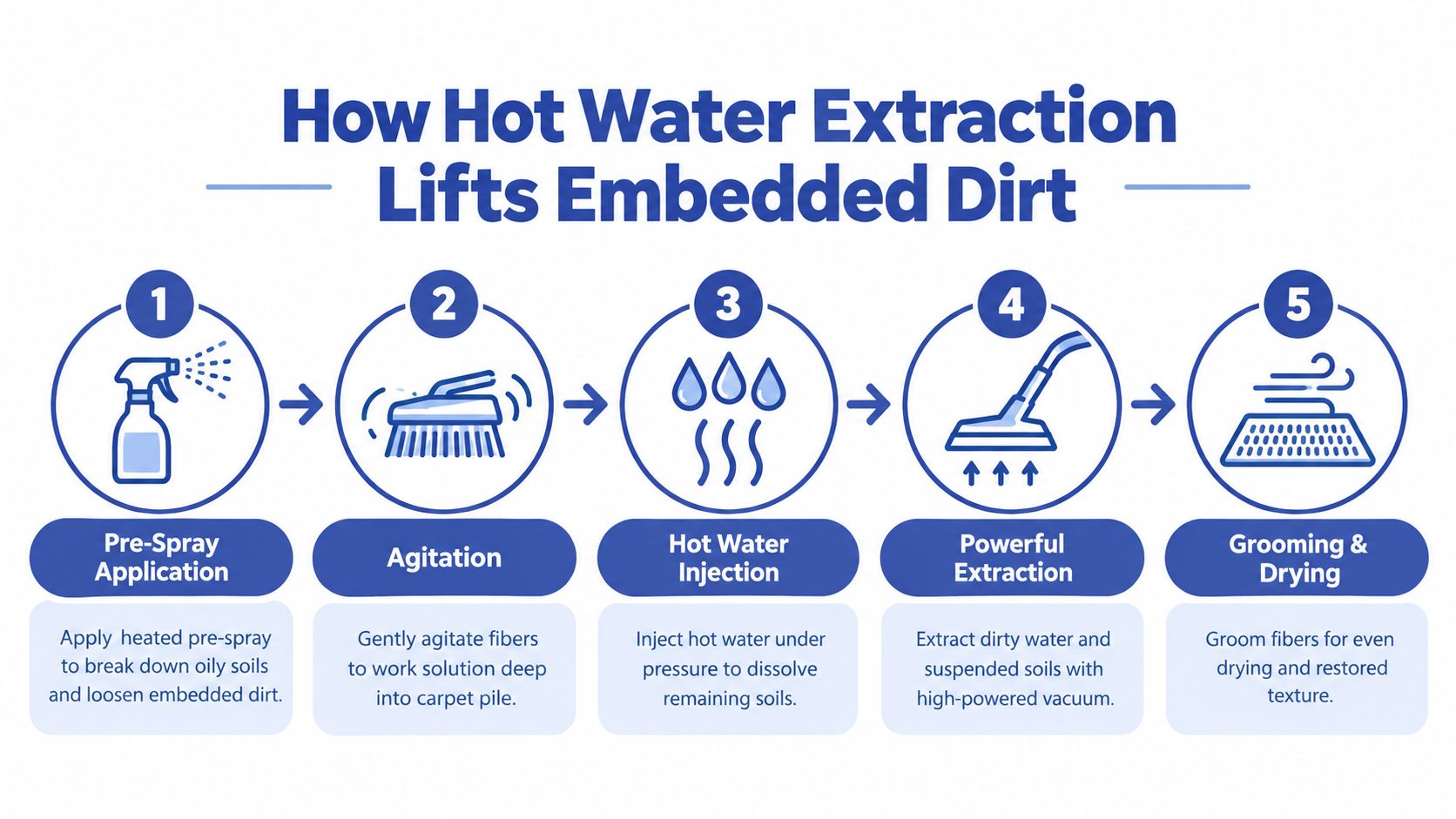
A proper extraction clean follows a sequence, and each step has a job. Australian industry guidance describes the process as pre-spray to loosen soil, agitation to lift the pile, then heated water injected under pressure and immediately vacuumed out. That matters because dirt doesn’t sit on carpet fibres like dust on a table. It binds to oils, settles low, and hides where a dry vacuum can’t reach.
The sequence that works
- Pre-spray application. The solution starts breaking down oily soil and loosens grit that clings to fibres.
- Agitation. A brush or similar action works the solution into the pile so the cleaner does not skim the surface.
- Hot water injection. Heated water flushes suspended soil away from the fibre surface.
- Powerful extraction. Dirty liquid is pulled out immediately, which keeps the carpet from staying soggy.
- Grooming and drying. The pile is reset so air can move more evenly through it.
That order is why extraction beats quick shampooing when the carpet is heavily soiled. Soil has to be broken free first, then lifted out before it can settle back in.
For automotive fabric, the same sequence matters even more. Tight footwells, seat seams, and boot carpets trap residue in corners, and those areas need extraction strength rather than surface foam. A practical seat-focused example sits here: steam cleaning seats like a pro.
Why Steam Cleaning Benefits Auto and Home Fibres?
Hot water extraction earns its place when fibres are packed with grime that vacuuming cannot lift. In a car or a lounge room, the benefit is soil removal. It pulls out embedded dirt that makes carpet look flat, feel rough, and hold odours. Wool and carpet guidance notes that this method is used to remove oily, sticky, and well-settled soils that dull appearance, and it says the work should follow AS/NZS 3733 for professional cleaning.
In vehicles, the benefit is access
Car interiors collect road film, drink residue, food crumbs, pet hair, and boot grime. Vacuuming clears loose debris, but it does not wash out the oils that bind dirt to the fibre. Extraction matters because it flushes residue from seat rails, footwells, boot linings, and other tight sections where dry cleaning falls short.
In homes, the benefit is maintenance
Residential carpet behaves the same way on a larger surface. The longer soil sits in the pile, the more it dulls the finish and adds friction underfoot. Regular extraction is less about rescue work and more about keeping the fibre from loading up until it looks tired and feels harsh.
A practical benchmark helps here. If vacuuming changes almost nothing, extraction is usually the next step.
The trade-off is simple. Steam cleaning is not a fix for every stain, and it does not replace routine vacuuming or stain-specific treatment. It does, however, restore fibres by removing the material that drives visual wear and tactile drag. That is why moisture control matters just as much as cleaning strength, especially in Perth’s climate and in enclosed vehicle cabins.
For a vehicle-specific example, Prime Shine Hand Car Wash lists seats and carpet steam cleaning among its add-ons. The same extraction logic applies in cars and homes, but the drying plan has to be tighter inside a sealed cabin.
Get Interior Steam Cleaning Help
When Added Moisture Becomes a Hidden Risk?
Risk in steam cleaning is usually drying, not cleaning. In Perth, that matters because coastal humidity, winter moisture, and closed-up garages or rooms can hold water in the carpet long after the surface feels dry. Western Australia’s Department of Health warns that damp materials left wet for too long can support mould growth, and the same guidance notes that steam cleaning adds moisture, so humidity control and drying speed need attention (WA Health mould and dampness guidance).
Where the risk shows up
Cars are the easiest place to miss it. Water can settle in floor contours, under mats, and around seat mounts, while the top fibres feel only slightly damp. Homes have the same problem in a different form, with moisture sitting in underlay, edges, and the shaded areas behind furniture. If extraction is weak, the carpet can stay wet below the surface even when the pile looks fine.
The same issue shows up when the carpet already has a moisture history.
What to watch before cleaning
- Already damp areas: A leak, spill, or recurring moisture issue needs to be treated as a drying problem first.
- Poor airflow: Closed rooms, sealed garages, and humid weather slow evaporation.
- Heavy fibre loading: Dense carpet can hold onto water if the cleaning passes are too wet.
If the carpet has a moisture problem before the clean, the plan has to deal with that first.
That is the practical call in Perth. Steam cleaning still works well when extraction is strong and drying conditions are managed. If the area is already vulnerable to damp, a staged drying plan or a different cleaning method is the safer option, especially in a vehicle cabin where airflow is limited.
Comparing DIY Machines to Professional Detailing
A DIY rental machine can tidy up light soil, but it often leaves too much water behind for Perth conditions. That is the trade-off. Cleaning power matters, yet moisture removal is what keeps carpet and underlay from staying damp long enough to trigger musty smells, shrinkage, or mould.
DIY machines are usually built for convenience, not controlled recovery. Professional extraction gives you more consistent pickup, better control over pass speed, and less chance of soaking the base of the carpet. Manufacturer benchmark material for a high-end steam cleaner shows around 4 bar steam pressure, about 3-minute heat-up times, and area performance around 130 m² per tank fill. That is not a direct comparison with every rental unit, but it does show how much workflow and recovery can vary.
DIY Rental vs Professional Extraction
| Feature | DIY Rental Machine | Professional Service |
|---|---|---|
| Water handling | Usually more limited extraction and smaller recovery capacity | Better moisture removal and more controlled pass technique |
| Drying risk | Higher if the operator moves too fast or over-wets | Lower when extraction is strong and ventilation is planned |
| Soil removal | Fine for surface refresh and lighter maintenance | Better for embedded soil and deeper grime |
| Convenience | Easy to hire, harder to judge moisture load | Requires booking, but the process is more controlled |
| Cost context | Lower upfront outlay | Typical local pricing for hot-water extraction sits around A$25 to A$50 per room, with some market guides placing it around A$35 to A$60 |
For car owners, the choice becomes more specific. Tight footwells, thick carpet, and seats that trap moisture all raise the risk of lingering damp, which is why a practical seat-cleaning process matters too, as outlined in this guide on steaming car seats like a pro. A cabin that dries slowly can smell fine at first, then turn stale once the day cools down.
DIY makes sense for light maintenance and quick refreshes. Professional detailing is the safer call when the pile is dense, the soil is packed in, or the space has limited airflow. In Perth, that moisture control is often worth more than the lower hire fee.
Post-Cleaning Drying and Care Best Practices
A clean that stays damp is not finished properly. After hot water extraction, the primary trade-off is moisture control, especially in Perth where heat, airflow, and enclosed interiors can turn a fresh clean into a mould or shrinkage risk if the fibres are left too wet.
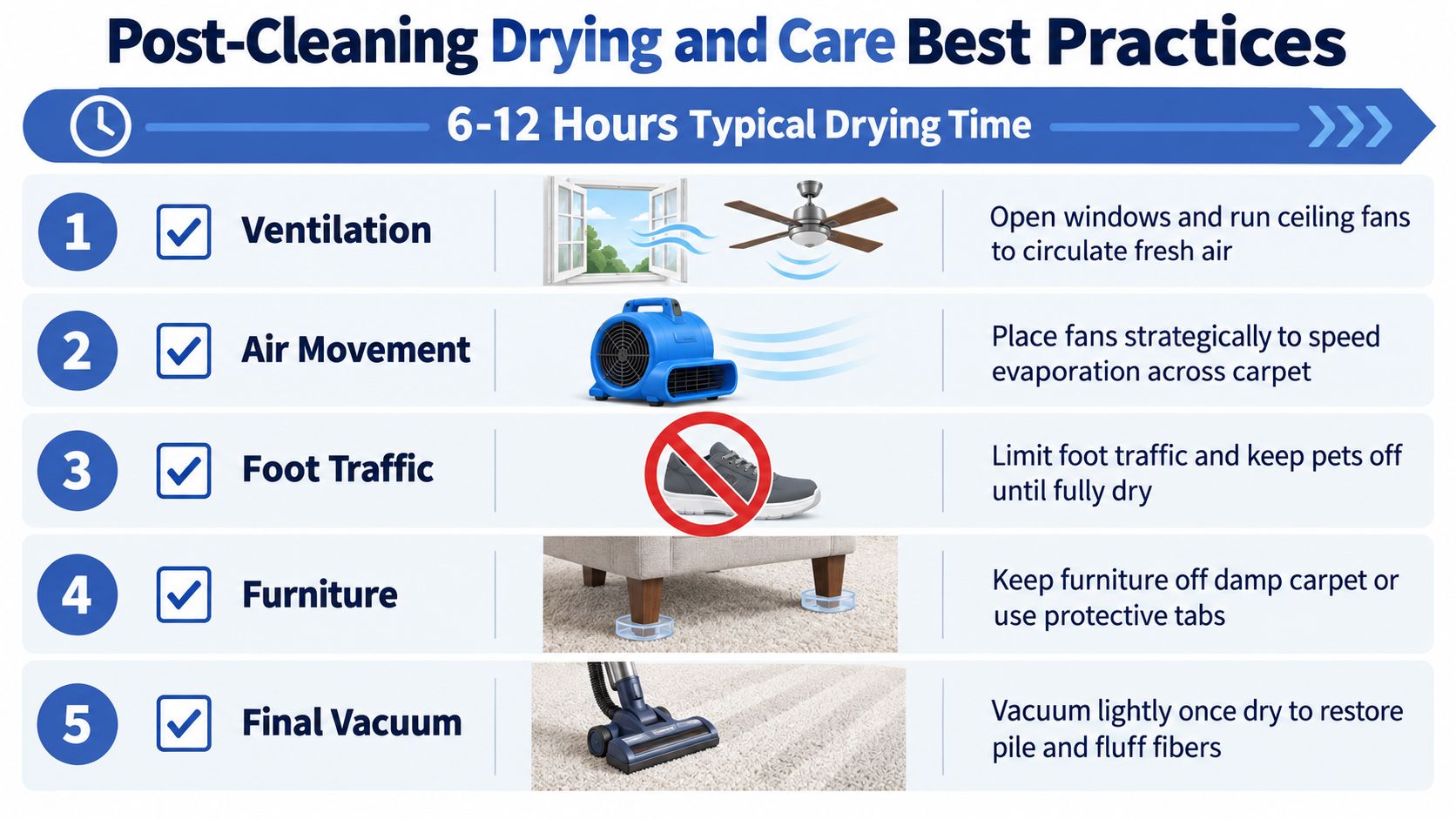
Dry times vary with pile thickness, ventilation, and how much moisture the extractor left behind. The practical target is simple, keep air moving and let the carpet dry evenly rather than forcing foot traffic back too soon.
What to do right after the clean
- Open the space up. Fresh air helps moisture leave the pile instead of sitting in it.
- Move air across the surface. Fans, ceiling circulation, or vehicle airflow shorten the damp window.
- Keep traffic off. Shoes, paws, and repeated steps flatten fibres and press soil back down.
- Protect furniture legs. If items have to go back early, use tabs so moisture does not transfer into the base.
- Vacuum lightly once dry. That lifts the pile and clears loosened residue.
In a car, the same approach applies with the air conditioner and fan settings. Push dry air through the cabin, crack the doors when safe, and leave mats out until the flooring is properly dry. A stale smell right after cleaning usually fades as the moisture leaves. If it hangs around, the carpet needs more airflow.
Practical rule: do not judge the dry point by touch alone if the underlay is thick. The surface can feel ready while the base still holds moisture.
The safer habit is patience. Fast drying lowers the risk of re-soiling, odour, and mildew.
Book Fast-Drying Carpet Cleaning
Maintaining Your Carpets Between Professional Cleans
A good maintenance plan is about keeping soil out before it settles and managing moisture before it lingers. Regular vacuuming, quick spill response, and a professional extraction cycle matched to how the carpet is used all matter. For carpeted floors in busy homes, family cars, and pet-heavy vehicles, the interval usually needs to stay on the shorter side of the cleaning cycle.
Keep the fibre from loading up
Dry grit is the problem. Once moisture hits it, that grit turns into slurry and works deeper into the pile.
Vacuum often, and clear spills fast. Fresh marks are easier to lift than older stains that have already bonded to the fibre. If pet hair is part of the mess, remove it before extraction so the cleaner can reach the carpet instead of fighting a mat of loose fibre. A practical guide for that stage is pet hair removal for cars.
In Perth, the dry issue can be just as important as the clean itself. Warm air helps, but thick underlay, shaded parking, and closed cabins can trap moisture long enough to cause odour, mould, or shrinkage if the carpet is packed with residue.
The goal is simple. Keep the carpet clean enough that hot water extraction resets it, rather than trying to rescue it.
If you need the job handled with moisture control in mind, book an interior or carpet service with Prime Shine Hand Car Wash. Their seat and carpet steam cleaning is built for detailing work where embedded soil has to come out and drying needs to be managed properly.