







You’ve just parked outside the shops in Westminster. The dash is hot, the bonnet carries a film of dust, and a streak of bird lime will bake on if you leave it. That is when Perth drivers start asking what is car ceramic coating, and whether it can keep the sun from dulling the paint.
The honest answer splits paint damage in two. UV, dust, grime and bird droppings attack the surface chemically, hour after hour in the heat. Stones and trolley knocks attack it physically. Ceramic coating belongs to the first fight, so judge it on easier washing and slower weathering.
Unsure what your paint is up against? Bring the car to Prime Shine Hand Car Wash in Westminster and we will check the clear coat first.
What Is Car Ceramic Coating?
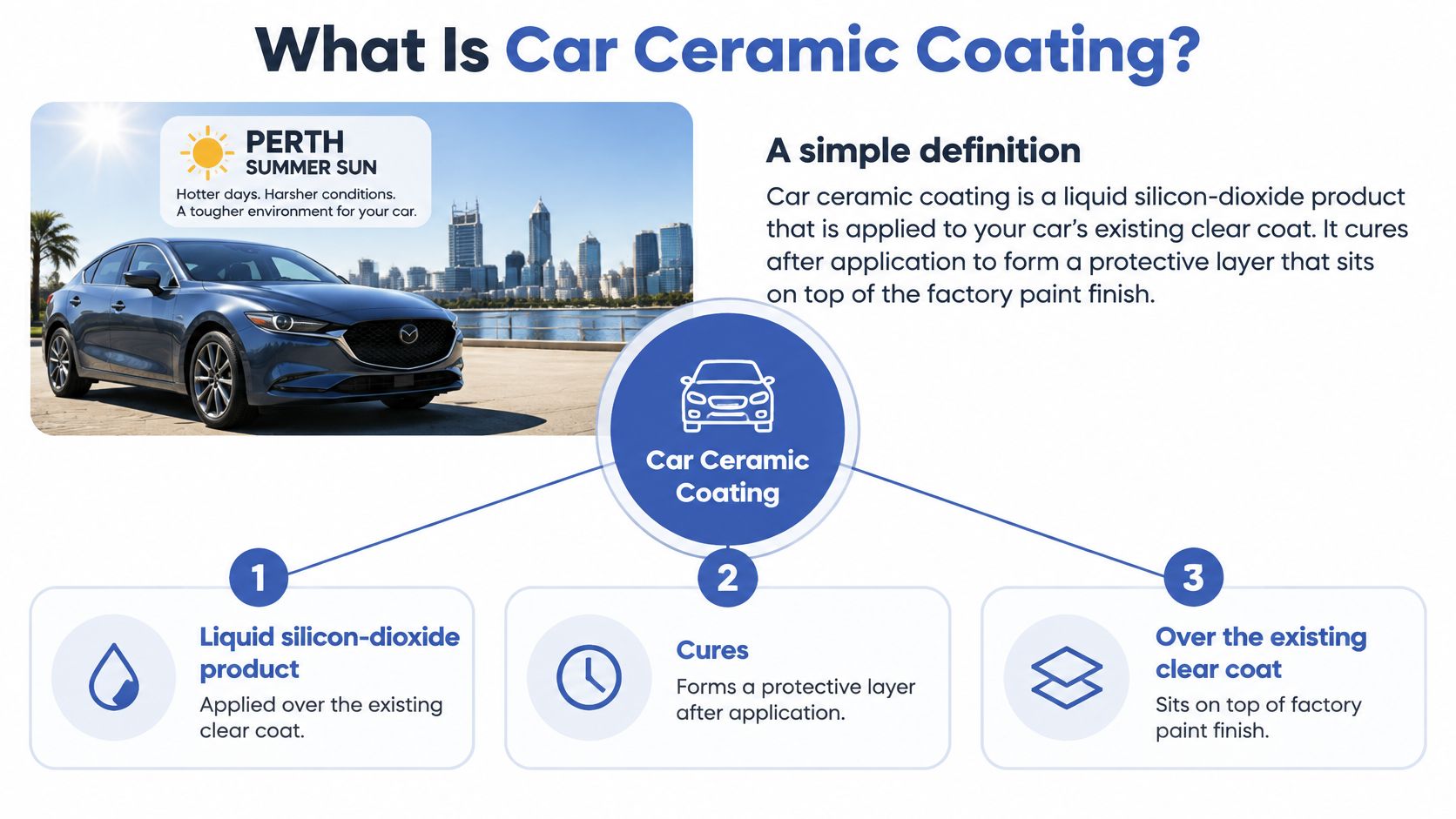
A white SUV sits in a Westminster car park at 2 pm. The shine you see is factory clear coat, not a second skin. Car ceramic coating is a liquid silicon-dioxide product wiped over that clear coat. It cures into a glass-like film, generally around 1-2 microns thick, and chemically bonds to the finish. The NRMA sun-protection guide treats it as a thin protective layer over the existing clear coat, not a replacement for the factory paint system.
At that thickness the layer can’t swallow a stone, stop a deep scratch, or shrug off a trolley. Its job is narrower, and still useful in Perth heat. It reduces direct contact between the clear coat and dirt, grime and chemical fallout, slows surface oxidation, and lets water bead and run off so a routine wash needs less scrubbing.
Want a local quote before the next hot week? Book a paint check with us in Westminster and we’ll say whether the clear coat is ready, or whether it needs correction first.
Ceramic coating is a sacrificial skin that slows weathering. It is not armour, and it is not a maintenance-free shell.
What the thin film changes in the sun
The same NRMA guidance is blunt about ultraviolet light. Coatings do not directly block 99% of ultraviolet radiation. They help protect the clear coat’s built-in UV inhibitors from oxidation and degradation. A typical service life is approximately 2-5 years, after which the coating gradually degrades and needs reapplication.
Say you hose that SUV at dusk. Water stands in tight beads and rolls toward the sill, taking loose dust with it. The paint underneath is still the finish the factory sprayed. You have added a bonded film measured in microns, which is why a shopping-trolley kiss still shows.
Practical rule: if a claim calls the coating scratch-proof, chip-proof or permanent, treat it as oversold. Judge it on easier washing and slower weathering, nothing more.
Explore ceramic coating at Prime Shine
How Does Ceramic Coating Compare with Wax?
A freeway stone and a summer of dust are different problems, and no single product answers both. The table below separates a short gloss boost, a bonded silica layer and a physical film, so each option is judged on the job it is built for.
| Protection | Typical life | Main job | Chips and scratches | Indicative AU cost |
|---|---|---|---|---|
| Carnauba wax | Weeks | Temporary gloss and water beading on top of paint | No impact or scratch barrier | Low, often a wash add-on |
| Synthetic sealant | Several months | Polymer seal that outlasts wax | Still no chip barrier | Usually below professional ceramic pricing |
| Ceramic coating | 2 to 5 years with proper maintenance | Bonded silica layer for easier washing and slower weathering | No chip barrier; does not stop washing swirls or deep scratches | From $699 at Prime Shine, with final pricing set by vehicle size, condition and extras |
| Paint protection film | Several years | Thick physical film on high-impact panels | Absorbs stone chips and abrasion | Well above ceramic; panel packages vary |
How the lifetimes split
Carnauba wax works like sunscreen. It helps for a while, then it needs reapplying. A Saturday wax on a daily hatch looks rich for a few weekends, then brake dust sticks and the wash effort is back where it started. A synthetic sealant stretches that cycle out to a season, but it still leaves the paint bare against chips. If that shorter cycle suits the car, our guide to when liquid car wax is the right call explains when a wash add-on is enough.
Ceramic coating is the bonded row. Where wax and sealant sit on the paint and wear away, the silica layer holds to the clear coat itself, which is why it keeps its water-repelling, easy-wash behaviour through several Perth summers rather than a few weekends. Ceramic coating at Prime Shine starts from $699, with the final price shaped by the vehicle’s size, condition and extras such as specialised protection for glass, wheels and trims. Quotes are transparent and obligation-free, and with proper maintenance the coating lasts two to five years, depending on driving conditions, washing habits and exposure to harsh elements.
Weighing up wax against ceramic? Get an obligation-free quote from Prime Shine and we will say which row of the table your car actually belongs in.
Paint protection film is a different tool. It is a much thicker physical sheet for bonnet and bumper stone chips, priced well above a coating. Say the worry is a freeway stone. No chemical row in the table absorbs that hit, because chemistry is thin and film has physical thickness. The silica layer can still make the panel easier to wash afterwards, and the chip will still be there.
One verdict
Choose wax for a cheap, short gloss boost. Choose ceramic coating for washability and slower clear-coat weathering. Choose film where impact damage is the main worry. Paying for silica when you needed thickness, or for film when you only wanted easier washes, is the expensive mix-up.
How Does Ceramic Coating Bond to Paint?
The liquid only bonds to clear coat that is bare. Anything left on top becomes a barrier, so the order of work matters more than the bottle.
Prep before any liquid touches the panel
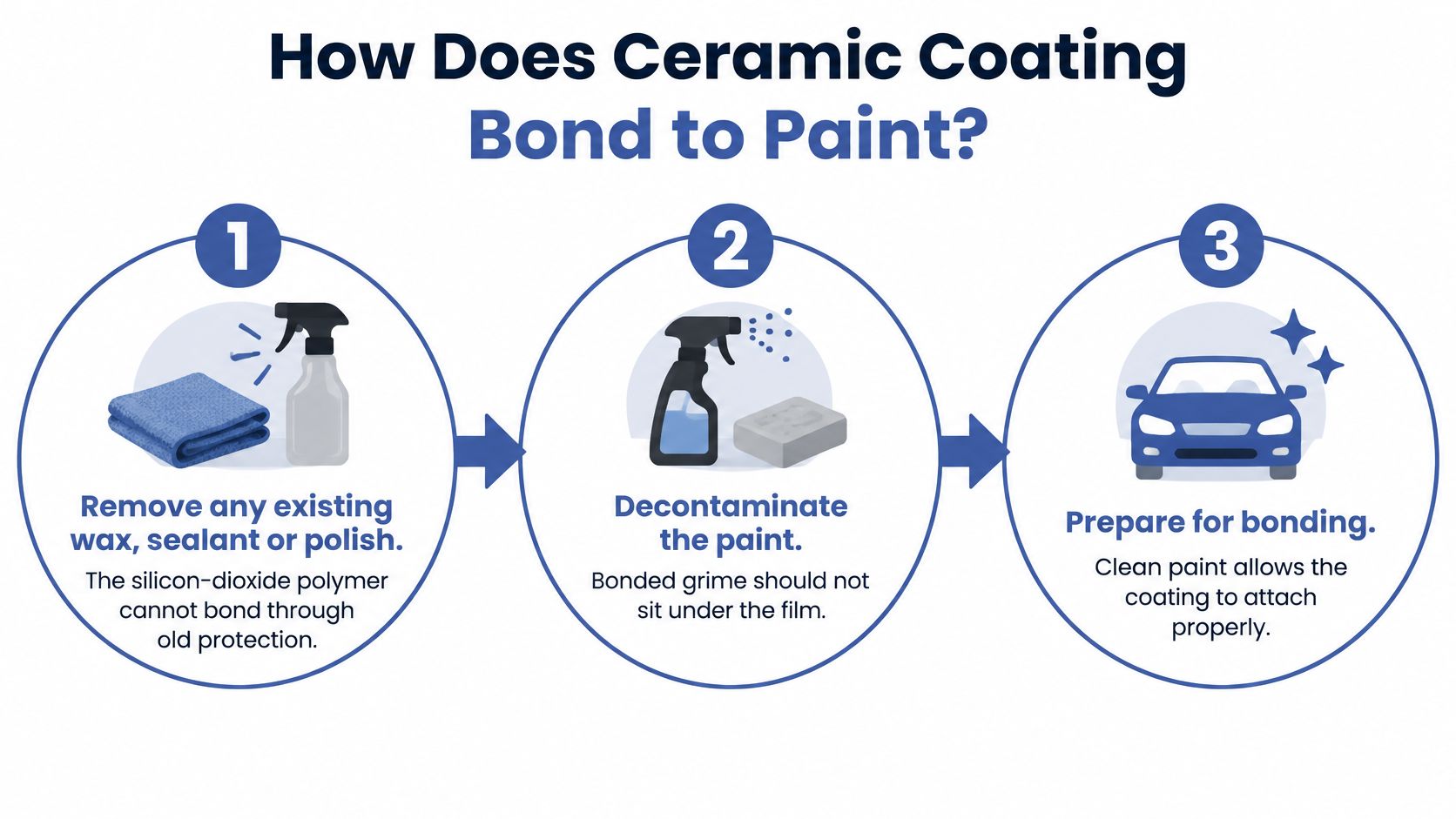
- Strip old protection. Existing wax, sealant or polish is removed before ceramic coating is applied, so the coating can bond properly. The silicon-dioxide polymer can’t grip through that old layer.
- Decontaminate the paint. Bonded grime, rail dust and tar shouldn’t sit under the film. If they do, the coating bridges over them and the bond is patchy.
- Correct swirls first. The cured film locks in whatever the clear coat already shows. Machine correction is a prep decision for dull or swirled paint, not a later fix. Our note on what paint correction is and whether it is worth it is the checkpoint before anyone coats over haze.
Swirled or dull paint needs correction with us before coating. Coating a tired clear coat only seals the marks you can already see in the sun.
What the bond does to a water droplet
Once the panel is clean, the liquid is wiped on and cures into a thin hydrophobic skin chemically bonded to the clear coat. Two figures describe what that skin does. Contact angle measures how tall a droplet stands on the paint. Slickness measures how readily the surface releases dirt. Higher on both means water beads tighter, rolls off sooner and carries loose dust with it, so each wash takes less effort. Washing still stays on the schedule; every wash just gets easier.
Read hardness ratings for what they measure. A “9H” label refers to a pencil-scale hardness test run in a lab, a different thing from a stone hit at freeway speed. Supplier figures work best as a guide to water behaviour and chemical resistance. Judge a coating on how the car washes and weathers over months of Perth sun, and treat any single lab number as one piece of that picture.
The bond keeps strengthening after the car leaves the bay. You can drive shortly after application, provided the paint stays dry and unwashed for at least 24 hours. Full curing takes up to seven days, a bit like varnish that feels dry to the touch while it is still soft underneath. Gentle handling through that first week protects the layer while it hardens.
Ready for paint that washes easier? Book a time and we handle the stripping, decontamination and application, then walk you through the first week’s care.
Learn about paint correction before coating
How Long Does Ceramic Coating Last and What Keeps It Working?
A professionally applied coating commonly lasts about two to five years with proper maintenance, then it gradually degrades and needs reapplication. Where a car lands in that window depends on driving conditions, washing habits and exposure to harsh elements. The figure on the bottle is a ceiling for a well-kept car, not a date you can set and forget.
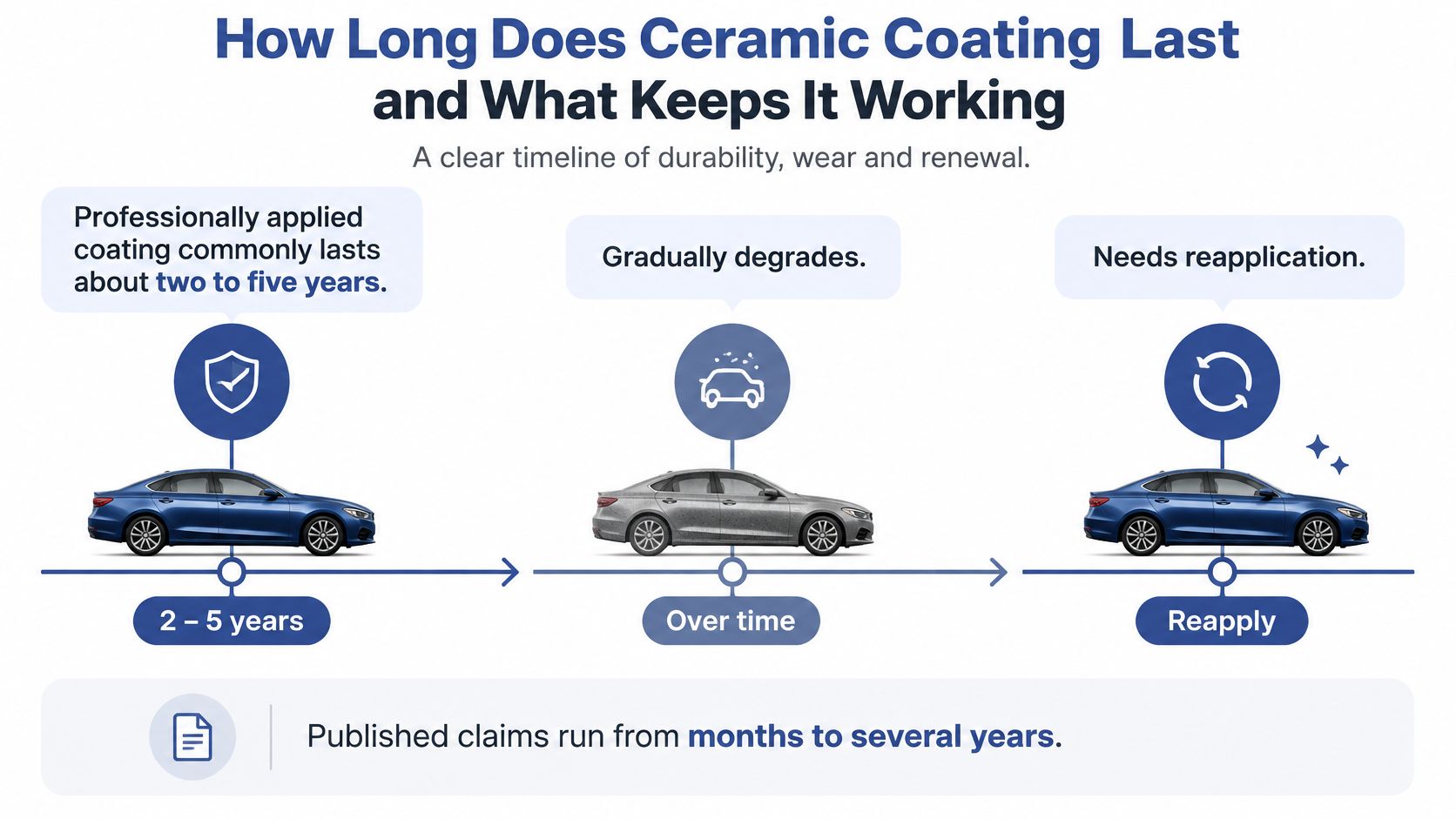
Ceramic coating is chemical protection, so judge it on slower weathering and easier washing rather than on surviving a stone. A garaged car that is washed gently sits toward the longer end of the range. An outdoor Perth commuter, a coastal car or a rideshare vehicle sits toward the shorter end, because UV, heat, road film and missed washes wear the layer down faster. Stone chips and car-park knocks stay a job for paint protection film, whatever the coating promises.
Not sure where your car sits in that range? Ask us to look at the paint and how the car is parked, and we will give you a straight answer.
Beading is not a health check
Strong beading is not proof the coating is healthy. Water can still stand up in beads while the surface is contaminated, or while performance underneath is already fading. The coating also does not prevent water spots: mineral deposits can still form wherever water is left to dry on the panel. Bird droppings, tree sap and pollen can still etch if they sit on hot paint, so beading is a cue to wash promptly and safely, not a clean bill of health.
Wash rhythm by how the car is used
| Use | Wash rhythm | Contamination habit | When to reassess |
|---|---|---|---|
| Outdoor daily driver in Perth heat | Hand wash about weekly | Dry promptly and lift droppings or sap the same day | Check beading and gloss about every 6 months |
| Coastal or salty roads | Rinse salt soon after exposure and wash more often than a garaged car | Soft microfibre only and no automatic brushes | Look for spotting and dull patches each season |
| Garaged weekend or luxury car | Hand wash every 1-2 weeks | Gentle dry and no abrasive cleaners | Plan a detailer inspection about yearly |
| Rideshare, delivery or fleet | Wash as film builds, often more than weekly | Do not leave grime on hot paint | Expect the shorter end of a 2-5 year life |
The same rules apply to every row. Wash with pH-neutral car shampoo and soft microfibre towels, and keep automatic brushes and abrasive cleaners away from the coating. Dry promptly so minerals cannot spot the surface, and follow the wash to the dirt the car collects rather than a fixed day of the week. Our maintenance guide for Perth drivers sets out the full routine step by step. Coating cuts the effort each wash takes; regular cleaning is still what keeps the shine.
Cure rules before the first wash
You can drive shortly after application, but keep water and washing off the car for at least 24 hours while the coating sets. Full curing takes up to seven days, so shield the car from rain, sprinklers and harsh chemicals through that first week. Water that lands on an uncured film can mark it before the bond has finished forming.
Reassess when water stops sheeting cleanly and the same panels hold dirt week after week. That pattern is the cue for a detailer inspection, not another heavy polish over a tired film. Build decontamination into that visit when bonded fallout will not release with a normal hand wash.
Once the cure window has passed, book the first maintenance wash with us. A gentle hand wash then is what keeps the new surface from starting life under road film.
See the ceramic coating care guide
Which Cars Benefit from Ceramic Coating?
The fit depends on the risk, not the badge. Three common Perth scenarios show where coating fits, and each one fails a different test if you expect it to do a film’s job.
Coating is chemical protection. It slows weathering, deepens gloss and lets dirt release with less effort. Physical protection against impacts is a separate product, and confusing the two is where disappointment starts.
The family SUV at the shops
A family SUV or daily hatch that sits in the open wants dust, brake dust and bird lime to release more easily. Ceramic coating fits if you still hand wash. Trolley dents and car-park knocks still mark the panel, and a stone on the bumper still chips the paint. The win is a quicker wash on a Thursday night and paint that weathers slower in the sun.
Already spending weekends washing? Ask for an obligation-free coating quote and see what easier maintenance costs.
The enthusiast car with dull paint
A luxury or enthusiast car with swirl marks and flat colour needs correction first. The coating locks in the surface it covers, so swirls left on the panel get sealed under it. It cannot repair faded paint or peeling clear coat, and coating over failing clear coat hides nothing and wastes the prep.
Sound paint on an SUV, ute, van or bike follows the same rule as a sedan. The clear coat has to be stable, and you have to accept ongoing washing.
Ask us for a paint-condition check before you book. We’ll tell you if the clear coat can take a coating, or if correction has to come first.
The rideshare ute and the stone-chip worry
A rideshare, delivery or fleet ute gains faster wash days. Expect the shorter end of the coating’s two-to-five-year life, because road film, heat and debris work the surface harder every shift. Chemical protection helps contamination release. Highway stones keep arriving at the same speed.
Match each scenario to the outcome it buys:
- Easier maintenance: fewer stubborn films and a wash that releases dirt with less pressure. This is what the shops-and-school-run SUV is paying for.
- Improved gloss and water behaviour: tighter beads and a clearer look on sound paint. This is the reward the corrected enthusiast car shows off.
- Actual impact protection: stones, abrasion and car-park hits. Paint protection film, a substantially thicker physical barrier, carries this one.
Judge a Perth daily driver on the first two lines. If the third is the fear, that is a film conversation, and CarsGuide’s ceramic coating advice draws the same line.
Tell us where the car lives and how it earns its keep. A quick look at the paint answers which outcome is actually worth paying for.
Check the Perth ceramic coating price guide
Should You Book Ceramic Coating in Perth?
Book when the clear coat is sound, or will be corrected first, and the goal is easier washing plus slower weathering in Perth heat. If stone strikes on the bonnet and bumper are the main fear, that points to paint protection film. The decision rule from the earlier comparison still applies here.
Prime Shine Hand Car Wash at 9/436 Wanneroo Rd, Westminster WA 6061, applies ceramic coating by hand, with no automated brushes, alongside hand washing, detailing and cut and polish. Preparation is part of the service: the paintwork gets a deep clean to lift out contaminants, and any existing wax, sealant or polish is removed so the coating can bond properly. Coating over old product or embedded grime is the main way a good coating gets wasted.
Ceramic coating starts from $699, with the final price set by vehicle size, condition and selected extras such as specialised protection for glass, wheels and trims. Booking online takes $100 off Full Car Detailing and Ceramic Coating with the code PRIME100, and start times run from 08:00 to 16:00 in 30-minute intervals. Quotes are transparent and obligation-free. The ceramic coating price guide for Perth drivers lines the starting figure up against your vehicle before you pick a slot.
One more check before you commit: confirm paint correction separately, so a dull car isn’t coated over its swirls. The service suits cars, SUVs, 4WDs, utes, vans, bikes and luxury vehicles when the paint underneath is stable.
Ready when the paint is. Book a ceramic coating start time at Prime Shine Hand Car Wash, or request an obligation-free quote.