







Cut and polish is a machine-assisted clear-coat refinement that reduces swirls and light scratches. It’s worth booking when the paint looks dull but the damage is still in the clear coat, and it isn’t worth paying for when the marks have cut through to primer or the panel already needs repainting.
If you’ve just washed the car in Westminster, rolled it into the sun, and still seen that hazy spider-web look on the bonnet, you’re seeing surface damage, not leftover dirt. A proper cut and polish targets that damaged top layer so the paint looks clearer again without jumping straight to heavy correction.
Why Your Paint Looks Dull Even After a Wash?
A clean car can still look tired in bright light. That’s the part many drivers miss, because the grime is gone, but the damage is still sitting in the clear coat. On a grey sedan or a black ute, that haze shows up as fine webbing, dull patches, and a finish that never quite looks crisp.
The most common culprits are simple. Automatic brushes can leave swirl marks, bad drying can create micro-scratches, and tight parking around Perth suburbs can leave brush marks along the sides. None of those are solved by soap alone, because washing removes dirt on top, not the texture damage underneath.
What’s actually sitting on the paint
The clear coat is the transparent top layer over the colour coat. It’s the layer that gives the paint depth and gloss, and it’s also the layer that gets marked first. Australian guidance from RACV describes swirl marks as one of the most common forms of paint damage on vehicles, and says they’re usually fine scratches caused by poor washing or drying rather than deep paint failure. RACV paint correction guidance
Perth drivers also deal with harsh conditions that make the finish look worse faster. Strong UV, red dust, and salty air all work against a clean glossy surface, so what looked fine under shade can look flat under direct sun. That’s why a customer often thinks the car needs a deep clean, when it really needs controlled refinement.
Practical rule: if the car feels clean but looks cloudy in sunlight, you’re probably dealing with surface texture in the clear coat, not embedded dirt.
If you want a simple place to start, Prime Shine’s paint cleaning treatment sits in that same preservation mindset, where preparation matters before any machine work touches the paint.
The short version is this. Dull paint is usually a texture problem, not a dirt problem, and that’s exactly where cut and polish earns its keep.
What Cut and Polish Actually Means for Your Car?
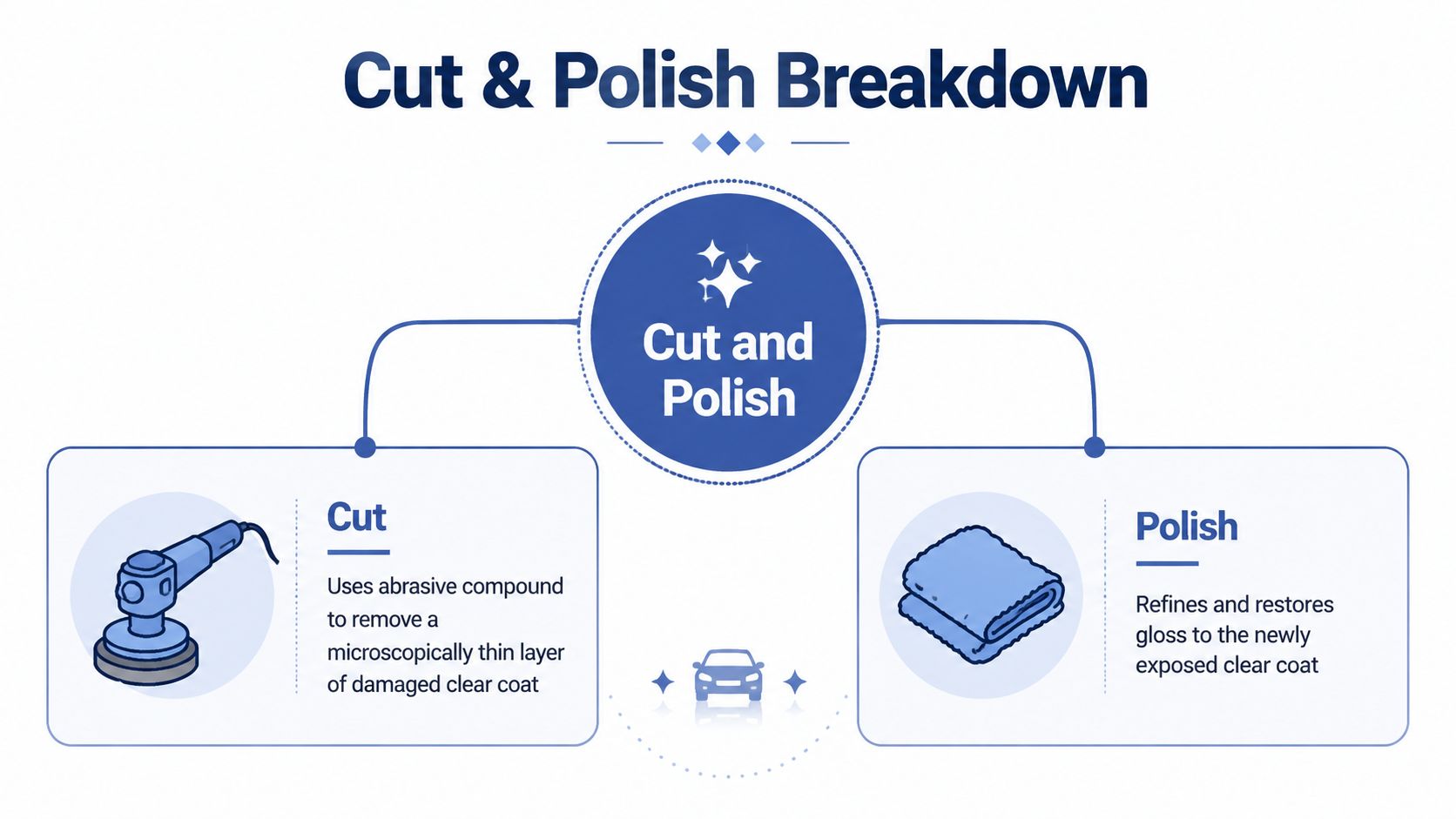
Cut and polish has two real jobs. The cut uses a mildly abrasive compound and a machine polisher to remove a microscopically thin layer of damaged clear coat, and the polish refines what’s left so the finish looks glossy again. Australian detailing guidance describes it as a clear-coat leveling process, not a wax job dressed up with nicer words. Cut and polish clear-coat leveling
A good way to think about it is sanding a rough wooden table before varnishing it. You’re not rebuilding the table, you’re flattening the surface so the finish can look even. In paint work, the removal is tiny, because a healthy clear coat usually has only a limited layer to work with, and the technician needs to remove just enough to flatten the marks without chasing them too far.
What it can and can’t do
A single-stage cut and polish is aimed at light to moderate defects. That fits the kind of paint Prime Shine offers on its cut and polish package, where the goal is to reduce swirls and light scratches rather than chase deep failure across every panel. On the other end, multi-stage correction goes further for heavier damage and takes more time because the paint needs more careful work. Prime Shine cut and polish service Australian paint correction stages
It can’t fix everything, though. Chips that have gone through to primer, clear coat that’s already peeled, and mismatch from a panel respray are outside the scope of normal cut and polish. Australian guidance also notes that deeper scratches that catch a fingernail are usually too deep to fully remove without repainting. What a cut and polish is worth
Important: the service should preserve paint, not consume it carelessly. Done properly, it extends the useful life of the clear coat by removing only the damage you can actually see.
That’s why the phrase matters. Cut and polish is controlled defect removal, not cosmetic buffing and not a miracle fix for damaged panels.
How the Cut and Polish Process Works Step by Step?
A proper cut and polish starts long before the machine touches the paint. First comes a full decontamination wash, because grit, tar, and bonded grime can get dragged across the surface if they’re left there. Australian detailing guidance recommends a thorough wash and then clay preparation before polishing, because polishing over embedded contamination can grind the debris back into the clear coat and make the defects worse. RACV paint correction guidance Clay bar preparation
Then the paint gets assessed under proper lighting. A detailer looks for swirl marks, holograms, high spots, and deeper scratches so the correction level matches the actual condition of the panel. That inspection matters because the wrong pad or compound can create haze instead of removing it.
The working stages
The cutting stage uses a pad and compound with a dual-action or rotary machine, worked panel by panel in overlapping passes. RACV advises starting with the least aggressive product first, and says a dual-action polisher gives more consistent results with lower risk than a rotary buffer. RACV paint correction guidance
The polishing stage follows with a finer pad and finishing polish to restore clarity after the cut. A detailed Australian process description says the surface may then be wiped with isopropyl alcohol so the true finish can be checked before any protection goes on. Australian paint correction process
A clean result comes from the whole sequence, not just the machine work. If the prep is rushed, the finish usually is too.
Protection comes last. That can be wax, sealant, or an optional ceramic coating, depending on what the driver wants after the correction. Prime Shine lists cut and polish alongside hand wash, detailing, and paint protection services, which makes sense because the finish is usually worth protecting once the defects are reduced. Prime Shine paint protection and detailing
For a standard sedan, a single-stage job often sits in the half-day range, while larger utes and SUVs take longer because there’s more paint to correct and more edges to work around. That timing comes from the physical process, not from a sales script.
Cut and Polish vs Wax, Paint Correction and Ceramic Coating
These services get mixed up because they all make paint look better, but they don’t do the same job. Wax adds shine and a sacrificial layer, paint correction goes deeper with multi-stage machine polishing, and ceramic coating is a longer-term protective layer applied after the paint has been corrected. Cut and polish sits in the middle, because it removes defects but doesn’t usually chase every heavy mark.
Wax is the easiest one to misunderstand. It can make a car look richer, but it won’t flatten swirl marks or remove oxidation. That means a waxed panel can still look cloudy in sunlight if the clear coat underneath is already marked.
Choosing the right level of work
Paint correction is the heavy-duty option. Australian guidance from 3Stage Car Care says Sydney pricing commonly runs from $400 to $2,500+, with Stage 1 starting at $400, Stage 2 at $700 to $1,200, and Stage 3 at $1,500 to $2,500+. It also says Stage 1 can remove about 50 to 70% of visible defects in 4 to 6 hours, while Stage 2 can remove about 85 to 90% and usually takes 1 to 1.5 days. Paint correction pricing and benchmarks
That gives Perth drivers a useful way to think about the service ladder. A cut and polish is for light to moderate swirls, a more aggressive correction is for heavier oxidation or scratching, and ceramic coating is for protection after the paint has already been refined. If you want to read the protection side of the story, Prime Shine also keeps a dedicated ceramic coating guide for Perth drivers.
| Service | Removes Swirls? | Longevity | Typical Price, Perth | Best For |
|---|---|---|---|---|
| Wax | No, it mostly hides the look | Short-term shine and protection | Varies by product and package | Fresh gloss between proper details |
| Cut and polish | Yes, for light to moderate defects | Better finish until the next wash cycle and aftercare habits | Usually sits below heavy correction, with local guidance often placing basic swirl reduction around $250 to $400 and multi-stage work upwards of $600 RACV paint correction guidance | Dull paint with visible swirls and light scratches |
| Paint correction | Yes, more extensively | Depends on the service depth and aftercare | $400 to $2,500+ in Sydney guidance, often used as a reference point for deeper work Paint correction pricing and benchmarks | Heavier defects, oxidation, and neglected paint |
| Ceramic coating | Not by itself | Longer-term protection after correction | Depends on coating and prep | Drivers who want easier maintenance after correction |
The best match is the one that fits the paint’s condition. If the damage is light, a cut and polish is enough. If the defects are deep, paying for a light service won’t solve the underlying problem.
Who Should Book a Cut and Polish and When?
The right customer is usually easy to spot. It’s the commuter whose bonnet has picked up highway grime, the owner getting the car ready for sale, the buyer of a used car who wants to reset neglected paint, or the enthusiast who wants a cleaner base before wax or sealant goes on. Those owners usually care about gloss, not just cleanliness.
The signs are practical too. Spider-webbing under fluorescent lights, hazy side panels after repeated automatic washes, dull patches after rain, and roughness you can feel across a clean surface all point to clear coat texture issues. If you can see the marks in shade and they get louder in sunlight, the finish probably needs refinement rather than another wash.
When to skip it
Skip cut and polish if the car is brand new and the paint is still healthy, especially within the first few months. Skip it again if the car has fresh respray work, because newly painted panels need the right cure time and a different approach. Deep oxidation or severe scratching belongs in a fuller correction discussion, not a quick surface refresh.
Simple test: if the defect disappears when the panel is wet but returns when it dries, you’re probably looking at surface marking that a polish can improve.
A used-car buyer should also stay honest about expectations. If the finish is badly neglected, a cut and polish may improve the look a lot, but it won’t turn tired paint into factory-new paint. That’s where people waste money, because they pay for shine when they really need defect repair.
The smartest booking decision is to match the service to the paint, not to the sales pitch. That keeps the spend sensible and the clear coat intact.
What a Cut and Polish Costs and How to Book at Prime Shine?
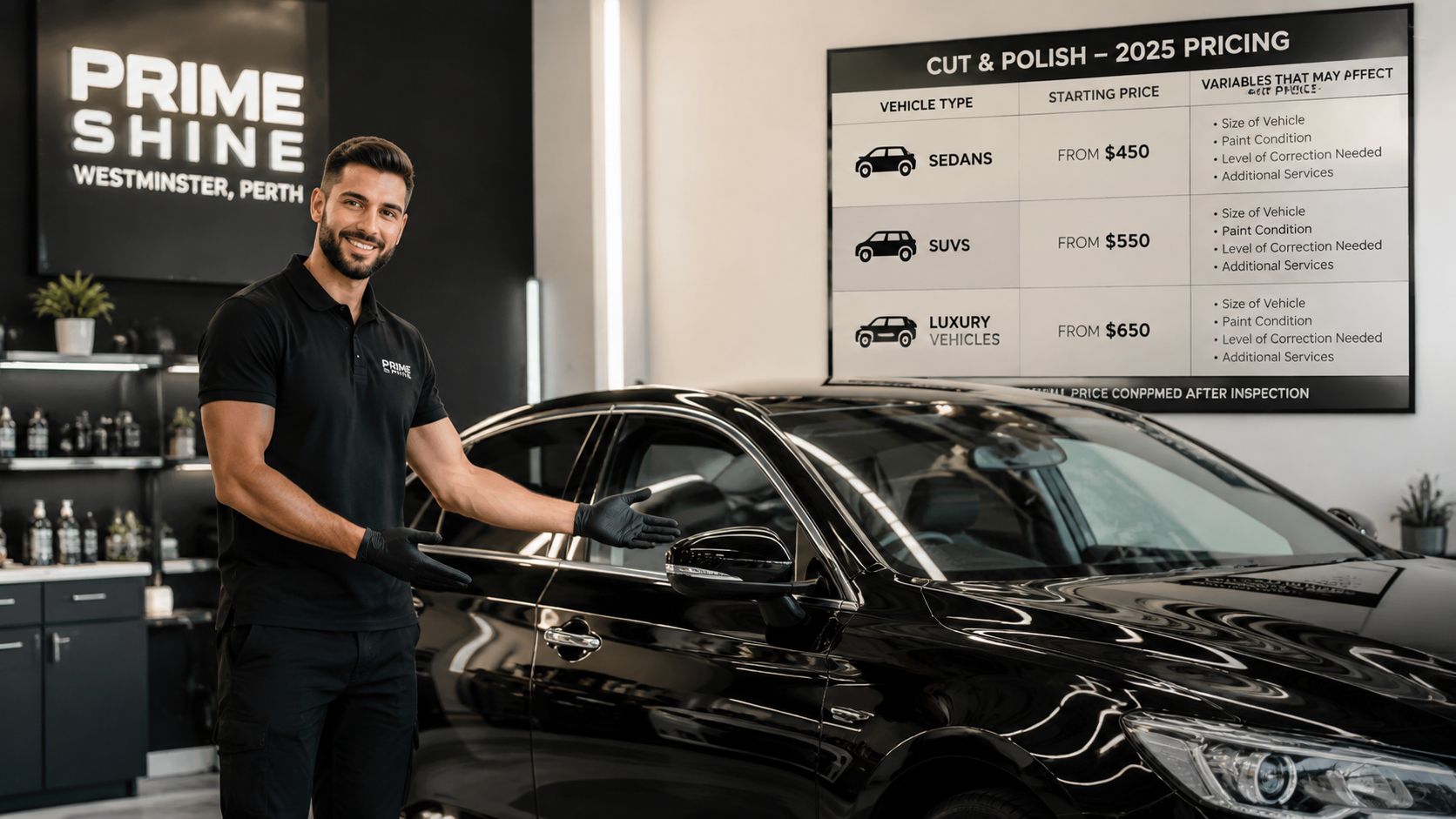
Perth pricing depends on the car, the paint, and how far the defects have gone. The biggest variables are vehicle size, paint condition, whether the job is single-stage or two-stage, and whether extra protection is added at the end. RACV says basic swirl reduction in Australia generally sits between $250 and $400, while multi-stage paint correction costs upwards of $600. RACV paint correction guidance
That’s the number to use as a reality check, not as a promise. A lightly marked sedan will usually sit closer to the lower end of the work spectrum, while a larger vehicle or a car with stubborn defects needs more time, more inspection, and more refinement. Prime Shine’s Westminster site keeps its services transparent, so the quote should reflect the actual condition of the paint rather than a one-size-fits-all package.
Booking without the guesswork
You can book through Prime Shine’s website, walk into the Westminster site at 9/436 Wanneroo Rd, or make an enquiry online and choose a time that suits your day. The business also runs seven days a week, which helps if you’re trying to fit the job around work, school runs, or a weekend sale prep. The cut and polish package sits alongside hand wash and protection services, so it’s easy to pair prep work with the finish you want.
Prime Shine’s package structure includes the sort of prep that matters: snow foam pre-wash, clay bar decontamination, machine polish, tyre dressing, and interior wipe-down. That kind of sequence is important because polishing a dirty panel is how you waste clear coat and money at the same time. If you want a broader cost reference before booking, the team also publishes a separate Perth car detailing pricing guide.
Bring the car as it is, but don’t wash it right before a booked correction if you’ve been told the service includes decontamination. Leave enough time for inspection and protection, because the final finish is only as good as the last step.
Common Mistakes That Waste Your Money on Cut and Polish
The five big mistakes are easy to spot. People book over unwashed paint, demand zero-swirl results on neglected single-stage finishes, skip paint depth checks, choose the cheapest quote without asking about pad and compound quality, and let someone polish the same panel repeatedly until the clear coat gets too thin.
Booking over dirty paint is the fastest way to ruin a good detail. Any grit left on the surface can get dragged into the clear coat, which means the job starts by creating new marks before it has even removed the old ones.
The quiet cost of bad choices
Pushing for perfection on badly neglected paint usually ends in disappointment. If the finish has deeper wear, a light one-stage service can improve it, but it can’t rewrite the condition of the panel. That’s where low quotes can become expensive, because you end up paying twice, once for the wrong service and once for the proper fix.
Skipping paint thickness checks is another red flag. A detailer who doesn’t assess the clear coat can overwork edges, burn through vulnerable areas, or create haze that takes more time to remove later.
If a quote sounds unusually cheap, ask what prep, machine, pad selection, and inspection are included before you hand over the keys.
Use this quick vetting list before you book:
- Machine type: ask whether the work uses a dual-action polisher or another machine, and why.
- Pad choice: ask what pad and compound are planned for your paint condition.
- Thickness readings: ask whether the paint will be checked before heavier work starts.
- Prep steps: ask if decontamination wash and clay bar treatment are included.
That one conversation tells you whether you’re paying for real correction or just a fast shine.
Aftercare and When to Schedule Your Next Service
The first 14 days after a polish matter most. Avoid automatic car washes, dry the car with a clean microfibre, and park in shade where possible so the fresh finish isn’t stressed by heat and contamination. If a ceramic coating is being applied, don’t add wax or sealant on top unless the coating system specifically calls for it.
After that, keep the maintenance simple. Sealant or wax top-ups usually make sense every 8 to 12 weeks, while ceramic maintenance washes can be done every two weeks with a pH-neutral shampoo. The next full cut and polish is usually a 12 to 24 month job, depending on garaging, kilometres, and how the car is washed between visits.
Perth conditions can shorten that rhythm. Coastal salt air, summer UV around Westminster, and bushfire-season ash fallout all put more stress on the clear coat than a mild inland climate would. If the car lives outside and gets washed in a hurry, it’ll usually need attention sooner.
Keep the plan simple. Wash gently, dry properly, protect the surface, and don’t book another correction until the paint needs it. That’s the easiest way to keep the gloss without burning through the clear coat too soon.
If your car’s paint looks tired and you want a straight answer before you book, Prime Shine Hand Car Wash can inspect the finish, carry out the prep, and handle the cut and polish from its Westminster site. Visit Prime Shine Hand Car Wash to book a time that suits you and get the paint checked by a Perth team that works on hand wash, detailing, and paint protection every day.