






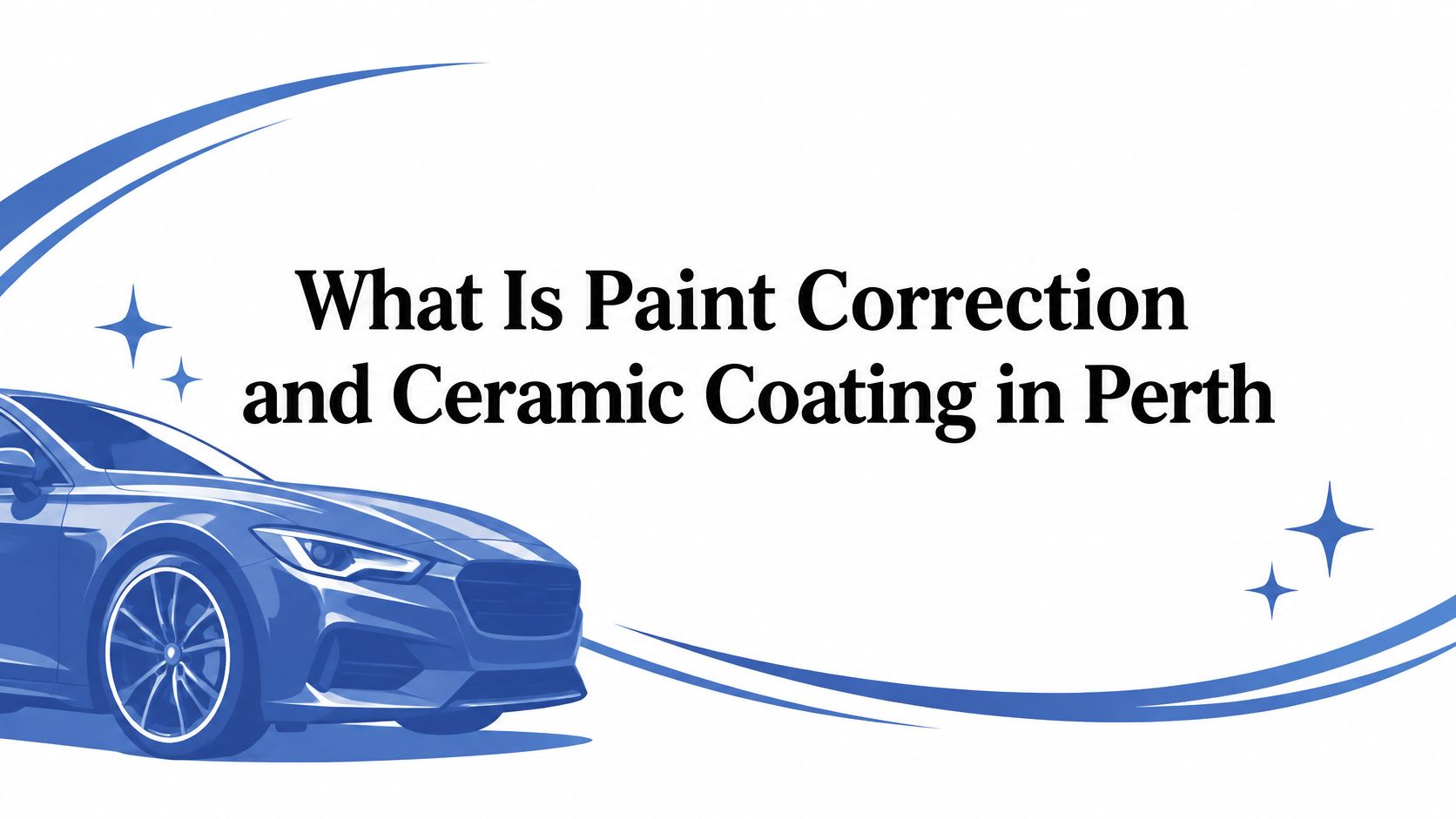
Paint correction is a machine-polishing process that levels the clear coat already on your car, reducing swirl marks, haze, oxidation and light scratches so reflections sit flat instead of scattering. Ceramic coating is a separate protective stage applied afterwards, a bonded film a few microns thick that commonly holds up for about two to five years with proper care, and it cannot repair a stone chip, a scratch you can feel with a fingernail, or paint that has started to peel.
Perth hands paint a hard life. Three summers of sun on an outside-parked bonnet, salt in the air near the coast, a fortnight between washes, and the clear coat starts to look tired in a way a wash no longer fixes. Water stops beading and starts sheeting. Under low afternoon sun the surface looks like it’s been wiped over with a dirty cloth.
Confusion usually starts at the quote stage. Ceramic coating gets sold as though it repairs damaged paint, and a cut and polish gets sold as though it guarantees a perfect panel. Neither is true. The order of work matters, the paint’s condition sets the limits, and the honest answer to “how much better will it look” depends entirely on what the defect is.
What Is Paint Correction and Ceramic Coating?
A bird dropping left on a bonnet through a Perth summer afternoon can etch the clear coat before the next wash. Sprinklers do quieter damage, leaving dull mineral rings that survive shampoo. The mark isn’t sitting on top of the paint. It’s in the clear coat itself, and no amount of washing lifts it back out.
Paint correction levels the clear coat that is already there. The Australian Government guide to motor vehicle refinishing describes the work as a controlled surface-refinement process: the panel is washed and decontaminated, the clear coat assessed, then abrasive compounds on a machine polisher shave the raised edges around each defect until the surface sits even. Etched spots, wash-induced swirls and dull oxidised patches all live in that top layer, which is why levelling it is what clears them.
The same guidance is blunt about the ceiling. Correction thins clear coat, so it stops where the defect stops being shallow. A key scratch down to grey, a chip that has taken paint off, or clear coat that has started to flake all sit below what abrasives can safely reach. Paint in that state needs touch-up or panel work first. Polishing around the edges only makes the damage shinier.
Ceramic coating is a separate job, and it only earns its keep after the paint is right. A liquid goes on over paint that has been polished and wiped free of every trace of residue, because the film has to bond to the paint itself rather than to leftover product. Once it cures it forms a thin, transparent film that resists UV rays, dirt and grime, deepens the gloss and makes water bead and release, which is why washing gets easier. Its job is to protect whatever finish sits underneath. Put a coating over swirls and it will faithfully protect the swirls.
A cloudy window shows the split. Polishing the glass until you can see through it cleanly is the correction. The rain-repellent film applied to that clean glass afterwards is the coating. The film sheds water; the pane underneath stays exactly as polished as it was left.
If you are not sure which side of that line your paint sits on, ask for a quote before booking. Ceramic coating quotes are transparent and obligation-free, so you can weigh the options with real numbers in hand.
The four common options each solve a different problem, and treating them as interchangeable is how a car gets booked for the wrong job.
| Treatment | What it changes | What it cannot do | Where it sits |
|---|---|---|---|
| Paint correction | Levels clear-coat swirls, haze, oxidation and light scratches by removing a little clear coat | Scratches into the colour coat or metal, chips with missing paint, flaking clear coat | Before any protection |
| One-step cut and polish | Wash, decontamination and a single machine polish for light marring | Heavy multi-stage correction or a guaranteed perfect panel | Entry-level correction |
| Ceramic coating | Thin bonded film for gloss, water beading and easier release of dirt | Filling defects, stopping stone chips, making paint scratch-proof | After correction and residue removal |
| Wax or sealant | Short-term shine and light sacrificial protection | Multi-year durability of a bonded coating | When a coating is more than the car needs |
The same guidance describes refinishing coatings as systems built in layers, with primer, topcoat and hardener combining to shield the metal beneath from corrosion, abrasion, ultraviolet light and water. Care for the finished paint follows the same logic: correction improves the finish, protection shields it. Two jobs on one surface, and the defect in front of you decides which one the car needs.
Explore paint correction and ceramic coating
How Do Paint Correction and Ceramic Coating Work?
Follow one panel from dirty to protected and the sequence stops being mysterious. Each step exists because skipping it costs more later.
- Hand wash and rinse. Loose grit has to come off before a machine touches the paint, or the polisher grinds it across the clear coat and adds marks instead of removing them.
- Decontaminate with clay or an equivalent. Bonded fallout, tar and industrial particles sit on top of the paint and won’t shift with shampoo. Clay pulls them off so the pad meets clean clear coat.
- Inspect the paint and plan the cut. Check the panel under good light, match the least aggressive pad and compound to the defect, then decide whether a single stage is enough.
- Machine polish. Abrasives cut down the raised edges around a defect, which reduces light scattering and sharpens reflected clarity. A one-step cut and polish stops here for light marring. Heavier swirls may take a second, finer pass, and no honest quote promises a set percentage of scratches will vanish.
- Wipe off the polishing oils. Any wax, sealant or polish left on the panel is removed before the coating goes on, so the coating bonds to paint rather than to a layer of product.
- Apply the ceramic. A liquid ceramic goes on in thin sections and is levelled before it sets, so the film builds evenly across the panel.
- Keep the car dry while it cures. Carsguide’s guide to ceramic coating notes the vehicle should stay dry for the product’s specified curing period. The car can be driven shortly after application, but water and washing should stay off the paint for at least 24 hours.
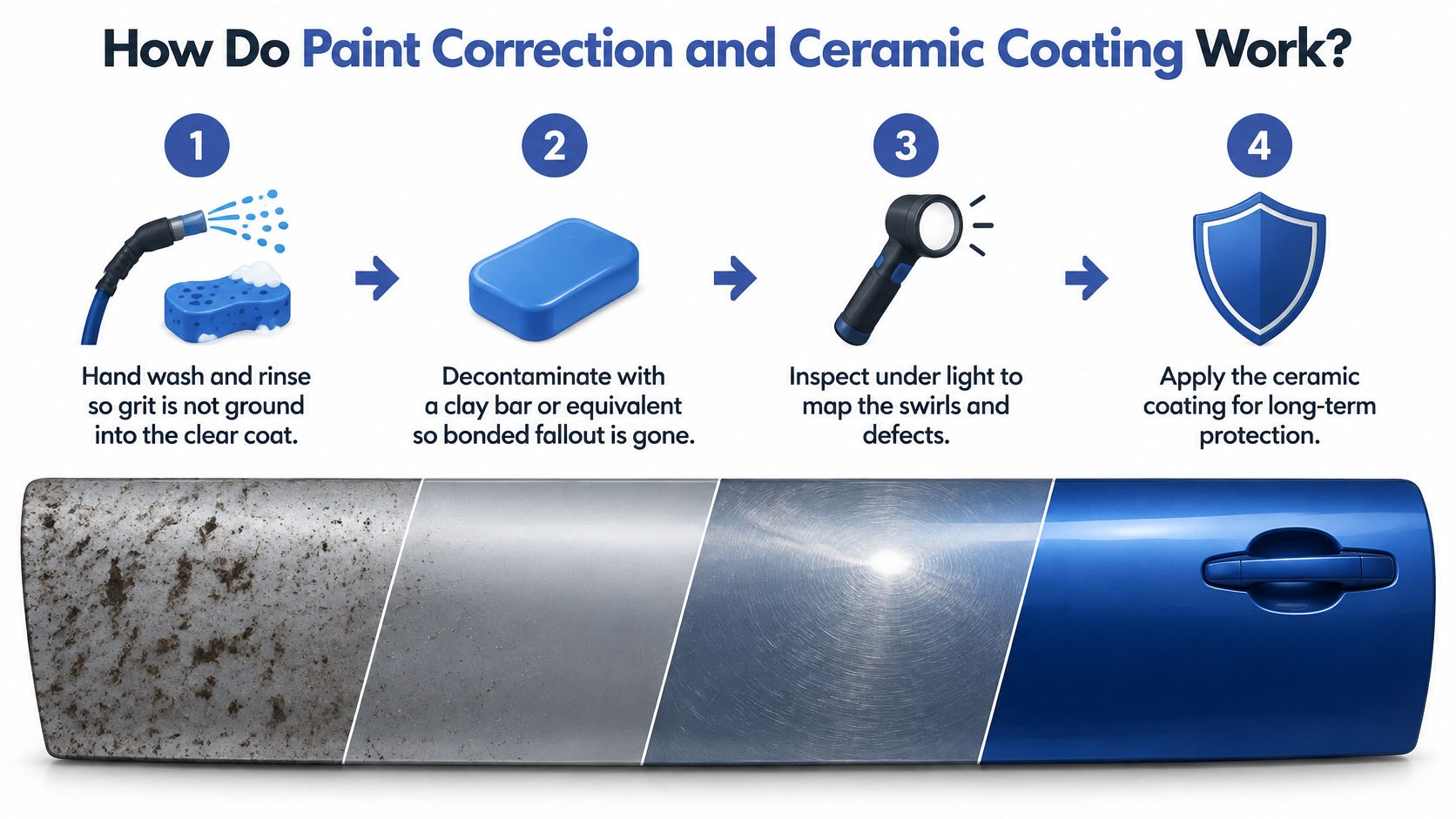
Step four carries the biggest risk. Polish over swirls without refining them properly and the coating locks them under a clear film, where removing them later means stripping the coating and starting again. Skip the residue wipe and you get high spots and patchy gloss that no amount of washing fixes.
Check your bonnet in direct midday sun before deciding on a stage. Swirl webs that show under glare are exactly what a coating will preserve, so dense webbing means the paint needs a closer look, and possibly a second pass, before anything goes on top.
Set expectations at panel level for the finished film. It lowers surface energy, so water beads, dirt releases more easily and each wash takes less effort. Light washing swirls meet more resistance, but the film adds no thickness back to a thinned clear coat, a stone still chips and a trolley ding still dents. For genuine stone-chip resistance, paint protection film is the tool, because a coating never was.
That is the trade: easier maintenance and slower loss of gloss rather than immunity. Under Perth’s sun the coating keeps ultraviolet exposure and grime further from the finish, while bird droppings still need prompt removal and mineral deposits can still spot a coated panel when water is left to dry. How well it holds up on a daily driver comes down to washing habits as much as the product, so gentle, regular hand washing is part of what you are paying for.
Ask about correction and coating
Which Defects Can Polishing Safely Remove?
Sort the mark before anyone sells you a stage of correction. The first question is where in the paint the mark lives, because that decides whether polishing helps, whether claying is enough, or whether the panel needs touch-up work instead.
Start with the surface. Tar, rail dust, a fresh bird dropping or a mineral spot sitting on top of the paint is contamination, not damage. It washes or clays off during proper paint preparation, and cutting a panel to remove something a clay bar would have lifted is wasted clear coat you cannot put back. One trap to know about locally: a dropping left to bake in summer heat can etch into the clear coat, so the same mark that wipes off today can become a real defect a week later.
Is the mark on the paint or in the paint?
The marks that live inside the clear coat are the ones polishing exists for. Swirl marks, holograms, buffer trails and light scratches that stay within the clear coat can generally be reduced or removed by machine polishing, because the process levels the surrounding surface. Peeling clear coat, missing paint from stone chips, and scratches reaching the colour coat, primer or bare metal sit beyond what polishing can do. Those need touch-up, refinishing or panel repair.
Run a fingernail gently across a scratch on a clean panel. If the nail catches, the mark is deep enough that polishing will only soften its edges, not erase it. If the nail glides over without a catch, it’s a candidate for correction.
Ask how the car gets washed, too. A high share of swirl marks trace back to washing technique, so a defect that returns every month will keep returning after correction unless the washing habits that created it change.
When is more cutting the wrong call?
Wet sanding is a last resort on sound, thick clear coat, not a default step for a daily driver. Clear coat is finite, and repeated aggressive polishing over the life of a car depletes it, so the least aggressive combination that achieves the improvement is always the right one.
The honest question to ask before booking is how much improvement is realistic. A one-step cut and polish can make a family car, rideshare vehicle or lease return noticeably glossier without chasing a show finish. Multi-stage correction suits an enthusiast car whose defects sit mostly in the clear coat. For more on technique, this guide to removing swirl marks from a car walks through it step by step.
There is a local reason to take the inspection seriously rather than treat it as an upsell speech. The Bureau of Meteorology’s Perth UV-index forecast shows how consistent the sun exposure is here, and strong sun accelerates oxidation and makes uneven gloss obvious from a distance.
Point out the chips and deep scratches you already know about when you book, so the quote can separate what polishing will improve from what still needs touch-up.
Sound practice anywhere in the trade is to stop cutting when the defect depth or the remaining clear coat says more material removal would create risk, and to agree before work starts on which defects will remain. Ceramic coating comes after that decision, and it repairs nothing. Coating a stone chip does not fill it. It just makes the edge of the chip shinier.
What Results and Timeframes Can You Expect?
A quote that only gives a price leaves out the two things that shape the decision: what you can do with the car on the day, and how long the result is likely to hold. Here is that lookup.
| Stage | Same-day driving | Keep dry | Typical durability |
|---|---|---|---|
| Wash and decontamination only | Yes | Not required for cure | No added protection |
| Cut and polish | Yes, then wash gently | Not a cure issue | Weeks to months if a wax is added |
| Professional ceramic coating | Shortly after, avoid washing | At least 24 hours | About 2 to 5 years with care |
| DIY ceramic product | Follow that product | Follow that product | Generally shorter than a professional coating |
| Spray sealant | Yes | Usually short | Months |
With proper maintenance, a professional ceramic coating can last two to five years. Where your car lands in that range comes down to driving conditions, washing habits and how much harsh weather the paint sees. A Perth car parked outside through summer sits at the hard end of that test.
Every other number in the table moves on the same variables: formulation, curing conditions, surface preparation, washing frequency and storage. That is why a year count quoted without a stated test method or application standard should be read as marketing rather than a promise.
CSIRO’s coatings testing service identifies ultraviolet radiation, heat and moisture as interacting causes of weathering, and compares formulations using accelerated and natural-weathering methods tied to specific standards. A hardness slogan or a universal lifetime does not survive that kind of scrutiny, because there is no universal result to quote.
Judge what you are buying by the things you will notice: easier washing, slower loss of gloss and better resistance to chemical fallout. For a closer look at each variable, this guide to how long a ceramic coating lasts walks through them one by one.
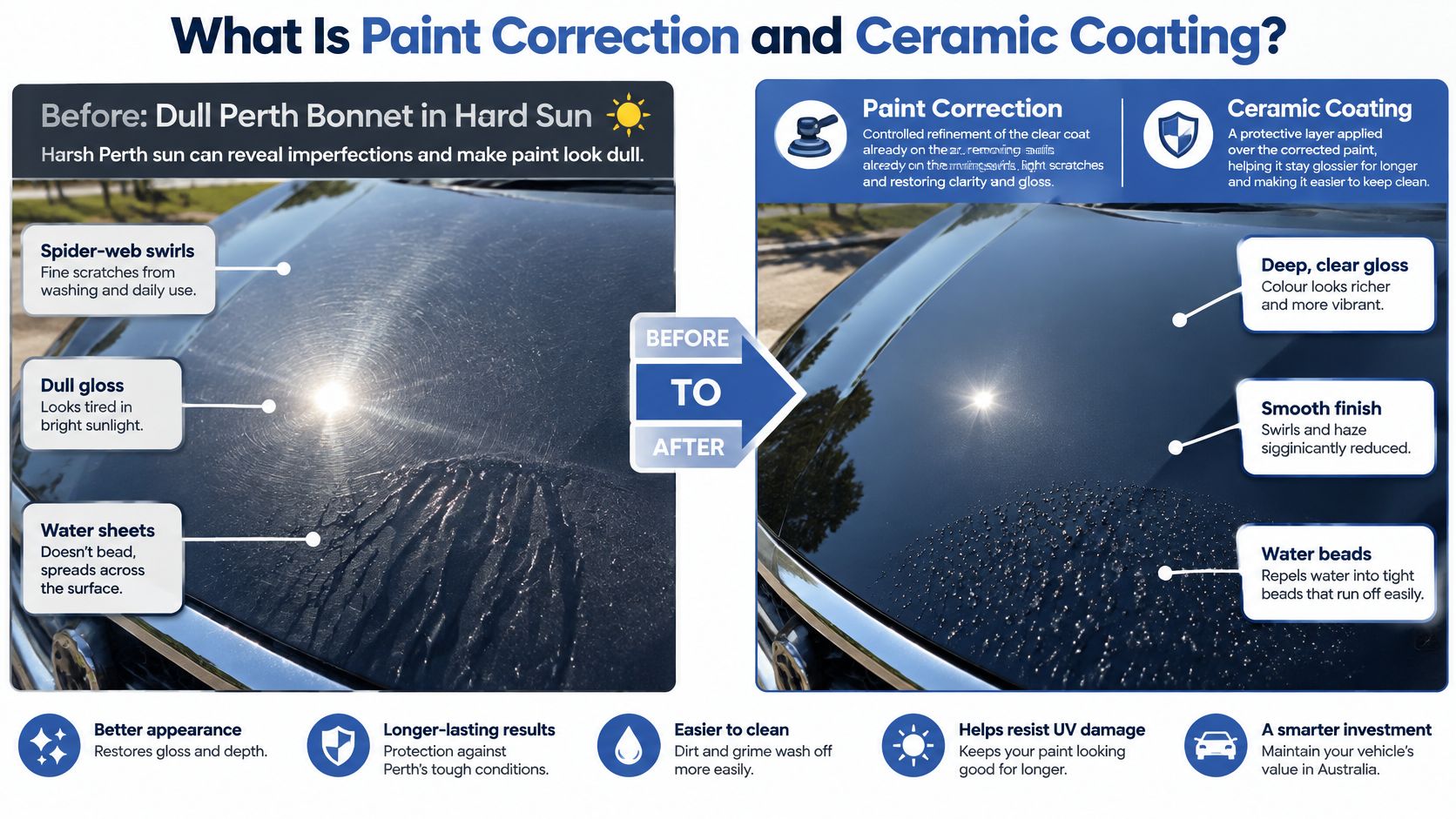
Now the defect-by-defect part of the answer. A dull, swirled bonnet under hard Perth sun gains sharper reflections and more even gloss after a one-step correction, and gentle hand washing keeps those marks from coming straight back. A coated panel sheds water in beads and cleans with less effort, but that gloss belongs to the thin film sitting on top, the way a laminate protects a printed page without repairing a tear in it. A deep scratch or a chipped edge still shows in the second photo, because a coating bonds to the surface rather than rebuilding it. A professional quote should list those defects as outside the result instead of leaving them unmentioned, and bird droppings or neglected washing will shorten the coating’s life no matter which stage you booked.
Want a realistic window for your own car rather than a generic number? Ask for an obligation-free quote. Ceramic coating starts from $699, with transparent pricing based on your vehicle’s size, condition and the extras you choose.
What Can Still Damage a Coated Car?
The most common misunderstanding about a coating is that it makes the car maintenance-free. In direct sun, the clear coat heats, softens and expands while a bird dropping dries and hardens on the surface. As the paint cools and contracts, it takes the shape of that deposit and leaves a dull, textured mark.
Acidity is not the main culprit, despite the folklore. Drive’s explanation of bird dropping paint damage reports that testing found severity was determined not by acidity or alkalinity but by the deposit’s grain-to-liquid content, with grainier deposits producing greater distortion. The longer the material sits, the harder it is to lift and the greater the chance of permanent etching.
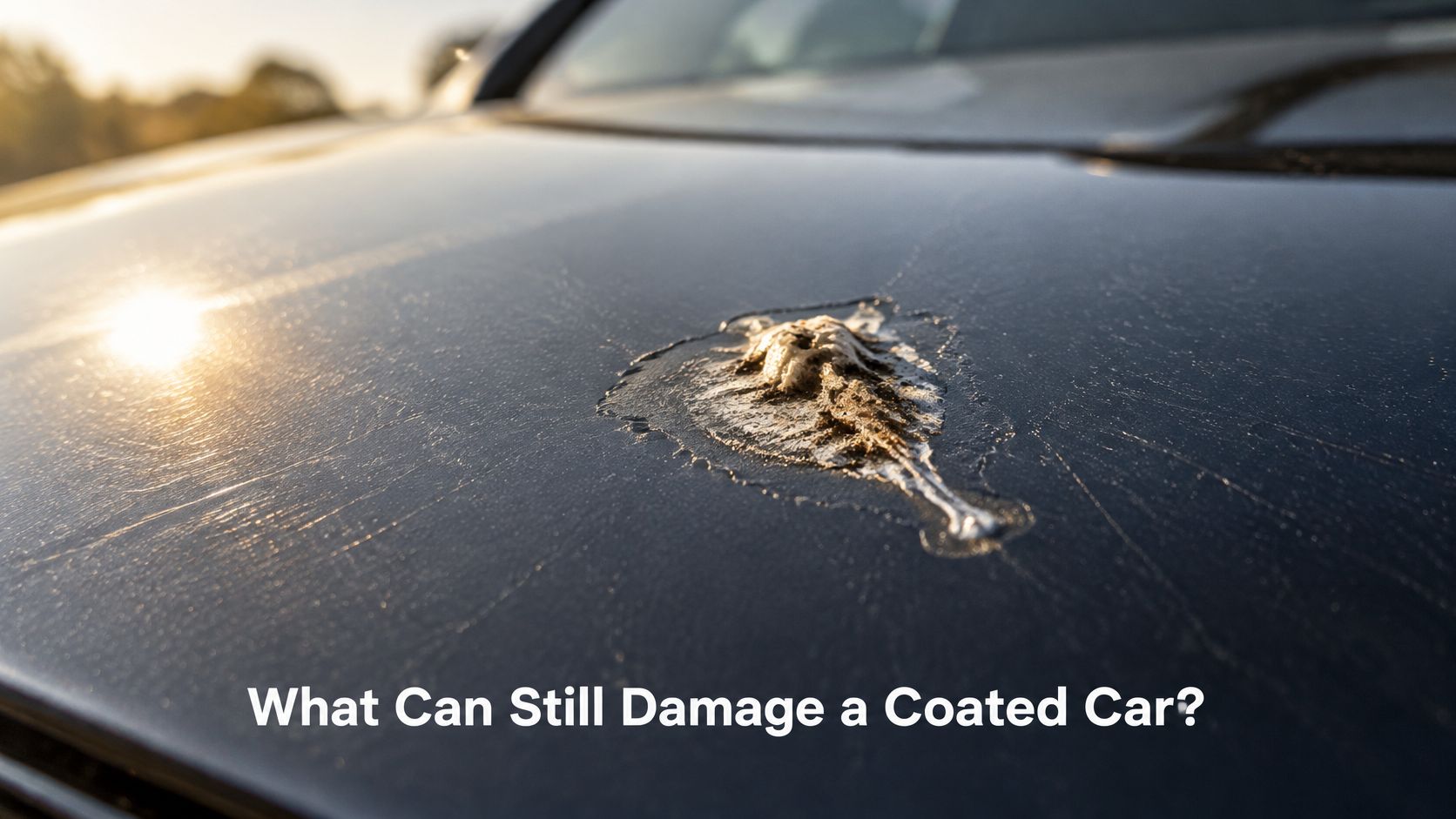
Tree sap, bug acids and hard-water minerals behave the same way. Water left to dry on a coated panel can still leave spots, because the film repels water, it doesn’t dissolve the minerals left behind. A brush tunnel or an abrasive cleaner can put wash marring straight back into a film measured in microns.
Practical rule: keep a microfibre and a bottle of water-based cleaner in the boot. Thirty seconds to lift a fresh dropping is cheaper than a compounding session to chase an etch.
Aftercare is unglamorous and effective. Gentle, regular hand washing with a pH-neutral car shampoo and soft microfibre towels, no automatic brushes and no abrasive cleaners. The coating reduces how often you need to wash and how much effort each wash takes, but regular cleaning is still what keeps it performing.
- Fresh contamination: wash it off within a day or two, before heat does the work for you.
- Sticky deposits: soften with a damp microfibre laid over the spot for a minute, then lift, never scrub.
- Parking: a carport or shade cuts the heat that drives imprinting far more than any product choice.
- Neglected weeks: expect a decontamination wash, not a new coating, unless the clear coat itself has etched.
For where the line sits between surface marring and real damage, this explains what ceramic coating stops and what it doesn’t.
When Does a Perth Vehicle Need Each Service?
Start with the defect. Paint that is dirty but glossy, with intact clear coat, needs a thorough hand wash and time under proper light before anyone talks about correction. Light swirl marks, wash marring and haze on a daily driver, family SUV, rideshare car or lease return point to a one-step cut and polish when safer defect reduction matters more than chasing maximum gloss on thin paint.
Then decide whether the finish is worth protecting.
- Sound paint, wants easier upkeep: correction followed by ceramic coating is the sensible pairing, in that order.
- Inspection finds no defects worth cutting: coating alone is defensible, but only then. A clear film over swirls preserves them.
- Highway kilometres and stone chips are the worry: paint protection film is the relevant product; ceramic solves a different problem.
- Peeling clear coat or missing paint on a panel: neither service. That panel needs refinishing first.
Perth exposure should move the decision as much as the defect map. A car that lives outside through summer sun, coastal air and bird droppings puts more heat and contamination into the same coating than a garaged weekend car, so preparation and aftercare carry more weight. Ceramic is still protection over the finish you already have: it can resist light surface scratches and swirl marks and help water and grime release, but it will not make paint chip-proof or remove etched damage.
The line stays condition first, protection second, never reversed. If the choice is between coating, film or refinishing, this guide to paint protection versus ceramic coating for Perth drivers shows where each option earns its keep.
Practical rule: note where the car is parked, what lands on it and how it is washed before choosing a service. Those three habits decide whether the result lasts.
Find the right service for your car
How Do You Book Correction or Coating at Prime Shine?
Start with the defect, then choose the service. If the paint is dull from swirls but still intact, begin with Cut & Polish at Prime Shine Hand Car Wash in Westminster, from $249, which covers an exterior wash, clay bar or paint preparation, and a machine cut and polish. If the corrected finish should stay easier to wash through the years that follow, add ceramic coating, which starts from $699 depending on size, condition and extras.
| Service | Starting price | What is included |
|---|---|---|
| Cut & Polish | From $249 | Exterior wash, clay bar or paint preparation, machine cut and polish |
| Ceramic coating | From $699 | Price depends on size, condition and extras; glass, wheels and trim ceramic available as add-ons |
| Typical booking path | From $249, with ceramic coating from $699 | Cut & Polish first where paint needs correction, then coating where longer-term protection is the goal |
Quotes are transparent and obligation-free. Book online with the code PRIME100 to take $100 off Full Car Detailing and Ceramic Coating. The shop is at 9/436 Wanneroo Rd, Westminster WA 6061, open seven days, with ceramic start times from 08:00 to 16:00 in 30-minute slots.
Glass, wheel and trim ceramic can make sense on a car that lives outdoors, especially where Perth sun, bird droppings and frequent washing wear the finish faster. None of them replace paint protection film for stone chips, so name the problem you are solving before you book. Deep chips through paint sit outside a polish and outside a coating too, so point them out when you request the quote and keep the decision defect by defect.
If the paint needs correction, book the correction first and let the finish settle into shape before protection goes on. If it is already sound, go straight to the coating conversation and spend the money where it lasts. For a clear starting point, request an obligation-free quote through Prime Shine Hand Car Wash, apply PRIME100 online, and bring the car to Wanneroo Rd any day of the week.