






A fine swirl appears across the bonnet after washing, and a fresh chip marks the bumper. Ceramic coating can help resist light wash marks and chemical etching, while its UV protection helps guard the paint. It cannot stop stone impacts or deep scratches. The force that caused the damage matters more than a hardness claim.
Abrasive washing causes light marring; road debris causes chips. Coating suits chemical exposure and light wash marks. Paint protection film is the better choice for impact-prone areas, while paint correction addresses marks already in the paint.
Inspect the marks you notice most and identify whether washing, chemicals or impact caused them.
Which Scratches Can a Ceramic Coating Actually Stop?
A ceramic coating can reduce fine surface marking, but it doesn’t rebuild vulnerable paint. In its 2026 explanation of new-car paint chips, NRMA describes modern paints as thinner and weaker than many older systems, partly following the shift towards lower-VOC, waterborne technologies over the preceding two decades.
That doesn’t mean every new car needs the same protection. It means you shouldn’t treat a glossy coating as extra clear coat, or assume that resistance to contamination translates into resistance to physical force.
What a ceramic coating does and does not stop
| Damage | Does ceramic coating help? | What actually protects against it |
|---|---|---|
| Light wash swirls and marring | Reduced, not eliminated | Safer washing and paint correction for existing marks |
| Chemical etching from bird droppings and sap | Resisted if removed promptly | Prompt cleaning and a coated finish |
| UV fading and oxidation | Slowed by UV resistance | Regular washing and shade parking |
| Stone chips from road debris | Not protected | Paint-protection film on high-risk panels |
| Deep scratches from keys or contact | Not protected | Panel repair or professional touch-up for existing damage |
| Water spots from drying in sun | Not prevented | Drying promptly with a clean microfibre towel |
List the marks that bother you most, then match their causes to the protection in the table before spending money.
Is the mark chemical or mechanical?
Bird droppings, sap and industrial fallout create a contamination problem. A coated finish gives you more resistance and easier cleaning, but leaving contamination attached can still result in staining or etching.
A scratch is different. Grit trapped beneath a mitt can cut the surface despite the coating, while a key concentrates force along a sharp edge. Likewise, water beading doesn’t prevent mineral deposits when droplets evaporate on a hot panel.
Start with the cause: Choose protection for what touches your paint, not just for how the paint looks afterwards.
For a useful self-check, write down the three marks you see most often. If your list contains swirls, chips and water spots, you’re dealing with separate problems, not a single coating failure.
Explore Ceramic Protection Options
Why Does a Thin Coating Fail Against Stone Chips?
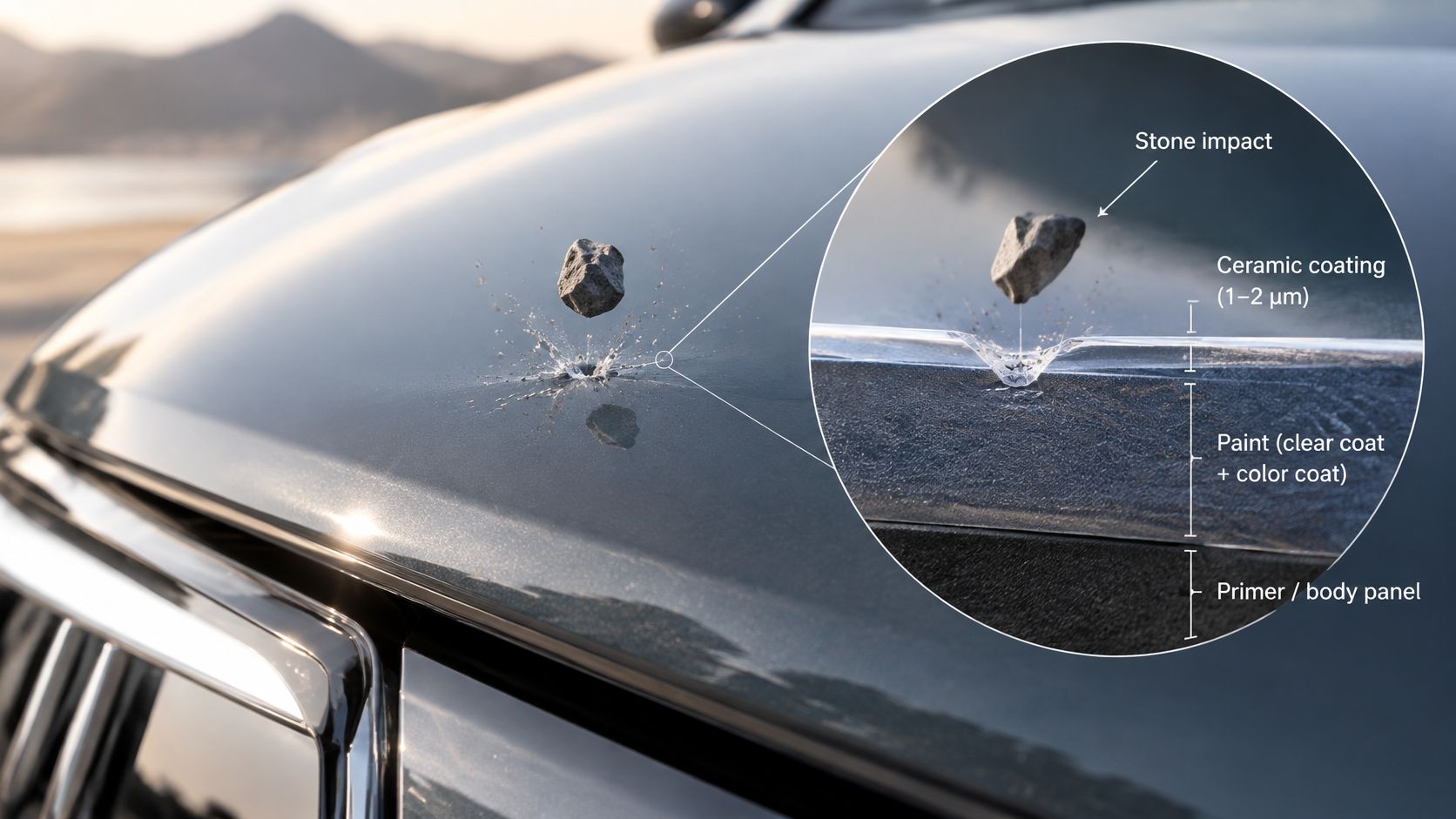
Loose gravel striking the front of a car creates a different risk from dust or light wash marks. Ceramic coating is a thin protective layer, so it can resist light surface scratches and swirl marks but cannot absorb the force of a stone impact. It does not make paint chip-proof, either.
A hard surface and an impact-absorbing barrier do different jobs. A stone can pass through the coating and damage the clear coat beneath it. Ceramic coating helps repel water and dirt, making cleaning easier, but it is not a substitute for paint protection film when stone chips are the concern.
If road debris is your main concern, identify the exposed panels before choosing between coating and film.
What changes when you use film?
Paint-protection film is a thicker, flexible barrier that can spread some impact force before it reaches the paint. It is better suited to flying gravel, though it cannot guarantee protection from every impact, dent or deliberate scratch.
On a Perth highway behind vehicles carrying loose gravel, the bonnet’s leading edge, lower bumper and mirror caps face more chip risk than the roof. Coating can help keep the roof easier to clean. Film is the more appropriate choice for exposed front panels when impact protection is the priority.
A shopping-centre trolley brings a different risk. Film may reduce surface scuffing, but neither film nor coating prevents dents. A firmly dragged key can also damage paint through either treatment.
Physical impacts call for a barrier designed to handle them, not a coating expected to act like padding.
This guide to ceramic coating versus PPF for Perth drivers explains how the two options address different risks. Match the protection to the force and cause: coating for easier cleaning and light wash marks, film for stone impacts, and paint correction for scratches already in the paint.
Mark the bonnet, lower bumper and mirrors on your protection checklist, then decide where impact resistance matters most.
Compare Ceramic Coating and PPF
What Does a 9H Hardness Rating Really Measure?
A 9H label describes a test result, not scratch-proof paint. Pencil-hardness testing assesses whether a pencil of a specified grade marks a surface under controlled conditions. It does not recreate grit dragged across paint, a branch scraping a panel or gravel striking a moving car.
The test method matters. 9H and 10H labels are not necessarily like-for-like comparisons or universal measures of scratch resistance. Neither tells you how a coating will perform against stone-chip impacts.
Before accepting a hardness claim, ask what was tested and whether the result matches the damage you want to avoid.
Which questions expose a weak claim?
- Who performed the test? Check whether the result comes from the manufacturer or from independently documented testing.
- Which standard was used? Without a defined method, the rating offers little basis for comparison.
- What counted as failure? A surface mark and damage that breaks through the coating are different outcomes.
- What force does it address? Resistance to a controlled scratch does not establish impact resistance.
- What preparation and cure were required? Application conditions affect how a test result should be interpreted.
Two coatings can carry the same hardness label and behave differently in everyday use. Proper surface preparation and curing matter; contamination beneath a coating or washing it too soon can affect its performance. The label alone does not tell you how well those steps were handled.
Washing also changes the kind of contact the paint faces. A clean mitt moving over lubricated paint is different from grit being pressed into the surface. A hardness rating cannot make those conditions equivalent.
Read hardness narrowly: It indicates resistance to marking under a particular test, not immunity to every contact or impact.
Use the rating as one clue about light-marring resistance. Give more weight to clear test details, preparation requirements, curing instructions and an aftercare routine you can maintain.
Request the test details, preparation requirements and maintenance instructions before comparing hardness labels.
Learn More About Ceramic Protection
Can Ceramic Coating Hide Scratches Already on Your Paint?
A family SUV with brush-wash swirls can look glossy after coating, yet the circles may still show in direct sunlight. Ceramic coating enhances shine and helps protect paint, but it does not remove existing scratches. Light wash marks and deeper paint defects need different treatment, while chips exposing primer or bare metal need repair.
Inspect existing defects before coating to decide which marks need correction and which require repair.
How should you classify existing damage?
| What you can see or feel | Likely next step |
|---|---|
| Fine circular swirls visible mainly in direct sunlight | Assess for machine polishing |
| A deeper line that catches a fingernail | Assess for touch-up or panel repair |
| A chip exposing primer or bare metal | Repair the chip, then consider paint protection film for future stone impacts |
The fingernail check is only a screening tool, not a paint-depth measurement. A scratch that catches deserves caution, since aggressive polishing can remove more clear coat than is sensible. Some marks are better improved than completely removed.
Preparation also matters for bonding. Existing wax, sealant or polish is removed before ceramic coating is applied, so the coating can bond to the prepared surface. Deep cleaning removes contaminants; polishing addresses defects in the paint. These steps serve different purposes, even when both are part of preparation.
What would improve a swirled family SUV?
For an SUV with brush-wash swirls before sale, suitable machine correction can reduce the visible marks. Applying coating afterwards helps protect the improved finish and maintain its shine. The guide to paint correction stages, costs and results explains how correction choices relate to paint condition.
On clean paint, check a scratch gently with your fingernail and inspect the panel in sunlight at a low angle. If you are unsure how deep it is, have the defect assessed before choosing a polishing approach. Match the protection to the cause: coating helps guard against light wash marks and surface contamination, film helps resist stone impacts, and correction improves marks already in the paint.
Bring clear sunlight photographs of existing scratches to your assessment, and distinguish cosmetic improvement from protection against future damage.
How Do You Wash a Coated Car Without Adding Swirls?
A coating makes safe cleaning easier; it doesn’t make abrasive cleaning safe. Prime Shine’s practical ceramic-protection guide cites an automotive top-coat weathering study recording approximately 30.3 nm of surface-roughness change after 24 hours with household detergent, compared with about 4.6 nm using car-wash detergent. That’s a reason to choose automotive shampoo, not a prediction of what happens during an ordinary wash.
Our recommended aftercare is gentle, regular hand washing with pH-neutral car shampoo and soft microfibre towels, avoiding automatic brushes and abrasive cleaners. You can drive shortly after application, but keep water and washing off the car for at least 24 hours; full curing takes up to seven days.
Plan the first wash around the curing window, and set aside clean wash media before you begin.
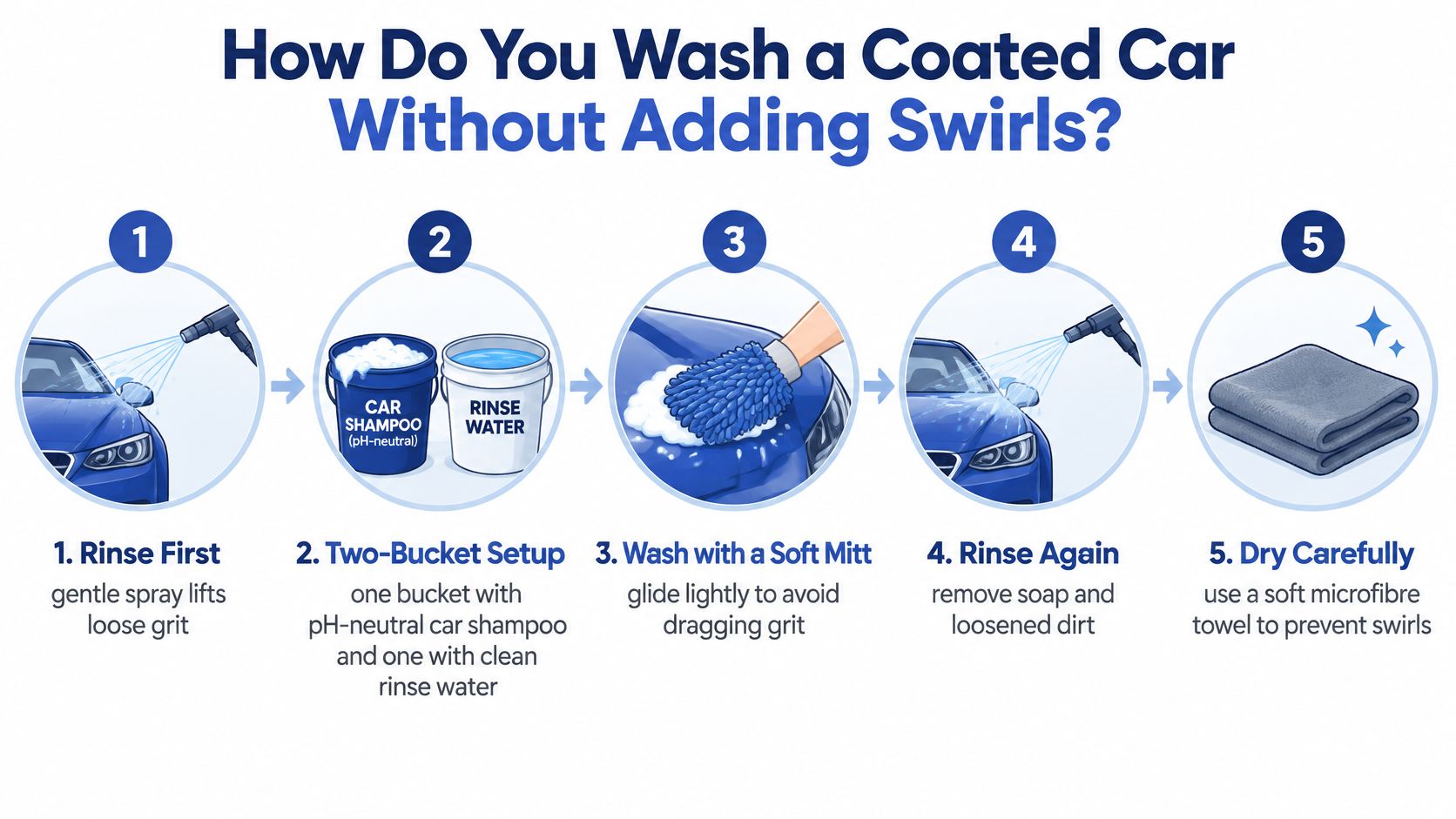
Follow a low-friction wash routine
Rinse loose grit first. Use a gentle spray over the whole car before touching it. Starting with a mitt on dusty paint turns loose contamination into abrasive contact.
Prepare separate wash and rinse buckets. Put pH-neutral automotive shampoo in one and clean rinse water in the other. Household detergent isn’t a substitute for a purpose-designed car shampoo.
Wash from the roof down. Glide a soft microfibre mitt panel by panel with light pressure. Leave dirtier lower sections until later rather than carrying their grime onto cleaner upper panels.
If the mitt feels gritty or the panel isn’t releasing dirt easily, stop and rinse rather than pressing harder.
Rinse the mitt before reloading. Agitate it in the rinse bucket, inspect it, then return to the shampoo. Putting a dirty mitt straight into wash water contaminates your cleaning solution.
Rinse before soap dries. Work in shade on cool panels and rinse sections as needed. Don’t let sunlight bake shampoo onto the finish while you complete the other side.
Dry with clean microfibre. Pat dry or use light, straight sweeps without pressure. Don’t drag a loaded towel around the car, and replace any towel that touches the ground.
Keep a spare clean drying towel ready so a dropped towel doesn’t become a paint-contact tool.
- Remove droppings and sap promptly. Aim to deal with them the same day rather than waiting for the next full wash. Soften contamination with a suitable cleaner before lifting it away; don’t scrape or scrub it dry.
Our coated-car washing steps provide a practical routine to keep alongside your supplies. Look for even gloss, clean water release and no obvious swirls under a light in shade, but don’t judge the entire coating solely by beading.
Should Your Car Get Ceramic Coating, Wax or Film?
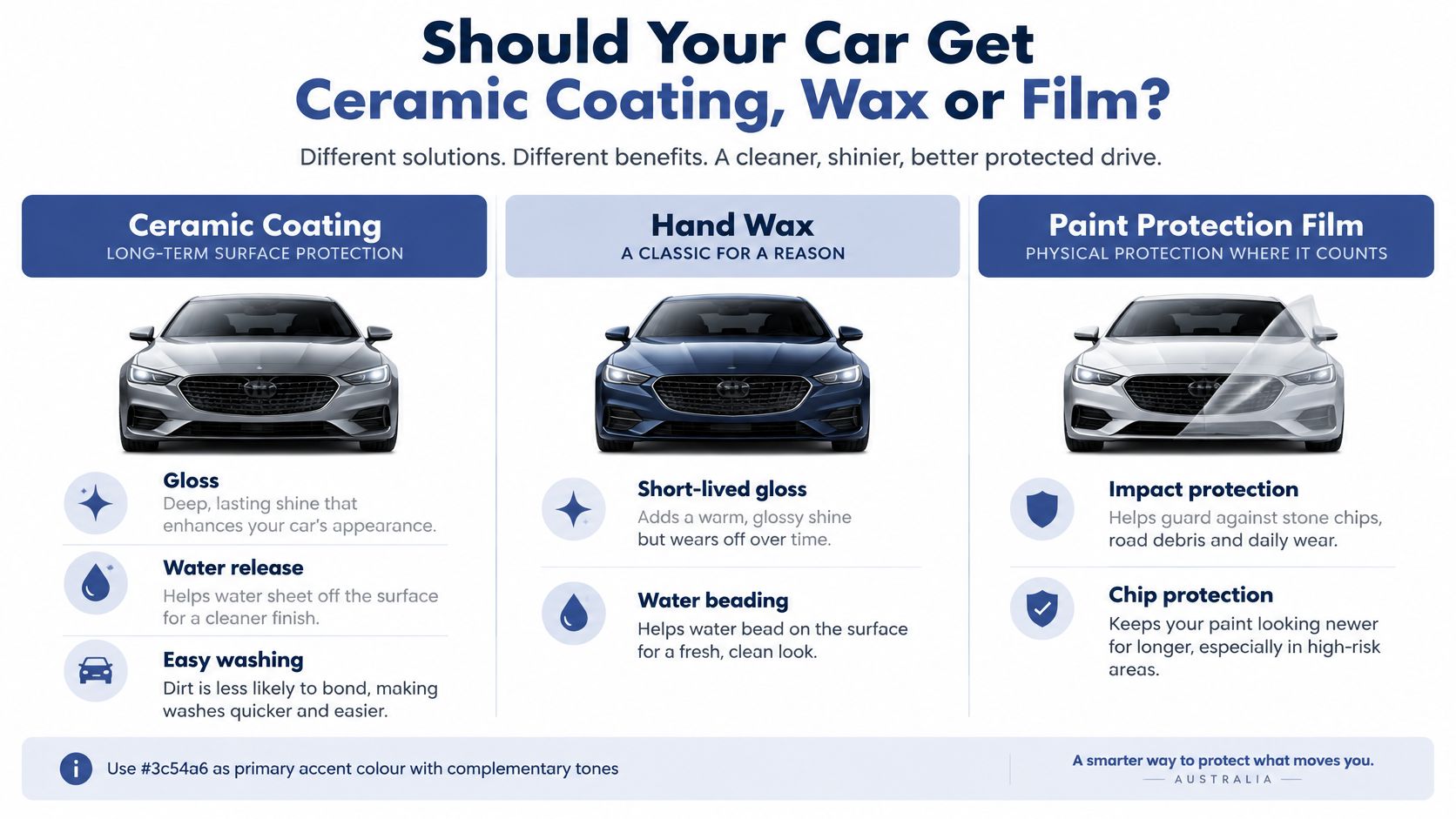
A car that spends most of its time garaged may benefit more from easier cleaning and a lasting shine than impact protection. A vehicle regularly exposed to road debris has a different priority. Match the protection to the cause of the damage, and consider how much upkeep you’re prepared to do.
| Option | What it helps with | Upkeep and trade-off |
|---|---|---|
| Ceramic coating | UV exposure, dirt and grime, water repellence, and light surface scratches or swirl marks | Regular gentle washing is still needed. It does not prevent stone chips or water spots. |
| Hand wax | Shine and some protection for exterior paintwork | Its finish is temporary and needs reapplication. |
| Paint-protection film | Physical protection against stone-chip impacts on covered panels | Coverage is vehicle-specific, and the film does not remove the need for careful washing. |
For a commuter regularly driving on gravel roads, film on exposed panels addresses impact risk more directly than coating. Ceramic coating has a different role: it enhances shine, repels water for easier cleaning, and helps guard against UV rays, dirt and grime. Mineral deposits can still leave water spots if water dries on the surface.
Choose based on the mark you want to prevent and the upkeep you’ll accept.
Which option suits your use?
- Rideshare or delivery work: Consider film for panels exposed to repeated contact or road debris. Coating can make other painted areas easier to clean.
- Sale or lease return: If existing marks are the main concern, paint correction may address their appearance more directly than adding protection.
- Lower upfront spending: Hand wax enhances shine and helps protect exterior paintwork, but requires renewal and is not a substitute for impact protection.
Our liquid car wax guide explains what wax does and when to use it. Choose it if you’re comfortable reapplying it rather than expecting coating-like durability.
Coating performance depends on preparation, washing habits, driving conditions and exposure to harsh elements. With proper maintenance, ceramic coating can last two to five years. Compare the paint preparation, coverage and aftercare included, not only the finish immediately after application.
For coating, ask for a clear quote covering the vehicle’s condition, selected extras and proposed work.
Film requires a vehicle-specific quote because the panels covered affect the protection provided. The trade-off is straightforward: coating supports gloss, water repellence and easier cleaning, while film is the option for reducing stone-chip damage on covered areas. Neither makes the whole car immune to every mark.
Should You Book a Coating Assessment First?
Book an assessment if you’re unsure what preparation your paint needs or which package suits your vehicle. A close inspection helps distinguish contamination from paint defects and clarifies what the coating service will involve.
At Prime Shine Hand Car Wash’s Westminster site, the assessment can establish the paint’s condition and the preparation required before coating. Quotes are transparent and obligation-free, so you can review the proposed work before deciding.
Bring route notes and paint photographs to focus the assessment on your driving conditions and paint concerns.
What should you budget?
Typical cost of protection options in Australia
| Option | Typical cost (AUD) | Source or note |
|---|---|---|
| Professional ceramic coating | Vehicle-specific professional quote | Depends on vehicle and paint condition |
| DIY ceramic coating kit | Product-specific retail price | Check the product price |
| Prime Shine ceramic coating | From $699 | Final price depends on vehicle size, condition and selected extras |
| Hand wax | Confirm with selected package | Price depends on the package |
| Paint-protection film | Quoted per vehicle | Coverage and vehicle assessed individually |
The starting price is a guide, not a final quote. Vehicle size, condition and selected extras affect the cost, and the assessment helps identify the paint preparation needed.
What should you bring?
- Route notes: Record gravel-road use, highway travel and frequent car-park exposure.
- Paint photographs: Take clear images in sunlight at a low angle.
- Panel priorities: Identify the bonnet, lower bumper, mirrors and areas with repeated contact.
- Correction questions: Ask which existing defects need attention before protection.
Book online and bring your notes. The assessment can clarify the preparation required, the coating price for your vehicle and the aftercare needed to maintain its performance and shine.
Prime Shine Hand Car Wash offers hand washing, paint correction and ceramic coating in Westminster, with transparent, obligation-free coating quotes. Visit Prime Shine Hand Car Wash to book online and bring your paint photographs and driving notes.