




You’ve probably sat in your car today without noticing what’s collecting around you. A few crumbs disappear beneath a child seat, sand settles into the carpet after a coastal trip, and a takeaway spill dries inside a cup holder. By the time you notice a stale smell or a sticky steering wheel, the cabin has been receiving dust, skin flakes, food particles, pet hair and tracked-in grit for weeks.
That’s why why cleaning your car interior is important goes beyond appearance. A vehicle is a small, enclosed space used repeatedly, and keeping it clean involves managing surfaces, settled debris, moisture, odours, ventilation and materials. A Perth car can look tidy while still carrying a substantial layer of fine contamination in places you rarely inspect.
What Builds Up Inside a Daily-Driven Car?
Consider a Westminster commuter with a familiar weekly routine. The car carries its driver to work, drops children at school, makes a supermarket stop, and handles the occasional coastal trip. Breakfast is eaten at a red light, a drink tips slightly in the centre console, and the family dog rides in the boot on the weekend.
None of these events creates a dramatic mess on its own. Instead, material moves into the gaps: crumbs beneath the seat rail, skin flakes on the upholstery, sand in the carpet pile, hair caught in the boot lining, and dust sitting along the dashboard and air-vent slats. Child-seat straps and buckles collect marks from frequent handling, while door pockets and cup holders become storage areas for wrappers, receipts and dried spills.
The cabin hides gradual accumulation
Most interior contamination isn’t visible from the driver’s seat. Carpet fibres hold fine grit, seat crevices retain food particles, and the area beneath floor mats can stay dirty even when the mats look presentable. A quick glance often shows only the most recent spill, not the material that has built up underneath it.
Australian vehicles travelled 238,499 million kilometres in the 12 months to 30 June 2020, while passenger vehicles averaged 11,100 kilometres each, according to the Australian Bureau of Statistics vehicle-use data. That repeated travel exposes cabins to road dust, tracked-in grit and passenger debris over and over again.
Practical rule: If people eat, commute, travel with children or transport pets in the car, interior cleaning should be treated as routine hygiene, not a once-a-year polish.
Monthly attention makes sense because it interrupts accumulation before stains become embedded and before odours settle into fabric. Families may need quick touch-ups between deeper cleans, while rideshare and delivery drivers often need more frequent attention because the cabin receives constant passenger contact. The objective isn’t to make the vehicle look perfect for one afternoon. It’s to keep the surfaces, fabrics and enclosed space manageable throughout everyday use.
Book an interior vacuum and tidy-up
How Cabin Air Quality Changes What Cleaning Means?
A Perth car can look tidy while carrying a steady load of fine dust, road residue and particles brought in through open doors, windows and the ventilation system. The cabin is not sealed, so outdoor traffic pollution enters during normal driving. Settled material can also return to the air when passengers move, floor mats are lifted or the fan starts.
NSW Health recorded Sydney tunnel cabin PM2.5 trip averages from 10 to 526 µg/m³, with an overall mean of 163 µg/m³. During high-pollution conditions, closing the windows and selecting recirculation reduced fine-particle exposure by about 80%, according to the NSW Health tunnel measurements.
Cleaning handles settled material
Vacuuming will not remove every airborne pollutant, and wiping the dashboard cannot fix poor ventilation. It does remove settled dust, grit, food particles, skin flakes and hair that can be disturbed during everyday use. Dashboard, vent and console crevices deserve attention because moving air can carry accumulated dust across the cabin.
Australian on-road research examined 301 tunnel trips across five passenger vehicles and found that the in-cabin-to-road ultrafine-particle ratio ranged from 0.08 to approximately 1.0. Outdoor airflow explained substantial variation in cabin concentrations, with R² = 0.81, as reported in the Australian cabin-particle research. Cleaning and air management address different parts of the problem.
| Pollutant source | Helped by interior cleaning | Helped by ventilation or filter action |
|---|---|---|
| Settled dust and grit | Vacuum carpets, seats, mats and the boot thoroughly | Recirculation can limit further outdoor particle entry in suitable conditions |
| Food particles and skin flakes | Vacuum and wipe high-contact areas | Airflow can clear loosened residue after cleaning |
| Outdoor fine particles | Remove settled material that may become airborne again | Window position, recirculation and a maintained cabin filter |
| Chemical vapours | Use low-residue products and dry the cabin | Open doors and ventilation help clear residual vapour |
| Stale air and occupant-generated carbon dioxide | Surface cleaning has limited effect | Fresh-air ventilation and sensible airflow management |
A visibly clean cabin is therefore only the dust-and-residue half of air management. Filter condition, ventilation settings and exposure to outdoor pollution still affect the air occupants breathe. In Perth, where dry conditions can load a cabin with fine dust, both jobs deserve regular attention.
Explore interior detailing services
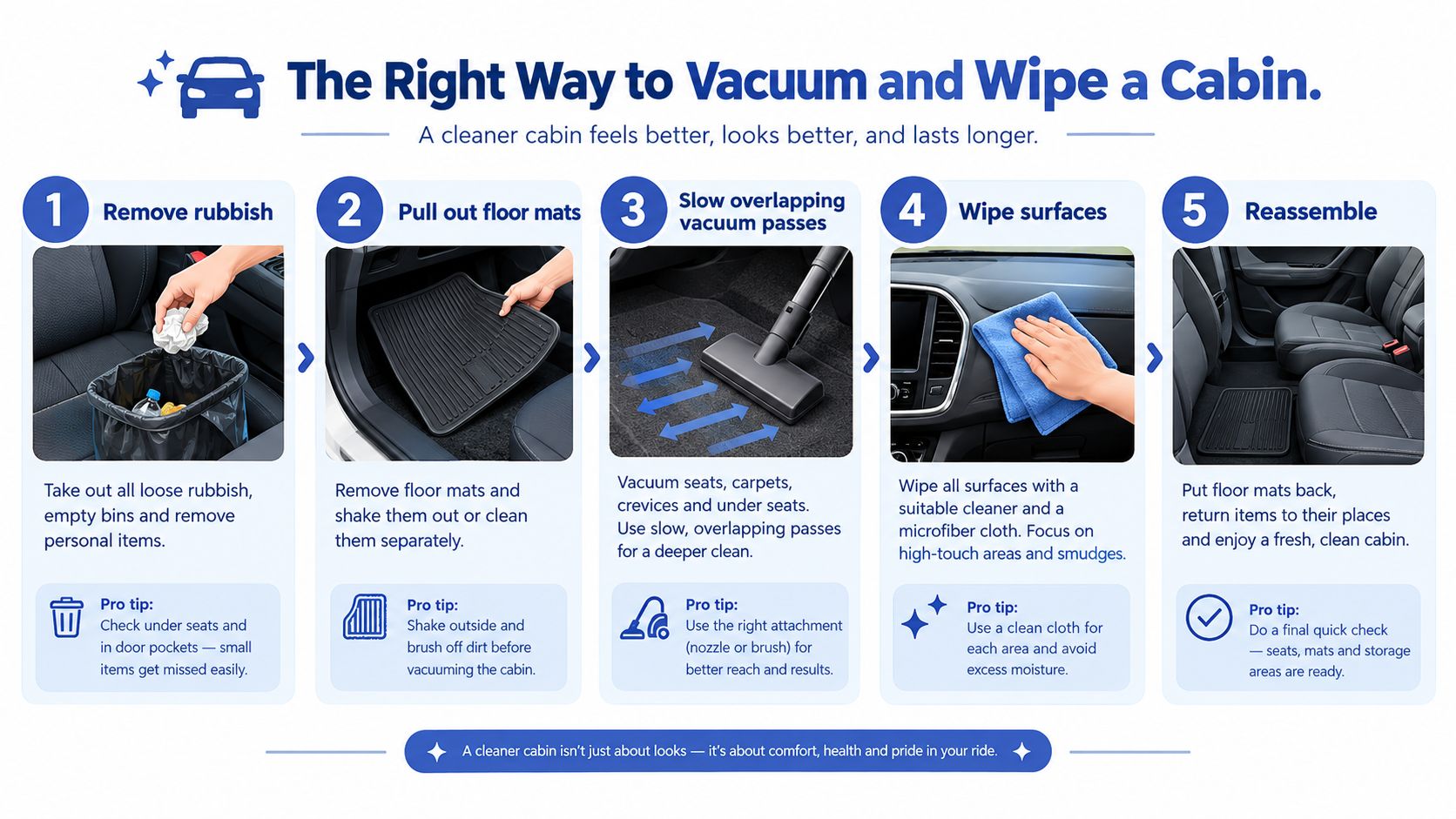
The Right Way to Vacuum and Wipe a Cabin
A daily-driven car can look tidy while grit sits under the mats, dust works into seat seams and residue collects around switches. Start by removing rubbish, bottles and loose belongings. Take the mats out completely, then check for dampness or staining beneath them before cleaning.
Vacuum slowly with overlapping passes across the seats, carpet, footwells and boot. Quick passes leave debris in carpet pile and seams. Use a narrow attachment around seat rails, between cushions and beside the centre console. A soft brush on the vacuum helps lift dust from dashboard crevices, vent slats and other delicate gaps.

Work from dry removal to controlled wiping
Remove loose dust before wiping. A lightly damp microfibre cloth suits many hard surfaces, but the cleaner must match the material. Give extra attention to the steering wheel, gear selector, door handles, seatbelt buckles, touchscreen and window switches. These areas receive repeated contact and quickly collect skin oils, dust and product residue.
Compressed air used too early just redistributes dust through the cabin, vents and upholstery. Over-wetting creates another problem. Saturated carpet and seat foam take longer to dry, and trapped moisture can leave odours or damage materials.
Apply a small amount of cleaner to the cloth instead of flooding the surface. Keep liquid away from switches, screens, airbag covers and electrical gaps. Clean leather with a suitable product, then condition it sparingly. Glossy trim generally benefits from a low-residue finish rather than a slippery dressing that attracts more dust.
Drying is part of the clean. Leave the doors open when conditions allow, and let mats, carpet and seats dry fully before closing the car. Perth’s dry air can help, but shaded areas, soaked foam and humid weather still slow evaporation. Check underneath mats and along seat edges before putting everything back.
Use a dry-first, wipe-second sequence throughout the cabin. For a more detailed guide to washing a car from the inside, follow the same order: remove dry contamination, wipe controlled areas, apply protection sparingly and allow materials to dry before trapping the cabin closed.
Read the full inside car washing guide
Why Fresh-Smelling Is Not the Same as Clean?
A strong fragrance can make a dirty car seem cleaner without removing the source of the odour. Spray over damp carpet, old food residue or pet contamination, and you may create a heavier mixture of smells rather than a hygienic cabin.
Australian health authorities identify dust-mite allergens, particulate matter, airborne viruses and chemical pollutants as indoor-air concerns, and recommend caution with high-VOC cleaning products, air fresheners, scents and sprays in the guidance on indoor air quality. A vehicle cabin is smaller and less ventilated than a room, so product choice matters, particularly when children, asthma sufferers or fragrance-sensitive passengers spend long periods inside.
Remove odours instead of covering them
Start with the source. Empty rubbish, vacuum fabric and carpet, clean hard surfaces, inspect under seats and check whether moisture has entered mats or upholstery. If a smell persists, adding fragrance isn’t the next logical step. The material causing the smell needs further cleaning or professional assessment.
A Perth-friendly approach uses low-fragrance, low-residue products and treats scent as optional. Avoid spraying directly onto vents, screens, steering wheels, airbag covers or leather. Aerosols can leave residues, impair visibility and affect sensitive materials, while heavily scented protectants may add chemical pollutants without improving the underlying cleanliness.
A cabin that smells faintly of clean materials is often preferable to one that smells strongly perfumed but still contains dust, dampness or residue.
Rideshare drivers face an additional consideration because passengers have different sensitivities. One person may enjoy a sweet fragrance, while another may experience discomfort from it. Thorough vacuuming, careful wiping and proper ventilation create a more neutral environment. For smoke contamination, source removal and fabric treatment matter more than masking spray, which is why this guide to removing smoke smell from a car focuses on treating the cause rather than only adding scent.
See how to remove smoke smell properly
Cabin Filters, Vents and the Air You Actually Breathe
The cabin-air filter sits within the vehicle’s air-handling system, commonly near the glovebox or at the base of the windscreen depending on the vehicle. It catches airborne material before air reaches the cabin, but it can’t work indefinitely. A loaded or damaged filter can restrict airflow and allow unpleasant smells or particles to circulate.
RAC Western Australia recommends detailing an interior once a month, identifies dashboards, consoles, door handles, window controls and air vents as priority areas, and advises cleaning vent slats every few months in its car detailing guidance. That schedule pairs naturally with checking the cabin filter according to the vehicle manufacturer’s maintenance instructions.
Ventilation is part of interior care
After a hot day, briefly flushing stale air with windows open can improve comfort when outdoor conditions are suitable. In heavy traffic or smoky conditions, closing windows and using recirculation with a properly fitted filter can limit incoming particles. Never rely on recirculation to manage exhaust exposure in an enclosed garage, and don’t idle a vehicle there.
Carbon dioxide also changes as occupants remain inside. Research from the University of the Sunshine Coast found that vehicle-cabin carbon dioxide reached about 1,500 ppm within 20 minutes with one occupant and nearly 3,000 ppm with two occupants in tested light passenger vehicles, with concentrations increasing with passenger number and time, as reported through the Australian built-environment and health information. Cleaning doesn’t lower carbon dioxide. Ventilation does.
Families in Perth may benefit from a quick rubbish clear and mat check each week or fortnight, followed by proper vacuuming and wiping on a monthly schedule. Rideshare and delivery operators often need shorter intervals because contact and cabin turnover are higher. Surface care and air-system care should be treated as one maintenance routine, not two unrelated jobs.
Stains, Spills, Pet Hair and When to Call a Pro
Fresh spills are easier to manage than established marks. Blot liquid from fabric or carpet with a clean absorbent cloth rather than rubbing it deeper into the fibres, then use a suitable fabric cleaner sparingly. Remove the source from leather promptly, wipe the area with a compatible cleaner and dry it without leaving moisture around seams.
Pet hair often needs mechanical removal before vacuuming. A rubber glove, rubber brush or upholstery brush can gather hair into manageable rolls, after which the vacuum can collect the loosened material. Check seat rails, boot corners and the junction between the seatback and cushion, where hair tends to remain hidden.
Know when home cleaning has reached its limit
DIY cleaning has limits. Set-in stains, milk, vomit, smoke contamination and odours embedded in seat foam or carpet backing can remain after surface treatment. Visible mould is a stronger warning sign, especially if moisture has reached the underlay or foam. Persistent odour after cleaning usually means the source hasn’t been reached.
Rural and off-road travel creates another reason to clean carefully. NSW Environment and Heritage guidance identifies seats, steering wheels, gear sticks, pedals and floors as surfaces that may require disinfection after travel through potentially contaminated areas, and lists 70% alcohol wipes or spray as an option in its vehicle hygiene guidance. Follow the product and vehicle-material requirements, and avoid applying unsuitable alcohol products to sensitive finishes.
Escalate to professional detailing when you can’t identify the source, when moisture or mould is involved, or when a lease-return or sale inspection is approaching. Services such as carpet and seat steam cleaning, leather cleaning and conditioning, and pet-hair removal are useful as targeted interventions rather than automatic add-ons. This guide to removing pet hair from car seats, carpets and the boot covers the problem before deciding whether a deeper service is needed.
Get help with stains, odours or pet hair
Protecting Upholstery, Resale Value and Your Weekly Routine
Dirt isn’t only a visual problem. Grit works into fabric, oils accumulate on leather and high-contact surfaces, and spilled drinks can leave residues that attract more debris. Keeping materials clean and dry helps preserve their feel and appearance, while early attention reduces the chance of a rushed, expensive-looking clean before a sale or lease return.
A workable Perth routine doesn’t need to resemble a detailing bay:
- Weekly: Remove rubbish, shake out mats, check cup holders and deal with fresh spills.
- Monthly: Vacuum seats, carpets, footwells and the boot, then wipe the dashboard, console, handles, switches and steering wheel.
- Every few months: Clean vent slats, inspect the cabin-air filter against the manufacturer’s schedule and arrange deeper treatment if odours or stains persist.
For material-specific protection, this complete guide to car interior protectants is useful when deciding whether leather, vinyl and trim need conditioning or a restrained protective finish. Products should support clean, dry surfaces, not conceal neglected ones.

Prime Shine Hand Car Wash offers interior and boot vacuuming, dashboard and trim dusting, deeper interior detailing, seat and carpet steam cleaning, leather cleaning and conditioning, pet-hair removal and interior protectant options at its Westminster site. If your car has moved beyond a quick home clean, those targeted services can reset the cabin without treating every visit as a full detail.
Visit Prime Shine Hand Car Wash in Westminster for a hand-cleaned interior, from routine vacuuming and surface care to steam cleaning, leather treatment and pet-hair removal. Book the service that matches your cabin’s actual problem, then keep the result with a short weekly reset and regular monthly cleaning.