






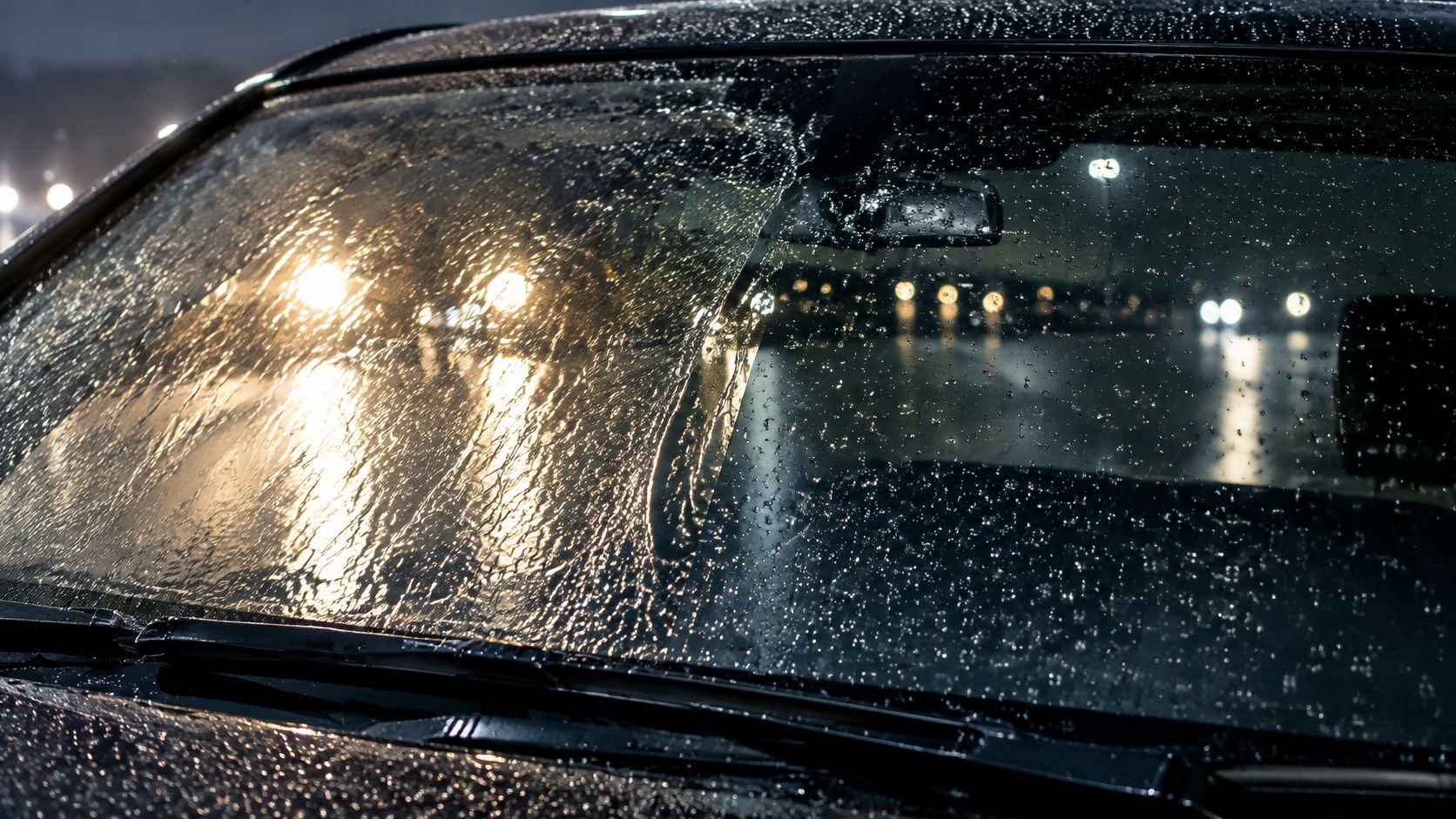
You’re driving home in rain after dark and your wipers aren’t clearing the glass, they’re smearing it. Road film, dust and insect residue turn every set of headlights into a halo, and you’re leaning forward trying to see through a windscreen you’ve already cleaned twice this week. That’s the problem a ceramic coating for glass is sold to solve, but it’s not one decision. Your windscreen, side glass and camera zones need separate answers, weighed against yearly cost, legal light limits and driver-assistance risk.
Ask for a glass assessment before you book any coating.
What Does a Ceramic Coating on Glass Actually Do?
On that wet night drive, untreated glass lets rain spread into a flat sheet. A ceramic coating for glass is a thin, durable, water-repellent layer, usually silica or polymer based, that bonds to the surface so water forms beads instead. At speed, airflow pushes those beads off rather than leaving a continuous film.
A non-stick pan works the same way. Dirt still arrives, but it releases with less effort. Road film and bug splatter still land on your windscreen, yet they need less scrubbing and less pressure to remove.
The physics is the same across the car; the decision is not. The windscreen takes the wiper passes and most night glare, side glass sees less blade wear but still collects film, and camera or sensor zones sit where streaks, residue or uneven application can matter more than extra beading.
Book a hand wash and glass check to see if your glass is ready to coat.
What changes in daily driving
- Faster rain shedding: Beads roll off at motorway speed, so you rely less on constant wiper passes in light rain.
- Easier cleaning: Insect residue and road film wipe away with less effort.
- Cleaner wipes: A slick surface wipes clean without dragging a cloth across bonded grime.
A worn blade will still smear, and a stone will still chip coated glass. The coating does not replace wiper blades, stop chips or cracks, or make glass scratch-proof; expect easier maintenance and better wet-weather shedding.
The research benchmark, and its limits
Curtin University in Western Australia reported a chemically bonded, organic surface layer that makes glass permanently water-repellent, using an ultrasonic process with selected diazonium salts to create a molecular-level bond. Curtin states that layer does not peel, dissolve in water, or deteriorate like conventional coatings. That work is still at research and industry-validation stage, not an established consumer service.
Get a transparent, obligation-free quote before you commit.
Retail ceramic or silica coatings sit in a different category: sacrificial layers that need ongoing maintenance. Contaminants, mineral scale or oily residue prevent uniform bonding and produce uneven water behaviour, which is why decontamination and inspection under oblique light matter before handover.
Practical rule: The layer is only as good as its preparation and its upkeep.
Explore Ceramic Coating and Glass Add-Ons
Which Glass Treatment Is Worth the Money?
Start with the job each product is doing. Some treatments change how water behaves, some only clean the surface, and tint changes light rather than water behaviour. That distinction saves money faster than any brand claim.
Glass treatments compared on durability, visibility risk and best use
| Treatment | What It Does on Glass | Typical Durability | Visibility Risk | Best Use |
|---|---|---|---|---|
| Ceramic glass coating | Chemically bonded, water-repellent layer | Longest-lived option here when maintained | Low if prepared and applied cleanly | Windscreen and exterior glass driven hard |
| Rain repellent spray | Temporary water beading for wet-weather visibility | Short-lived, needs frequent reapplication | Low, though heavy residue can smear under wipes | Occasional drivers and quick fixes |
| Glass sealant (polymer) | Adds slickness and some water repellence | Shorter than ceramic, longer than a quick spray | Low to moderate if left uneven | Lower-cost protection between cleans |
| Decontamination clay and glass polish | Removes bonded contamination and light surface marks | One-off preparation step | Low if rinsed fully | Preparation before any coating |
| Standard car wax | Shine and sacrificial protection on paint | Poor choice on glass, wears quickly under wipers | Moderate, smears and attracts dust on glass | Paintwork |
| Window tint film | Reduces light transmission and glare | Long-term film choice, subject to legal limits | Higher, because light loss is regulated | Privacy and heat reduction |
Read the rows by lifespan first, then by risk. Sprays and polymer sealants are the cheaper ladder rungs: easy to apply, easy to reapply, easier to forgive. Ceramic asks more from preparation and upkeep, and pays back through longer service. Clay and polish are preparation steps: they strip bonded contamination so a coating can bond evenly, and skipping them is a common reason coatings haze or bead patchily.
Wax is for paint; on glass it smears under wipers and attracts dust. If you want the paint-side case, read our guide to where liquid car wax earns its place. Tint is a separate decision governed by visible light rules, and clear coatings should stay clear: haze, ripple or residue in the wiper sweep is a failed job, whatever the bottle promised.
Compare your options in person, bring the car in for a glass inspection.
Three criteria decide it
- How long the effect must last: Daily drivers notice a short-lived spray fading first on the freeway.
- How much preparation you will do: Ceramic products punish rushed prep with haze and patchy beading.
- Whether the car has cameras or a head-up display: Sensors and projection zones change where product can go, not only which product you buy.
Now run the cost as a yearly figure, not a sticker price. Prime Shine’s ceramic coating starts from $699, and with proper maintenance it can last two to five years depending on driving conditions, washing habits and exposure. On that service benchmark, $699 over two years is just under $350 a year; if care carries it toward five years, the figure falls to about $140 a year. Neglect flips the maths, because a coating abandoned early costs more per year of real use than one maintained for its full span.
Three Perth cases
A Mitchell or Kwinana Freeway commuter collects road film, insects and summer dust at speed. For that driver the windscreen case is strongest, because beading and easier cleaning pay off every trip. A rideshare driver cleaning the windscreen several times a day gains differently, through time saved at every wipe-down between fares.
Book a windscreen-first coating quote based on how you drive.
A family SUV carrying pets and children is the weakest case for coating everything. Side glass gains little from water shedding, since it sits out of the airflow and away from the wipers, and interior smudges are a cleaning issue rather than a coating issue. Coat the windscreen, clean the rest properly, and spend the difference elsewhere.
Buy clear coating for water behaviour, not for heat promises. Australian guidance summarised by Transport Victoria’s window tinting and films information shows most vehicle glazing already blocks almost all UVB, and clear coatings do not automatically match solar-control films for heat reduction. In Perth’s bright, dry conditions, glare, dust and rapid contamination matter more than UV alone, and cabin-cooling claims for side glass or panoramic roofs need measured solar data rather than the word ceramic.
If you drive often in rain, dust or bugs, coat the windscreen first. If you want a cooler cabin, look at compliant solar-control film instead.
The verdict is narrow on purpose. A ceramic glass coating earns its cost on a windscreen driven hard in dust and rain by an owner who will maintain it. A rain repellent suits an occasional driver who would rather reapply cheaply than pay for preparation.
Is Coated Glass Legal and Safe to Drive With?
Two cars can carry the same clear coating and only one passes a roadworthy check. The difference is rarely the product. Regulators judge the finished glass, so a coating that leaves haze, ripple, bubbles or measurable light loss is tested against the same visibility rules that govern tint. Light transmittance works like a budget: the glass, any existing film and the new coating each spend part of it, and the total has to stay above the legal floor.
Minimum light transmittance by rule and location
| Rule or Jurisdiction | Windscreen | Front Side Windows | Rear Side and Rear Windows |
|---|---|---|---|
| National windscreen minimum (ADR 8/01, AS 2080:2019) | 70% regular light transmittance | Set by state or territory rules | Set by state or territory rules |
| South Australia guidance for post-applied coatings | 75% for vehicles built after 1971, outside the upper 10% and the wiper sweep | Set by South Australian vehicle guidance | Set by South Australian vehicle guidance |
| ACT vehicle guidance | Covered by the national windscreen minimum | 35% driver and front passenger | 20% rear passenger and rear window |
| Northern Territory | Covered by the national windscreen minimum | Set by territory vehicle guidance | A lower limit applies behind the driver |
| Western Australia (combined glass and tint) | Covered by the national windscreen minimum | Assessed as a combined glass and film system | Assessed as a combined glass and film system |
South Australian vehicle guidance treats a post-applied coating like tint: it must not reduce windscreen luminous transmittance except within the greater of the upper 10% of the windscreen or the area above the wiper sweep, and at least 75% is generally required for vehicles built after 1971. The Australian vehicle glazing determination sets a 70% minimum through the primary vision area and requires glazing not to create noticeable distortion or confusion between the colours used in road signs and traffic signals. A coating that streaks or hazes can breach those limits even without darkening the glass.
Tell us your glass details when you book.
Brightness is only half the test. Uneven residue, rippling and night-time halos are visibility defects, not cosmetic flaws. On side glass, Access Canberra’s tinting guidance sets at least 35% for driver and front-passenger windows and 20% for rear windows, and the Northern Territory applies its own lower limit behind the driver. A transparent coating still counts as part of the complete glass-and-coating system, which matters most over existing tint: the film has already spent most of the transmittance budget, leaving the least room for any added layer.
Cameras and displays change the answer
A windscreen is not one decision. Forward cameras, rain sensors and head-up displays each look through their own patch of it, so weigh those zones separately from the rest of the glass. Coating over a camera viewing zone or sensor aperture can disturb what those systems see, and incorrect glass specification can cause head-up display blur or ghosting. The money saved by treating the whole windscreen in one pass is small next to a driver-assistance fault.
Tell us about your cameras and sensors when you book.
Before treatment, disclose driver-assistance features, a head-up display and any recent windscreen replacement. Exclusion zones should be masked and recorded, and the car should be checked at night and in rain before you drive away.
Ask About Your Windscreen and Sensors
How Do You Apply a Glass Coating Step by Step?
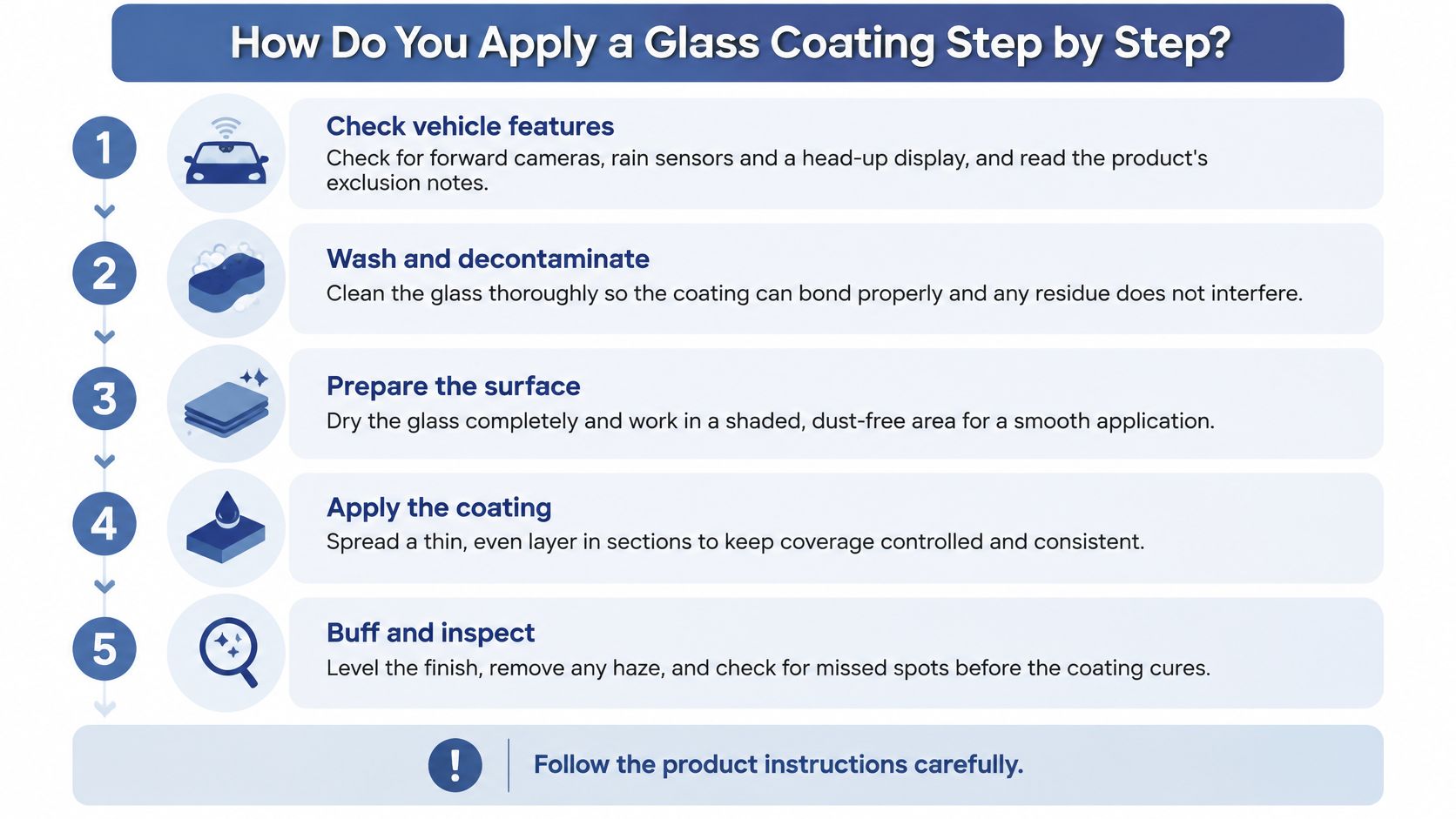
Application is a routine, and each step exists for a reason. Rush the early ones and the later ones can’t rescue the result.
- Check vehicle features first. Look for forward cameras, rain sensors and a head-up display, then read the product’s exclusion notes. The Australian ADAS Industry Code of Conduct notes windscreen replacement can alter forward camera alignment and may require calibration, so coating should never go over camera zones, sensor apertures or manufacturer-specified areas.
- Wash the glass thoroughly. Remove road film, dust and insect residue with a glass-safe cleaner so you’re not sealing grime under the layer.
Book a pre-coating wash if your glass needs decontamination first.
- Clay or use a mild iron remover, then rinse fully. Mineral scale and oily residue stop the coating bonding evenly. Our guide to cleaning glass the right way covers the cleaning technique behind this stage.
- Strip what’s already on the glass. Existing wax, sealant or polish is removed before ceramic coating is applied, so the coating can bond properly to bare glass. Dry with clean microfibre, not the towel you used on the paint.
Masking, application and cure
- Mask before you open the bottle. Cover rubber seals, trims, camera windows and sensor zones, and write down what was masked. That record protects you if a sensor behaves oddly later.
- Apply thin and even. Work one panel at a time in straight, overlapping passes. More product doesn’t mean more protection, it means more residue to level.
Prefer a documented masking plan? Request one with your quote.
- Level within the stated window. Remove excess promptly with clean microfibre. Product left sitting too long is the common source of haze and rainbow patches.
- Respect the cure. The car can be driven shortly after application, but water or washing should be avoided for at least 24 hours, and full curing takes up to seven days.
- Inspect before handover. Check in oblique light and again at night for streaks, halos and wiper chatter, because faults invisible at midday show up under headlights.
Most DIY results fail at preparation, not at the application stroke. Clean glass does the heavy lifting.
See How to Prepare and Clean Glass
How Long Does It Last and What Goes Wrong?
A coating that beaded beautifully in month one can look flat by month eight, and the difference usually isn’t the product. Glass coatings don’t expire on a fixed date; they fade as contamination builds on top of the layer. A consumer glass product on a working windscreen generally wears through sooner than a professionally applied coating, because wipers drag grit across the surface on every pass. With proper maintenance, a ceramic coating can last two to five years, depending on driving conditions, washing habits, and exposure to harsh elements, and the windscreen end of that range runs shorter than sheltered side glass that sees no wiper contact.
When water stops forming distinct droplets, decontaminate first and recoat only if beading doesn’t return after a proper clean. Dusty parking, heavy rain use and trees dripping sap all shorten the working life. Ceramic coating reduces washing frequency and effort, but regular cleaning is still needed to maintain its performance and shine, and our guide to how long ceramic coating lasts explains how driving conditions and washing habits shift that figure.
Book a maintenance wash to keep your coating performing.
Aftercare that protects the layer
- Wash gently and regularly: Use gentle hand washing with pH-neutral car shampoo and soft microfibre towels.
- Clean glass safely: Use a glass-safe, ammonia-free cleaner and a clean cloth kept only for glass.
- Replace worn blades: A torn wiper edge smears water no coating can fix.
- Avoid abrasive brushes: Automatic car washes with brushes and harsh cleaners wear the layer faster.
- Dry standing water: Mineral deposits form when water dries on the surface, coated or not.
Glass coating symptoms, likely causes and fixes
| Symptom | Likely Cause | Fix |
|---|---|---|
| Streaks or haze after curing | Excess product or poor buffing | Re-buff with clean microfibre; if haze stays, professional correction |
| Beading fades within months | Contamination or film left on the glass | Decontaminate, clean fully, then re-check beading |
| Mineral spots that will not wipe off | Water left to dry on the coated surface | Prompt drying and a glass-safe mineral remover |
| Smearing in rain | Worn wiper blades or film on blade edges | Replace blades and clean the blade edges |
| Halos or rainbows at night | Uneven residue or over-application | Remove residue and inspect at night; recoat if needed |
| Visible ripples or bubbles | Uneven application or dust under the layer | Professional removal and reapplication |
Bring hazy or streaky glass in for a diagnosis before recoating.
Location matters as much as the symptom. A streak on the side glass is cosmetic; the same haze sitting over a camera window is a driver-assistance problem, because the sensor reads through that patch of glass. Get residue in a camera zone levelled or removed rather than waiting for the next wash.
Adding more product over contamination layers a new problem on top of the old one. Start with the cheapest fix that matches the cause: clean the blade edges before blaming the coating, decontaminate before recoating, and reserve full removal for ripples or trapped dust that cleaning can’t touch. A windscreen that lost its beading after a month of road film will often bead again after one gentle re-wash with pH-neutral shampoo, with no new product involved.
Explore Hand Wash and Aftercare Services
Should You Coat Glass Yourself or Hire a Professional?
Treat each pane as its own decision. A bare windscreen on an older car with no cameras or head-up display is the strongest DIY case: you need a free evening, a clean shaded workspace and patience for decontamination. Side glass carries less risk again, because no driver-assistance camera reads through it. The moment a camera, rain sensor or HUD shares the glass, the calculation changes, since a streak sitting in that zone can interfere with systems the driver relies on.
DIY versus professional glass coating application
| Factor | DIY Application | Professional Application | What to Check |
|---|---|---|---|
| Upfront cost | Lower outlay on the product | Quote-based; car ceramic coating from $699 | Final price depends on size, condition and extras |
| Preparation quality | Easy to rush decontamination and residue removal | Surface preparation included: deep cleaning to remove contaminants | Ask what the preparation step covers |
| Camera and sensor zones | Owner judges where to mask and can miss a zone | Raise camera zones at booking so they stay uncoated | Check the vehicle and glass manufacturer notes |
| Time required | A full evening or longer, plus cure | One visit, with full curing still up to seven days | Ask how long the visit takes and when the cure window ends |
| Durability and redress | Depends on the owner's work; no comeback | Depends on provider terms | Ask for the workmanship policy in writing |
Request a transparent, obligation-free quote before you decide.
Your time is part of the DIY price. Washing, claying, stripping old residue, masking and levelling a windscreen consumes an evening, and a hazed result costs a second evening to correct. Weighed against the two to five years a maintained coating can deliver, the professional premium narrows on a yearly basis. Our Perth driver’s guide to car ceramic coating sets out how preparation differs across the whole car.
Two questions to ask any provider
- What light transmission data does the product carry, and does it fit the legal threshold for this glass?
- What preparation is included in the price, and is the workmanship policy in writing?
A provider who can’t answer both clearly is selling beading. You’re buying visibility.
At Prime Shine Hand Car Wash in Westminster, specialised ceramic protection for glass, wheels and trims is offered as an add-on service, so the windscreen decision can be quoted on its own. If your windscreen smears in rain or you’re weighing the coating against your car’s cameras and legal light limits, ask for a quote and confirm what the preparation covers. Visit Prime Shine Hand Car Wash to book.