






The most popular advice about protecting a car’s paint in Perth is to choose the coating first. Ceramic if you want the safe option, graphene if you want the newer one. That order is backwards. A coating is a film a few microns thick that bonds to whatever surface it lands on, and if that surface is oxidised, swirled or holding bonded road film, a premium top coat seals the problem under a glossy layer.
What decides the result is inspection, decontamination, a measured cut and polish, and protection applied last. Coating chemistry matters, but it matters third. The gap between a well-prepped mid-range coating and a badly prepped premium one is far wider than the gap between graphene and ceramic.
Start with the paint rather than the product and book a paint assessment with Prime Shine Hand Car Wash in Westminster.
Which Is Better for Perth Cars, Graphene or Ceramic Coating?
For a Perth daily driver, a professional ceramic coating is the safer default. Graphene becomes worth the premium only when the technical data sheet names the graphene or graphene oxide content, states the cure schedule, and shows test results beyond a slow-motion water beading clip. Plenty of products sold under the graphene label are hybrid ceramic formulas carrying a small additive load, and the additive’s contribution is impossible to isolate without independent data.
Perth detailing shops sell both labels, and the price gap between them is real. The typical local car lives outside, commutes daily and gets washed when it looks dirty. That use pattern punishes weak preparation far more than it rewards premium chemistry.
Not sure what your paint can carry? Book an inspection at Prime Shine Hand Car Wash before you compare product names.
| Criterion | Ceramic coating | Graphene coating |
|---|---|---|
| Main active ingredient | Silica (SiO2) or a silicon-based polymer | Silica or polymer base with graphene or graphene oxide additive |
| Bonding to paint | Cross-linked layer bonded to the clear coat | Similar bonding; graphene content varies by product |
| Typical water contact angle | Quoted values vary by product and sit higher on freshly prepared paint | Similar quoted range; additives may lift initial slickness |
| Hardness claims | Often marketed as 9H; test method varies | Often marketed as 9H; not a reliable differentiator |
| Typical professional service life | 2 to 5 years (indicative) | 1 to 3 years (indicative) |
| Maintenance demand | Regular pH-neutral washing; no wax needed | Regular pH-neutral washing; no wax needed |
Every range in that table is indicative and product-dependent. Treat it as a starting point for a conversation, not a specification.
What the chemistry actually says
Ceramic coatings are silica or silicon-based polymer films that cure into a cross-linked layer bonded to the clear coat. The result is a hard, glass-like surface with hydrophobic behaviour and decent chemical resistance. Cure is a chemical reaction, not evaporation, which is why temperature, humidity and the no-water window matter more than the brand on the bottle.
Graphene coatings use the same silica or polymer base with graphene or graphene oxide flakes dispersed through it. The graphene functions as an additive within that base formula. Whether it adds anything beyond the base depends on loading, dispersion quality and how well the flakes stay suspended, which is precisely the information a brochure rarely gives you.
Three checks before you pay for a label
- Active ingredient. Ask for the technical data sheet rather than the marketing page. If it lists a siloxane or silica base and never quantifies the graphene, price it as a ceramic coating, because that’s what you’re buying.
- Cure time and conditions. A credible product states a cure window, a working temperature range and how long the car must stay dry. If nobody can tell you what happens if it rains on the first night, the aftercare advice is guesswork.
- Published test data. Contact angle, chemical resistance and hardness should be measured against a named standard, with hardness commonly reported on the pencil scale that produces the 9H figure. A number with no method behind it tells you nothing.
The three criteria that decide the answer: how exposed the car is, how it’s driven and washed, and how much upkeep you’ll realistically do. A mid-range coating washed weekly outperforms a premium one washed twice a year.
Compare coatings on your car, not on a screen. Book a paint assessment at the Prime Shine Hand Car Wash workshop in Westminster.
Does Perth’s Climate Change Prep Before Coating?
Perth’s rainfall splits hard, and that split rewrites the preparation list. The Bureau of Meteorology records roughly 731 mm of annual rainfall, with about 148 mm in July against only around 10 mm in December (Bureau of Meteorology Perth climate averages). A long dry summer leaves fine dust and grit sitting on horizontal panels, and the first real winter rain turns that dust into a bonded road film.
Strong sun changes the arithmetic again. A coating applied over oxidised paint protects a dull finish, it doesn’t restore one. Correction comes first, then protection seals the work. That order is why the cut and polish Perth drivers book before a coating matters more than the coating brand.
Find out whether your paint needs correction or just protection. Book an assessment with Prime Shine Hand Car Wash.
The preparation sequence that has to come first
- Inspect under honest light. Direct sun or a focused LED shows swirls and haze that shade hides. Map defects panel by panel.
- Wash thoroughly. A two-bucket hand wash with separate wheel media removes the loose grit that would otherwise be dragged across the paint.
- Decontaminate. Where the surface feels rough, a clay bar lifts bonded contamination. WA automotive training treats cleaning contaminants as a defined preparation step before any paint work, not an optional extra (vehicle painting preparation competency).
- Test defect depth. Run a clean fingernail across the mark. If it catches, the damage is through the clear coat and no amount of polishing will level it.
- Polish conservatively. A one-step cut where the paint allows it, refined afterwards. The WA competency for cutting and polishing painted panels describes a full surface-preparation and machine-polishing workflow with selected compounds, pads and equipment, verified under suitable lighting (cutting and polishing competency).
- Apply the coating. On corrected, panel-wiped paint, following the cure schedule exactly.
The boundary is easy to state. Swirls, oxidation and shallow wash marks respond to correction. Scratches that expose primer or metal need touch-up paint or panel repair, and polishing a coating over them only hides the problem for a season. Correction also removes a small amount of clear coat, so repeated aggressive correction isn’t better than careful maintenance.
The rule for Perth owners: coat only after the paint has been inspected and corrected. Never as a substitute for it.
The interaction between strong sun and coating durability is covered in this guide to ceramic coating protection against Perth sun.
Book a cut and polish assessment
Which Coating Lasts Longer Under UV, Heat and Chemicals?
No coating wins every stressor. UV stability, heat cycling, chemical resistance and abrasive wear are separate properties, and a product that excels at beading may be ordinary at resisting bug splatter. The comparison that matters is stressor by stressor.
| Stressor | Ceramic coating | Graphene coating | What to watch |
|---|---|---|---|
| UV fading and chalking | Strong on prepared paint | Comparable when UV-stabilised | Check datasheet for UV stabilisers |
| Heat cycling in summer | Good; silica is thermally stable | Similar base; additive effect not proven in field | Park in shade where possible |
| Bird droppings and bug splatter | Resists if cleaned promptly | Similar; cleaning window matters | Remove within 24 to 48 hours |
| Fuel and harsh chemical spills | Good resistance | Good resistance | Wipe spills promptly |
| Mineral sprinkler deposits | Resists bonding; still needs acid-free cleaner | Same | Use pH-neutral cleaner |
| Abrasive wash damage | Resists micro-marring when maintained | Same | Use the two-bucket method |
Park under cover when you can. Shade is cheaper than any coating and it removes most of the UV load.
What a regional test tells you
One Western Australian specification shows how aggressively coatings are stressed in this climate. Main Roads WA subjects anti-graffiti products to accelerated QUV exposure of 8 hours of UV-B at 60°C followed by 4 hours of condensation at 45°C, with performance assessed after 1,000 hours on measures including discolouration, chalking and colour change (Main Roads WA testing method). That method was written for structural coatings, so it cannot predict automotive clear coat life. What it does show is the exposure regime a Perth summer imposes, and why high UV and heat accelerate fading, oxidation and surface breakdown.
The service-life ranges in the earlier comparison follow that logic. Preparation quality, cure conditions and washing habits move the outcome more than base chemistry does, which is why the same product can outlast its quoted range on a garaged, well-maintained car and fall short on a daily driver parked in the open. A coating cured in a cold, damp garage on a humid day won’t deliver its stated window.
The practical rules that protect any coating
- Bird droppings: remove within 24 to 48 hours, before the uric acid etches clear coat. A coating slows that attack rather than stopping it.
- Fuel spills: wipe immediately, especially around the filler neck. Solvent sitting on a coating softens it.
- Washing: hand wash with pH-neutral shampoo and clean media. Automatic brushes undo correction work in a few passes.
- Annual check: a quick inspection catches failing beading and embedded contamination before they become a polishing job.
The honest conclusion is simpler than the marketing. Every coating slows UV fading rather than stopping it, and correction is what improves gloss and defect visibility while protection slows renewed weathering. Any fixed service-life promise only holds when the coating, preparation standard, exposure and maintenance schedule are all documented.
Curious how long a coating realistically holds in this climate? This breakdown of how long ceramic coating lasts covers the variables that move the number.
Get a realistic, product-specific durability estimate. Book a coating consultation at Prime Shine Hand Car Wash.
Which Coating Keeps Water Beading Longer Between Washes?
Beading is the easiest thing to see and the easiest thing to misread. On properly prepared paint, both coating families bead strongly when fresh: water pulls into tight domes, sheets off the panel, releases dust and road film more readily, and drying takes minutes instead of a towel workout. That initial performance confirms the surface is hydrophobic. It says nothing about how long it will stay that way.
Beading also fades faster than hardness. Detergents, mineral deposits and traffic film gradually strip the surface layer, so sheeting behaviour tells you far more about your wash routine than about the coating’s remaining protective life.
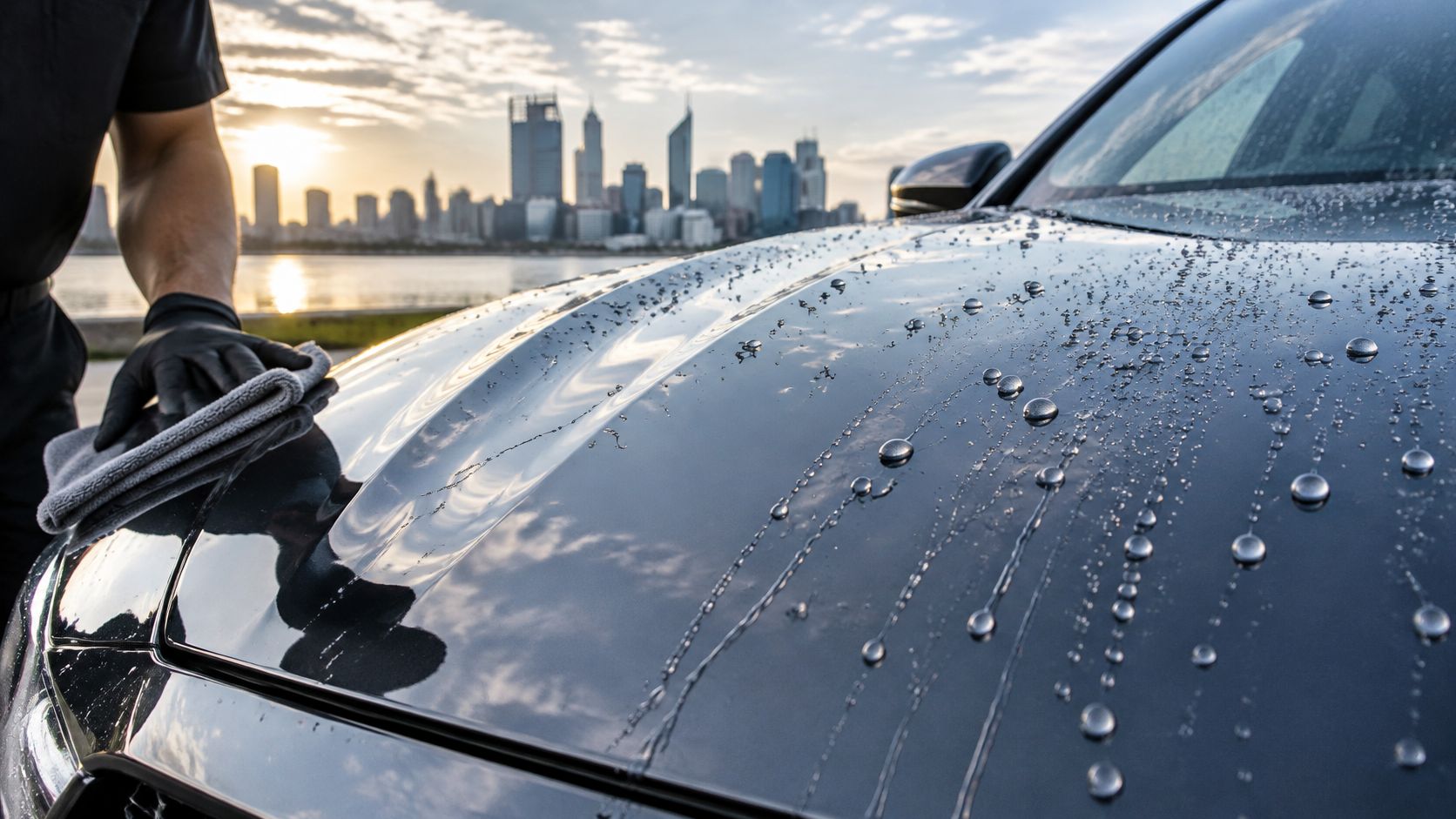
Graphene marketing leans hard on slickness, and fresh graphene-enhanced coatings can feel noticeably slick. Much of that slick feel comes from additive content sitting at the surface, which is the first thing detergents and contamination remove. The base chemistry bonded to the clear coat underneath is what keeps water beading once that top layer is gone. Judge a coating on how it behaves after months of normal washing, and judge marketing claims by whether they describe the additive or the base.
Want the finish to bead for longer, not just on day one? Book a maintenance wash at Prime Shine Hand Car Wash.
Why Perth dust matters more than beading angle
Perth’s air-quality reporting identifies wind erosion from unpaved roads and cleared areas as a significant source of PM10, with unpaved roads across the metropolitan area producing ongoing low-level emissions (Perth air emissions study). That fine abrasive dust settles on paint, and washing drags it across the surface if you don’t rinse it away first. A hydrophobic layer reduces how well dust adheres, but it doesn’t replace a careful hand wash and it won’t save a coating from a gritty sponge.
Three checks any owner can run
- Beading that dies early. If water stops beading soon after a wash rather than fading gradually, the top layer is already compromised and the wash routine is the first suspect.
- Sprinkler spotting. Chalky rings after a dry night mean mineral deposits are bonding. Switch to a pH-neutral cleaner and dry the panels.
- A plain rinse, no soap. If water still sheets cleanly under a hose, the coating is working. If it sits flat and dull, the surface needs decontamination rather than another layer of product.
Keeping that surface alive is a routine question, and this guide to maintaining a ceramic coating for Perth drivers sets out the wash intervals and products that suit local conditions.
What Does Each Coating Cost and Demand Over Five Years?
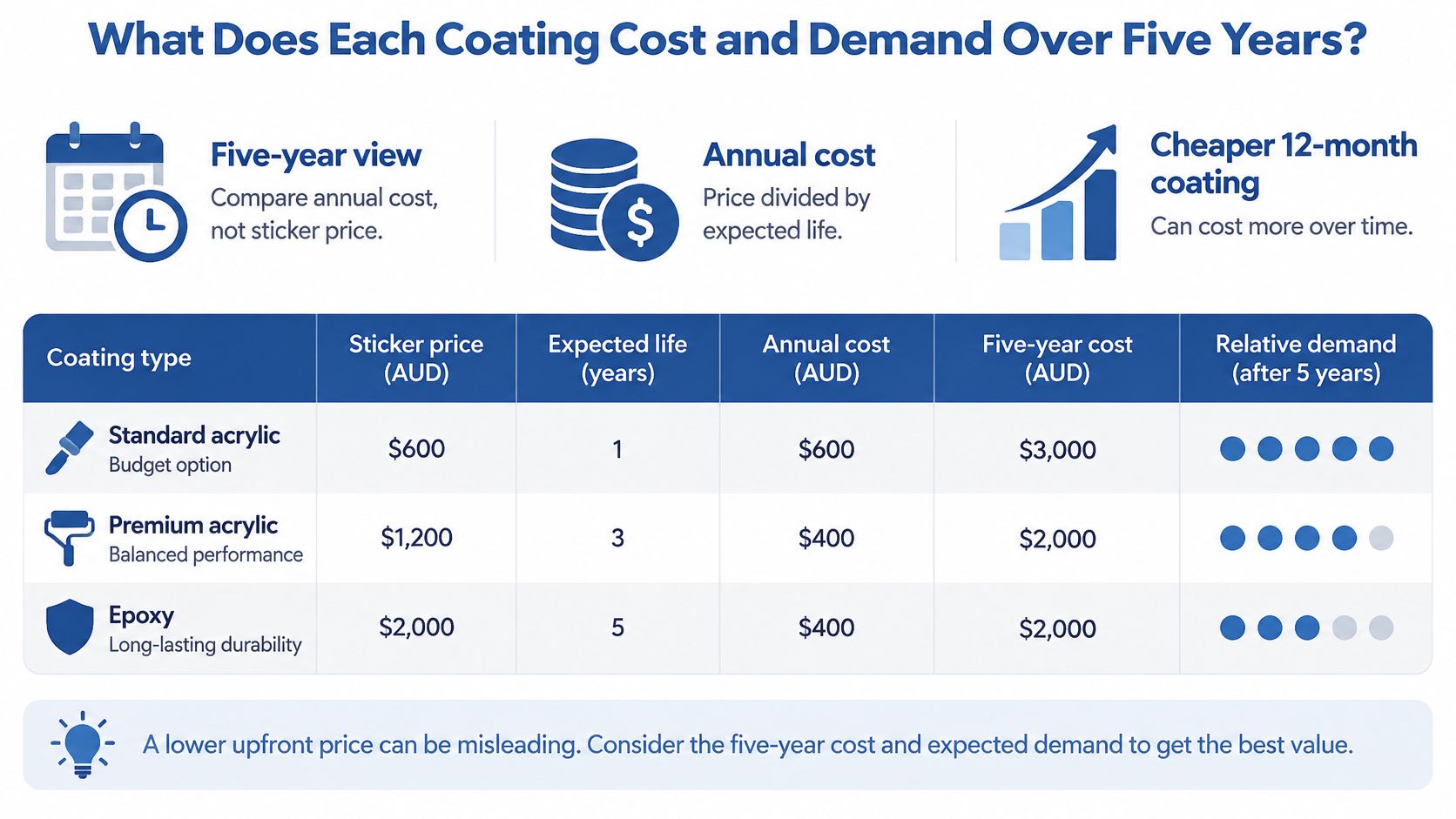
Sticker price answers the wrong question. Divide the quoted price by the expected service life and you get a yearly cost, the only figure that lets you compare a cheap coating against an expensive one fairly. A product that costs half as much but lasts a third as long is the more expensive choice.
A worked example with two hypothetical quotes
Take two hypothetical quotes: one shop prices a coating at $700 with a two-year expected life, another at $1,300 with a five-year life. The first works out at $350 a year, the second at $260. Over five years the cheaper sticker costs about $1,750 in repeat work against $1,300 paid once, and that ignores the extra polishing each reapplication requires.
Run the sum before you compare the invoices.
Hidden costs sit outside the coating price. Correction has to happen first, pH-neutral shampoo and fresh wash media are ongoing purchases, and top-up products or an annual inspection add a little each year. Exact prices vary by product, vehicle size and paint condition, so ask for a written quote covering preparation, correction and protection as separate lines.
| Option | Five-year demand | Upkeep |
|---|---|---|
| DIY spray coating kit | Repeated applications spread across the whole period | Reapply several times a year |
| Professional single-layer ceramic | One application covers most of the period | Regular pH-neutral washing and annual check |
| Professional multi-layer ceramic | One application; the longest coverage of the group | Regular pH-neutral washing and annual check |
| Professional graphene-enhanced coating | One application, with coverage shorter than multi-layer ceramic | Regular pH-neutral washing; check warranty terms |
| Paint correction before any coating | One-off step completed before the coating goes on | Required for best results |
The maintenance routine that protects the investment is unglamorous. Wash every one to two weeks if the car lives outdoors, use pH-neutral soap, skip automatic brushes and book an annual inspection. Perth's pattern of a long dry summer and concentrated winter rain makes infrequent washing expensive, and the Bureau of Meteorology's city climate records show how uneven that split is. Buyer regret around paint protection usually traces to weak preparation and poor aftercare rather than the coating chemistry failing, which is why the prep sequence matters more than the label on the bottle.
Sometimes the honest answer is no coating at all. A car being sold within a year, or a garaged vehicle doing low kilometres, is well served by correction and a quality wax. Buy a coating only if you'll keep the maintenance routine and keep the car long enough to spread the cost.
For a full breakdown of what each tier costs locally, this ceramic paint protection cost guide for Perth separates preparation, correction and coating line by line.
Which Coating Suits Your Car and Driving Pattern?
The owner profile decides the answer more often than the product does. Australia's fleet keeps ageing, with the average vehicle rising from 10.8 years in 2021 to 11.0 years in 2022, so most Perth owners keep a car long enough for a coating to pay back (ABS vehicle age data). Long ownership makes a longer-life product rational, provided the paint underneath is corrected first.
| Owner profile | Better fit | Why | Maintenance commitment |
|---|---|---|---|
| Daily commuter, parked outdoors | Professional ceramic | Sustained UV and dust resistance, longer life | Wash every 1 to 2 weeks |
| Garaged enthusiast car | Ceramic or graphene | Lower environmental stress; gloss is the priority | Wash monthly; detail after events |
| Family vehicle with pets and spills | Professional ceramic | Easier cleaning of spills and contamination | Weekly wash; interior protection |
| Rideshare or delivery vehicle | Single-layer professional ceramic | Lower cost per year under high mileage | Wash every 1 to 2 weeks; interval tied to mileage |
| Sale or lease return | Correction with wax or sealant | Presentation without a long commitment | Maintenance wash before handover |
| Older car with swirls and oxidation | Correction first, then sealant or ceramic | Coating over defects locks them in | Correction, then basic protection and regular washing |
Unsure which row you fall into? Book an assessment at Prime Shine Hand Car Wash and we'll match the coating to how the car is used.
Two cars, two different answers
A 2016 SUV parked on a driveway with light swirls across the bonnet and a dull, chalky finish needs correction before anything is applied. Without it, a coating seals in the haze and the owner pays premium money to protect a dull panel. The right sequence is a conservative polish, then a mid-range ceramic if the car is staying another four years.
A garaged 2023 sedan washed weekly by hand has clean, glossy paint and low UV exposure. Correction may not be needed at all, and a graphene-enhanced product suits an owner who values the gloss profile and accepts a shorter reapplication interval.
When film thickness changes the plan
Older cars carry more unknowns. WA paint rectification training starts by determining the cause of a paint fault, visually inspecting its extent, assessing existing paint-film build-up and comparing damaged panels with undamaged ones (paint rectification competency). A panel that has been machine-polished repeatedly has less clear coat left, so a measured one-step correction may be the only safe option, and the finish you promise should be modest.
One recommendation per profile, then. High-exposure daily use goes to ceramic. Garaged low-kilometre cars can take either, so choose on gloss preference and budget. Short-term ownership gets correction and wax. Older paint gets assessed before anything is promised.
Which Prime Shine Service Should You Book?
Match the service to the paint condition rather than to the product shelf. Correction restores the surface, protection slows what happens next, and the two work as a sequence rather than a choice.
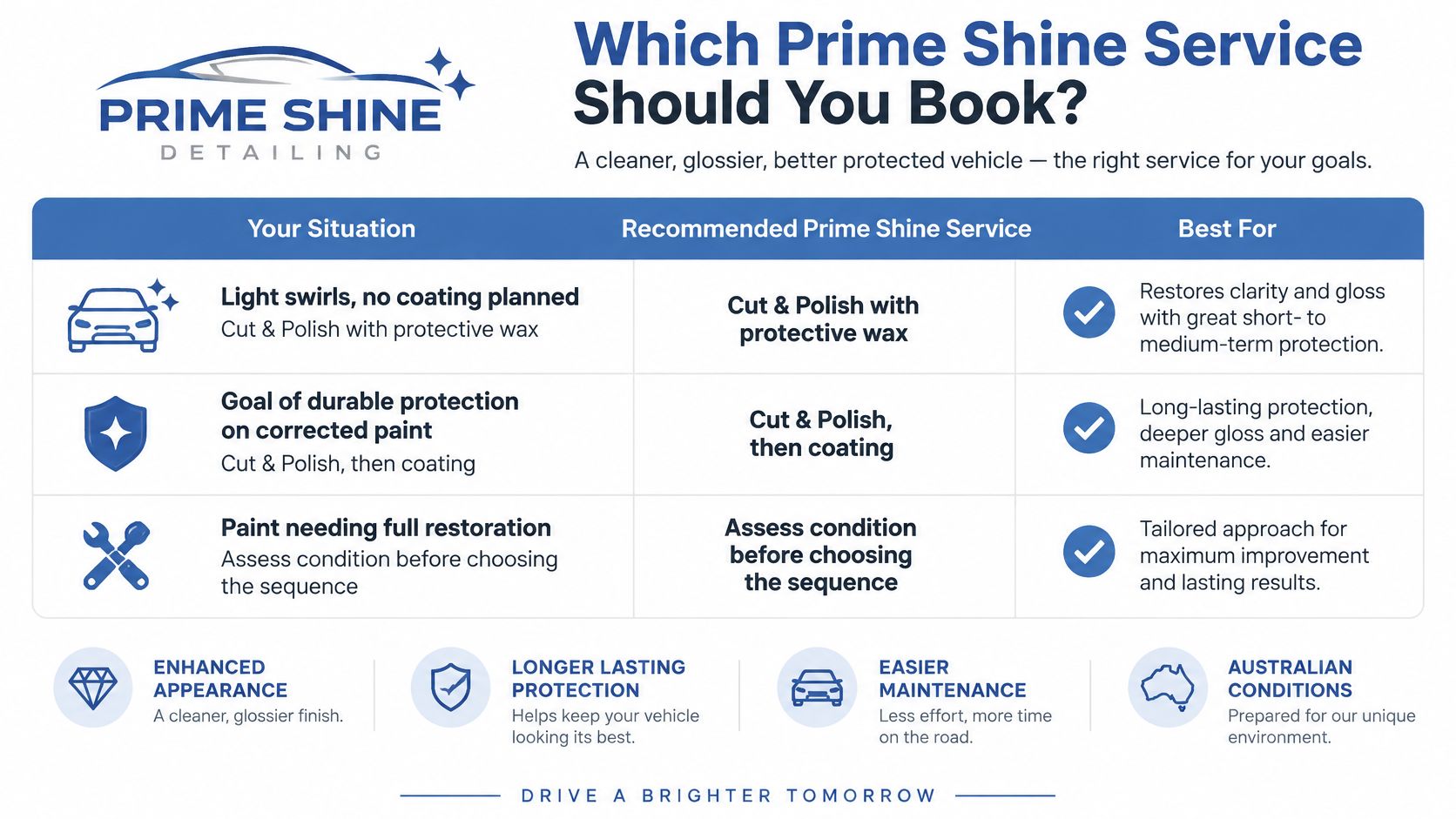
| Paint condition or goal | Recommended path | Reason |
|---|---|---|
| Light swirls, no coating planned | Cut & Polish with protective wax | Restores gloss; wax adds short-term protection |
| Durable protection on corrected paint | Cut & Polish, then Ceramic Coating | Correction first locks in clarity |
| Deep scratches through clear coat | Paint repair before any polishing | Polishing cannot repair paint loss |
Judge the paint in direct sun before you book. Swirls that show as a spiderweb around the light source are correction work. A scratch you can catch with a fingernail has usually reached past the clear coat, and polishing it harder only thins what is left.
Cut & Polish starts from $249 for a sedan, $269 for an SUV or wagon and $299 for a 4WD or seven-seater. The price includes an exterior wash, clay bar or paint preparation, and machine cutting and polishing, so the preparation steps that decide the result sit inside the price rather than being added later.
Customers who book online can use the code PRIME100 to take $100 off Full Car Detailing and Ceramic Coating. All washing and detailing is done by hand at a single Westminster site, with no automated brushes anywhere in the process.
A four-point booking checklist
- Confirm paint condition. Note swirls, deeper marks, and any previous polishing, repainting or touch-up work.
- Set the protection goal. A wax finish suits short-term ownership. A coating suits a car you are keeping and washing regularly.
- Confirm the size band. Sedan, SUV or wagon, and 4WD or seven-seater sit in different price bands.
- Book online. A short-notice slot is often possible if you are flexible on timing.
The decision that matters is whether the paint gets corrected before anything is bonded to it.
Prime Shine Hand Car Wash runs a single site at 9/436 Wanneroo Rd in Westminster, so the cut and polish work and any coating that follows sit with the same team. Tell us what your paint looks like in the afternoon sun, and we will say whether a correction with protective wax will do the job or whether the finish has earned a longer-term coating. Visit Prime Shine Hand Car Wash to book a slot and settle the correction question first.