







You’ve washed the car, parked it outside, and noticed the bonnet looks different in strong afternoon light. Fine spiderweb marks appear around the reflections, water spots sit on the horizontal panels, and the colour seems flatter than it did when the vehicle was newer. In Perth, that combination isn’t unusual. Persistent ultraviolet exposure, dust, heat, and airborne contaminants put regular pressure on automotive paint.
So, does ceramic coating protect against Perth sun? Yes, but not as an absolute UV shield. The coating bonds to the existing clear coat and helps slow oxidation, chemical etching, and loss of surface performance. It won’t repair faded paint, stop stone chips, or compensate for poor washing and outdoor exposure. The result depends heavily on what happens before application and how the vehicle is maintained afterwards.
Diagnosing Swirl Marks and Paint Defects Under Perth Sun
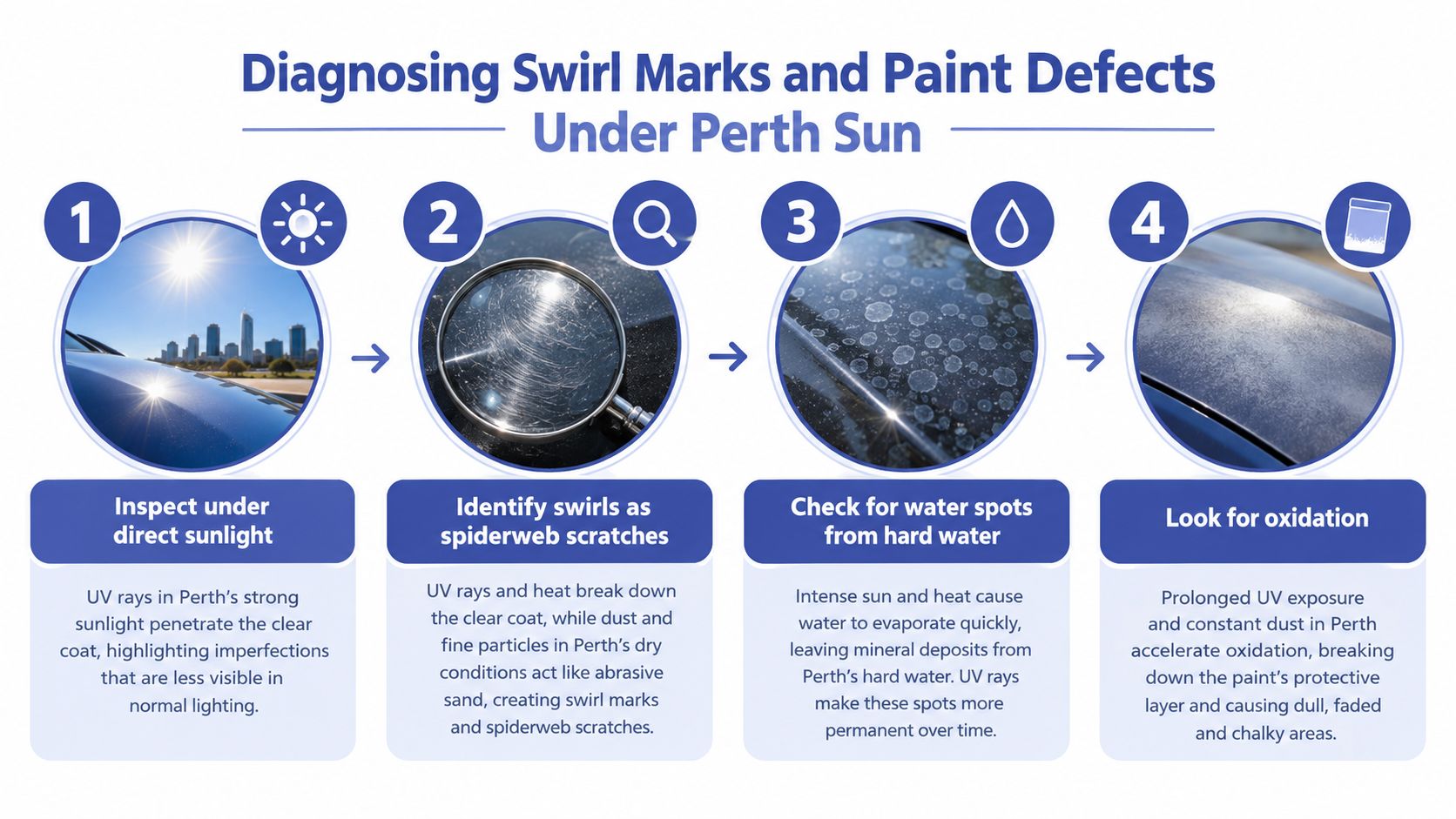
Perth’s UV conditions make paint defects easier to notice and harder to ignore. Australian radiation data shows a monthly UV profile that stays high across much of the year, reaching around 12 in December, 11 in January and February, and commonly remaining at or above 3 in June and July, the threshold at which sun protection is recommended by Australian authorities. The Australian sun-protection guidance and Perth UV information provides useful context for why exposed clear coat deserves attention even outside summer.
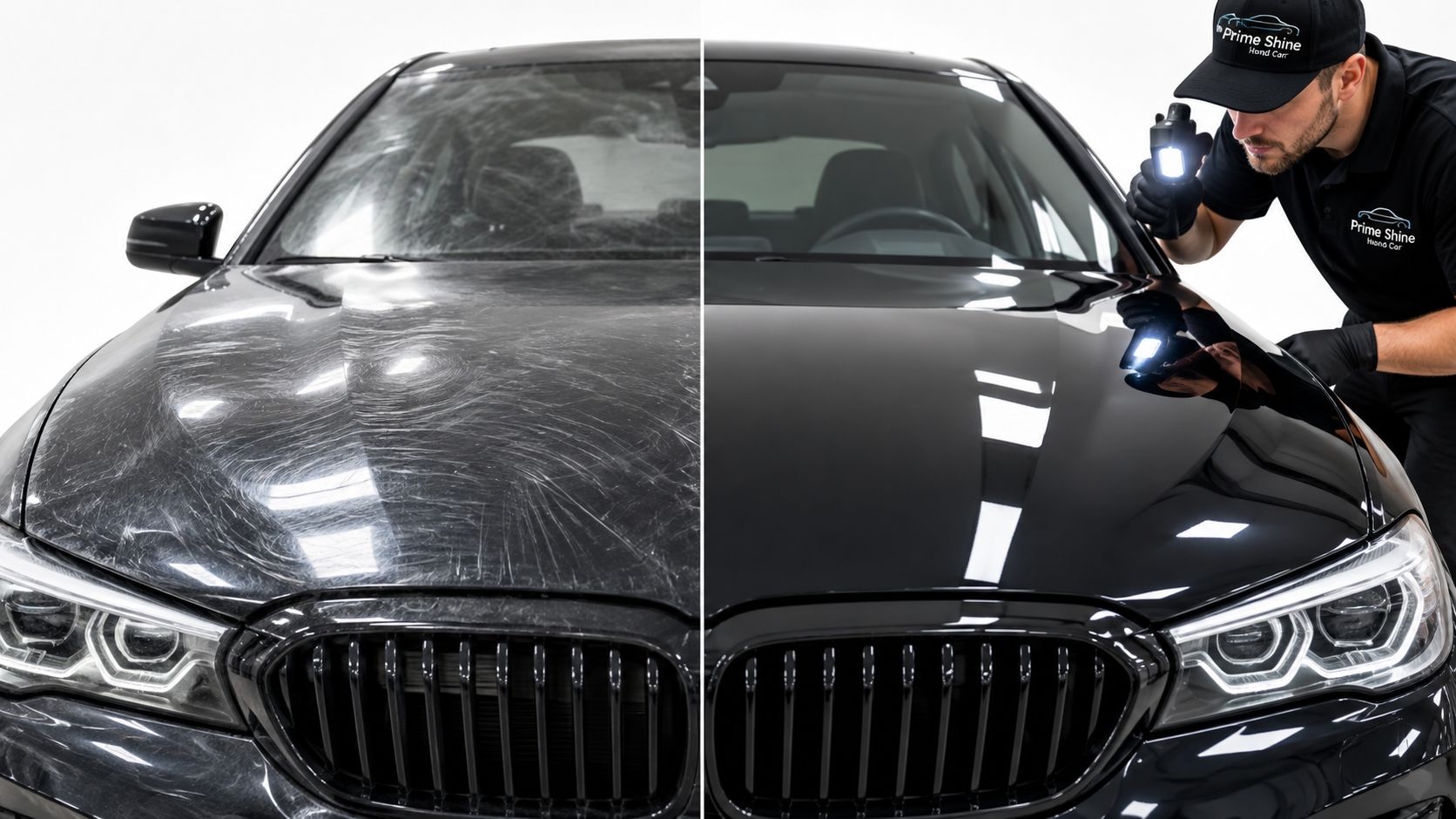
Direct sunlight reveals defects that softer shade can hide. Swirl marks look like fine spiderwebs around a reflected light source, water spots appear as pale rings or etched dots, and oxidation creates a hazy, chalky or uneven appearance. Dust makes the problem worse by increasing the chance of wash-induced marring, while UV exposure gradually degrades the resins that keep clear coat glossy and transparent.
What should you check before polishing?
Use a clean vehicle and inspect one panel at a time. A quick assessment should include:
- Reflections: Check the bonnet, roof and boot under direct sunlight or a strong inspection light. Distorted reflections usually indicate wash marks or haze.
- Surface feel: After washing, gently feel the paint through a clean plastic bag. Roughness suggests bonded contamination that polishing alone may not remove safely.
- Water marks: Look for circular stains, especially on horizontal panels. Some marks sit on the surface, while others have etched into the clear coat.
- Colour consistency: Compare shaded and exposed sections. Fading, chalking or a milky finish can indicate oxidation or clear-coat degradation.
- Scratch depth: If a mark catches a fingernail, it may extend beyond what a routine refinement polish can safely reduce.
Ceramic coating doesn’t reverse any of these defects. It chemically bonds to the vehicle’s existing clear coat, which already contains UV blockers. Its practical role is to help preserve that clear coat and slow oxidation, rather than create a standalone sunscreen. That’s why safe paint correction without damaging the clear coat matters before coating.
If the paint looks hazy, rough or heavily marked, arrange a proper inspection before buying a coating kit. Surface condition determines the result.
Check Your Paint Before Coating
Essential Tools and Products for Safe Polishing
Good polishing starts with control, not maximum cutting power. Perth dust can settle on panels quickly, and a hot surface can make compounds flash or dry before they work evenly. Work indoors or under solid cover where possible, keep panels cool, and use clean equipment throughout the process.
A sensible preparation kit includes a pressure washer or gentle rinse system, pH-neutral wash solution, quality wash mitts, drying towels, chemical decontamination products, clay media, masking tape, a dual-action polisher, foam pads, cutting compound, finishing polish, panel-wipe solution and several short-pile and plush microfibre towels. Each item has a job. Skipping decontamination can make polishing uneven, while using one dirty towel across the vehicle can put new marks into corrected paint.
Which pad and compound combination is appropriate?
| Tool/Product | Best For | Perth-Specific Tip |
|---|---|---|
| Soft finishing foam pad | Light haze, faint wash marks and final gloss | Use on a cool panel and clean the pad often so dust doesn't become abrasive. |
| Medium polishing foam pad | Moderate swirls and mild dullness | Test a small section first. It often corrects enough without unnecessary clear-coat removal. |
| Firm cutting foam pad | More pronounced swirls and light scratches | Use controlled passes and inspect frequently. More cutting isn't automatically better. |
| Microfibre cutting pad | Resistant defects requiring stronger initial correction | Keep the pad clean and reduce working time if the panel starts warming quickly. |
| Finishing polish | Refining micro-marring and improving clarity | Follow cutting with a clean pad so the coating sees a clear, uniform surface. |
| Clay media | Bonded contamination that washing can't remove | Use plenty of lubrication and light pressure to avoid adding fresh marring. |
| Panel-wipe solution | Removing polishing oils before coating | Apply to a cool surface and wipe with a fresh towel, not the towel used for compound removal. |
Why does product quality matter?
A compound that dries quickly or leaves heavy dust creates extra wiping, and extra wiping creates extra risk. Cheap or contaminated microfibres can drag particles across the clear coat. Likewise, an aggressive pad used on every panel may remove more material than the defect requires and still leave haze behind.
Before coating, the paint should be smooth, clean and visually consistent. Don't judge readiness by gloss alone. A panel can look impressive while polishing oils hide remaining defects, so the final inspection needs clean lighting and a proper wipe-down.
Use the least aggressive combination that achieves the required finish. Preserve clear coat now, because no coating can replace clear coat that has already been removed.
Machine and Hand Polishing Techniques for Coating Prep
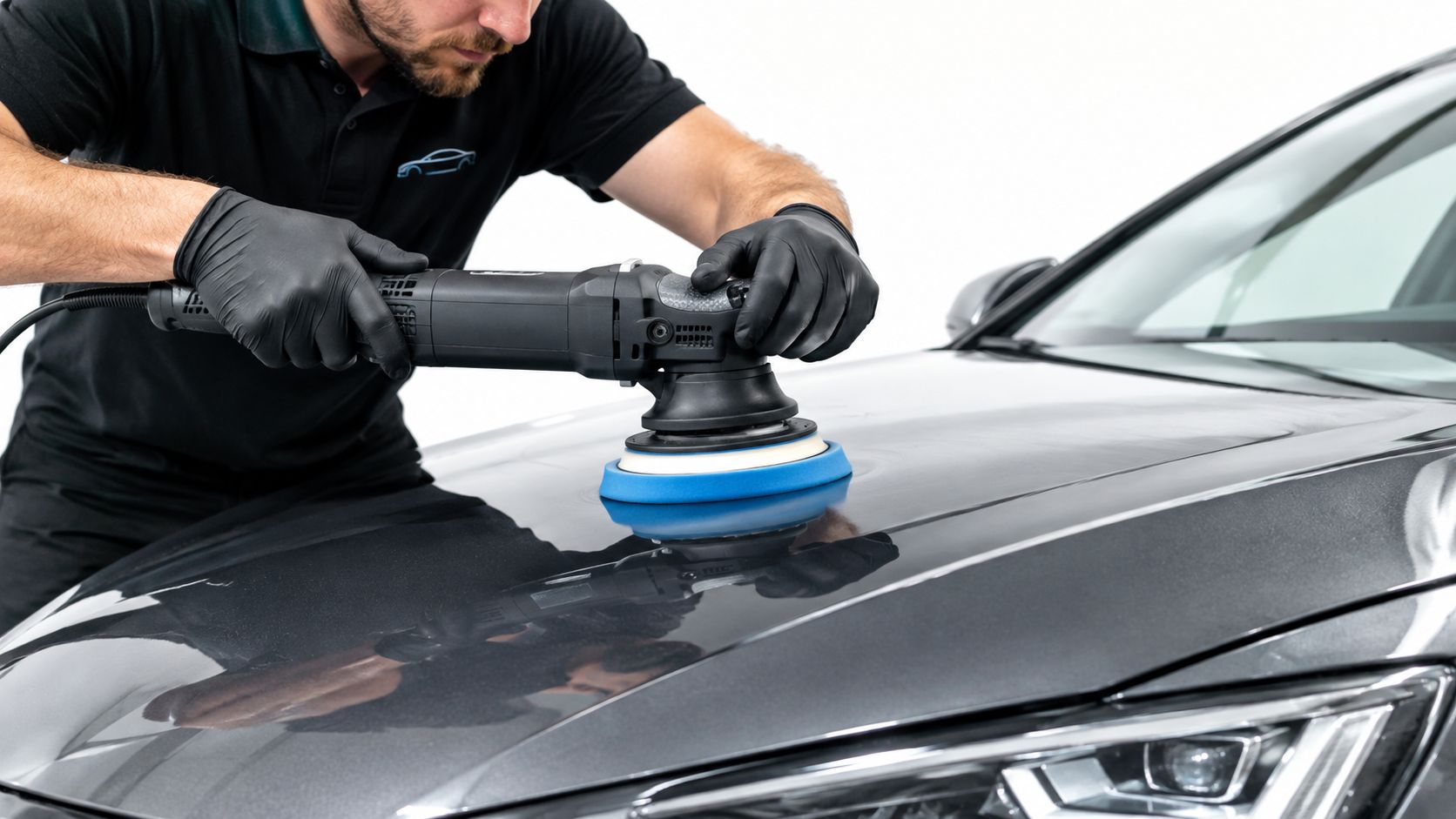
Machine polishing is effective when the operator controls panel temperature, pad pressure and working time. It becomes risky when someone chases every defect with excessive force. Perth's heat makes that distinction especially important, particularly on bonnets, roofs and dark-coloured vehicles.
Begin with a thorough wash, rinse and dry. Remove tar, iron contamination and bonded grit before touching the paint with a clay mitt or clay bar. Mask rubber seals, textured plastics, badges and sharp edges. Then inspect the paint and choose a small test area before committing to a full panel.
How should you correct the paint?
-
Start with a test spot. Use a medium pad and polish on a small area. Inspect the result before increasing cut. This tells you how the clear coat responds and prevents unnecessary correction across the entire vehicle.
-
Work small sections. Spread the compound at low speed, then make overlapping passes with moderate pressure. Keep the polisher moving and avoid sitting on an edge or body crease.
-
Manage heat continuously. Touch the panel between passes. If it becomes noticeably hot, stop and let it cool. A cool panel gives the compound more predictable behaviour and reduces the risk of stressing the clear coat.
-
Refine after cutting. A cutting step can remove heavier marks but may leave faint haze or micro-marring. Change to a clean finishing pad and polish until the reflection becomes sharp and uniform.
-
Finish by hand where necessary. Tight areas around handles, badges and edges need a soft applicator or microfibre. Use light pressure and short movements rather than trying to force a machine into an unsuitable space.
After polishing, remove all residue and inspect the paint from multiple angles. A panel-wipe stage is essential because coating products need clean contact with the clear coat. If oils remain, they can disguise defects and interfere with even bonding.
The Perth guide to cutting and polishing a car is useful for understanding how correction choices change according to paint condition. Deep scratches, exposed primer, peeling clear coat and severe oxidation aren't routine polishing problems. They need a realistic assessment rather than aggressive experimentation.
Practical rule: If the defect is deeper than the clear coat, stop trying to polish it out. The safest result may be reduction, not complete removal.
Do a test spot before full correction. A short inspection can prevent a long, irreversible mistake.
See the Perth Cut and Polish Guide
Aftercare and Maintenance to Preserve Coating Performance
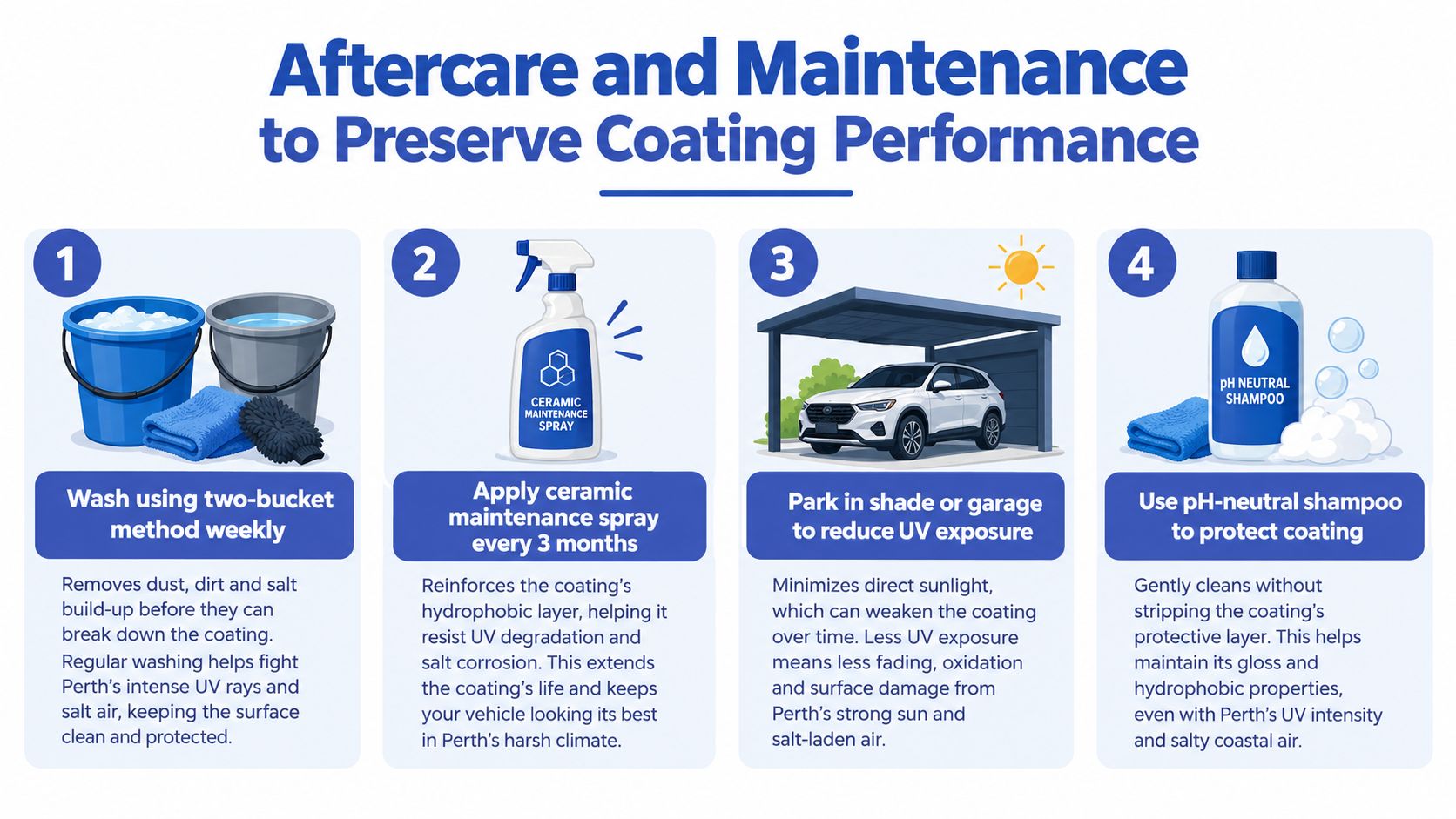
A ceramic coating makes routine cleaning easier, but Perth conditions still demand regular care. Dust, salt air, bird contamination and road film settle on the surface. Left in place, they can reduce the coating's easy-clean behaviour even when the coating layer remains present.
Wash using a gentle two-bucket method, a clean mitt and pH-neutral shampoo. Rinse the vehicle before touching the paint, particularly after dusty-road travel or coastal exposure. Dry with a clean, absorbent towel instead of letting mineral-rich water evaporate on the panels.
What routine keeps the surface performing?
- Wash consistently: Remove loose dust before it bonds to the surface. Gentle hand washing is safer than forceful scrubbing.
- Use suitable chemicals: Strong solvents, abrasive cleaners and unsuitable detergents can reduce slickness and interfere with compatible maintenance products.
- Deal with bird droppings promptly: Soak the contamination first, then lift it away without rubbing grit across the coating.
- Choose shade intelligently: Garage or undercover parking limits direct exposure and keeps panels cooler during washing.
- Refresh the surface when needed: If water behaviour changes, wash and decontaminate the paint before assuming the coating has failed.
Perth's UV conditions make shade and aftercare practical requirements rather than cosmetic preferences. Bureau of Meteorology forecasts have shown protection periods from 8:50 am to 3:20 pm with a predicted UV Index of 8, and from 8:30 am to 3:30 pm with a predicted UV Index of 9. These Perth UV forecasts from the Bureau of Meteorology help explain why parked vehicles and exposed panels need consistent protection.
The coating's hydrophobic behaviour provides a useful maintenance check, but reduced beading does not prove the coating has disappeared. Contamination can mask performance temporarily. Clean the vehicle properly, feel for bonded roughness and try a compatible maintenance product before booking a recoat. For a full wash and top-up schedule, see our guide to maintaining ceramic coating for Perth drivers.
Coatings still need maintenance washes and occasional top-up products. Recoating requirements vary with the product, preparation and care, so follow the coating system's maintenance instructions rather than relying on a fixed lifespan. The NRMA's explanation of protecting a car from the sun distinguishes ceramic coating's stronger chemical and UV protection from wax, while making clear that a coating is not scratch-proof or a direct UV blocker.
If washing and decontamination do not restore the finish, stop adding products. Have the paint assessed before further polishing, and use Prime Shine for cut and polish when Perth exposure has left defects that routine maintenance cannot resolve.
Treat the coating as a maintenance system, not a one-off purchase. Wash gently, limit direct exposure and investigate performance changes before applying more product.
Maintain Your Coating Properly
When to Seek Professional Cut and Polish Services
DIY polishing makes sense when the defects are light, the paint is healthy and you can work in a controlled environment. It becomes a poor trade-off when the vehicle has severe swirls, deep scratches, patchy oxidation or a thin-looking clear coat. In those cases, the risk isn't just an imperfect finish. Incorrect pressure, a dirty pad or repeated passes can permanently worsen the surface.
A professional detailer can inspect the paint, measure the correction requirement visually and choose a process that balances defect reduction with clear-coat preservation. That doesn't mean every mark will disappear. Good work sets a realistic target and avoids claiming that a coating will protect against damage it isn't designed to handle.
DIY or professional correction?
| Situation | DIY approach | Professional approach |
|---|---|---|
| Light wash marks | A test spot with a finishing polish may be suitable | Useful when you want a consistent finish across every panel |
| Moderate swirls | Requires careful pad and compound selection | A technician can correct efficiently while managing heat and edges |
| Deep scratches | Stop if the mark catches a fingernail or exposes another layer | The defect can be assessed for safe reduction or separate repair |
| Heavy oxidation | Avoid aggressive repeated passes | The detailer can decide whether correction is viable |
| Coating preparation | Possible with strong process discipline | Better suited when clean-room style preparation and even application matter |
A reputable provider should explain the preparation steps, identify defects that won’t polish out and separate paint correction from the coating itself. Ask what happens before application, how the surface is cleaned afterwards and what washing routine they expect you to follow. Clear starting prices are useful, but the final cost should reflect vehicle size and paint condition rather than promising the same process for every car.
For a Perth owner weighing the options, this guide to cut and polish costs in Perth can help frame the questions to ask before booking. The cheapest application isn’t necessarily the best value if the operator skips decontamination or applies coating over visible defects.
A coating can preserve a well-prepared finish. It can’t turn neglected or damaged paint into corrected paint.
Professional help is particularly sensible for family cars parked outdoors, daily-use vehicles, rideshare cars and enthusiast vehicles where the finish matters. It also suits anyone who can’t provide a cool, clean and covered workspace for polishing and curing.
If you’re unsure whether a mark is polishable, get the paint assessed before cutting. A correct diagnosis is cheaper than repairing avoidable damage.
Key Takeaways for Protecting Your Vehicle in Perth Sun
Ceramic coating can help protect Perth paintwork, but the result comes from a complete process rather than the bottle alone. Perth’s persistent UV exposure accelerates the conditions that lead to fading, oxidation and loss of clarity. The coating helps slow that degradation by bonding with the existing clear coat and supporting its protective function.
Use this working checklist:
- Inspect first: Find swirls, water spots, bonded contamination and oxidation under strong light.
- Correct selectively: Start with the least aggressive pad and compound combination that improves the defect.
- Control heat: Keep panels cool, work smaller areas and stop when the surface becomes too warm.
- Clean before coating: Remove polishing oils and residue so the coating can contact the clear coat properly.
- Maintain the finish: Wash gently, use suitable products and remove bird contamination and road film promptly.
- Reduce exposure: Use garage or undercover parking where available. A coating isn’t a replacement for shade.
- Know the limits: Ceramic coating doesn’t stop stone chips, deep scratches or careless washing.
The most useful answer to “Does ceramic coating protect against Perth sun?” is therefore qualified but practical. It helps preserve prepared paint and slow UV-driven degradation, but it doesn’t block UV directly, repair existing defects or eliminate maintenance. Preparation, washing technique and parking habits determine how much value you get from the protection.
Start with the paint condition, not the coating label. A clean, correctly polished surface gives any protection system its best chance to perform.
Prime Shine Hand Car Wash provides careful hand washing, paint correction, cut and polish, ceramic coating and interior and exterior detailing for Perth drivers. If your vehicle has swirl marks or sun-related dullness, visit Prime Shine Hand Car Wash to book an assessment and choose the right preparation before coating.