






You park in the same unshaded bay every weekday. By five in the afternoon the bonnet is hot enough to sting your palm, and the bird dropping from this morning has already baked into a pale ring. Water no longer beads on the roof the way it did when the car was new, and the paint looks flatter than you remember. You’ve seen the ads for 9H paint protection ceramic coating and wondered whether it’s the answer or an expensive version of the wax you used to buy at the auto parts shop.
It’s a fair question, and the honest answer sits in the middle. A coating does real, measurable work on a Perth car. It also doesn’t do half of what the marketing implies, and knowing which half is which saves you money and disappointment.
Is Ceramic Coating Better Than Wax for Your Car?
For a car that lives outdoors, ceramic coating is the better buy. It lasts longer, shrugs off sun and contamination more effectively, and makes washing faster. Wax still earns its place: it costs a fraction as much, adds a warmer glow, and suits a garaged car or one you’ll sell inside a year. Neither product stops a stone chip.
The comparison below puts both on the criteria that decide the question.
| Feature | Ceramic coating | Traditional wax |
|---|---|---|
| Main ingredient | Silica-based polymer that cures into a hard layer | Carnauba or synthetic wax that sits on top of the paint |
| Typical durability | About 1 to 3 years when applied and maintained | Usually a few weeks to a few months |
| UV and chemical resistance | Stronger barrier against oxidation and etching | Limited, wears down quickly under sun |
| Water beading and cleaning | Strong, longer-lasting water repellency | Good when fresh, fades with each wash |
| Gloss | Sharp, glassy shine | Warm, deep glow |
| Scratch and chip resistance | Minimal, does not stop chips or deep scratches | Minimal |
| Application | Multi-stage preparation and curing, usually professional | Quick and suited to DIY |
| Upfront cost | Higher | Low |
Read the table with your parking spot in mind, not your taste in products. If the car sits in the open and gets washed weekly, the durability, UV and cleaning rows carry the decision, and the coating wins all three. If it sleeps in a garage and a Saturday wax is part of your weekend, the cost and application rows matter more, and wax is enough. Our guide to liquid car wax and when to use it covers the product side if you want to stay on that path.
Notice what sits in the scratch and chip row for both products: almost nothing. A trolley in a car park or a stone off a truck at 100 km/h passes through a wax layer, a coating and your clear coat. The comparison is about chemical and environmental protection, not impact.
Quick self-check: outdoor parking plus regular washing points to a coating. Garage parking plus a seasonal wax points to wax, and there’s no shame in that.
Not sure which way your car leans? Book a ceramic coating assessment at our Westminster workshop and we’ll check the paint condition before you commit to anything.
Explore Ceramic Coating and Wax Options
What Is Ceramic Paint Protection and How Does It Work?
Think of the clear coat as the skin of your paint and the coating as a thin lens bonded over it. The lens doesn’t change what’s underneath. It changes what reaches it.
Most products are built around silica, sometimes with titanium dioxide added, and they cure into a cross-linked network that bonds to prepared clear coat. Once cured, the surface behaves differently. Water pulls into tight beads and rolls off. Road film releases more easily under a wash mitt. Oxygen and airborne contaminants meet a more chemically resistant barrier than bare clear coat offers.
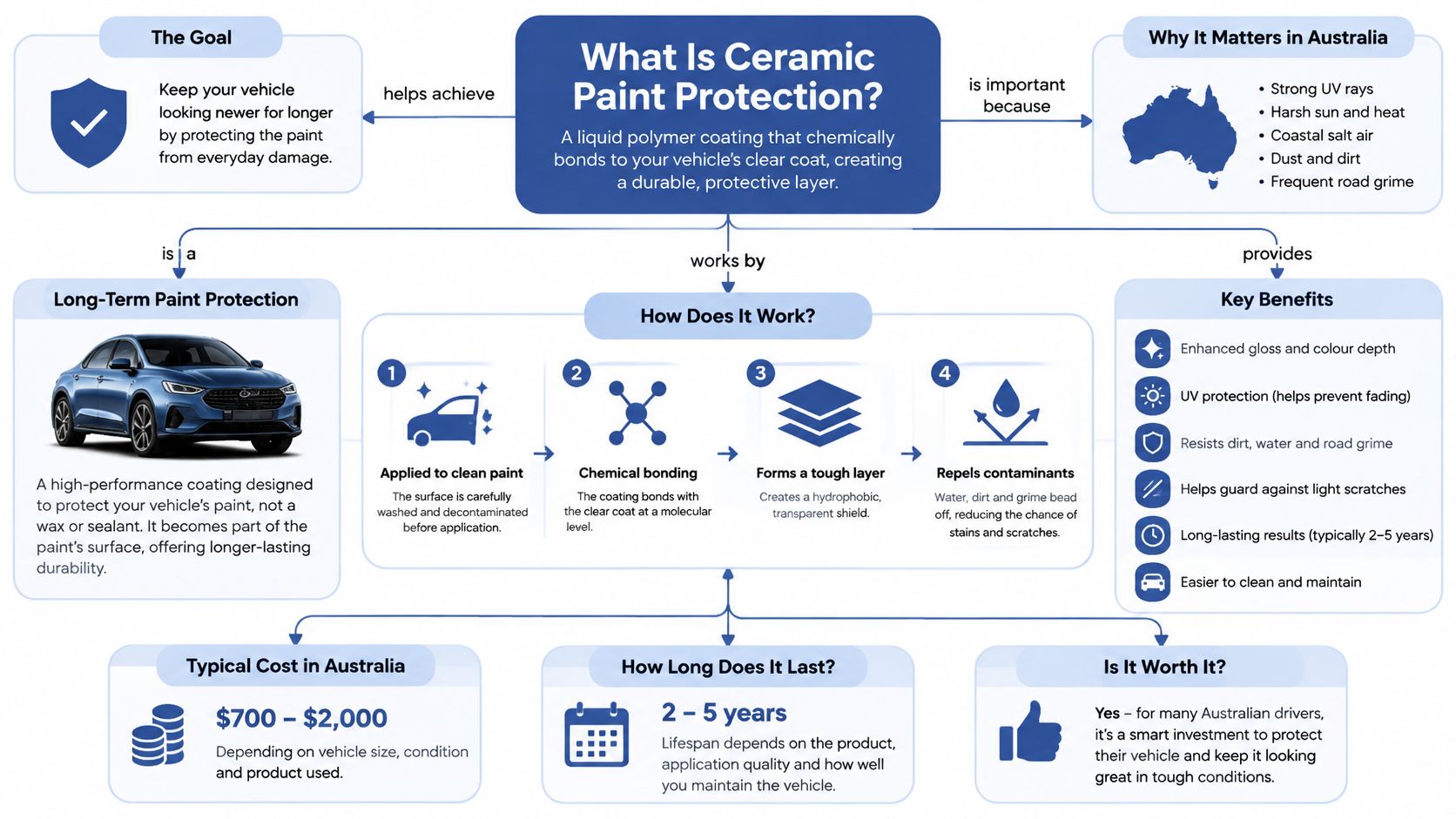
The ‘9H’ badge you see on every bottle is a pencil-hardness reading from a lab bench, not a promise about your bonnet. Australian technical guidance on coating performance is blunt about this: results depend far more on preparation, film chemistry and maintenance than on the hardness number, and the same source describes practical durability in the roughly one to three year range when application and upkeep are appropriate. That range moves with coating thickness, cure conditions, what’s underneath, which shampoo you use and how much sun the car sees.
Hardness sells bottles. Preparation and aftercare are what keep a coating beading in year two.
For a Perth daily, judge the coating by retained behaviour rather than claims. After a wash, look at the horizontal panels. If water beads tightly and slides off the roof and bonnet, the layer is still working. If water lies flat and sheets away in a film, the surface is contaminated or the coating is spent, and it’s time to decontaminate and inspect before you assume the worst.
Want that beading checked properly? We record paint condition before application and inspect beading at service intervals, so you can book a ceramic coating review with Prime Shine and see where yours stands.
Explore Ceramic Coating at Prime Shine
What Can a Ceramic Coating Resist, and What Can’t It Stop?
The most expensive misunderstanding in paint protection is the word “protection”. A ceramic layer changes how chemistry and contamination interact with your paint. It does nothing about kinetic energy. A stone flicked off a truck tyre carries the same force into your bonnet whether that bonnet is coated or bare.
Start with the sun, because that’s the pressure your car faces most. The Bureau of Meteorology’s UV Index runs from 1 (low) to 11 and above (extreme), with protective measures recommended from index 3 upward. That scale describes human exposure rather than coating lifespan, but it tells you how hard the light works on a parked car. Australian automotive-care guidance goes further for this state, noting that UV levels in Western Australia regularly exceed an extreme index of 11 for much of the year.
That’s why the coating conversation is louder in Perth than in Hobart. It’s also why expectations run ahead of reality. Coatings handle chemical and environmental pressure. They don’t handle impact, and most disappointed owners were sold the second thing while paying for the first.
The threats a coating genuinely handles
- UV and heat. Photons break polymer bonds in clear coat and pigment, heat accelerates oxidation, and a coating slows that decline so gloss holds longer. Parking under cover still does more than any product.
- Bird droppings. Fresh paint etches fast in hot weather. A slicker surface reduces how strongly the mess bonds and gives you a longer window to wipe it off, though removal within a day is still the rule.
- Tree sap. Sap hardens onto paint and pulls away more cleanly from a coated panel when you wash promptly with warm, soapy water.
- Road grime and dust. Coated paint rinses cleaner, which matters because damage happens when someone wipes a dry, gritty panel with a towel.
- Salt air. Coastal aerosol accelerates corrosion, and a coating reduces how readily salt residue bonds. It doesn’t stop corrosion, so regular rinsing after coastal runs still counts.
- Hard water. A coating reduces adhesion, but minerals still deposit when water dries on the surface and leave spots. Dry the car promptly rather than expecting the layer to prevent them.
Book a ceramic coating with Prime Shine and we’ll walk your car’s specific exposure with you, from coastal parking to unsealed road trips, before you choose a package.
The threats it cannot stop
- Stone chips: the impact penetrates coating and clear coat. Paint protection film on bonnets, guards and leading edges is the correct fix.
- Deep scratches: anything that reaches through the coating needs professional paint repair, not another layer of product.
- Swirl marks and light scratches: these get sealed beneath the coating. Paint correction has to come first or you’re locking defects under glass.
- Trolley dings and key scratches: impact damage. Film or paint repair, depending on depth.
| Threat | Does a ceramic coating help? | Better option or fix |
|---|---|---|
| UV and heat | Slows oxidation and fading, helps gloss last | Park under cover where possible |
| Bird droppings | Yes, slicker surface reduces etching and bonding | Prompt removal alongside the coating |
| Tree sap | Yes, releases more easily when washed promptly | Prompt washing |
| Road grime and dust | Yes, rinses away more easily | Regular two-bucket wash |
| Salt air | Partly, reduces bonding but does not stop corrosion | Regular rinsing after coastal travel |
| Hard water | Reduces adhesion but does not prevent spots | Dry surfaces promptly |
| Stone chips | No, impact penetrates coating and clear coat | Paint protection film on high-impact areas |
| Deep scratches | No, the scratch reaches through the coating | Professional paint repair |
| Swirl marks and light scratches | Not on their own, sealed beneath the coating | Paint correction before coating |
| Trolley dings and key scratches | No, impact damage is not stopped | Paint repair or protection film |
The takeaway is simple enough to say in one line: a coating buys you time to clean. It doesn’t replace cleaning, and it doesn’t replace film where the road throws gravel.
How Do Perth’s Sun and Coastal Air Test a Coating?
A commuter in Westminster leaves the car on the street from eight until five. The afternoon sun hits the bonnet square on, a sea breeze carries salt a few kilometres inland, and the car hasn’t seen shade since it was bought. That’s the environment a coating is being asked to survive.
The summer numbers explain why. Bureau of Meteorology maps of average clear-sky UV Index show values of 11 or more across virtually the entire country in January, measured around local noon when radiation peaks. Perth cars face that radiation alongside heat and moisture, and the three together degrade paint faster than any one of them acting alone.
Coastal salt adds a second front. Salt aerosol accelerates corrosion and leaves residue that holds moisture against the surface. A coating reduces how strongly that residue bonds. It doesn’t make rinsing optional.
Different owners need different things from the same product:
The open-air commuter. Coating earns its keep here, mostly by slowing oxidation on the bonnet and roof and making the weekly wash quicker. Cover parking, even a carport, changes the maths more than an extra coating layer would.
The weekend coastal driver. Salt rinsing matters as much as the coating. A quick fresh-water rinse after a beach run does more for the paint than any topper applied on top of salt.
The garaged car. The threat is already lower, so coat it for gloss and easy cleaning rather than out of fear. Maintenance intervals can stretch.
The family SUV on gravel and red dirt. Prompt washing is the priority. Red dirt and mud hold moisture and grit, and leaving them on for a fortnight undoes months of protection.
Our guide to ceramic coating and the Perth sun goes deeper into exposure by suburb and season.
Ask yourself two questions before you book anything. Where does the car sleep at night, and how often does it actually get washed? The answers decide more than the product label does.
Book a ceramic coating at Prime Shine and we’ll match the package to how your car is parked and driven, not to a generic pitch.
Read About Ceramic Coating in Perth Sun
How Is Ceramic Coating Applied, Step by Step?
The coating only bonds as well as the surface beneath it, so most of the work happens before the bottle is opened. Preparation isn’t a sales upsell. It’s the difference between a coating that beads for two years and one that beads for six months.
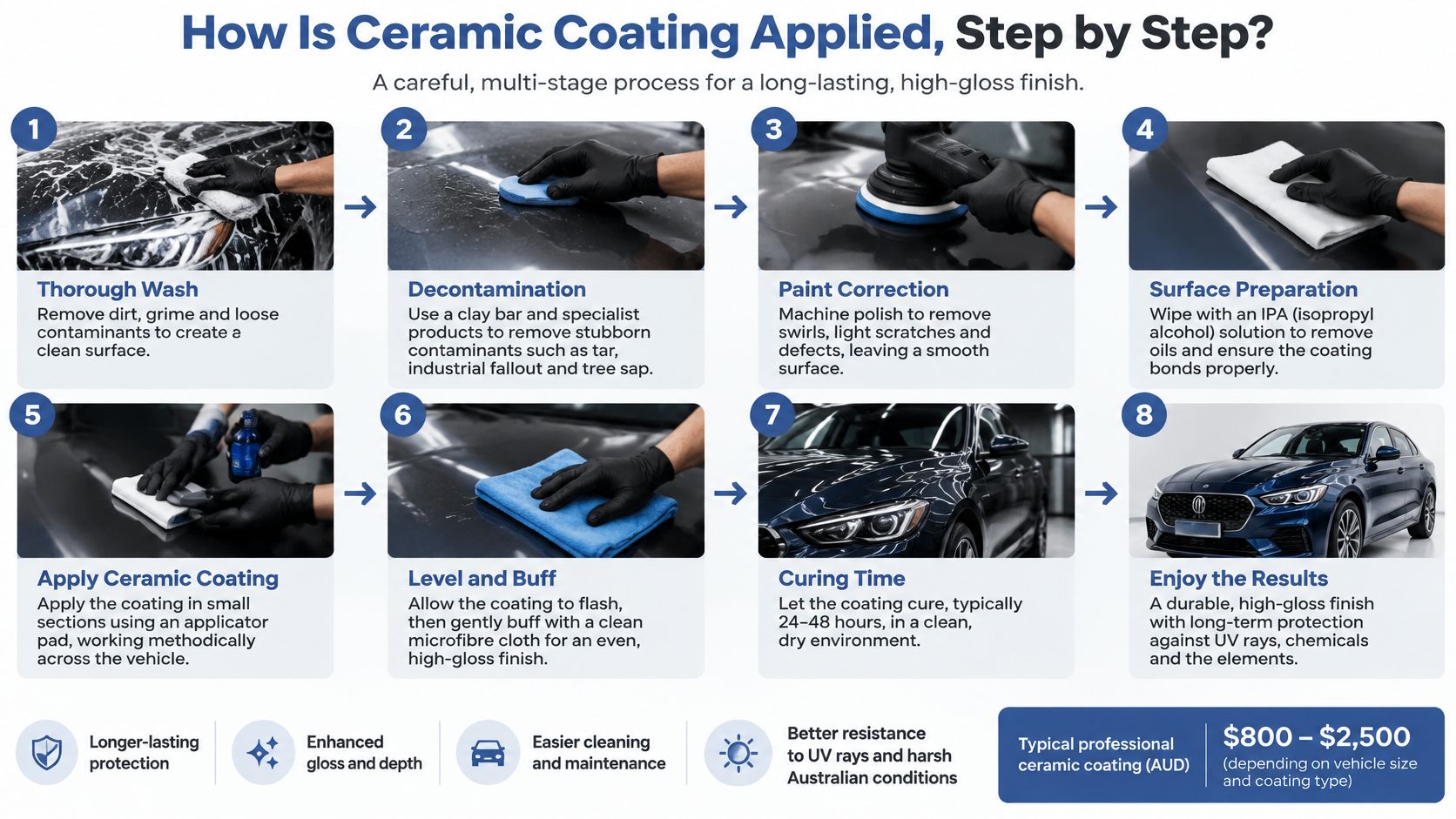
- Wash and decontaminate. Strip road film, dust and bonded fallout with a proper wash and an iron remover. The common slip is washing quickly and calling it clean, which leaves contamination trapped under the layer.
- Clay the surface. A clay bar lifts embedded particles a wash can’t touch, leaving the paint smooth and ready. Skip this step and you’ll feel grit under the applicator and seal it in place.
- Correct the paint. Machine polishing reduces swirl marks and light scratches, because the coating preserves whatever sits beneath it. Our paint correction process, stages and real results explains what each stage removes.
- Remove old protection. Existing wax, sealant or polish is stripped before application so the coating can bond to the paint itself rather than to a layer of somebody else’s product.
- Apply in small sections. Work panel by panel with a thin, even layer and level it before it flashes. The classic mistake is laying it too thick, which leaves high spots that catch the light afterwards.
- Let it flash and cure. After the coating flashes, keep the car dry while it cures. Full curing of the ceramic coating takes up to seven days, so plan for covered parking during that window.
- Protect the first day. The car can be driven shortly after application, but water or washing should be avoided for at least 24 hours. Rain, sprinklers and a well-meaning hose-down all risk the finish you just paid for.
A good result looks boring: even gloss across every panel with no streaks, no smears around badges and trim, and water standing in tight beads at the first wash. If a panel looks darker in one patch, that’s a high spot and it needs levelling, not hiding.
Book online with Prime Shine and we’ll confirm the preparation steps your car needs before we quote the coating.
Explore Ceramic Coating Services
How Do You Maintain Ceramic Coating Between Washes?
A coating reduces how often you wash and how much effort each wash takes. It doesn’t remove the need to wash, and the cars that look best two years after coating are the ones that get washed properly.
- Rinse before you touch. Blast off loose dirt, brake dust and grit so your wash mitt isn’t dragging it across the panels.
- Wash with pH-neutral shampoo. Use soft microfibre towels or a clean mitt, and two buckets if you can, keeping rinse water separate so grit stays out of the wash solution.
- Dry gently. Pat or glide a clean microfibre towel rather than scrubbing, because most swirl marks are installed during drying, not washing.
- Deal with organics fast. Bird droppings, tree sap and salt residue come off in seconds when fresh and leave marks when left for a week in the sun.
- Park under cover when you can. Shade lowers surface temperature and cuts the UV load, which is the cheapest protection available to any Perth car.
What to avoid is just as important: automatic brushes and abrasive cleaners wear the coating and dull the gloss it was bought for. A brush tunnel is the fastest way to undo a careful application.
Check performance every few months on the bonnet and roof. Tight beading means the layer is intact. Water that sheets flat means it’s time to decontaminate and refresh the protection rather than wait for the paint to look dull.
Regular maintenance is what keeps the water-beading and easy-cleaning advantages working across the coating’s service life, not just in the first month.
Our seven safe steps for washing a ceramic coated car covers dilution, towels and the order of panels in more detail.
Is Ceramic Coating Worth It for Your Car?
If you keep the car at least a couple of years, park it outdoors in strong sun or near the coast, and care about gloss and easy washing, a coating is worth the money. If the car is going in a year, gets washed rarely, or sleeps under cover, wax or a seasonal treatment is the sensible spend.
Cost is where quotes deserve scrutiny. Professional ceramic-coating services in Australia typically run AUD 900 to 2,000 in 2025, according to Schmicko’s published pricing guide. When you compare quotes, compare the preparation included, because a cheap coating over uncorrected paint is the most expensive outcome available.
At Prime Shine, ceramic coating starts from $699 at our Westminster site, with the final price set by the vehicle’s size, condition and the extras you choose. Quotes are transparent and obligation-free. The service suits cars, SUVs, 4WDs, utes, vans, bikes and luxury vehicles, and it includes paint surface preparation as part of the job rather than an optional line item.
Before you book, ask for a paint condition assessment, confirm what preparation is included, and get the aftercare plan in writing. That’s the difference between buying a product and buying a result.
Prime Shine Hand Car Wash runs a hand-wash, detailing and paint protection workshop at 9/436 Wanneroo Rd, Westminster, open seven days a week, with ceramic coating, cut and polish, and full detailing on the menu. If your paint has lost its beading and you want a straight answer on whether coating, correction or film is the right next step for a Perth car, bring it in for an assessment and we’ll show you what the surface is doing before we quote. Book online and visit Prime Shine Hand Car Wash to pick a time that suits.