







You’ve seen the photo. Half a bonnet in shadow, half in hard sunlight, and a caption crediting a ceramic coating with turning a tired daily driver into a show car. The coating earned some of that. The polisher earned more, and it ran over the panel an hour before the bottle was opened.
That distinction matters when you’re the one paying for it. A ceramic coating is a protective layer, not a repair. It preserves the finish underneath and makes that finish easier to live with. It doesn’t flatten a scratch you can feel with a fingernail, and it doesn’t bring back clear coat that has already gone chalky.
So treat any before and after you’re shown as a claim to be read, not a result to be trusted. What follows is how to separate the part you’re buying from the part the camera and the cutting compound did for free.
What Changes After Ceramic Coating?
A properly prepared coating changes three things you can see and feel: gloss and colour depth, water behaviour, and how easily light contamination releases during a wash. Deep scratches, stone chips and etching already in the paint stay exactly where they were. Often they look sharper, because everything around them now has more clarity.
The division of labour is simple. Correction removes defects; the coating seals what remains and slows how fast the finish degrades again. Australian ceramic coatings market reporting describes the product’s role the same way: UV protection, water repellence and surface durability across paintwork, wheels and trims.
Here is what changes, and what governs each change.
| Visible change | Typical before | Typical after | What controls the result |
|---|---|---|---|
| Gloss and colour depth | Dull, hazy or oxidised clear coat | Richer, more uniform gloss once the paint is corrected | Paint correction before coating |
| Water beading | Water sheets or sits in patches | Droplets bead tightly and roll off | Surface cleanliness and coating age |
| Water spotting | Mineral rings after water dries | Still possible if droplets dry on the panel | Drying method and water hardness |
| Contamination adherence | Road film and tar bond to the paint | Light contaminants release more easily during washing | Decontamination before coating |
| Light swirl marks | Visible in direct sun | Reduced only if corrected before coating | Cut and polish beforehand |
| Deep scratches and stone chips | Visible and penetrating | No change; the coating does not fill or repair them | Repair, or paint protection film for chips |
| Wash effort | Frequent waxing and drying needed | Washing less often, but still regularly | Maintenance routine after coating |
A before and after photo stacks three effects on top of each other: paint correction, thorough cleaning, and the coating itself. Only the third one is the coating. Ask which stage each frame was taken at. A cut and polish on a neglected bonnet produces a far bigger visual jump than any coating layer will.
Light is the other variable. The Bureau of Meteorology publishes a Perth UV index forecast, and the same strong sun flatters a glossy panel at a low angle. Photos taken at the same time of day, from the same position, are the only ones worth comparing.
Practical rule: if the after photo looks different mainly because the swirls vanished, credit the polisher. The coating’s contribution is the gloss that holds, the water that beads, and the dirt that releases more easily at the next wash.
Want your paint assessed before you spend anything? Prime Shine Hand Car Wash in Westminster gives transparent, obligation-free quotes, and ceramic coating starts from $699 depending on the vehicle’s size, condition and selected extras.
Why Does Preparation Decide the Final Result?
A ceramic coating works like the clear glaze on a dinner plate: it seals whatever sits underneath. Over clean clear coat you get depth and shine. Over dried contamination, the coating makes that contamination permanent. The coating bonds to bare, clean clear coat, so every trace of embedded iron, tar, oxidation or polishing oil left on the panel ends up sitting between the paint and that bond.
Each stage below removes something that would otherwise be locked in for years. A proper coating job runs through seven of them.
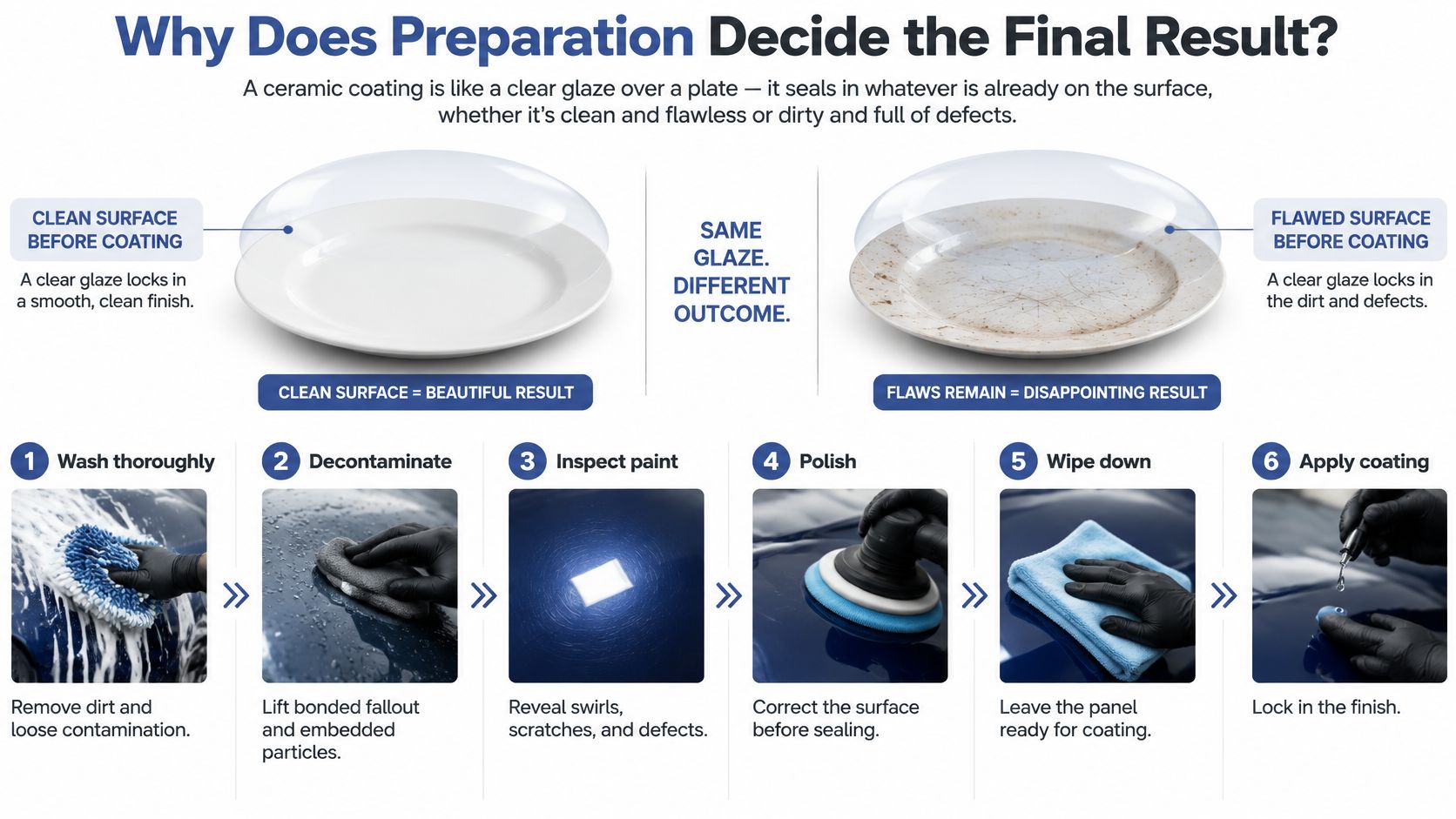
- Wash with pH-neutral shampoo. Two buckets, one for shampoo and one for rinse water, with a grit guard in each, and the mitt rinsed between panels. A tunnel wash or a dish-soap bucket adds fresh swirls before the job has started, and those swirls get sealed under the coating.
- Remove iron and tar. Brake dust and airborne fallout embed in clear coat and sit flush with the surface. Iron remover dissolves them and turns violet as it reacts; a tar solvent lifts the sticky spots. Skip it and the clay bar drags grit across the panel.
- Clay the paint. Clay lifts bonded contamination that chemistry can’t dissolve, leaving a surface smooth enough for the coating to sit flat. Use plenty of lubricant, work small sections and knead the clay often. Claying dry leaves marring that has to be polished out.
- Strip old wax, sealant or polish. Anything sitting on the clear coat keeps the coating off the paint. Existing wax, sealant or polish is removed before a ceramic coating goes on, so the coating can bond properly.
- Cut and polish where defects show. Machine correction reduces swirls, wash marks and light scratches, and it produces most of the gloss in any after photo. How much correction a car needs depends on the paint in front of you, so a corrected finish usually starts with an inspection: a well-kept newer car and one carrying years of wash damage call for very different levels of work, and the paint correction stages and costs page shows how that scope is set.
- Wipe with panel prep. A solvent wipe strips polishing oils and dust so the panel is bare clear coat. Residual oil causes patchy bonding and visible high spots where the coating sits thicker.
- Apply under controlled light and temperature. Work out of direct sun so you can watch the flash-off and level each panel evenly. Heat and wind make the coating flash too fast, which is where streaks come from.
Once cured, an SiO₂ coating turns a high-energy, contamination-retaining clear coat into a lower-energy, hydrophobic surface. Water stops spreading and starts beading, which cuts the dwell time that mineral deposits, bird-dropping acids and road film need to etch the surface.
How water behaves on the panel tells you about surface energy. It says nothing about film thickness or stone-chip resistance. Preparation has a ceiling too: correction can level a scratch down toward the surrounding clear coat and remove oxidation while clear coat remains. It cannot rebuild clear coat that is already gone.
Not sure which stage your car needs? Talk to Prime Shine Hand Car Wash before you book a coating.
How Does Paint Condition Change the Outcome?
Two cars can take the same coating, on the same day, from the same hands, and look nothing alike afterwards. A late-model car with intact clear coat and light swirling comes up deep and wet-looking. A twelve-year-old car that has lived outdoors improves, but the ceiling is set by how much clear coat is left and how deep the damage runs.
Western Australia’s fleet is old enough for that to matter. A WA Government safe-vehicles information sheet reports that about 681,647 light passenger vehicles, roughly 43% of the state’s registered light passenger fleet in 2017, were manufactured before 2007, and puts the average vehicle age in WA at 10.5 years. That’s a decade of ultraviolet exposure, heat, road grime and washing friction before anyone considers paint protection.
And the exposure is routine, not occasional. Perth Airport averages 8.8 hours of sunshine per day across the year, with monthly averages reaching 11.6 hours in January and December (Bureau of Meteorology). Paint that sits in that all day, every day, ages on a schedule the owner never sees.
| Paint condition | What you see before | Preparation needed | Realistic after result |
|---|---|---|---|
| Newer, well-kept paint | Light swirls and mild road film | Decontamination and a light polish | Strong gloss and easier maintenance washes |
| Daily driver, five to ten years old | Wash marks, water spotting and dull patches | Clay bar, and cut and polish if swirls show | Clearer gloss; swirls reduced, deeper marks remain |
| Older car with oxidised clear coat | Chalky, faded finish with rough texture | Full decontamination, correction and possibly several polish passes | Improved finish if clear coat is intact; lost clear coat is not restored |
| Deep scratches or clear coat failure | Scratches that catch a fingernail, peeling clear coat | Repair or respray before coating | Coating protects the repaired finish but cannot fix the damage |
| Outdoor coastal parking | Salt residue, bird droppings and etch marks | Decontamination and an assessment of etch depth | Easier removal of contamination; etching already in the paint may remain |
Before you accept any quote, run one test. Drag a fingernail lightly across the defect. If the nail catches, the scratch is deeper than polishing can safely reach and needs repair or a protective film first. If the nail glides over it, it’s a surface defect that correction can reduce and the coating can then protect.
Get an honest read on your paint before booking. Request a ceramic coating quote from Prime Shine Hand Car Wash and send daylight photos of the panels that bother you.
How Long Do the Results Last and How Do You Maintain Them?
Results change over time. The useful benchmark is how well the film survives the conditions it meets: sun, salt, heat, washing chemistry and contact. With proper maintenance, a ceramic coating lasts two to five years, and where your car lands in that range comes down to driving conditions, washing habits and exposure to harsh elements. Track the right things at the right intervals and you will see wear coming long before the gloss goes.
The first year, checkpoint by checkpoint
| Checkpoint | What to check | What it signals |
|---|---|---|
| First 24 hours | No water or washing | Coating still bonding |
| Days 1 to 7 | Avoid harsh chemicals and early stress | Film still curing |
| 1 month | Beading and water spotting | Film intact or contaminated |
| 3 months | Gloss and wash effort against the before photo | Visible gain holding |
| 6 months | Beading after a maintenance wash | Hydrophobic behaviour present |
| 12 months | Top up or recoat decision | Remaining film not measurable by beading alone |
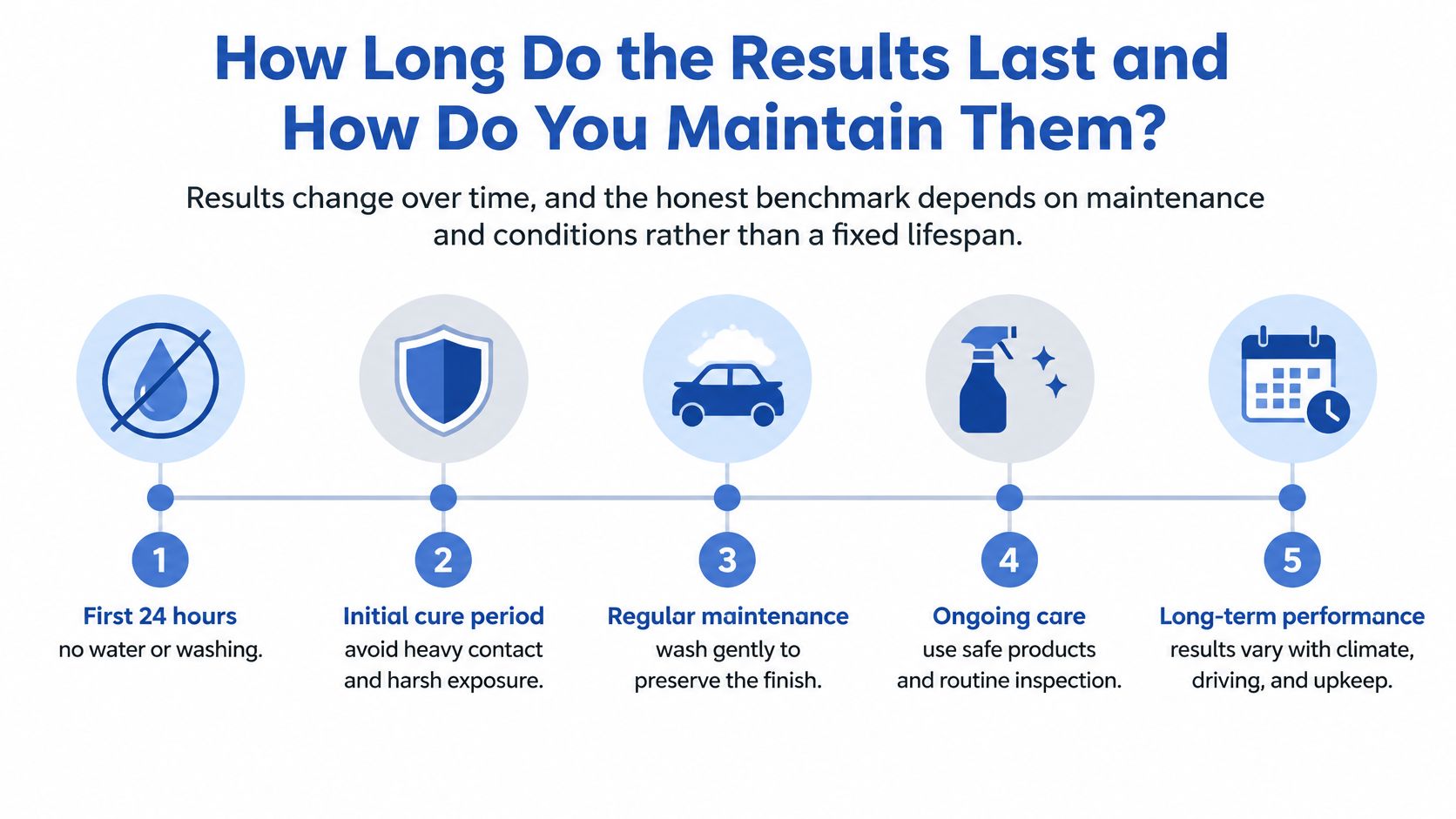
Full curing of the coating takes up to seven days, so the first week is the fragile one. Keep the car out of harsh chemical exposure and skip the urge to “test” the finish with a wash.
Here’s how the timeline looks as a maintenance path, rather than a set of dates.
What shortens the life of a coating
Untreated clear coat loses gloss as ultraviolet radiation, heat and moisture break down the polymers in it, and the three acting together do more damage than any one alone. A cured ceramic layer works as a sacrificial barrier on top, so the practical benefit is slower gloss loss and easier removal of environmental contamination, with no immunity from fading or etching.
Controlled weathering tests on coated panels point the same way. A coated surface loses gloss more slowly than an uncoated one, though the margin depends on the formulation and the test regime. No laboratory result is a promise about your car in Westminster.
In Perth, the life-shorteners are specific: outdoor parking, coastal salt, summer heat, harsh washing chemistry and abrasive brushes. A coated car that goes through a tunnel brush wash every fortnight will lose the finish it paid for faster than one hand-washed monthly.
The maintenance routine that protects the result
- Wash with pH-neutral shampoo. Two buckets, fresh water, and a clean microfibre mitt. This is the single habit that decides whether the coating looks good at twelve months.
- Dry with a soft microfibre and a light touch. Lay the towel flat and pat, rather than scrubbing. Prompt drying is also what prevents mineral spotting.
- Avoid automatic brushes and abrasive cleaners. Spinning brushes and gritty towels do more visible damage in one pass than a month of ordinary driving.
- Remove bird droppings, tar and road film promptly. These are the contaminants that etch, and the coating buys you time rather than immunity.
- Test beading every few months, after a wash. Tight beading means the film is intact; flat sheeting or patchy beading points to contamination or wear.
- Wash where the runoff is managed. An uncontrolled home wash can release more than 100 litres of contaminated wastewater carrying soaps, hydrocarbons, suspended solids and heavy metals, while commercial washing can capture and treat that runoff (Australian Car Wash Association).
A coating reduces washing frequency and effort, but regular cleaning is still needed to keep performance and shine. The ceramic coating maintenance guide for Perth drivers sets out the wash sequence and inspection points that keep a film intact across a full year. Beading alone doesn’t prove how much film remains, so treat it as a signal to investigate, not a certificate.
Set the routine up properly from day one. Book a ceramic coating with Prime Shine Hand Car Wash and put it to work on a finish worth protecting.
Explore ceramic coating aftercare
What Do Real Before and After Cases Look Like?
The three scenarios below are staged examples of how each step behaves, not finished customer cars. Each one runs the same photo sequence: before, after decontamination, after cut and polish, after coating, and after several maintenance washes.
The black daily-driver sedan. Swirls show as circular haze in direct sun, and the paint looks flat rather than black. Decontamination makes the surface feel smoother yet changes almost nothing visually, which is the point most photos skip. Cut and polish removes most of the haze and the gloss jumps. The coating then adds clarity and tight beading on top of a finish the machine work created. After a few maintenance washes it still beads, with a little light marring returning from ordinary use. The transformation happened on the polishing machine; the coating sealed it in.
The ute that lives outdoors. The clear coat is chalky and rough to touch, with water spotting etched into the horizontal panels. Correction recovers a noticeable amount of gloss and confirms how much clear coat is left to work with. Coating then protects what remains and makes the weekly wash quicker. Polishing removes a fraction of a micron at a time, so etching that sits deeper in the clear coat stays visible afterward. A coating preserves the finish preparation leaves behind, and paint lost to weathering stays lost.
The rideshare hatch washed several times a week. Frequent washing with the wrong method leaves towel marks and mineral spotting, and the paint looks tired despite being clean. A light polish and a coat cut the wash effort and reduce how much water clings after a rinse. Some marks from years of rushed washing survive the polish. Wash habits leave their signature in paint long before a coating enters the picture.
On test design: an honest comparison photographs identical panels under the same light, from the same angle, at each stage. Anything else is a lighting demo.
That matters because extra gloss and beading get presented as proof of protection in most before and after content, with preparation, lighting, paint condition and coating performance blurred into one result. Local conditions vary too: temperature, humidity, wind and rainfall are measured at Perth Metro while cloud, sunshine and evaporation observations come from Perth Airport, and the Bureau of Meteorology warns that significant variations occur across the metropolitan area on individual days. A coastal car and an inland car live different tests.
Before you pay anyone, ask three things. Whether photos exist for each stage rather than only the finished one. Whether paint correction is included in the quoted price, and at how many stages. And what the finished photo fails to show. See what paint correction alone changes before you credit a coating with it.
Want the stages documented on your own car? Book ceramic coating at Prime Shine Hand Car Wash and ask for the sequence, not just the reveal.
Ask about your coating results
Which Before and After Claims Are Misleading?
“It makes paint scratch-proof.” It resists light marks and contamination. It does not stop stone chips, deep scratches or parking-lot damage. Check instead: ask what the coating is expected to do about a chip, and listen for an honest answer.
“It’s self-cleaning.” Dirt still lands on it and still needs removing. What changes is how much effort the removal takes. Check instead: ask how often a coated car in your situation still needs washing.
“Strong beading proves full protection.” Beading shows surface behaviour, not film thickness or remaining protection. Check instead: ask how the finish is assessed beyond water behaviour.
“The day-one photo proves durability.” Durability can only be judged over months of real use. Check instead: ask for photos taken after a season of driving, not an hour after application.
“Every car gets the same result.” Paint condition and preparation decide the outcome, not the product name. Check instead: ask what preparation your specific paint needs and whether correction is included.
Then there’s the photo itself. Different sun angles, wet paint versus dry paint, and camera exposure settings can make an unchanged panel look transformed. Water spotting still forms when hard-water droplets dry on the panel, so any claim that water never marks coated paint is false. If you want the full breakdown on what a coating can and can’t do about physical damage, read whether ceramic coating prevents scratches.
Run one test on any claim you’re quoted: would it still hold if the photo were taken under identical lighting after a week of normal driving? If the answer is no, it’s marketing.
Ask for the version that survives a week of driving. Request an obligation-free quote from Prime Shine Hand Car Wash and put the claims to the test.
Request a ceramic coating quote
Should You Book Ceramic Coating for Your Car?
Book it if you want easier maintenance and a corrected finish that stays protected. Hold off if deep damage is the main complaint or the clear coat is failing, because a coating applied over unstable paint seals the defect in place rather than fixing it.
Run this checklist before you commit.
- Inspect in direct sun. Look along the panels at a low angle in bright daylight. Swirls and etching that vanish under a car park ceiling show up immediately in sunlight.
- Be realistic about preparation. The service includes paint surface preparation: a deep clean that strips old wax, sealant and contaminants so the coating can bond. Correcting scratches is a separate decision, and it changes the result more than the coating itself.
- Commit to the washing method. Plan on gentle hand washing with pH-neutral shampoo and soft microfibre towels. Automatic brushes and abrasive cleaners degrade the finish faster than they should.
- Plan for curing. The car can be driven shortly after application, but keep it away from water for at least 24 hours and allow up to seven days for full curing.
- Know your ownership horizon. With proper maintenance the coating lasts two to five years, so it pays back best on a car you intend to keep. Coating a vehicle you are selling in a few months rarely returns the spend.
If the checklist reads in your favour, the next step costs nothing. Ceramic coating at Prime Shine Hand Car Wash starts from $699, with the final figure depending on your vehicle’s size, condition and chosen extras, and every quote is transparent and obligation-free. When you request yours through Prime Shine Hand Car Wash, attach daylight photos of the panels that concern you; they show the preparation your paint needs far better than a phone description. Online booking offers start times from 08:00 to 16:00 in 30-minute intervals, and the code PRIME100 takes $100 off Full Car Detailing and Ceramic Coating when you book online. The workshop is at 9/436 Wanneroo Rd, Westminster.