







You vacuumed the mats on Sunday, but by Wednesday there’s sand in the seat rails, crumbs beside the console and a sticky patch where a drink spilled. Outside, the paint looks reasonably clean until the Perth sun catches the road film and dull patches.
Full car detailing is a condition-based reset, not just a longer car wash. The useful question isn’t whether your car deserves a premium clean. It’s whether routine washing and vacuuming can still remove what’s building up.
What Does Full Car Detailing Actually Include?
A full detail addresses both the cabin and exterior, including places a quick clean misses. That means deep cleaning the dashboard, carpets, mats, seats and boot, then cleaning windows, door jambs, wheels and tyres, treating door rubbers, and finishing properly prepared paint with hand polish and protective wax.
The distinction is depth, not just effort. A 2025 Australian survey published by Budget Direct found that 45% of respondents cleaned their car interior at least monthly, including 15% weekly. Even regular cleaning can leave compacted sand, sticky seat seams and soil beneath removable mats.
If your car already feels beyond a home vacuum, check a Westminster booking slot and choose the cleaning depth that matches its condition.
What each clean covers
| Zone | Inside and outside wash | Mini detailing | Full car detailing |
|---|---|---|---|
| Dashboard, console and trims | Dusted | Dashboard, console, ashtray and door panels cleaned | Deep cleaned, including high-touch plastics |
| Carpets, mats and crevices | Light vacuum | Vacuum suited to everyday crumbs | Slow vacuum, agitation and shampoo where the textile allows |
| Seats and seams | Surface tidy only | Light stains and minor spills | Seam vacuum plus shampoo or compatible wet clean |
| Boot and cargo well | Boot vacuum | Light cargo dust | Deep vacuum and clean of the boot well |
| Windows, jambs, wheels and tyres | Exterior wash focus | Wash, chamois dry, jambs and windows | Windows, jambs, wheels, tyres and door rubbers |
| Paint finish | Wash and dry | Exterior wash for everyday film | Paint cleanse, hand polish and protective wax |
| Odour and heavy soil | Not the aim | Light odours and minor marks | Reset for older, high-mileage or heavily used cabins |
Which level matches the mess?
Everyday dirt, minor spills and light marks usually suit a shorter hand detail. Extremely dirty, neglected or stained vehicles need a deeper assessment, particularly when several surfaces hold contamination rather than loose debris.
A full detail is especially suitable for older, high-mileage or heavily used vehicles. A family wagon might need attention around child-seat contact areas and the boot well, while a delivery car might need more work on the steering wheel, door pulls and driver’s seat edge.
Choose the booking level for the areas that need work, rather than paying for a lighter clean that leaves the main problem untouched.
Scope matters: Detailing can remove settled dust and grime. It doesn’t replace a cabin filter, fix a water leak or treat mould.
Use the table row that matches your dirtiest zone, not your cleanest panel. Shiny paint doesn’t make a stained seat base an ordinary maintenance-cleaning job.
Explore car detailing in Westminster
Which Cabin Zones and Tools Does a Pro Vacuum Use?
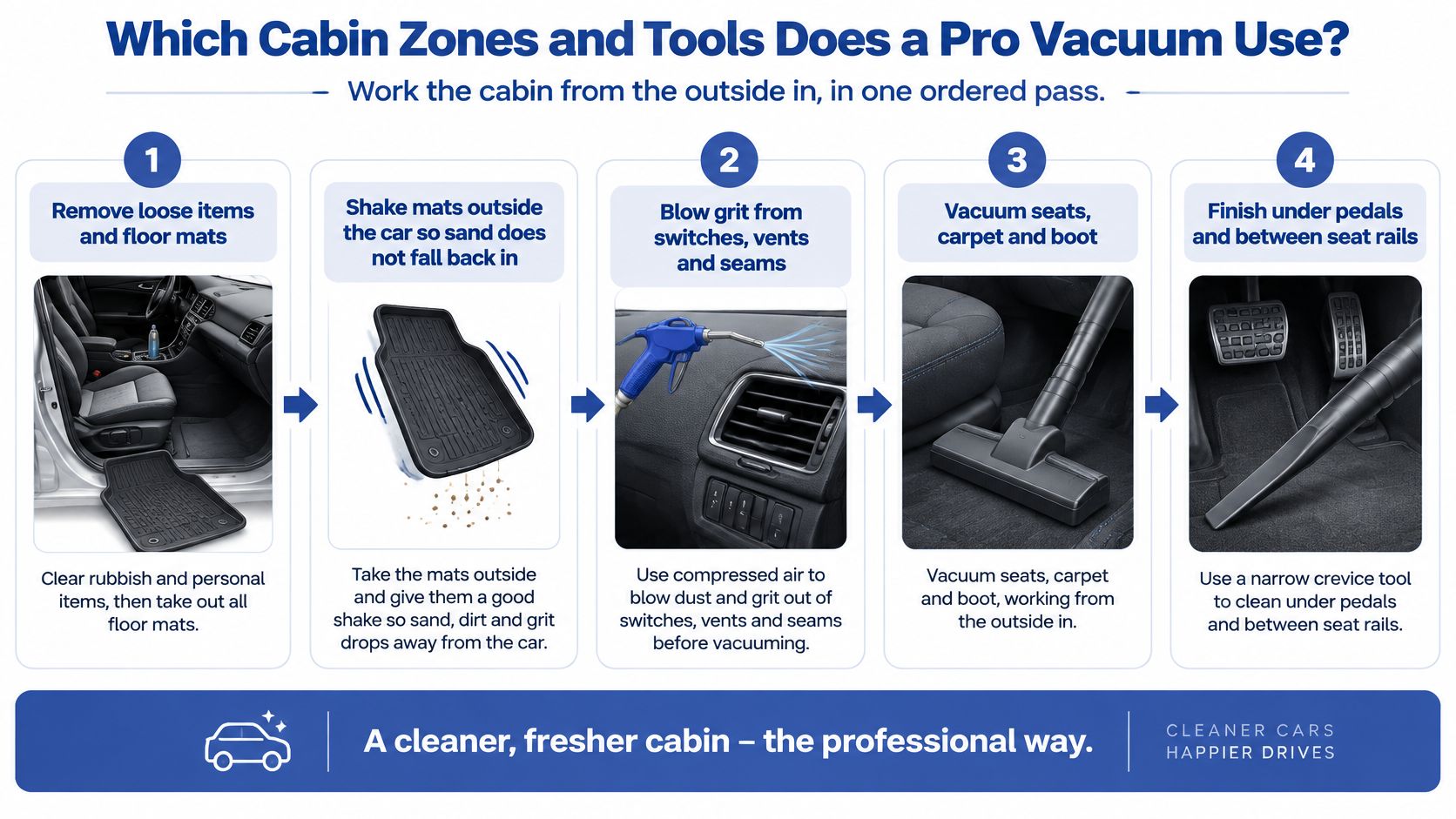
A professional vacuum follows a route so loosened dirt doesn’t land on finished surfaces. Work from the outside in, keeping an open collection area for grit rather than scattering it around the cabin.
Work the cabin in one ordered pass
Remove loose items and floor mats. Empty door pockets, cupholders and the boot before starting. Shake mats outside the car so sand doesn’t fall back onto exposed carpet, then set them aside for separate cleaning.
Release grit from small openings. Use a controlled compressed-air gun to move loose debris from switches, vent surrounds and seams towards an accessible area. Keep the nozzle away from delicate components, avoid forcing dirt deeper into controls, and vacuum the released grit promptly.
Vacuum seats, carpet and boot. Use slow, overlapping passes along carpet edges, under-seat channels, seat seams and bolsters. Include child-seat contact patches, seatbelt webbing paths, centre-console gaps, door-pocket lips and the boot well.
Finish the edges the wide head missed. Work around pedal bases and between seat rails with a narrow crevice tool, without disturbing wiring or connectors. Run a clean white cloth along a dry seam afterwards. Grey dust is a reason to revisit the seam more slowly.
The sequence below keeps those tasks in a practical order.
Slow passes matter more than quick coverage. Pulling the nozzle rapidly across carpet can collect surface crumbs while leaving sand at the base of the pile. Gentle agitation with a soft upholstery brush helps release that trapped material before another suction pass.
Seat rails need particular care. Move the seat only when the surrounding area is clear, keep fingers away from the mechanism and never disconnect seat electronics just to reach a crumb.
If grit remains around rails and seat seams after your usual vacuum, select a deeper cabin clean when arranging your Westminster visit.
What makes the equipment different?
A household barrel or stick vacuum can manage accessible debris, but its attachments may limit access. A wide floor head bridges narrow channels, a cordless unit may run short of runtime, and an awkward hose can make reaching beneath a seat difficult.
A detailing setup combines effective suction at the tool tip, a long hose and narrow attachments. The crevice nozzle reaches gaps, while a soft upholstery brush lets the technician agitate fabric without using a hard edge against it.
- Carpet edges: A narrow nozzle follows the join where the broad head can’t sit flat.
- Seat fabric: A soft brush releases dry soil without dragging a sharp plastic edge across the weave.
- Fragile materials: Loose headliners and suede-like upholstery need material-specific handling, not stronger suction or aggressive scrubbing.
- High-touch plastics: A residue-controlled interior cleaner removes hand oils without leaving a slippery silicone-heavy film.
A stronger motor still won’t reliably remove hair woven into loop carpet. Our guide to pet hair removal from cars explains why mechanical release matters before suction can finish the job.
What can vacuuming actually change?
Removing embedded dust reduces the loose material available to move around the cabin. However, Australian vehicle-cabin research hosted by QUT identifies outdoor-air entry and cabin airflow as important determinants of occupant exposure to airborne contaminants, so surface cleaning alone isn’t a complete air-quality solution.
A visually clean interior can still need ventilation-system attention if dust or musty odours persist. Record where the smell appears, whether it changes with the fan running and whether the carpet feels damp, rather than masking the symptom with fragrance.
Include persistent dust or ventilation-related smells in your booking notes so the cabin’s condition is clear before cleaning starts.
Explore cabin cleaning in Westminster
When Should You Add Steam or Pet Hair Removal?
A juice spill in a family wagon and felted dog hair in a hatchback need different treatments. Suction collects dry debris, but it won’t dissolve sticky drink residue or untangle hair hooked around carpet fibres.
For the wagon, start with a thorough dry vacuum, then assess the seat material and depth of the spill. A compatible steam treatment or hot-water extraction pass can help release the sugar film that leaves the seat tacky, although these aren’t interchangeable methods: steam applies heat and limited moisture, while extraction applies cleaning solution and recovers it by suction.
For the dog owner’s hatch, remove embedded hair mechanically before wet cleaning. Wetting a dense mat of hair makes it harder to separate from the carpet, so use an appropriate rubber brush or fabric-safe hair-removal tool first, then collect the loosened material.
Add pet hair removal or seat and carpet steam cleaning when those problems are present, rather than hoping a standard vacuum will finish the job.
Match the treatment to the symptom
- Choose pet hair removal when a lint roller loads up in a swipe, hair outlines the pedal pads, or brushing exposes more strands beneath the surface.
- Consider compatible wet cleaning when a stain has a visible ring, the fabric remains sticky, or an odour returns after the car has aired.
- Flag persistent smells when light odour treatment has already failed. Mini detailing can address light odours, while severe or persistent smells may need deeper interior treatment or steam cleaning.
The process described in our guide to steam cleaning a car interior starts with identifying the material and contamination. Heat isn’t automatically suitable for every leather dye, glued trim, seat adhesive or area containing electronics.
Steam also isn’t a mould remedy or a shortcut around dry vacuuming. Where contamination has reached seat foam or underlay, cleaning the visible fabric may improve presentation without removing the underlying source.
Mention the spill, stain or recurring smell when selecting your appointment, so the intended treatment matches the actual problem.
Drying is part of the job
Wet-cleaned surfaces need to dry fully before anyone sits back in the car. If the workshop process allows, shade, airflow and slightly open windows can assist drying, but a dry-looking seat surface doesn’t prove the foam beneath is dry.
Don’t add fragrance to judge success. The useful sequence is hair and dry soil out, compatible wet cleaning next, complete drying, then protectant only on suitable trim.
What Results Can You Fairly Expect Afterwards?
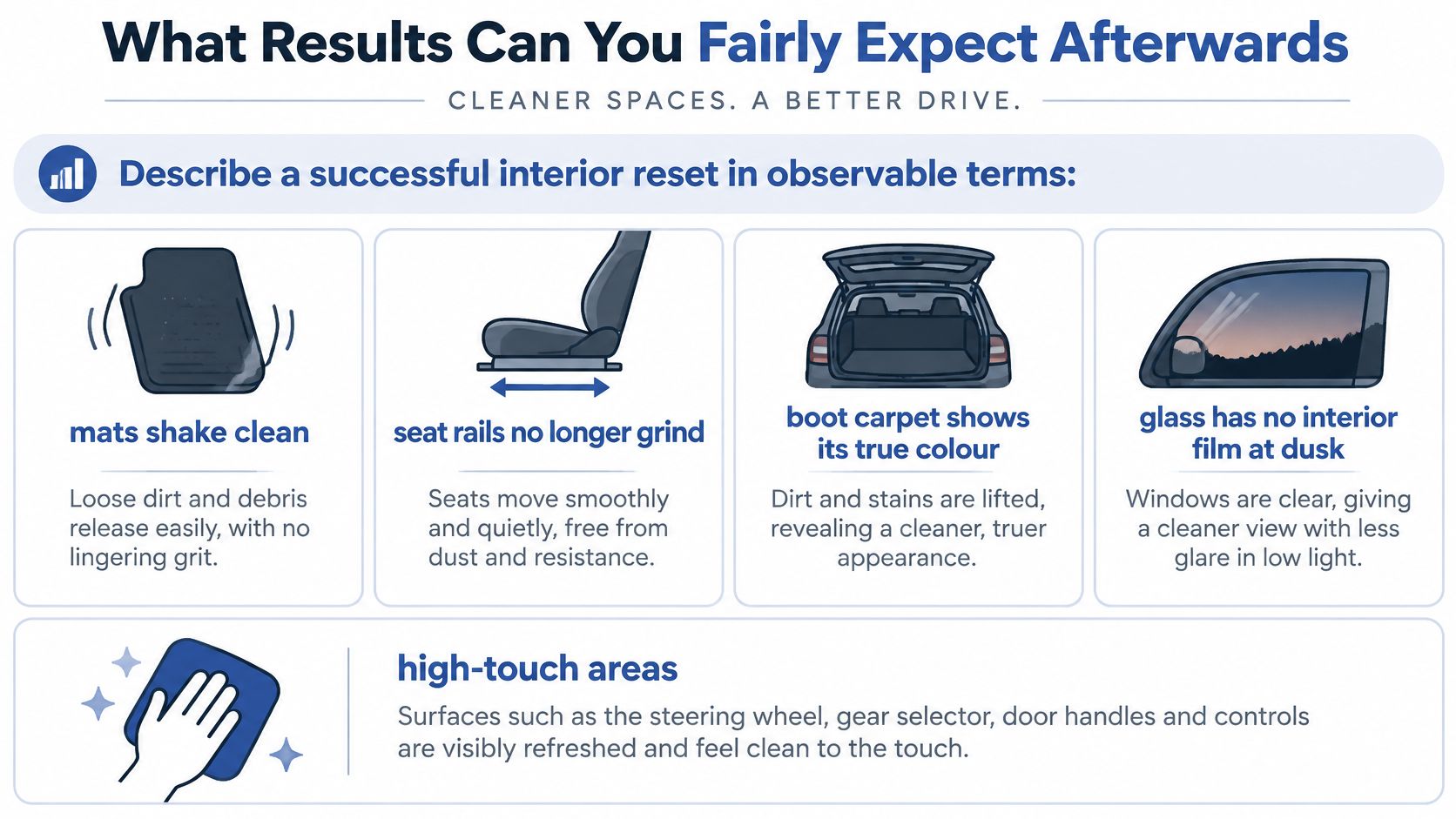
A successful interior reset has observable results. Mats shake clean without releasing a hidden layer of sand, seat rails no longer grind over loose grit, boot carpet shows its true colour, and glass stays free of interior film when low evening light catches it.
High-touch areas should feel clean and dry to the hand. Permanent abrasion, worn seat bolsters and damaged trim may still be visible. Cleaning lifts contamination; material that has worn away needs repair or replacement. Remove personal items and valuables before the appointment so every surface can be treated, and skip the pre-clean entirely.
Before booking, identify the marks you want changed and separate removable dirt from wear that needs repair.
Those signs make a more useful handover standard than how the car smells.
What should change outside?
The exterior gets cleaned before any protection goes on. Bonded road film needs appropriate paint cleansing, wheels and jambs get their own attention, and hand polishing lifts gloss. Some scratches will still show.
Wax adds gloss and protection; correcting paint means removing a thin layer of clear coat, which needs an inspection first. A scratch that reaches through the clear coat calls for repair work beyond polishing.
If swirls or scratches are your main concern, identify them before booking so cleaning and correction stay separate jobs.
Does a detail guarantee better resale value?
No. GoAuto’s Australian used-market reporting put used-car prices 12.5% lower in 2025 than three years earlier, and reported two-year retained values near 54% for the Tesla Model 3 and 88% for the Toyota RAV4. Presentation works like staging a home for inspection: it shapes first impressions, while demand and the wider market set the price range.
A clean car photographs well and removes easy buyer objections. Buyers still weigh kilometres, service history, mechanical condition and timing, so detailing can improve how a listing is received without deciding the sale price.
Spend on the defects a buyer will notice first.
Ceramic protection, if chosen later, mainly affects how easy the car is to maintain. Ask for an itemised scope that separates cleaning, defect correction and protection.
For a sale or lease return, book against the visible condition you want improved and treat any change in offers as a bonus.
A practical standard is a car that looks reset and smells neutral. Showroom condition and medical-grade sanitising sit outside what cleaning can deliver.
Explore detailing in Westminster
How Often Should a Perth Driver Book?
Book when the home clean stops working, and use travel data to judge how fast that happens. The ABS Survey of Motor Vehicle Use recorded average passenger-vehicle travel of 11,100 kilometres over the survey’s annual period. An average is a starting point; the spread around it matters more.
A BITRE analysis of Australian car travel reported annual travel of 4,190 kilometres at the 20th percentile, 10,320 at the median, 19,810 at the 80th percentile and 57,840 at the 99th percentile. A car near the top of that range collects dust, food residue and embedded hair several times faster than a median car, so a sensible schedule scales with exposure.
A cabin filter gets replaced when airflow drops, and detailing follows the same logic: the bands below give you the likely range, while the cabin itself tells you the moment.
Book when your current use and cabin condition show the home clean is falling behind, rather than following a generic six-month habit.
Detail timing by how far the car is driven
| Driver band | Annual car travel | What builds up | Full detail timing |
|---|---|---|---|
| Lower-use, near the 20th percentile | About 4,190 km | Light dust, occasional sand | Seasonal reset, or sooner if pets or spills appear |
| Typical median driver | About 10,320 km | Mats, seams and road film between home cleans | When monthly vacuuming no longer resets the cabin |
| Higher-use, near the 80th percentile | About 19,810 km | Faster food residue, dust and exterior film | Shorter gap than a low-use car; inspect every season |
| Very high use, including rideshare or delivery | Well above the median; 99th-percentile benchmark about 57,840 km | Cabin wear and embedded debris | Inspect monthly and book as soon as condition slips |
What changes the timing in Perth?
Age matters here because Western Australian cars run older than most. BITRE’s January 2024 vehicle report lists the state’s average passenger-vehicle age at 11.89 years, compared with 11.18 years nationally. Older cabins have compressed seat foam, worn carpet pile and weathered trim where grit settles deeper than in a new car.
Kilometres and years both count, and so does how the car lives. A new vehicle on gravel tracks can need a reset sooner than a carefully kept older sedan, while a garaged low-kilometre hatch can still collect substantial dog hair.
Choose your next appointment around pets, passengers and road conditions as well as kilometres.
- Family use: Check seat edges, child-seat contact areas and the boot after food-heavy outings or beach trips.
- Work use: Rideshare and delivery drivers should inspect high-touch areas and footwells between shifts, since the odometer is a weak trigger for a cabin used by dozens of passengers.
- Dust exposure: After dusty travel or smoke haze, check settled residue on dash surfaces, vents and seat seams.
Routine washing still has a separate role. Our guide to how often to wash your car in Perth helps distinguish exterior upkeep from the deeper reset needed when contamination remains after normal cleaning.
A practical trigger is two failing zones: seams that retain grit plus a dirty boot well, or stained seats plus persistent exterior film. That combination is a stronger reason to book a full detail than the date alone. A cabin that looks clean yet still smells of last week’s takeaway points to a deeper interior treatment, which is a separate question from timing.
Check full-detail booking details
Should You Book a Full Detail in Westminster?
Choose a full detail when several areas need sustained attention: gritty seat seams, a heavily soiled boot, neglected upholstery or a heavily used cabin approaching sale or lease return. Stay with a lighter clean when the problem is loose everyday dirt and the surfaces underneath remain in good condition.
The appointment should match what needs changing. If the main complaint is paint swirls rather than contamination, cut and polish is a separate correction step, not something protective wax will erase.
Match the booking to the dirtiest areas and include any paint defects, embedded hair or stains that need separate attention.
What does the Westminster booking involve?
At Prime Shine Hand Car Wash, 9/436 Wanneroo Rd, Westminster, full car detailing starts from $349 for a sedan, $369 for an SUV or wagon, and $399 for a 4WD or 7-seater. It includes an in-depth deep clean inside and outside, chamois drying, cleaned door jambs and windows, with the final price varying by vehicle condition.
Allow three to five hours, depending on size and soil. We work by hand, without automated brushes, and offer online date and time selection seven days a week.
- Remove personal items and valuables: Empty the places the technician needs to reach, including pockets, seat storage areas and the boot.
- Don’t pre-clean: You don’t need to vacuum or wash the car before bringing it in.
- Identify special concerns: Point out old spills, delicate trim, loose upholstery and areas where you’re unsure whether a mark is damage or dirt.
- Confirm the vehicle type: Sedans, SUVs, wagons, 4WDs and 7-seaters are covered; specialty or unusually large vehicles can be discussed.
Why prepare rather than pre-clean?
Clearing belongings gives the technician access to rails, seams and storage areas. It also lets you keep valuables organised without spending time doing the cleaning you’re booking.
Our single Westminster workshop supports direct quality control, with more than five years in service, 2,500-plus vehicles detailed and 200-plus Google reviews. You can review the location through our Westminster car wash page before selecting an online appointment.
Select the matching vehicle category online, choose an available date and time, and arrive with personal items removed rather than the car pre-cleaned.
Prime Shine Hand Car Wash offers a hand-cleaned interior and exterior reset for Perth cars that need more than routine washing. Visit Prime Shine Hand Car Wash to select your vehicle category and book a Westminster appointment, with pet hair, stains or paint concerns identified before the work begins.