






Buffing is the machine stage that raises gloss, while paint correction is the full measured process that reduces defects and must stop before the clear coat is compromised. If you’re standing on a Perth driveway watching spider-web swirls appear in hard sun, that distinction decides whether a quick shine is enough or whether you’re paying someone to remove paint.
Not sure which one your paint needs? Book a paint check before you choose a service.
What Is the Difference Between Paint Correction and Buffing?
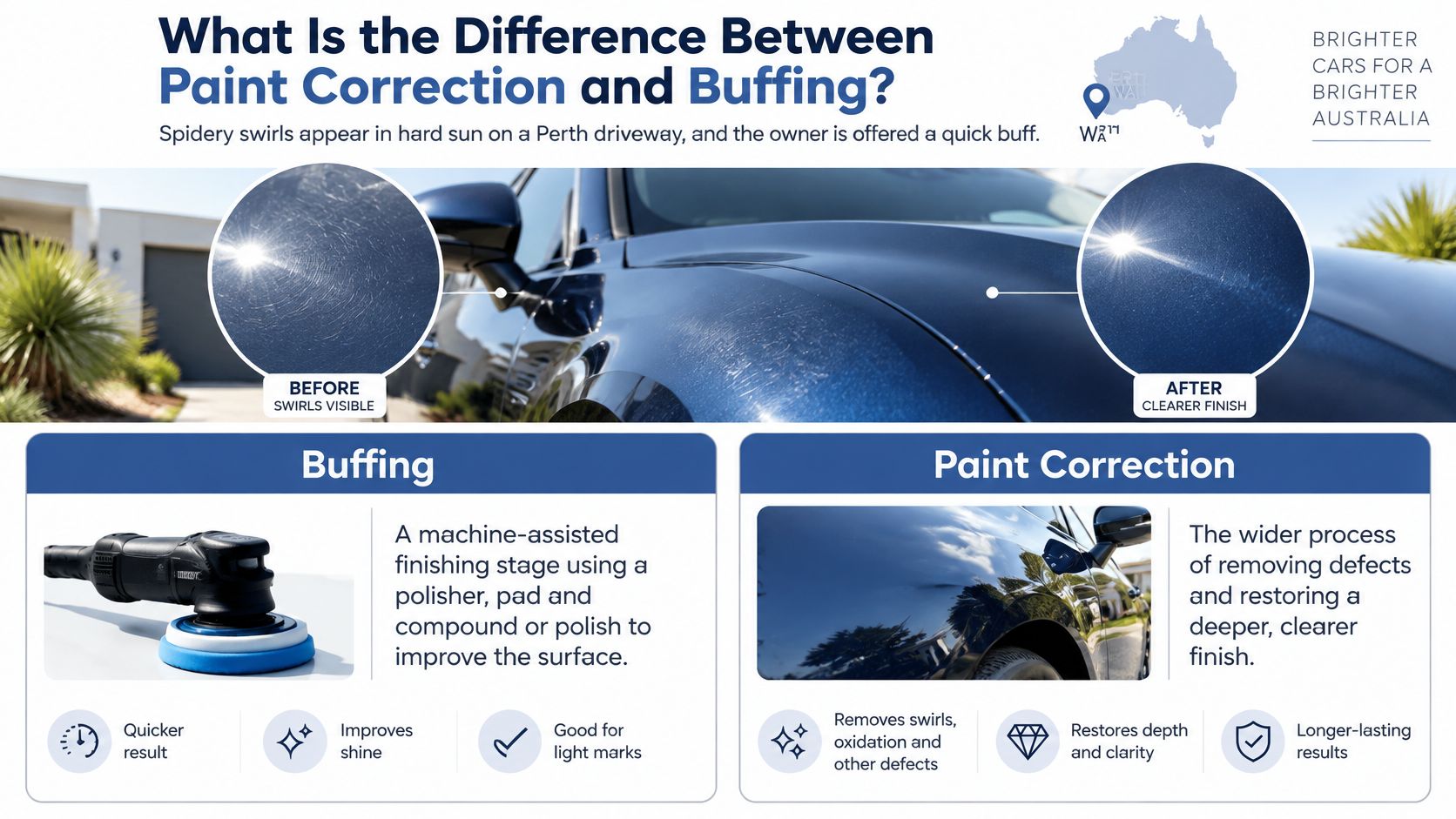
Buffing is a machine-assisted finishing stage. A detailer uses a polisher, pad and compound or polish to lift gloss and refine light swirls or haze. It can make sound paint look clearer, but one pass doesn’t automatically level deeper marks.
Paint correction is the wider job built around that machine stage. It includes a wash, decontamination, inspection under direct light, a test spot, compounding where it’s needed, polishing and a final check. The goal isn’t just shine, it’s reducing defects while keeping as much clear coat as the panel can spare.
Book a paint inspection first, so we can tell you whether you need gloss or defect removal.
Paint Correction vs Buffing at a Glance
| Criterion | Buffing | Paint correction |
|---|---|---|
| Goal | Raise gloss and refine light haze | Reduce measured defects while preserving clear coat |
| Typical defects | Light swirls, haze and dullness | Wash marring, oxidation, sanding marks and deeper clear-coat scratches |
| Process | One machine stage with pad and compound or polish | Wash, decontamination, lighting check, test spot, cut, polish and inspect |
| Clear coat | A light abrasive pass removes a thin layer; wax or glaze may only fill | Removes more material in controlled stages and stops before the film is compromised |
| How long the look lasts | Shine fades if marks were filled rather than levelled | Clearer for longer when defects were actually levelled |
| Best suited to | Sound paint that mainly needs gloss | Older or neglected paint whose marks are still inside the clear coat |
That last row matters locally because many cars aren’t new. The Bureau of Infrastructure and Transport Research Economics report found Australia’s average passenger-vehicle age rose from about 11.0 years to about 11.18 years between 2023 and 2024. Western Australia’s passenger fleet averaged approximately 11.89 years in 2024, older than the national passenger-vehicle average.
Those figures don’t count swirls, but they explain the pattern you see every week. An older daily driver often carries years of wash marks, oxidation and previous product build-up. A gloss-only pass can brighten it for handover photos, yet the marks return once fillers wash away because nothing was levelled.
Tell us your vehicle’s age and main paint complaint when you book, and we’ll match the service to the condition.
Simple rule: Choose a light buff for shine on sound paint, and staged correction when defects are still in the clear coat.
Think of a late-model car that’s garaged and hand washed. If the paint feels smooth and only looks slightly flat, a finishing buff is the proportionate choice. Now think of a ten-year-old wagon with a dull bonnet and circular marks on every door. That car needs inspection and staged work, because polishing harder without a plan just spends clear coat faster.
The confusion around Paint Correction vs Buffing usually comes from shops using one word for several outcomes. Ask what will happen to the defect. If the answer is filling, masking or waxing, you’re buying temporary gloss. If the answer involves a test spot and controlled levelling, you’re buying correction.
How Do Buffing and Correction Steps Actually Differ?
Buffing sits inside a finishing sequence, it isn’t the whole sequence. Australia’s nationally recognised Certificate III in Automotive Refinishing includes the unit AURVTP020, “De-nib, buff and polish vehicle painted surfaces,” in the Certificate III in Automotive Refinishing qualification outline. That split is useful because it separates the machine step from the wider objective of reducing visible defects.
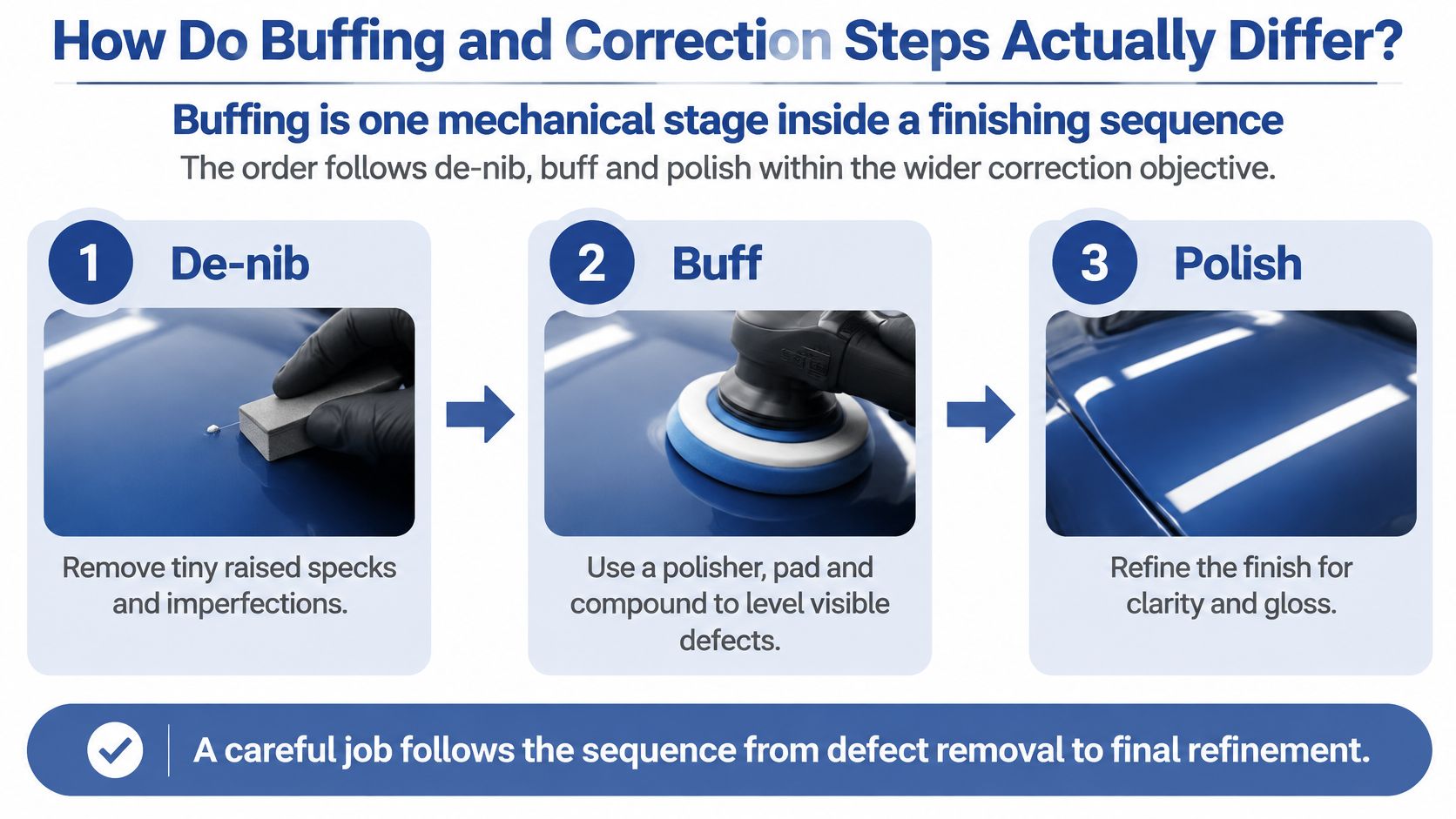
A careful job follows an order, and skipping early steps creates new marks. Grit left on paint gets dragged under a pad. Bonded contamination does the same, only finer.
Ask for the step order before you pay, including whether a test spot is part of the booking.
What Does a Careful Correction Sequence Look Like?
- Wash the grit off: Clean the panels so the pad doesn’t grind road film into the clear coat.
- Decontaminate: Use clay or an equivalent process to remove bonded particles you can feel with your fingertips.
- Inspect under light: Check each panel under LED light or direct sunlight, where swirls and holograms are visible.
- Run a test spot: Match pad, compound and machine speed to that panel’s clear coat before working the whole car.
- Compound only where needed: Level defects on the panels that need cutting, rather than cutting every panel equally.
- Refine with finishing polish: Clear the haze the cutting stage leaves behind and restore optical clarity.
- Inspect again: Look for leftover marring, holograms and uneven gloss before any wax or protection goes on.
A heavy compound levels more material, including wash-induced micro-marring and sanding marks, but it also risks haze and unnecessary clear-coat loss. A finishing polish does the opposite job. It removes very little and is there to refine what the cut stage disturbed.
Book cut and polish when you want defects levelled, not just a shinier layer over them.
Australian collision-finishing guidance follows the same logic, where compounds remove sanding scratches and polish removes swirls left by compounding, with an ultrafine pass sometimes needed for hologram-like marks, as set out in Australian paint finishing and detail shop guidance. That’s why a single pass can look glossy indoors and still show trails in sun. The cut worked, but nobody finished it properly.
Wax and glaze sit outside that levelling process. They can improve apparent gloss by filling fine marks, which is fine if you know that’s what you’re buying. They don’t permanently flatten the clear coat around a scratch, so the defect reappears as the product wears.
Which Tools Should You Expect to See?
You don’t need a shopping list, but the tools tell you how controlled the job is. A dual-action polisher gives controlled movement for most correction work. A cutting pad belongs only to the cut stage, a finishing pad belongs to refinement, and a paint thickness gauge matters when the car’s repair history is unknown.
Mention any resprays or panel repairs when you book, so thickness can be checked before cutting starts.
If you’re comparing quotes, our Perth driver’s guide to what cut and polish involves explains the local booking in more detail. Use it to ask three direct questions. How many stages are included, was a test spot done, and was thickness checked on older or repaired panels?
A shiny panel at pickup isn’t proof of correction. Proof is fewer defects under the same harsh light, with no new haze added.
Explore Our Paint Care Services
When Is Buffing Unsafe Rather Than Just Ineffective?
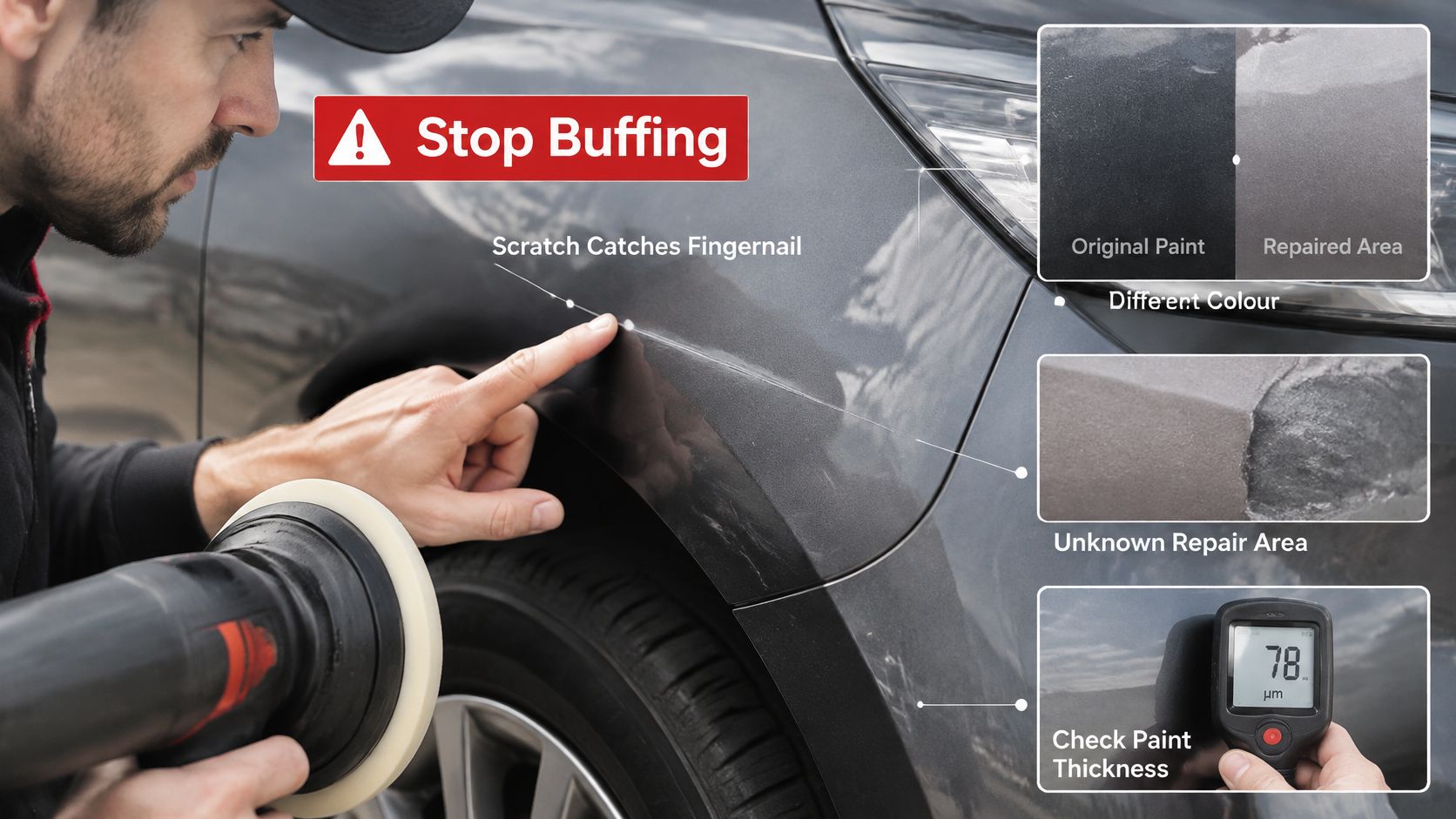
Start with two tests you can do in your driveway. Run a clean fingernail gently across the scratch. If it catches, or you can see a different colour inside the mark, don’t keep polishing that panel and hope it disappears.
Polishing works by removing clear coat around a defect until the surface is closer to level. The RACV guide to removing swirl marks notes that swirl reduction depends on defect severity and remaining clear-coat thickness, because polishing removes a microscopic layer of that coat. Repeated aggressive work therefore reduces the protection the colour coat has left.
If a scratch catches your fingernail, book an assessment instead of the cheapest buff you can find.
How Thick Is the Layer You’re Spending?
A useful benchmark comes from the Australian PPG Autoclear Plus HS technical sheet, which specifies a typical cured film thickness of 60-80 µm for that refinish clear coat. It also treats sanding and heavy polishing as more substantial operations than polishing dust or minor imperfections after proper drying or baking. Factory paint isn’t always that system or that thickness, so treat the figure as a scale, not a promise for your car.
That’s why readings across panels matter. A bonnet that’s been resprayed can read very differently from an original door, and edges usually carry less paint than flat centres. Our DIY guide to car paint scratch repair covers the at-home checks, but unknown thickness on a repaired panel is a good reason to stop and get it measured.
Ask us to assess repaired or thin-looking panels panel by panel before any machine work begins.
What Does a Conservative Technician Do Differently?
- Least aggressive first: Start with the mildest pad and compound combination that meets the target on the test spot.
- Edges protected: Tape or avoid sharp body lines and panel edges where clear coat is thinnest and heat builds quickly.
- Temperature watched: Keep the pad moving and check that panels aren’t getting hot under pressure.
- Results judged properly: Compare remaining defects, holograms and edge clarity under direct light, not just immediate shine.
Defects through the clear coat into colour or primer need refinishing, not another buff. More abrasion only widens the area with no protection left. Australian refinishing practice also expects eye protection, gloves and protective clothing around machine polishers and compounds, which is a reminder that this isn’t a risk-free cosmetic wipe.
Book a thickness-minded assessment if you’d rather keep a faint mark than lose the panel’s clear coat.
A good detailer may leave a deep mark partly visible rather than burn through the panel chasing perfection.
Every full correction removes clear coat permanently. Re-correct only when defects have returned, not on a fixed yearly schedule, and check thickness again before a second cut. For Perth cars living in strong sun, that remaining clear coat is the colour’s main UV barrier, so spending it carelessly shortens the life of the finish you’re trying to save.
How Much Time and Money Should You Expect?
Separate a cheap shine from a correction quote before you compare dollars. A hand wax and polish add-on is a short gloss and protection step. Cut and polish is the correction-style booking, with preparation and machine stages that take real time.
Perth Starting Prices for Gloss Versus Correction
| Booking | Starting price | What is included | Time band |
|---|---|---|---|
| Hand wax and polish add-on | $30 | Short-term gloss and protection on already clean paint | Added to a wash, not a correction day |
| Cut and polish, sedan | From $249 | Exterior wash, clay bar or paint preparation, machine cut and polish | Often half a day; longer if paint is hard or neglected |
| Cut and polish, SUV or wagon | From $269 | Same correction scope on a larger body | Longer than a sedan |
| Cut and polish, 4WD or 7-seater | From $299 | Same correction scope | Longest of these three sizes |
At Prime Shine Hand Car Wash, Cut & Polish starts from $249 and includes an exterior wash, clay bar or paint preparation, and machine cut and polish. The Hand Car Wax & Polish add-on costs $30.00. Those two numbers describe different outcomes, so don’t treat the lower one as a discount version of the higher one.
Choose your vehicle size when you book so your quote starts from the right row.
Starting prices assume a starting condition. Neglected paint, hard clear coat or a multi-stage finish takes longer and can cost more, because the technician is doing more test spots, more passes and more inspection between them. A larger body also means more panels, more pad changes and more edges to protect.
Use these time bands as planning ranges, not promises. A light buff on a clean sedan is often one to three hours. A measured correction on a daily driver is commonly half a day to a full day, and a badly oxidised or previously repaired car can need more than one day if work pauses to reassess thickness.
Note oxidation, prior repairs and how the car is washed when you book, so we allow enough time.
Our breakdown of cut and polish costs in Perth explains how size and condition move a quote. Read it before comparing a correction price with a quick buff special. The cheaper offer often removes the preparation and inspection steps that make correction safe.
Watch the real cost: The lowest buff price can become the expensive one if it hazes edges or thins paint that later needs a respray.
Don’t compare these figures with a full interior detail either. That service solves a different job inside the cabin and boot. Judge paint work on preparation, stages, inspection and how much clear coat the plan is likely to spend.
Book your size and paint condition honestly, and we’ll confirm the scope before work starts.
How Do You Keep the Finish After the Work?
Aftercare decides how long the result survives Perth sun and weekly washing. Most new swirls don’t come from driving, they come from grit dragged across paint during washing and drying. Your first month of habits matters more than any extra product layered on top.
For the first washes, use a pH-neutral shampoo, two buckets or a grit guard, and soft microfibre towels. Rinse loose grit off before a mitt touches the panel, wash from top to bottom and keep wheel brushes away from paint towels. Dry carefully so minerals don’t spot the fresh gloss as water evaporates.
Book a gentle hand wash for the first clean after correction if you don’t have a two-bucket setup at home.
What Should You Avoid in the First Month?
Avoid automatic brushes and abrasive cleaners. Our recommended ceramic coating aftercare is gentle, regular hand washing with pH-neutral car shampoo and soft microfibre towels, while avoiding automatic brushes and abrasive cleaners, and that same rule protects a fresh cut and polish. Household cream cleansers are also a poor choice on door jambs and edges, which were high-risk areas during polishing.
Don’t stack another heavy compound a week later because the paint looks ordinary in shade. Judge the finish in the same direct light used at handover. Shade hides gloss on perfect paint too, and chasing that difference with abrasives just spends clear coat for no visible gain.
If the finish looks flat, book a wash and inspection before anyone compounds it again.
Our guide to the two-bucket hand wash method that prevents swirls sets out the routine in full. The short version fits a fortnightly habit. Rinse first, wash top to bottom, clean wheels separately with their own tools, and wash your microfibre towels apart from anything used on tyres or wheel arches.
Does Wax or Coating Change the Rules?
Only partly. If a ceramic coating is added after correction, it helps water bead and slows light marring, but it still needs gentle hand washing and won’t stop stone chips. A spray wax or hand wax suits owners who had a light buff and want easier drying, not owners who think wax replaces the correction they skipped.
Ask about protection at booking so it’s applied to corrected paint, not used to hide defects.
Park in shade where you can, remove bird droppings promptly with plenty of water rather than dry wiping, and keep a clean towel in the car for spills. Small habits like these protect the finish without another machine pass. Owners who want that handled for them are better served by regular hand washing than by a tunnel wash between corrections.
Should You Book a Buff or a Full Correction?
Put four Perth cars side by side and the answer stops being abstract. A garaged late-model car with faint wash marks needs a light buff or hand wax, because full correction would waste clear coat it may need later. The paint is sound, the complaint is dullness, and gloss is the honest outcome.
A Westminster daily driver with a dull bonnet and door swirls from tunnel washes is a different booking. Oxidation and circular marring sit deeper than a finishing wipe can reach, so staged cut and polish after preparation is the proportionate choice. Anything lighter will shine for a week and then show the same pattern again.
Describe how your car is washed when you book, because tunnel-wash marring usually needs more than a finishing pass.
A seller or lease-return customer should be more selective again. Correct only the marks still inside the clear coat and leave fingernail-catching chips for a body shop, since a glossy fill shows again under inspection lighting at handover. Spending correction money on defects that need paint doesn’t raise the car’s value, it just delays the proper repair.
An enthusiast planning ceramic coating should correct first. Coating doesn’t remove defects, and ceramic coating resists light surface scratches and swirl marks but does not make a car fully scratch-proof or chip-proof, and it does not replace clear bra or paint protection film for stone chip resistance. Locking swirls under a coating only makes them harder to fix later.
Planning a coating? Book the correction assessment first so defects aren’t sealed in.
What Are the Three Booking Rules?
- Book a light buff, hand wax or polish when the complaint is dullness on smooth paint and the objective is short-term gloss and protection.
- Book cut and polish when swirls are visible in sunlight but don’t catch a fingernail or show another colour, and the objective is defect reduction.
- Stop and ask about refinishing when the mark is through the clear coat, or the panel was repaired and has never been measured.
That outcome-based split matches Australian training practice. The national AURV332308A training unit on cleaning and polishing vehicle paintwork separates defect removal with compounds, polishes and glazes from broader preparation, and assesses the finished surface for texture, depth, gloss and freedom from contamination. In plain terms, the product and abrasive level should follow the fault, not the other way round.
Use the three rules above, then book the service that matches the outcome you actually want.
What the Mark Tells You to Book
| What you see | What it usually means | Safer choice |
|---|---|---|
| Fine spider webs in direct sun | Light clear-coat marring | Finishing buff or polish |
| Dull, chalky panels | Surface oxidation | Staged correction after a test spot |
| Scratch that catches a fingernail | Deep in or through the clear coat | Stop buffing and consider refinish |
| A different colour inside the scratch | Colour coat or primer exposed | Panel refinish, not more polish |
| Holograms after a cheap buff | Cut stage left unfinished | Refining polish, not another heavy cut |
At our Westminster site at 9/436 Wanneroo Rd, every car is hand-washed only, with no machine brushes touching the paint. Our Cut & Polish restores paint and removes scratches that sit within the clear coat, after the wash and preparation stages that make machine work safe. We're open seven days a week, so you can choose a time that fits around work rather than rushing a same-day special.
Head to our booking page, choose your vehicle size, and note any oxidation or prior repairs before you pick a time.
Bring the car as it is and point out the marks that bother you most in direct light. That gives the technician a target for the test spot and a clear stopping point. If a panel shouldn't be cut further, you'll hear that before money is spent, not after the clear coat is gone.
Pay for the least abrasion that reaches the look you can live with, and leave the rest of the clear coat on the car.
If your paint only needs gloss, we'll say so, and if it needs staged cut and polish to level swirls and light scratches, we'll scope that by vehicle size and condition before work starts. Book your hand wash, cut and polish or paint assessment with Prime Shine Hand Car Wash in Westminster, seven days a week, and note any oxidation or previous repairs so we allow the right time.