





Choosing biodegradable shampoo isn’t enough to make a hand car wash environmentally responsible. The more useful question is where the dirty water goes. A wash can use little water and gentle soap yet still send everything removed from the vehicle into a street drain.
For Perth drivers, paint care and wastewater control need to work together. Choose a method that lifts contamination without dragging grit across the finish, then check that the washwater is captured rather than allowed to escape.
Before your next wash, check the drainage first, then choose the cleaning method.
Which Hand Car Wash Method Uses the Least Water?
The lowest litre figure is rarely the greenest wash on offer. What decides that is the destination of the dirty water, and a controlled hand wash in a bunded bay pairs modest consumption with full capture: reported benchmarks put manual washing far below an automatic tunnel’s draw, while the bunded floor sends every litre to treatment or sewer instead of the gutter.
Waterless spray uses less wash water again. It handles dust and light film well; mud and road grit still need flowing water to lift them off the paint safely. The useful comparison is water used to clean the vehicle without damage, weighed alongside how the operator manages the resulting waste.
Choose a wash suited to the dirt on your car, and confirm that its wastewater stays contained.
Hand Car Wash Methods Compared by Water and Runoff
| Method | Typical Water Use | Runoff Control | Best For |
|---|---|---|---|
| Professional hand wash in a bunded bay | About 40-50 litres per wash | Captured for approved treatment, sewer disposal or recycling | Routine exterior cleaning, with interior work added separately |
| Automatic tunnel wash | About 200 litres per wash | Check collection drains, treatment and recycling at the site | Quick cleans where brush contact is acceptable |
| Hose wash on a driveway | Set by hose flow rate and running time | None on an uncontained driveway draining towards the gutter | Not recommended |
| Bucket wash on a lawn | Bucket-controlled supply; lower water and detergent use advised | Grass absorbs washwater, subject to ground conditions | Occasional light cleans |
| Waterless spray wash | Minimal; spray and wipe | Little free-flowing washwater; residue remains on towels | Dust or light film only |
Reported manual and automatic volumes: Australian vehicle-washing study.
Those volumes describe the water drawn during the wash itself, so a facility that recycles can cut its net freshwater demand well below them. An automatic site may recover much of its supply, while a hand-wash operator can waste water by leaving a hose running during wheel scrubbing or mitt rinsing. Ask whether consumption is metered per vehicle or inferred from the equipment.
A driveway hose wash is the hardest to assess without a meter. A bucket limits the initial supply, but repeated refilling and an uncontrolled rinse can undo that saving. On a lawn, absorption reduces surface runoff; saturated ground, slopes and a nearby drain can undermine it.
Rank measured water use, controlled rinsing and a clear drainage route above any low-water promise.
What should you measure?
For a professional operator, litres per completed vehicle is the working measure that matters. Record it by vehicle size and package so a muddy work ute is compared with similar jobs rather than a lightly dusty sedan. Trigger-controlled hoses and deliberate rinsing keep the figure honest, and staff still need enough water to flush abrasive dirt off the paint safely.
For drivers weighing the methods, our rinseless versus professional outside-wash guide explains the practical distinction. Book a contained bay-based wash for routine grime, keep waterless spray for light dust, and leave driveway hosing that drains to the street out of the rotation.
Compare rinseless and professional washes
Why Does Washwater Runoff Harm Waterways?
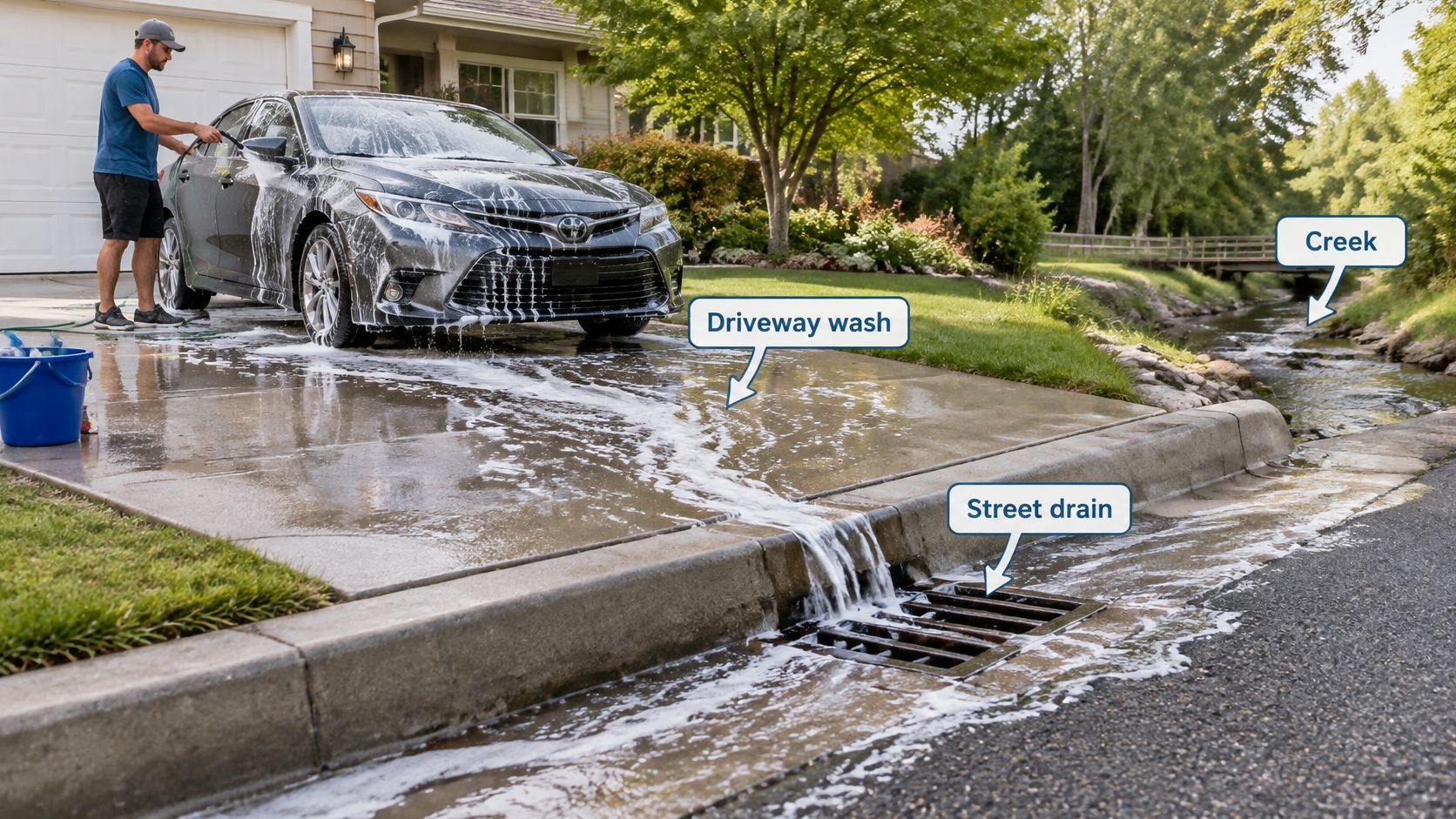
Washing a car on a draining driveway is like tipping a dirty bucket onto the street, except the street drain may carry its contents towards a creek rather than a treatment plant. The foam is visible; much of the contamination isn’t.
The Australian car-wash environmental document hosted by NSW water authorities.pdf) identifies grease, oil, detergents, paint particles and metals such as zinc and lead as washwater pollutants. It also describes EPA Victoria’s recommendation for bunded or graded washing areas that direct wastewater to an interceptor or separator.
Check where the rinse water flows before you start washing, particularly beside a kerb or street drain.
How does contamination reach the water?
- Scrubbing releases it. Detergent and agitation loosen road film, brake residue and grease from panels, wheels and lower bodywork.
- Rinsing transports it. Water carries suspended particles and dissolved contaminants away from the car.
- Stormwater conveys it. Unlike sewage, stormwater commonly reaches receiving waters without comparable treatment.
Consider a Westminster driveway sloping towards the kerb. If the rinse water reaches the street inlet, it can enter the stormwater network and then local surface water. Rain during the wash does not make that discharge clean; it adds more moving water.
Western Australian wash-down guidance says vehicle washwater should not enter stormwater or groundwater, and recommends dedicated, preferably covered washing areas with appropriate sewer and trade-waste arrangements. A separator is part of that managed system, not permission to discharge its outlet anywhere convenient.
Choose containment that protects local waterways as deliberately as the wash protects your paint.
On-site test: If washwater is visibly entering a gutter or stormwater drain, the wash isn’t contained, whatever soap was used.
Good housekeeping matters after the vehicle leaves, too. Operators should keep wheel tools separate from body tools, collect polishing and preparation residues, and maintain separator inspection and disposal records. A clean-looking bay isn’t enough if its drains carry contamination to the wrong destination.
Explore hand car wash services
Are Biodegradable Products Enough on Their Own?
A weak-looking blanket of foam tempts some washers to keep adding concentrate. The extra detergent still needs somewhere to go, carrying oil, sediment and wheel residue with it. Biodegradability affects what happens after discharge; the wash site decides where the water flows first.
Measure automotive shampoo at its specified dilution. More foam isn’t proof of better cleaning, and overdosing leaves more product to rinse and contain. If cleaning feels weak, confirm the dilution and application instructions before reaching for more concentrate.
Check the wash location before buying shampoo, then measure the product instead of pouring by eye.
Where does better product choice help?
The Queensland Government’s water-care guidance recommends minimising detergent and water, using a bucket or trigger-nozzle hose, choosing biodegradable detergent, washing less frequently and directing household washing towards a suitable grassy area rather than a driveway or road.
That advice depends on the site controlling where rinse water goes. A biodegradable wash can still move contamination towards drainage before the product breaks down. If soil is saturated or water can escape the area, the route remains uncontrolled.
For paintwork, choose a lubricating automotive wash product compatible with the finish. Keep stronger wheel cleaners and tar removers for the contamination they’re designed to treat, rather than spraying them over the whole vehicle. Work on cool surfaces, and don’t let cleaner dry onto wheels or panels.
Use targeted products only where they’re needed, and keep their rinse water within the wash area.
What order should your decisions follow?
- Destination first. Establish where the wastewater will go before opening the bottle.
- Quantity next. Control both water flow and detergent dosing.
- Formulation after that. Select a suitable product with clear application and dilution instructions.
The label gives mixing directions; the site determines the discharge route. Read whether it describes a ready-to-use product or a concentrate, because confusing the two can produce poor lubrication or unnecessary chemical use. I’d treat drainage as the pass/fail test: if the site cannot contain rinse water, change the location or wash method first.
Which Eco Method Suits Your Car’s Condition?
Match the method to the contamination, not the calendar. A car carrying loose dust needs a different approach from one with gritty mud packed behind its wheel arches.
Eco Wash Method by Vehicle Condition
| Vehicle Condition | Suitable Eco Method | Caution |
|---|---|---|
| Light dust or pollen | Waterless spray wash | Use a lubricating product and fresh towels to avoid scratches |
| Everyday road film | Bucket wash on a suitable lawn or bay-based hand wash | Minimise detergent and control rinsing with a trigger nozzle |
| Mud or salt build-up | Rinse in a bunded bay, then hand wash | Waterless wipes can drag grit across paint |
| Bird droppings or tree sap | Prompt spot treatment, then hand wash where needed | Don't dry-wipe; soften and remove promptly |
| Brake dust on wheels | Dedicated wheel cleaner with runoff captured | Keep wheel washwater out of stormwater drains |
| Deep scratches or swirl marks | Hand wash first, then assess for correction | Polishing can reduce superficial defects, not repair every deep scratch |
For light dust, saturate the working area with a purpose-made waterless lubricant and wipe gently with clean microfibre. Fold the towel to expose a fresh face as it collects dirt. If the towel encounters gritty deposits rather than light film, stop and use a rinse-based method.
Everyday road film usually warrants a proper wash. Mud needs loosening and rinsing before a mitt touches the paint, while salt-like deposits need dissolving and flushing from affected areas. Our two-bucket hand-washing guide explains how separating the shampoo supply from mitt-rinsing water helps limit grit transfer.
Choose the least intensive method that safely removes the contamination, rather than the largest package available.
When should you act?
Bird droppings need prompt softening and removal, not aggressive rubbing. Treat tree sap with a finish-compatible spot product, and inspect the surface afterwards before deciding whether a complete wash is necessary. For wheels, use dedicated brushes and avoid transferring their residue onto paint.
Cleaning needs also depend on use. A Perth rideshare or delivery car may need frequent cabin vacuuming and touch-surface cleaning without needing paint correction. A garaged second car may need fewer complete washes but still need immediate attention when droppings or tree residue land on it.
Assess the exterior and cabin separately so you’re paying for the work the vehicle actually needs.
A clean cabin doesn’t require polishing the paint, and a dusty exterior doesn’t automatically justify a full detail.
Pet hair, food spills, passenger turnover and preparation for resale or lease return are useful service triggers. WA mechanical-services guidance identifies vehicle washing as a source of contaminated wastewater, reinforcing the value of avoiding unnecessary washing. The best eco choice is the least intensive effective clean, performed before contamination becomes harder to remove.
Learn the two-bucket wash method
What Are the Trade-Offs of Eco Hand Washes?
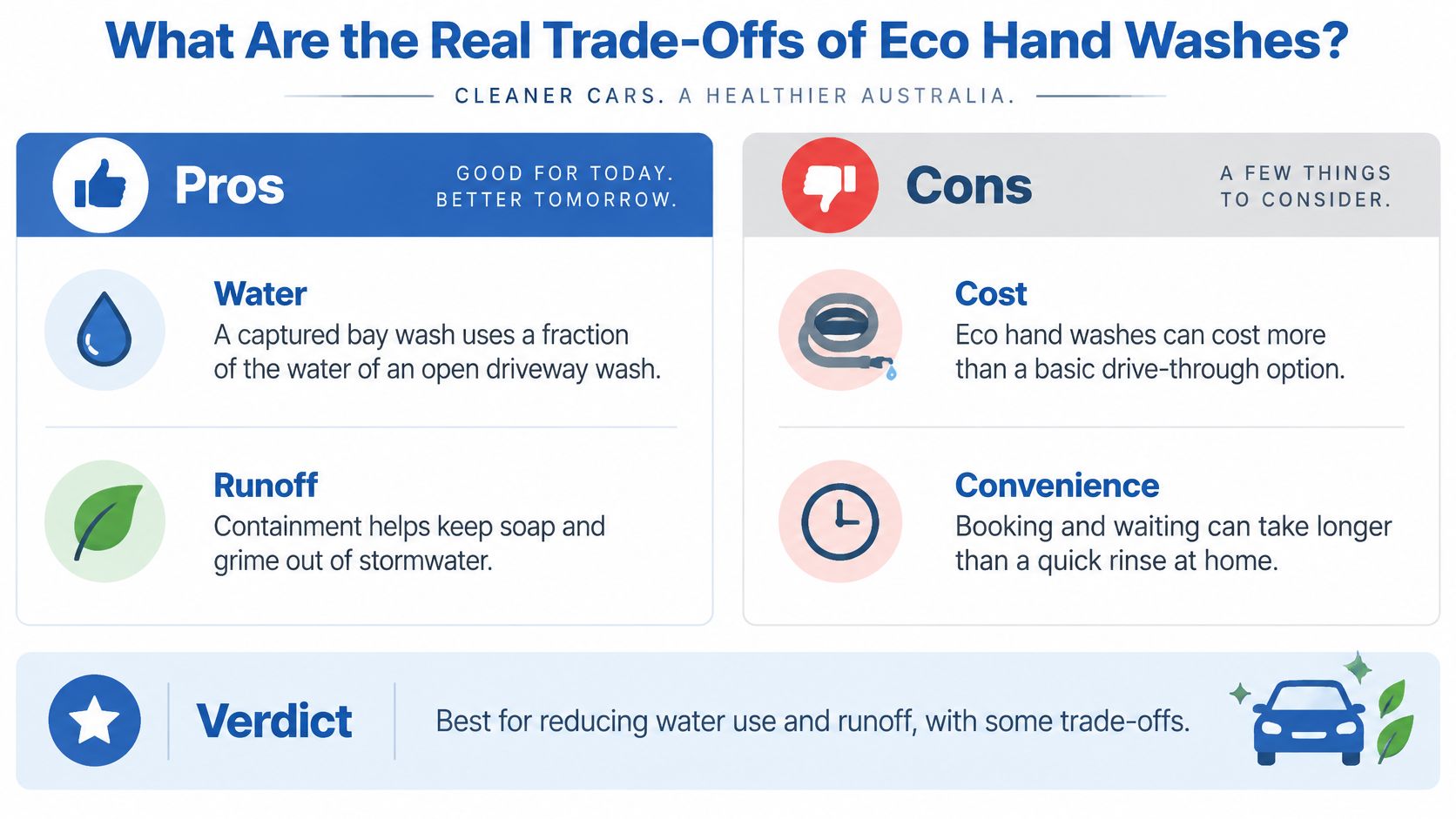
Eco hand washes can deliver genuine water and runoff advantages, but every benefit carries a cost somewhere else. Hand washing is a method of work; the result depends on how carefully the operator works. A careful operator protects paint. A dirty mitt still scratches it.
What are the benefits?
- Water control: A measured bay wash makes consumption easier to manage than an unrestricted hose wash.
- Paint care: Clean mitts, adequate lubrication and gentle contact avoid the machine-brush contact some owners prefer to exclude.
- Drying: Clean, absorbent towels or suitable air drying help remove water before it leaves visible marks.
- Wastewater management: Approved sewer disposal or treatment and recycling provide a managed alternative to uncontrolled runoff.
These benefits require working procedures, not an eco label on the reception counter. Staff need somewhere to put used towels, a clean supply of mitts and a process for checking contamination before touching the paint. The strongest sign is what happens to the washwater once it leaves the panel: a contained bay sending waste to sewer or recycling beats a low-litre wash that drains to the street.
Choose the process you can verify, including clean tools, controlled rinsing and careful drying.
What do you give up?
- Cost: Hand labour can make a careful wash more expensive than a basic automated option.
- Time: Inspection, wheel work, hand washing and drying can take longer than driving through a machine.
- Cleaning range: Waterless products are convenient for light contamination but unsuitable for heavily gritty surfaces.
- Technique tolerance: A dropped towel must leave service immediately; continuing to use it risks dragging grit across panels.
- Access: A convenient parking space isn’t necessarily a suitable wastewater-controlled wash site.
A hand wash also needs enough water and product to work safely. Chasing the lowest possible consumption can backfire if the operator wipes dry contamination or leaves cleaner behind. Efficient cleaning that protects the finish is the objective, measured by results on the panel rather than litres saved on a sign.
Where the washwater ends up is the trade-off that matters most to me. I’d accept higher water use at a contained site over a low-volume wash that discharges toward a stormwater drain, because the second option relocates the problem rather than solving it.
For timing, use the condition-based approach in our Perth car-washing frequency guide. Judge effectiveness by the result and the process: clean paint without avoidable abrasion, properly dried surfaces and managed waste.
Balance convenience against the work your car needs, and don’t trade containment for a quicker booking.
Worth paying for: Controlled work that suits the vehicle, not extra washing steps that don’t solve a problem.
Which Eco Hand Car Wash Should You Book?
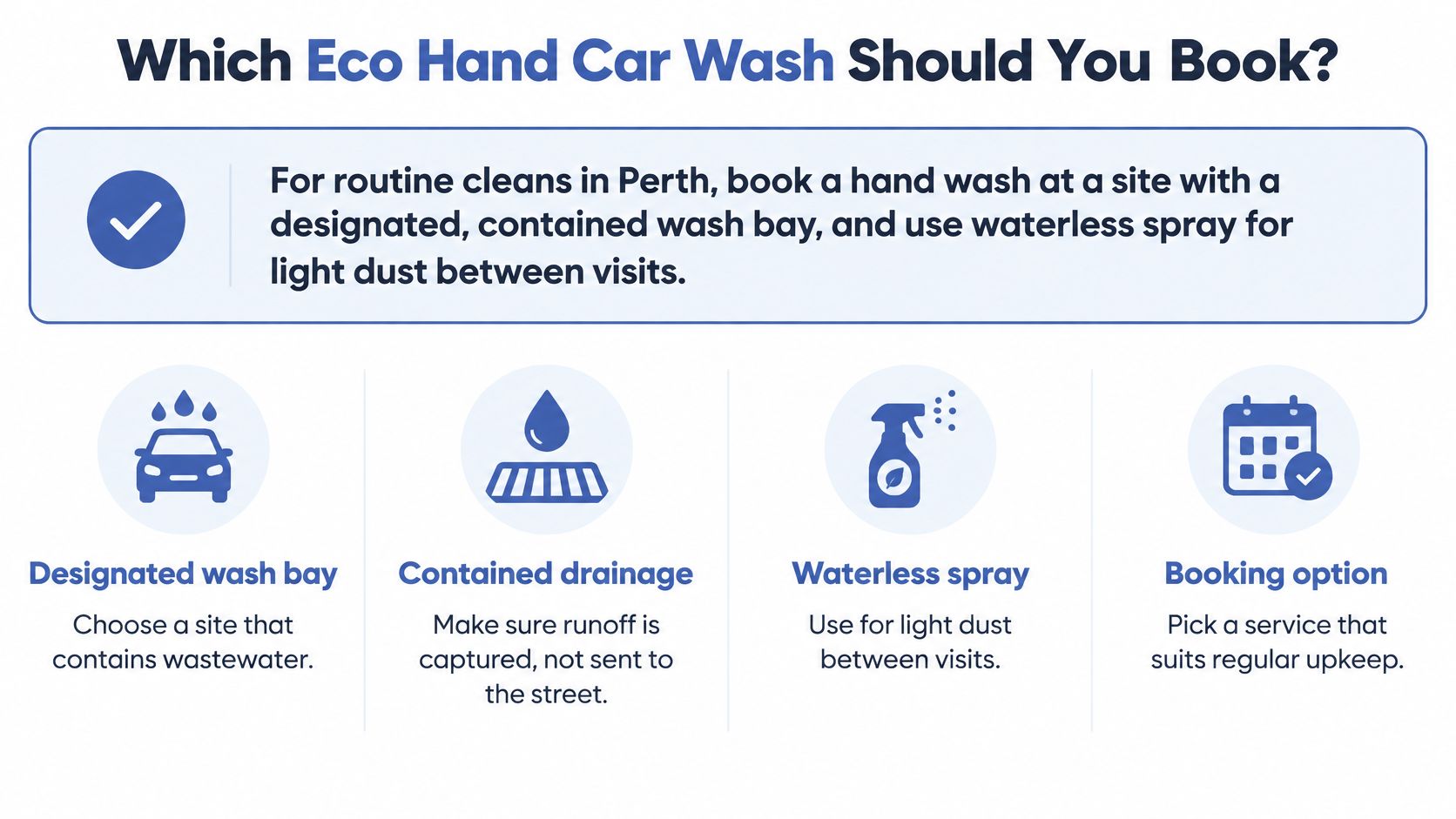
For routine cleaning in Perth, book a hand wash at a site with a designated, contained wash bay. Reserve waterless spray for light dust between visits. The soap in the bucket and the litres quoted matter far less than one question: where does the washwater go once it leaves your panels?
The NSW Environment Protection Authority says washing should be confined to a designated bay where wastewater is collected and directed to sewer under an approved trade-waste arrangement, or treated and recycled. It also says bays should be away from stormwater drains, drainage lines and water bodies. Although this is NSW guidance, it provides a concrete Australian benchmark for assessing a commercial washing process.
Confirm the drainage arrangement before booking a routine wash, especially if the service operates in an open parking area.
What should you establish before booking?
Where does the washwater go?
Look for a dedicated, preferably covered or bunded bay with collection drainage leading to approved treatment and sewer disposal, or treatment and recycling. An oil-water separator by itself leaves the question half answered: the operator should explain where its outlet discharges and how collected waste is maintained.Is the bay separated from stormwater drains and water bodies?
Check whether the bay’s grading and boundaries keep dirty water inside the collection area. A nearby drain is a warning sign if overspray or overflow can reach it.What detergent is used, and at what dilution?
The operator should name the product category and explain how concentrate is measured. Biodegradability describes the chemistry in the bottle; dosing accuracy, suitability for your finish and the path of the rinse water each need a separate answer.Is water measured per vehicle?
Metering lets the operator tell controlled consumption from guesswork. Read the figure against package type and vehicle condition, since a heavily soiled wagon and a lightly dusted sedan are different jobs.
Ask for clear operational answers rather than general assurances that the wash is eco-friendly.
How is the water supply controlled?
A bucket system or trigger nozzle stops water running while the operator does other work. Watch the transitions between rinsing, wheel cleaning and contact washing, where an unattended hose can waste water and add nothing to the finish.Will machine brushes touch the paint?
At Prime Shine Hand Car Wash, every car is hand-washed only, with no machine brushes touching the paint. That removes machine-brush contact from the wash, while clean tools and appropriate technique remain important.How will the car be dried?
Our Outside Car Wash includes careful exterior drying to finish the wash and reduce water marks. The outside car-wash service guide sets out the work involved before you choose the service.Are wheel and body tools kept separate?
Dedicated wheel brushes and mitts keep brake residue and coarse grit off the bodywork. Ask how wash media are cleaned or swapped between vehicles, since a mitt carrying grit from the last job undoes the benefit of careful hand work.
What should make you look elsewhere?
Treat washing done on a street, driveway or open lot with caution when no collection system is visible. Portable equipment can clean a vehicle effectively, yet a mobile hose still needs somewhere legitimate for the dirty water to go. A tidy van and pleasant-smelling detergent can sit alongside a discharge headed for a stormwater drain just as easily as a contained bay.
We provide hand car wash and detailing services in Westminster, Perth. Hand-only washing and careful drying are part of the published service; drainage, treatment and trade-waste arrangements are still worth confirming directly before you make an environmental judgement.
Confirm containment first, then select the wash that matches your vehicle’s condition.
The decision rule is straightforward: if a provider can’t clearly explain where wastewater goes and how it stays out of stormwater, look elsewhere. Once those answers are clear, compare the cleaning scope, paint-contact method and drying process rather than choosing by an eco label alone.
Prime Shine Hand Car Wash offers hand-only exterior washing and interior and exterior detailing in Westminster, Perth. Visit Prime Shine Hand Car Wash to choose a service for your vehicle, confirm the site’s wastewater arrangements and book once containment has been established.