






You’ve just finished washing the car, and it looks immaculate in the shade of the carport. Then you back it into the driveway, the low afternoon sun catches the bonnet, and the paint shows a fine web of lines that weren’t there a month ago. Nobody scratched it. It hasn’t been near a panel shop. It looks like someone took a scouring pad to the top coat and gave up halfway.
That web is what people are looking at when they search for what causes swirl marks on car paint. The answer rarely involves the paint failing or a bad batch at the factory. It’s the twenty minutes a week you spend washing and drying, repeated a hundred times, with a small amount of grit in the wrong place.
The uncomfortable part is where the damage lands. The drying stage dulls a finish faster than the wash itself, and in Perth it’s worse, because dust settles back onto the panels in the time between the final rinse and the first pass of the towel.
Book a hand wash at Prime Shine Hand Car Wash in Westminster and watch how the car is dried.
What Causes Swirl Marks on Car Paint?
Swirl marks are clusters of extremely fine scratches sitting in the top layer of the clear coat. They’re produced by grit being dragged across the paint by whatever touches it, whether that’s a wash mitt, a sponge, a drying towel, a brush or a polishing pad. Circular hand motion gets blamed, but the direction of travel matters far less than what’s trapped between the tool and the panel. RACV describes fine swirl marks as shallow scratches generally created when tiny dust or dirt particles are wiped across the bodywork during washing and drying, which is why the fix is a change of process rather than a change of wax.
Bring the car in for a hand wash and paint check if you want a second opinion on where the lines are coming from.
Seven habits account for almost every case, and each one leaves a signature on a different part of the car.
| Cause | How it creates swirls | Where it shows most |
|---|---|---|
| Dirty wash mitt or sponge | Trapped grit is pressed and dragged across the clear coat | Lower doors, rocker panels, rear bumper |
| Wiping dust off a dry panel | Loose particles move across paint with no lubrication | Bonnet, roof, horizontal panels |
| One contaminated wash bucket | Each dip of the mitt reloads grit onto the paint | Whole car, most visible on dark colours |
| Dragging a chamois or towel to dry | Residual grit is pressed in and pulled across the panel | Bonnet, boot lid, doors |
| Automatic brush washes | Brushes carry grit left by earlier vehicles | Whole car, especially the sides |
| Wheel-cleaning tools used on paint | Brake dust and road grit transfer to body panels | Panels behind the wheels |
| Dirty polishing pads | Residual grit becomes new scratches under the pad | The panel being corrected |
The pattern tells you which habit is to blame
Nearly every row combines two things: contamination and pressure. Remove either one and the scratch doesn’t happen. A mitt full of grit dragged with force cuts deep. The same mitt, rinsed and reloaded with soapy water, glides. Clean paint wiped with pressure survives because there’s nothing to cut with. Paint covered in road film and wiped dry doesn’t stand a chance.
The dirt responsible is usually too fine to see. You won’t spot the particle on the panel, which is exactly why the damage keeps happening to careful owners who believe their car is clean.
A useful diagnostic: swirls concentrated low on the doors, sills and rear bumper point to mitts, wheel tools and dirty water. A uniform web across the entire car that appeared after a period of tunnel washes points to brushes.
If the lines are localised, fix the tool that touches those panels. If they’re everywhere, the problem is upstream in the whole routine.
How Do Swirl Marks Form on the Clear Coat?
A dark sedan parked on a Westminster street for a week looks clean from three metres away. Walk around the front, crouch to bonnet height, and the sun shows a faint grey web radiating across the panel in every direction. Nothing has touched that car except air, dust and one wash.
The defect is easiest to see at a low sun angle, exactly like this:
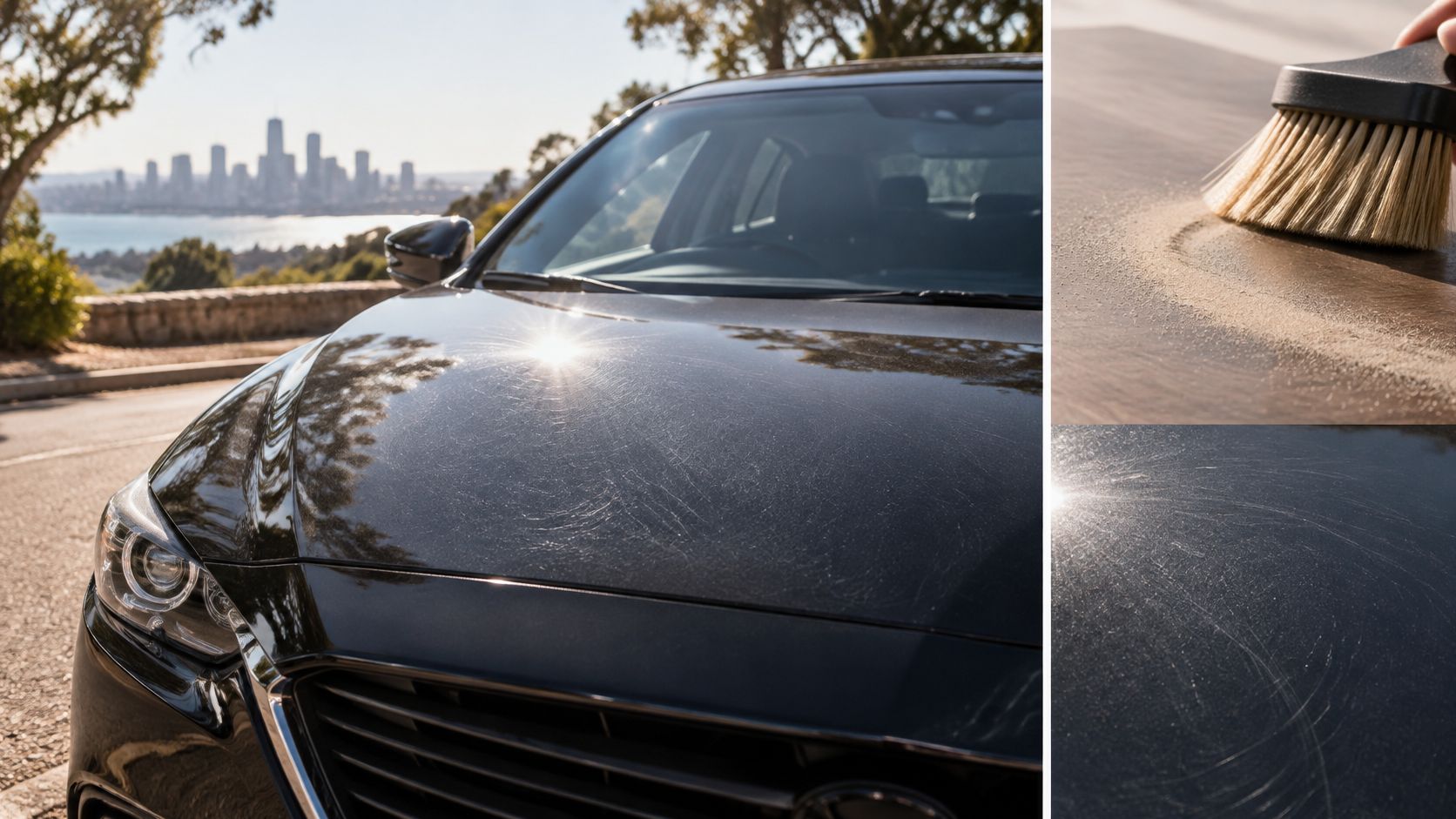
The damage is mechanical, not chemical. A particle of sand or road grit, small enough to be invisible on a black bonnet, gets caught in the fibres of a mitt or towel. The tool moves. The particle doesn’t slide, it cuts. Think of sweeping a tabletop with a cloth that has sand underneath it: the cloth glides, the sand carves a shallow curved line into the surface. One pass leaves one line you’d never notice. Fifty washes leave hundreds at slightly different angles, and the panel stops reflecting a clean image.
RACV’s guidance on swirl marks describes them as clusters of extremely fine scratches in the clear coat, usually produced by repeated friction rather than by circular washing motions, and names dust, road film, sand and other grit trapped in a sponge, mitt, brush, bucket, towel or drying cloth as the mechanism. It also makes the point that matters most for anyone deciding what to do next: swirl marks are an accumulated consequence of maintenance technique, not a defect the paint creates by itself.
Why lubrication changes everything
Each individual particle creates only a shallow scratch. What makes the damage visible is repetition, and what controls repetition is how well the panel is lubricated when the tool crosses it. A dry or lightly lubricated sponge, towel or chamois drags particles across the surface. A wet, soapy panel lets them slide.
Practical rule: if you can hear the towel, you’re scratching the paint. Drying should be almost silent.
This is why Perth cars suffer more than the same models in cooler, wetter cities. Dry, dusty conditions leave fine material on horizontal panels and lower bodywork between rinses, and every extra particle on the panel is one more cutting point during the dry.
Our Westminster site runs seven days a week, so you can book a wash around your own schedule.
Why Do Swirl Marks Show More on Older or Dark Paint?
Two cars can leave the same wash looking very different. The reason is the condition and colour of the paint. A fine wiping mark that disappears on a fresh, light-coloured panel can stand out sharply on older, darker paint.
Car paint is commonly built as a clear coat over a coloured base coat over primer, with the clear coat generally about 30 to 40 micrometres thick, as Australian clear-coat research sets out. That research also analyses 71 clear-coat samples from American and Australian automobiles and confirms that Australian vehicle coatings have measurable, material-specific characteristics. In practical terms, age and exposure change how the surface reflects light, which changes how obvious fine scratches appear.
Ask for a paint assessment at Prime Shine Hand Car Wash before committing to polishing an older finish.
What UV does and what it doesn’t do
UV light breaks down the clear coat over time. It degrades and embrittles the protective film, so the coating resists repeated micro-abrasion less well than it did when it was new. The scratches themselves still come from contaminated contact. Keeping those two mechanisms separate helps an owner choose the right fix, because wax and sealant can add gloss and protection but will not remove a scratch, and polish cannot reverse sun damage to the polymer.
Perth’s sunlight and outdoor exposure add to that ageing process. A panel parked outdoors collects dust and grit, and heat and UV exposure leave the clear coat duller and less reflective over time. Cars kept under cover usually keep a cleaner, more even finish because they spend less time exposed to that combination. The practical issue is that a weathered surface shows the marks left by washing and drying more readily, especially when dust settles between the final rinse and the towel.
Colour changes how visible a scratch is, not how durable the paint is. Dark and black finishes show fine lines most clearly because reflected light breaks across the mark and contrasts with the deep surface. White and silver finishes scatter light in a way that hides many fine lines at normal viewing angles. The paint underneath may have taken the same contact, but the eye reads it differently.
Three practical implications follow:
- Inspect before you polish. Look at the panel under direct sun and under a bright torch at an angle. A hazy, chalky surface is weathering, not just swirls, and it needs a different approach.
- Don’t cut aggressively into weathered panels. Thin, oxidised clear coat has less material to give, and machine polishing removes material permanently.
- Reduce the need for abrasive cleaning. Protection that sheds dirt means fewer washes with pressure, and fewer washes means fewer opportunities for grit to cut. A ceramic coating that resists light scratching is worth considering for exactly this reason, as long as you understand it slows the problem rather than ending it.
How Can You Wash and Dry a Car Without Creating Swirls?
A careful hand wash can still leave swirls if the drying stage adds pressure over grit. Blotting or patting with a clean, suitable microfibre towel is different from wiping, because the pressure goes down rather than across. Hand washing alone does not guarantee a swirl-free result. The drying sequence matters just as much as the wash.
Washing frequency also sets the amount of abrasive material on the paint between washes. RACV’s advice on protecting car paint recommends washing about once a week to remove dirt, grime and grit that otherwise sit on the surface. It also points to mild car shampoo, a soft sponge or microfibre cloth and thorough drying, while warning against abrasive cleaners and scrubbing brushes. Weekly and gentle beats monthly and aggressive.
Book a hand wash at Prime Shine Hand Car Wash if you’d rather someone else handled the rinse and dry sequence properly.
A wash sequence that keeps grit off the paint
Order matters more than products. Work through these seven steps and each one closes a route for grit to reach the clear coat.
- Rinse top to bottom before any contact. Loose dust, sand and road film come off with water pressure alone. Every particle removed here is one that never gets dragged.
- Set up two buckets plus a grit guard. One holds suds, one holds rinse water, and the guard traps grit at the bottom of the wash bucket so the mitt does not pick it back up. The two-bucket method that prevents swirls is a low-cost change for anyone washing at home with a bucket and mitt.
- Wash in sections from the roof down. Use a soft mitt or microfibre cloth with plenty of mild shampoo and minimal pressure. The roof and upper panels are the cleanest part of the car, so they get the cleanest mitt.
- Rinse the mitt after every panel. Dip it in the rinse bucket, wring it out, then reload with soap. A mitt that goes back to the paint loaded with grit undoes the last panel’s work.
- Leave wheels and lower panels until last. Brake dust and road grit are the most abrasive material on the car, so use dedicated wheel tools and never take them back to a body panel.
- Rinse the whole vehicle again. Soap residue and loosened grit need to go down the drain rather than into a drying towel.
- Dry by blotting, not wiping. Lay a clean, high-absorption microfibre towel on the panel, press gently, lift, and move to a clean face. Drag lines are the giveaway that the towel has travelled across the paint.
If the paint already looks hazy in the sun, book a wash with Prime Shine Hand Car Wash and ask us to look at the panels during the dry.
The Perth gap between the final rinse and the towel
In Perth, the final rinse and the first towel pass are separated by a real exposure window. A dry week leaves fine dust on the driveway, panels and open door shuts, and a wet surface catches whatever settles during that pause. One sentence is enough to describe the risk: that drying-stage dust is what turns a soft towel into an abrasive one.
Shed the bulk of the water before the towel touches the paint. Use gravity first: keep the car in shade if possible, rinse from the roof down, let water run from the bonnet, glass and panels, then use a controlled final rinse to break the remaining sheet into droplets. Start drying at the roof and glass, then work down to the sills and bumpers. Use a separate towel for wheels, tyres and door shuts. Two or three towels for a sedan is a practical floor, not a luxury, because a damp towel loses efficiency and gets swapped too late.
The drying rule: if the towel feels damp or gritty, take it off the paint. Swap to a fresh one and keep the used towel away from panels it has already touched.
The slips that undo a good wash are almost always at the end:
- Reloading a dirty mitt because the rinse bucket felt like an extra step.
- Washing wheels first, which loads the wash water with brake dust before it ever touches the bonnet.
- Reusing the wheel towel on door panels because it was already in your hand.
- Dropping a towel on the driveway and carrying on. Grit from concrete does not rinse out in the bucket.
Success looks unremarkable. Water sheets evenly off the paint, the towel comes away clean after each panel, and there are no drag lines where the towel travelled. Nothing dramatic, which is the point.
Swapping an automatic wash for just any hand wash is not automatically an upgrade. A hand wash done with one bucket, a gritty chamois and a dragged towel can still mar paint. Prime Shine hand-washes every car with no machine brushes touching the paint, and careful exterior drying finishes the Outside Car Wash to reduce water marks. That control at the drying stage is the difference that matters.
Can Swirl Marks Be Removed or Only Reduced?
Most swirl marks can be reduced, and light ones removed, with a polishing compound, a cutting compound, or a combination of both. NRMA’s guidance on clear-coat scratches explains that defects confined to the clear coat generally respond to these abrasives, which is why ordinary swirls and deeper damage need to be treated as different problems.
Polishing works by levelling the damaged surface so light reflects evenly again. Polishing levels the surface by removing material around the scratch. The clear coat is a finite layer, so every correction spends some of that remaining depth. In my judgement, two or three careful corrections is a realistic limit over a paint’s life. A machine polish every year is not.
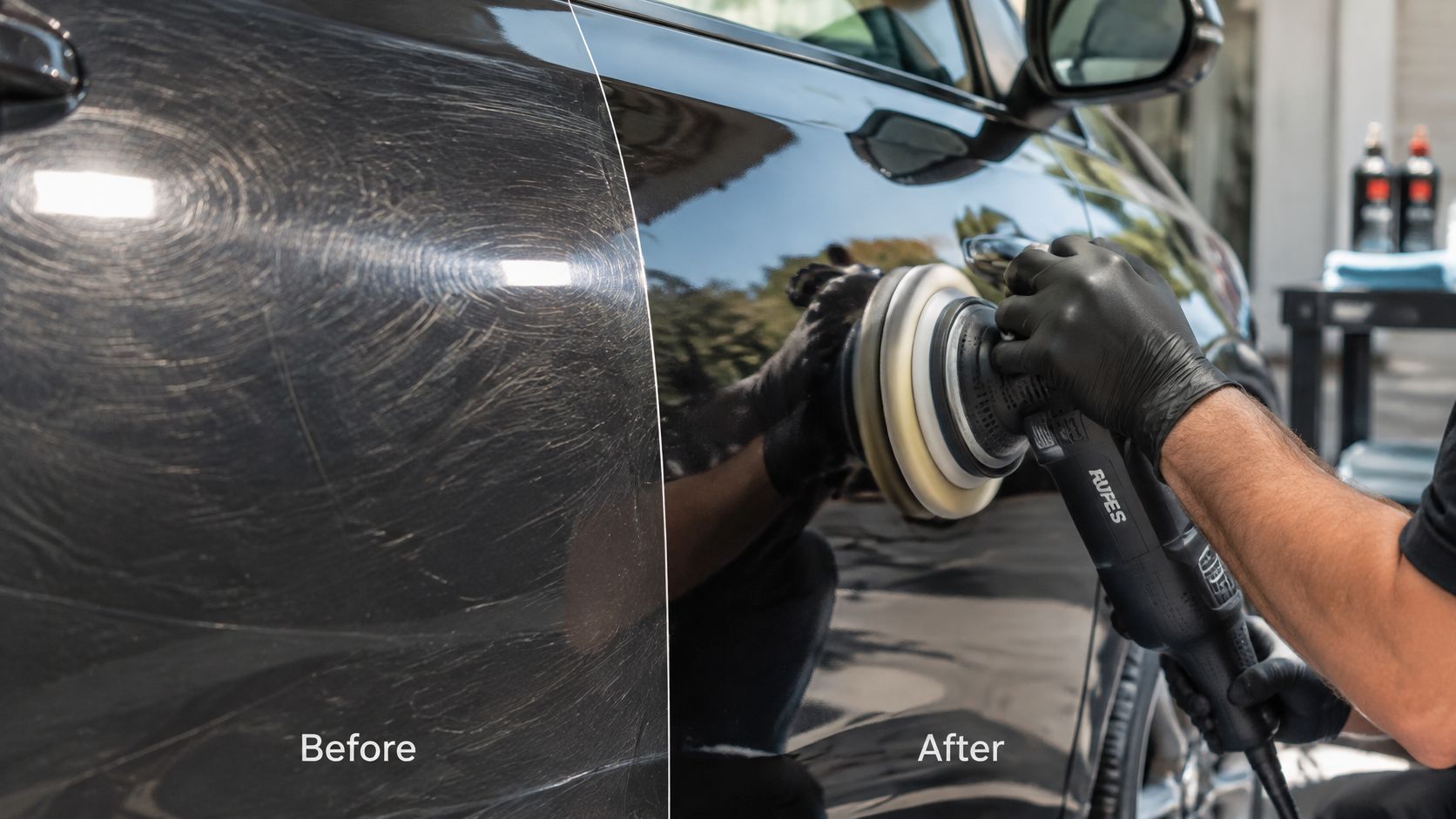
The surface has to be clean before a pad touches it. Grit left on the paint becomes fresh scratches under the polisher faster than the abrasive removes the old ones. Decontamination comes first, and a wash is part of that preparation. Perth dust left between the final rinse and drying is a good example: once it is dragged across the panel, correction becomes a deeper decision than it needed to be. Careful hand washing reduces that risk because every car is hand-washed only at Prime Shine, with no machine brushes touching the paint.
Matching the defect to the correction
| Defect depth | Approach that fits | Realistic outcome |
|---|---|---|
| Light haze visible only in direct sun | Clean the surface, then a fine polish by hand or machine | Gloss restored, most swirls refined |
| Fine web of swirls across panels | Compound followed by a finer polish, with clean pads | Most swirls reduced; repeated sessions thin the clear coat |
| Scratches that catch a fingernail | Cutting compound after a professional depth check | Partial improvement; some marks may remain |
| Peeling or failed clear coat | Polishing is not suitable | Needs refinishing; polishing cannot repair it |
Get a clear-coat check at Prime Shine before you buy a compound.
The fingernail test gives you a practical first read. Run a nail across the mark, perpendicular to it. If it glides over, the defect is likely in the clear coat and correction has a good chance. If it catches, the scratch may have gone through to the base colour or primer, and polishing alone may leave some trace behind.
Correction also has a maintenance consequence. Cut & Polish restores paint and removes scratches, while a hand wax and polish enhances shine and helps protect the exterior paintwork. Ceramic coating resists light surface scratches and swirl marks, though it does not make a car fully scratch-proof or chip-proof, and it does not replace clear bra or paint protection film for stone chip resistance. That means correction gets the finish back, but drying habits and protection decide how quickly light swirls return.
A professional assessment is worth the fee when swirls are dense across several panels, when scratches catch a nail, or when the paint is dark and heavily weathered. A detailer can check defect depth and clear-coat condition before deciding how much correction is safe, because that decision protects the paint’s remaining life. Paint correction done without damaging the clear coat is a matter of sequence and restraint, not aggression.
Should You Book Professional Paint Correction in Perth?
A clear-coat check should come before any compound touches the paint. Light haze seen only in direct sun can often be refined with a careful wash, clean tools and a fine polish. Dense swirls across several panels need a more controlled approach. So do scratches that catch a fingernail, dark paint that shows every defect, and weathered panels where the remaining clear coat is thin. The aim is to remove the least paint needed to improve the finish, because correction always trades a small amount of clear coat for a clearer, glossier surface.
At Prime Shine Hand Car Wash in Westminster, every car is hand-washed only, with no machine brushes touching the paint. Cut & Polish restores paint and removes scratches, while professional-grade products and careful hand techniques protect the paint and restore shine. Ceramic coating resists light surface scratches and swirl marks, but it does not make a car fully scratch-proof or chip-proof. It also does not replace clear bra or paint protection film for stone chip resistance.

Before booking correction, ask two practical questions: how deep the defects go, and how the car is dried after washing. Perth dust can settle between the final rinse and drying, and dragging that grit across the panel is a common way fine swirls return. Careful exterior drying helps reduce water marks, but the drying method also matters if you want the correction to last. Book online at Prime Shine Hand Car Wash, describe what the paint looks like in direct sun, and have the clear coat checked before choosing a correction level.