






You washed the car on Saturday. By Wednesday, the front wheels are wearing a grey-brown film again, and a plain rinse won’t lift it. That film is brake dust, and on a car doing short suburban runs around Perth it comes back faster than most owners expect. The instinct is to reach for the strongest bottle under the sink and scrub hard. That’s the move that turns a five-minute job into a refinishing bill, because alloy wheels aren’t a single material. Under a similar-looking silver surface you might have clear coat, paint, bare polished aluminium, an anodised layer or a ceramic coating, and each one tolerates different chemistry.
Getting how to clean alloy wheels right starts with one decision most guides skip: what the wheel is finished with. The finish sets the product, the tool, the dwell time and the temperature you can safely work at. Everything else is repetition.
Which Cleaner Suits Your Wheel Finish?
Treat “alloy wheel” as a description of the metal, not a care instruction. A cleaner that safely strips years of dust off a painted wheel can dull a polished face, and the acid brightener sold for bare aluminium will attack an anodised layer without hesitation. The finish decides the product, and the product never gets to overrule the finish.
A generic wheel cleaner is the default in most how-to advice, yet the safe method depends on whether your wheel carries clear coat, paint, polished aluminium, anodised sections or an aftermarket coating, as Sunshine Coast Council’s smart car washing guidance sets out. That same guidance makes two practical points worth borrowing: work one wheel at a time, and keep wheel tools separate from bodywork tools so metallic dust never migrates to your paint.
Before you spray anything: identify the finish, then pick the chemical. If you can’t identify it, treat the wheel as delicate until a test patch proves otherwise.
Match the product to the coating, not the shine
| Wheel finish | Safe cleaner and tool | Avoid |
|---|---|---|
| Painted or clear-coated | pH-neutral wheel cleaner and soft brush | Steel wool, scouring pads, abrasive brushes |
| Polished aluminium | pH-neutral cleaner, microfibre and light sealant | Household scourers and strong acids |
| Anodised | Mild detergent and clean water | Abrasive cleaners and caustic soda |
| Ceramic-coated | pH-neutral shampoo and soft microfibre | Automatic brushes and harsh alkaline cleaners |
| Raw or uncoated aluminium | Mild detergent, prompt rinse and immediate drying | Acids and chloride-rich household products |
Anodised wheels deserve their own warning. Australian aluminium industry care guidance warns that abrasive cleaners and materials can severely damage anodised surfaces, and the same document is blunt about caustic soda, which reacts vigorously with aluminium. No scouring powder, no oven cleaner, no improvised chemistry on a finished rim.
Raw or uncoated aluminium, common on older 4WD and trailer wheels, has no clear coat doing the protecting. Mild detergent, a prompt rinse, immediate drying, and nothing acidic or heavy in chlorides.
When the finish is unclear: read the owner’s manual or the manufacturer’s care sheet before you buy anything. A two-minute test patch tells you more than any label claim.
Coated wheels narrow the choice further again. If your rims carry a ceramic layer, what ceramic coating on rims does and how long it lasts explains why the coating changes both the cleaner you should use and how often you need to be under the arches.
Explore ceramic coating for rims
How Do You Clean Alloy Wheels Step by Step?
Order of work matters more than brand loyalty. Nearly all finish damage I’ve had to assess comes from three things: heat, contact made while grit is still on the surface, and cleaner allowed to dry before it’s rinsed. Fix those three and a basic pH-neutral product out-performs an expensive one used badly.
The cold-wheel test, before step one
If you don’t know the finish, test it somewhere nobody looks. Choose a concealed spot, the inner barrel or the lip behind a spoke, apply a small amount of your chosen pH-neutral cleaner and leave it for one to two minutes without letting it dry. Rinse, then inspect under good light for haze, dulling or a colour shift. Unchanged means carry on with the full routine. Marked means move to a milder product or stop and confirm what the finish is.
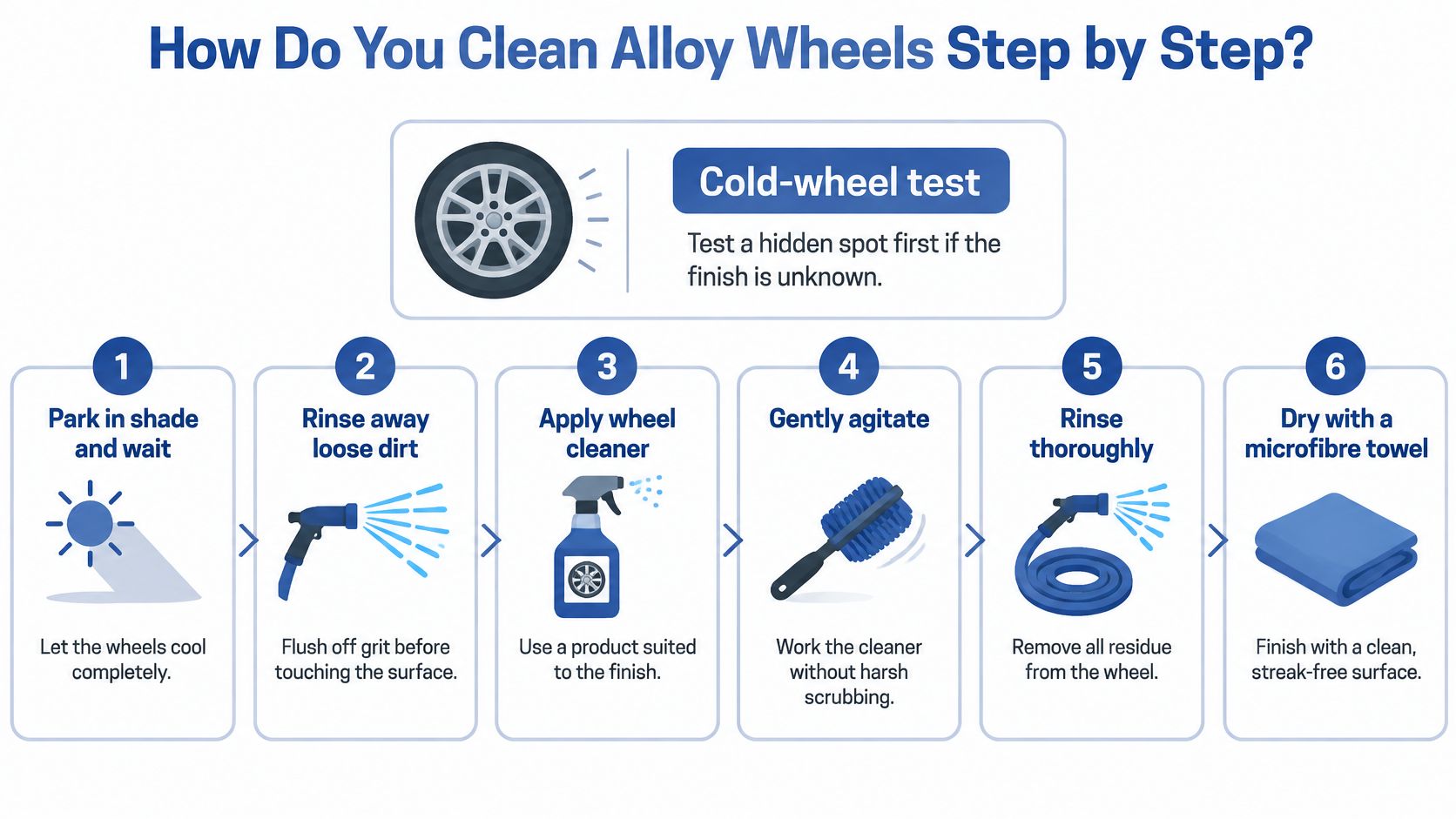
The routine in full, in the order that works:
Park in shade and let the wheels cool. Heat does the damage here; cleaning products dry on heated metal and leave spotting or uneven marks, which is why Performance Wheels Australia’s care guide recommends washing only once the wheel has cooled fully and preferably in shade. Twenty to thirty minutes after a drive is usually enough.
Rinse from the top down before touching anything. You’re flushing loose grit and the loose fraction of the dust so a brush never drags sand across the face.
Apply a pH-neutral wheel cleaner and keep it wet. Bendix’s brake dust cleaning guidance specifies a dwell of about one to two minutes, gentle agitation with a soft-bristle brush or microfibre, then a full rinse, and notes that heavy accumulation may need a second application. Two short applications beat one long soak every time.
Agitate with a soft wheel brush, one wheel at a time. Work behind the spokes, around the hub and into the inner barrel. Keep the wheel bucket, brush and mitt separate from the bodywork set, following the two-bucket method that prevents swirls, so metallic dust never ends up in the mitt you use on paint.
Rinse until no film remains. Cleaner left sitting in spoke recesses or around the valve dries into a haze that looks like damage.
Dry immediately with a clean microfibre towel. Water left in the gaps spots as it evaporates, and a dedicated wheel towel keeps the grit off your drying cloth.
Inspect the face, spoke gaps, valve stem and lip before you move on. A stone chip or kerb scuff caught now is a cheap fix. The same defect found in three months is a refinish.
Quality check: the wheel should feel smooth with no gritty residue, no cleaner film and no dust packed at the spoke bases. Run a clean towel across the face. If it glides without catching, the job is done.
If the towel snags, repeat the gentle cycle rather than reaching for a stronger chemical. Abrasion is the one thing you can’t undo.
Explore the two-bucket hand-wash method
How Do You Remove Baked-On Brake Dust?
You follow the routine, the wheel dries, and the surface still feels like fine sandpaper. The black dust has gone but orange-brown speckles stay in the clear coat. That’s embedded ferrous contamination, particles from pads and rotors that have bonded into the finish, and no amount of extra scrubbing will shift it.
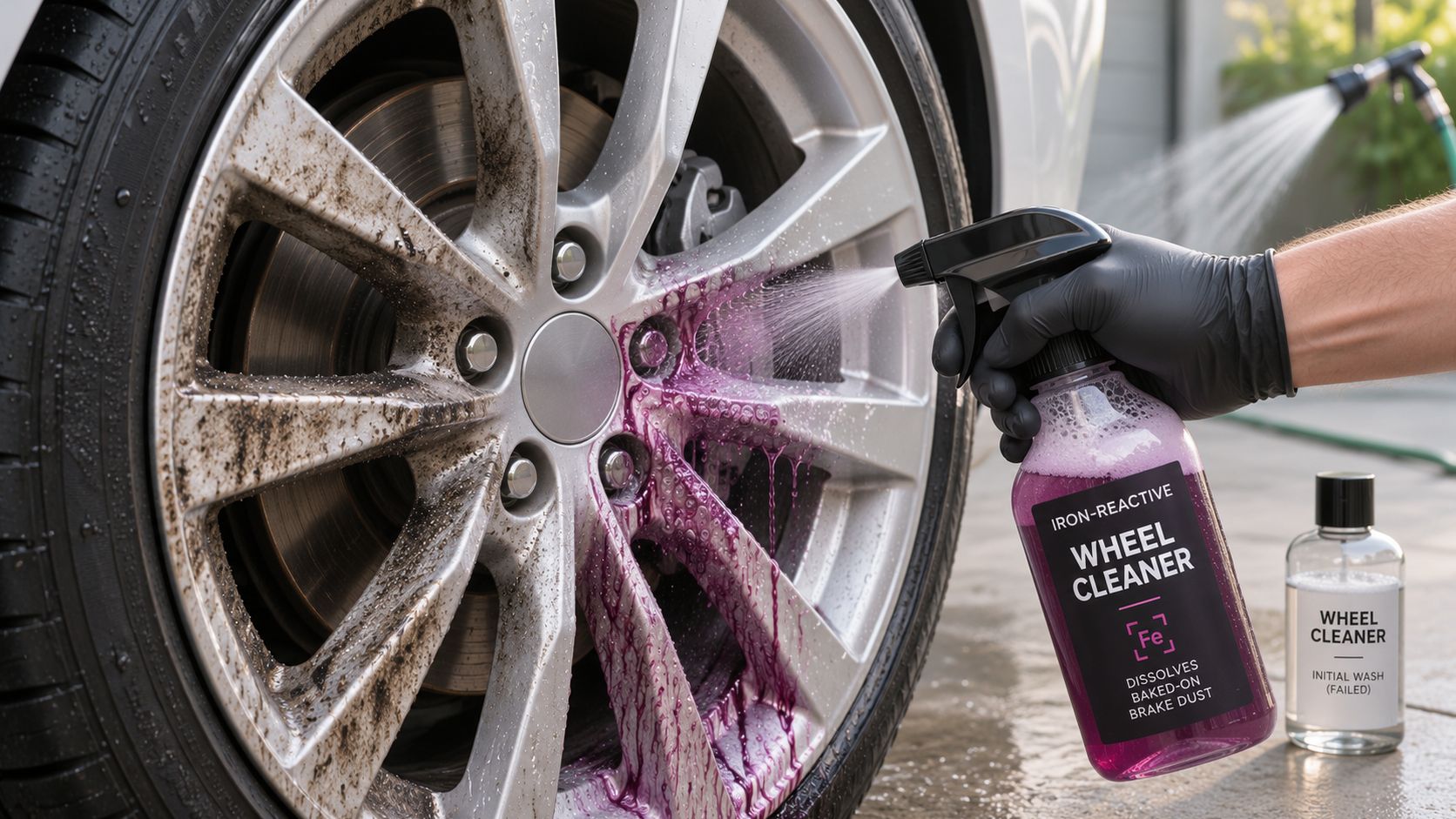
The method changes rather than the effort. Rinse loose grit away, then apply an iron-reactive cleaner to a cool wheel and keep it wet for roughly two to five minutes, according to The Detail Market’s alloy wheel cleaning guide. Many of these formulas turn purple or red as they react with ferrous particles, which is a visible signal the contamination is dissolving rather than being sanded off.
The order for an iron-reactive clean
Rinse first, apply to a cool wheel in shade, hold the dwell while it stays wet, agitate gently with a soft brush, rinse completely, then dry. The colour change is your progress indicator, not a cue to scrub harder.
Dry methods have no place here. Motor Trade Association waste management guidance recommends a damp cloth or a mist-spray vacuum for brake dust work instead of compressed air, with collected dust sealed in a container so it can’t go airborne. Fine metallic particles blown off a dry wheel end up in the air you’re breathing.
Stop rule: if a wheel still feels rough after two gentle cycles, stop and assess for bonded contamination or coating failure. Escalating to harsher chemistry at that point removes finish, not dirt.
For the stubborn remaining cases, the next steps are detailing clay or a light machine polish, both of which remove a trace of surface material and belong in a detail rather than a wash.
Explore hand detailing options
What Damage Should You Check for After Cleaning?
The inspection gets skipped because the wheels look clean and the job feels finished. It’s the most useful thirty seconds of the whole process. Brake dust gathers inside the rim, behind the spokes, around the inner barrel and near the wheel nuts, and the wheel cleaning guide from Speedy Wheels recommends reaching those concealed areas with a soft or flexible brush because trapped dirt and grime hold moisture and speed up corrosion. Its drying advice matters just as much: dry each wheel with a dedicated clean microfibre to cut water spotting and expose clear-coat failure, corrosion around the centre cap, stone chips and kerb damage.
What the marks are telling you
Most of what you’ll find falls into a short list, and the fix differs by symptom. Work through the wheel face, the spoke gaps, the inner barrel, the lip, the centre cap and around the valve stem under good light, then match what you see to the cause.
| Symptom | Likely cause | Fix |
|---|---|---|
| Powdery white oxidation | Corrosion from salt, chloride or trapped moisture | Clean gently and seek refinishing if the surface has pitted |
| Bubbling or lifting clear coat | Trapped contamination or heat damage | Stop abrasive cleaning and have the finish assessed |
| Dull or hazy film after drying | Cleaner dried on a warm wheel or hard water residue | Rinse fully and clean in shade |
| Water spots in spoke recesses | Water left in gaps after rinsing | Dry spokes with a dedicated clean microfibre |
| Pitting along the rim edge | Kerb damage or embedded iron | Iron-reactive clean, then repair if pits persist |
| Staining around the valve stem | Trapped moisture and residue | Clean the valve area separately and dry thoroughly |
Practical rule: if the finish is lifting or bubbling, repeated cleaning won’t improve it. Every further wash cycle removes a little more of what’s left.
Accumulated brake dust contributes to staining, pitting, peeling and corrosion, especially when moisture sits trapped in road grime, and once particles have bonded, ordinary washing stops being enough, as this alloy wheel maintenance guide for Australian weather notes. That’s the line between a mark that cleaning improves and damage that washing can’t reverse.
See when to book a professional detail
How Often Should You Clean Alloy Wheels?
The wheels looked clean when you parked. A week later a thin grey veil is back on the front rims, and it’s always worse on the front. That’s normal. The front wheels do more of the braking work and collect the dust the rear wheels never see.
For ordinary city driving, a gentle wheel wash every 7 to 14 days keeps deposits from baking on, and that’s the interval Alcoa Wheels Australia’s wheel care guidance lands on, recommending a mild pH-neutral soap, clean water, cool wheels, a soft brush or microfibre, and a thorough rinse. The same guidance flags the mechanism behind most avoidable marks: cleaning products dry on heated metal and leave spotting or uneven finish. Shorten the interval after beach exposure, heavy rain, dusty roads or visible build-up.
| Driving condition | Suggested interval | Why the timing changes |
|---|---|---|
| Ordinary city commuting | Every 7–14 days | Brake dust builds steadily and should be checked at each wash |
| Beach, coastal spray or heavy rain | Within 3–7 days of exposure | Salt and chloride accelerate corrosion on aluminium |
| Dusty unsealed roads | Every 5–7 days | Grit can scratch the finish if it isn't rinsed off first |
| Rideshare, delivery or fleet use | Weekly | Frequent braking produces heavier dust build-up |
| Before sale or lease return | Before inspection | Baked-on dust creates a poor first impression |
Six habits that stretch the interval
- Rinse with plain water after a coastal drive. Ten minutes with a hose before salt dries on the rim is cheaper than any restoration.
- Park in shade, not in full midday sun. Cleaner that dries before it’s rinsed leaves marks you’ll chase for months.
- Keep wheel tools separate. One brush, one mitt and one towel that never touch bodywork.
- Rinse wheels before the body. Metallic dust stays on the ground instead of the panels.
- Use a wheel-safe protection matched to the finish, then reapply on the manufacturer’s schedule. It makes the next clean easier without changing the chemistry you’re using.
- Skip washing in direct midday sun. If the cleaner can’t stay wet for its dwell, the conditions are wrong, not the product.
Simple check: if dust is visible on the face at your next wash, the interval is too long for the way that car is used.
Our Perth conditions add their own schedule pressure, and how often you should wash your car in Perth sets the wider rhythm so wheels and paint fall into the same routine.
When Should You Book a Professional Wheel Clean?
Routine cleaning inside the interval stays DIY. The jobs that need a professional start at a clear line: the finish is already lifting or bubbling, white oxidation or pitting has appeared along the rim, brake dust won’t shift after a correct iron-reactive treatment, or the car is heading to a sale or a lease return. Those are condition problems, not dirt problems, and stronger chemistry at home makes them worse.
Ask three questions before booking anywhere: Are the wheels washed by hand rather than by machine brush? Is an iron-reactive treatment included when the surface needs it? Does anyone inspect the finish and report damage before work begins?
The second question is the one that separates a quick shine from a proper clean. Iron-reactive work and clay or polish are the deeper operations that address contamination bonded to clear coat, and a provider who can’t describe the difference isn’t doing them. Our Outside Car Wash includes a hand wheel clean and tyre shine, nothing in our process goes near a machine brush, and the finish is checked as part of the job.
Before you book, set the reminder for the next interval so the routine doesn’t collapse back into annual panic cleaning. If any symptom from the post-clean damage check is on your wheels, book it in rather than buying another product.
For a fuller picture of which service suits a car that’s been neglected, what to book in a hand car detailing in Perth and why walks through the levels from a maintenance wash to full correction.
Bring the car to Prime Shine Hand Car Wash at 9/436 Wanneroo Rd, Westminster and we’ll match the cleaner and method to your wheel finish before anything touches the rim. Every vehicle is hand-washed with no machine brushes on the paint, and our Outside Car Wash from $29 includes a wheel clean and tyre shine. Book a slot online at Prime Shine Hand Car Wash and we’ll take the dust off properly, so the finish stays intact.