





You washed the roof first because the panel looked filthy, and the paint was already hot. The towel you grabbed still held grit from the last car. Three hours later the polish was done, and the bonnet wore a fresh field of swirls that were not there at breakfast. That is the failure a car detailing checklist is meant to stop, and the order is the part that does the stopping.
Contamination moves from the dirty surface to the clean one. It never moves the other way without you dragging it there. Wheels throw brake dust onto arches. A dry mitt grinds sand into clear coat. A protectant locks that sand in place. Polish on bonded iron cuts the iron and the paint together. If you reverse any of those pairs, the later step damages what the earlier step was supposed to protect.
This sequence is built on that risk, not on what is convenient to reach with a hose. Eight steps cover assessment, wheels, the wash, decontamination, correction, protection, the interior, and handover. Each one earns its place by making the next step safe. On a clean commuter you can stop early. On a neglected car you cannot skip the step that is holding the grit.
Australian households had an average of 1.8 motor vehicles per dwelling in 2021, according to the Australian Bureau of Statistics. Most of those cars are daily tools, not garage queens. A brand-colour button after the next few paragraphs is there for the step you would rather hand to us than do on the driveway.
1. What Should You Check Before Any Wash Mitt Touches the Paint?
Start with the car in front of you, not with a bucket. Australia had 22.3 million registered motor vehicles as at 31 January 2025, up about 2.6% on the year before, and drivers covered an estimated 264 billion vehicle kilometres in 2024–25, on the Bureau of Infrastructure and Transport Research Economics figures. A Westminster commuter, a rideshare car and a car that sits all week do not carry the same film, so the checklist opens with identification and a written condition check.
Walk the body in natural light before the panel is wet. Note road film, insect residue, brake dust, tar, mud, water spotting and paint defects. Inside, note dust, food debris, odour, pet hair, stains, leather condition and whatever is loose in the boot. Photograph every side, plus close-ups of chips and deep scratches, so a mark found at handover is not blamed on the wash.
Clear-coat thickness and finish type decide the products. Gloss paint can take a pH-neutral shampoo and, later, a light polish. Matte, satin and vinyl wrap cannot. A ceramic coating or paint-protection film already on the car changes the chemical you are allowed to use. Ask the owner before you assume the panel is bare clear coat. Heavily caked mud needs a pre-rinse and loose-grit removal before any mitt, or the wash itself becomes the scratch.
Say the upper panels of a Perth commuter are faded and the lower panels are only dusty. That car needs decontamination and a protection decision, not a full machine cut on healthy clear coat. A car going to sale photos is different. It may need a correction assessment, interior extraction and a high-gloss finish, and the inspection is what tells you which of those is real work rather than an upsell.
This infographic is the inspection order we use before shampoo touches paint.
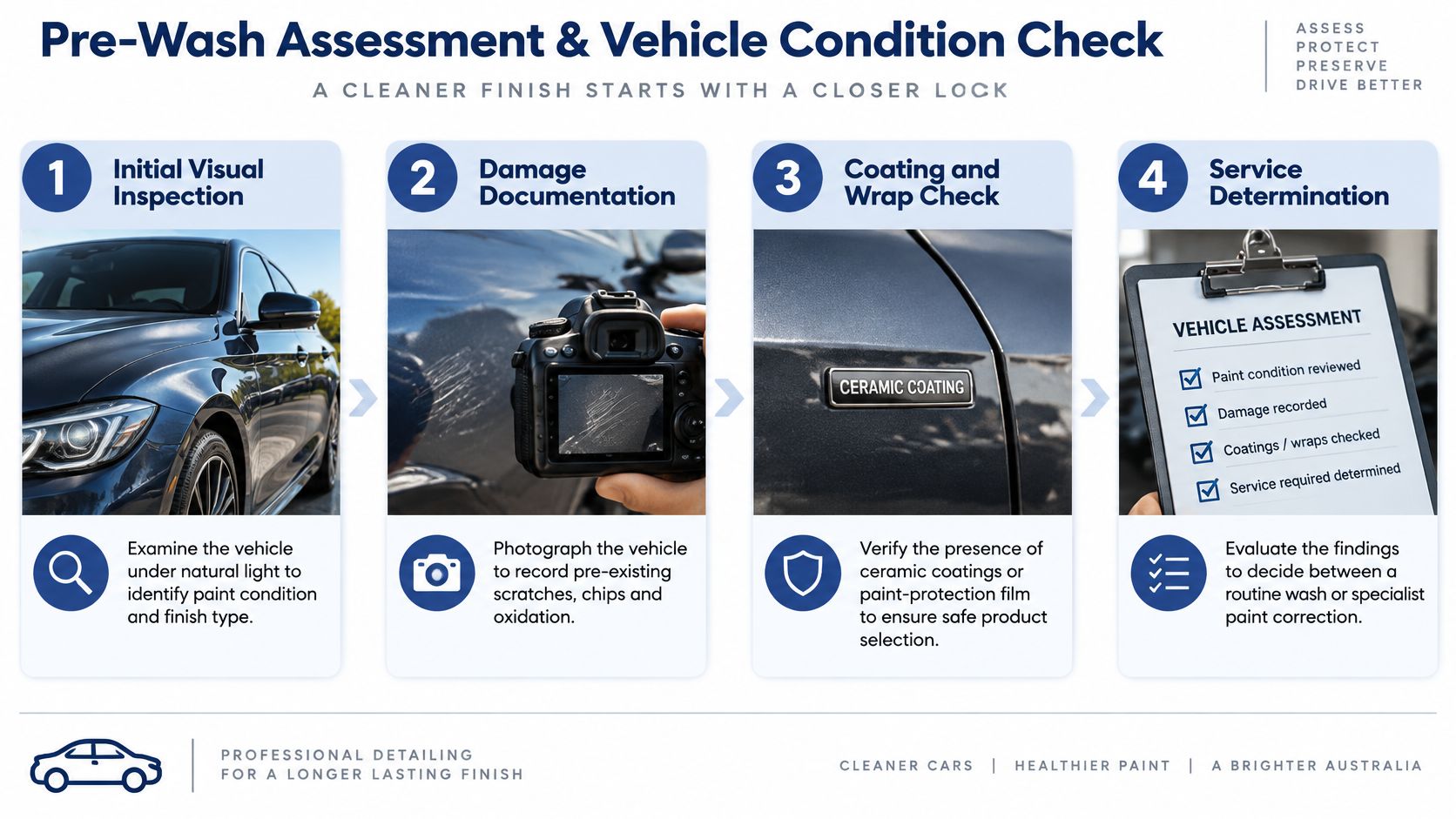
What the inspection lets you skip
Practical rule: If the paint is smooth, the coating is intact and the owner only wants road film gone, do not sell a polish. Flag peeling paint, deep scratches and damaged film for a panel shop, not a pad.
- Photograph first: Four sides, roof if you can see it, and any chip you would argue about later.
- Ask about film and coating: Wrap, paint-protection film, ceramic coating and aftermarket aero all change the chemical and the pressure.
- Match the complaint: Fix the water spots they hate before you chase swirls they cannot see.
- Write the baseline: Selected services and excluded defects go on the same sheet as the photos.
Book a condition check before the wash
2. Why Do Wheels Come Before the Painted Body?
Brake dust is metallic and sharp. Tyre shine and road film stick to the sidewall. None of that comes off with the shampoo you will use on the doors. If you wash the body first, then scrub the barrel, the rinse from the wheel runs across a panel you just made clean, and the drying towel picks up the dust you just loosened.
Rinse the wheel cold. Spray a wheel cleaner and test it on a hidden spot of the barrel first, especially on bare aluminium or a fresh powder coat. Agitate the face, the sidewall and the inner barrel with brushes that never touch paint. Multi-spoke alloys hide most of the dirt behind the spokes. A luxury wheel that only looks clean from the kerb still throws grit onto the arch the moment it turns.
Rinse until the runoff is clear, then leave the wheel wet while you move to the body. Dressing goes on last, after the body is dry, so you do not sling product onto fresh paint. Let the dressing set for the time on the bottle. A wet dressing smeared by a door shut is a smear you will chase for ten minutes.
A rideshare car on the freeway builds brake dust every shift, so the wheel step is weekly, not seasonal. A family SUV after a gravel car park needs the barrel and the arch liner, or that grit lands on the sill when someone opens the door.
Failure points on the wheel in front of you
Acidic iron cleaner that dries on a hot face etches the finish. A stiff nylon brush on a gloss black wheel leaves its own scratches, which then look like brake dust forever. Sharing the body mitt with the tyre loads rubber and dust into the shampoo bucket, and that bucket is what you will wipe across the bonnet next.
Keep one mitt and one brush set for alloys and tyres, and a second mitt that has never seen a wheel.
- Cool the face: Strong wheel cleaner on a hot rotor-side spoke flashes dry and stains.
- Rinse before the body wash: Dirty wheel water on a clean door is how arches get re-contaminated.
- Dress after the dry: Tyre gel on wet paint in the jamb is almost impossible to wipe without a streak.
- Clay only if bonded: If the face still feels gritty after the chemical and the brush, a lubricated clay pass beats more acid.
Book a wheel and brake-dust clean
3. How Do You Wash Without Grinding Grit Into the Clear Coat?
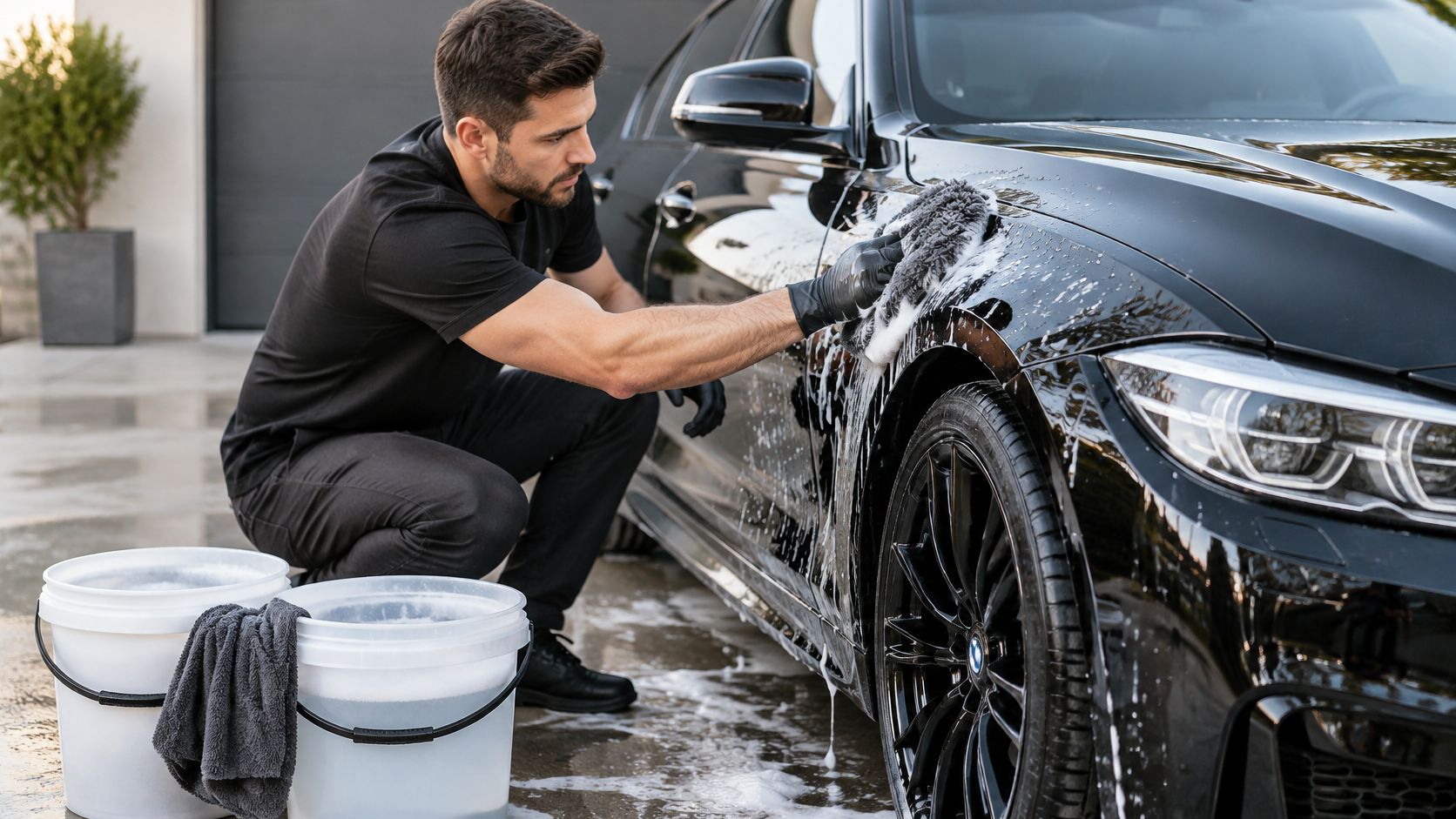
Rinse loose sand off before any contact. A coastal drive or a dusty Wanneroo Road week puts grit on every horizontal panel. Wiping that dry, even with a clean mitt, cuts the clear coat in circles you will see in sunlight tomorrow. We wash by hand, with no automated brushes, because those brushes carry the previous car’s grit across this car’s paint. That matters most on black luxury paint, low cars and anything that already has a coating.
Use two buckets. One holds shampoo solution. One holds rinse water with a grit guard in the bottom. Load the mitt in the shampoo, wash a panel, then wring and plunge the mitt in the rinse bucket before it goes back to the soap. Dirt stays in the rinse bucket instead of riding back onto the roof. Wash top to bottom, roof and glass first, sills and bumpers last. Use a separate mitt for the lower panels if the arches are still shedding mud.
The two-bucket method is the whole point of keeping the mitt cleaner than the panel, and the two-bucket hand wash method that prevents swirls is the version we run on site when the car should not see a tunnel brush.
Rinse until shampoo is gone from panel gaps, mirror backs and the fuel door. Dry at once with clean, dry microfibre or a chamois that has been washed since its last job. Dragging one sandy towel across a wet black door puts in the swirls the polish step would then have to chase. Change the mitt halfway through a neglected car. A mitt that feels crunchy is finished.
Perth wash water is not a free-for-all. Spot Free Rinse notes that home washing is generally allowed with a bucket, a trigger-nozzle hose or a high-pressure cleaner, while the winter sprinkler limits are aimed at sprinklers, and that washing on lawn lets water soak in rather than run to a drain. Detergent, brake dust and oily film in that runoff are the pollutant, not the fact that you washed a car. On a driveway that falls to the street, use less water, skip the flood rinse, and do not let the suds reach the gutter. A black sedan after the beach gets a long pre-rinse on a permeable surface so the sand leaves in the water, not in the mitt.
Book a grit-controlled hand wash
A detailer working a luxury black car by hand, not with a spinning brush, is what this step looks like when the paint cannot afford a shortcut.
When the wash is the whole job
If the paint feels smooth after the dry, and you are not correcting or coating, stop. Jambs, glass and a light spray wax are maintenance. Clay, compound and a long cure are not. Mini Car Detailing is done by hand and usually takes 1.5 to 2 hours, depending on size and how dirty the car arrived. You do not need to pre-clean it. You do need to take valuables out.
- Never dry-wipe dust: Rinse first or you cut a ring into the clear coat.
- Split the buckets: Soap bucket stays upstream of the dirty rinse bucket.
- Retire a gritty mitt: One fresh mitt is cheaper than a polish.
- Dry edges and jambs: Trapped water becomes the spot you see at handover.
4. When Is the Paint Still Contaminated After a Careful Wash?
Run a clean hand, in a plastic bag if you want the grit to shout, across the dry bonnet. Smooth means the wash finished the job. A fine prickle means bonded fallout is still sitting in the clear coat. Wiping, waxing or polishing over that prickle drags metal and tar across the panel and writes micro-scratches into the finish you are trying to save.
Small black specks after rain are often iron, not stone chips. An iron-removing product turns purple as it reacts. Use it on cool paint, test a low corner first, and do not let it dry. Tar spots need a dedicated solvent on a microfibre, not more shampoo. After the chemical rinse, a clay bar or a synthetic clay mitt lifts what is left, but only with plenty of lubricant and light, straight passes. Pressure is what makes clay cut. If the clay drops on the ground, it is finished. Grit in the clay becomes the scratch.
Clay is a preparation step, not a shine step. The practical limits, including what not to clay, sit in our clay bar treatment guide. Do not clay a fresh ceramic coating unless that coating’s maker says you can. You will haze the layer you paid to bond.
Inspect under a strong side light before and after. Fine swirls are in the clear coat and can be polished. A catch with a fingernail is deeper and will not disappear with a finishing polish. A sale car gets this inspection on the bonnet, roof and doors, because those are the panels a buyer sees first. Decontamination is also the last honest moment before wax, sealant or coating. Seal over the prickle and you have glued the defect down.
If the panel feels like glass after the wash and the dry, skip clay on that car today. If it feels like fine sandpaper, do not skip it, and do not polish yet.
Book decontamination before any polish
5. Should You Machine Polish or Leave the Clear Coat Alone?
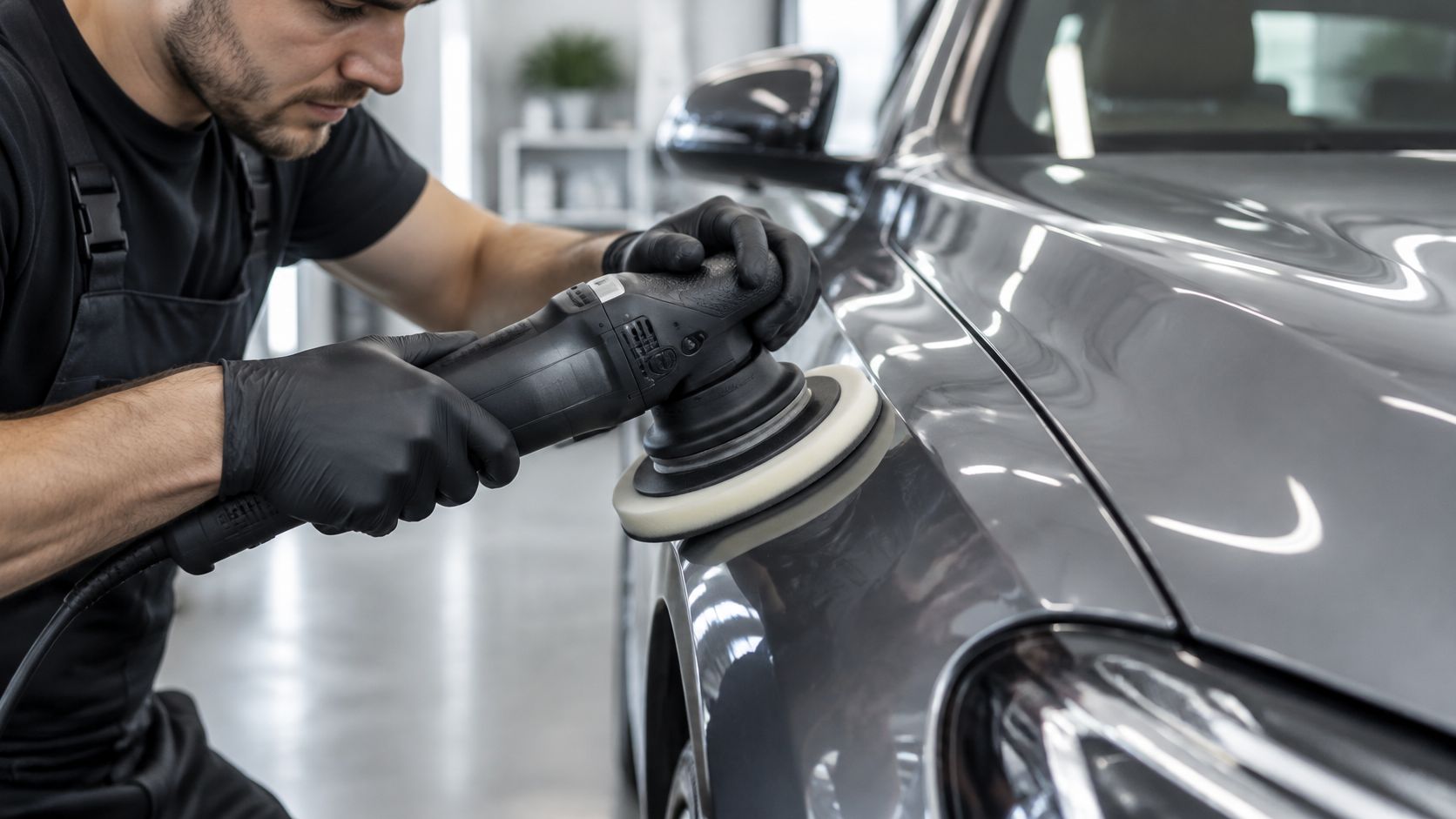
Polish removes clear coat. That is the trade-off, not a slogan. A light finishing polish on a dark metallic covered in wash swirls can restore gloss in one conservative stage. The same pad and compound on thin, chalky paint can cut through at an edge and leave a dull patch you cannot wax away. Assess before you chase shine. If you cannot see a defect in sunlight, you do not need the machine.
Work only on paint that is already washed and decontaminated. Compound on bonded iron cuts both. Pick the pad and the liquid for this paint system. A soft finishing pad and a fine polish suit light haze. A firmer pad and a compound suit oxidised bonnets, then you refine. There is no single speed that suits every clear coat. Keep the machine moving. Parking it on a panel edge, or on a sharp swage line, burns through fastest exactly where a chip already lives.
Prime Shine’s cut and polish starts with the exterior wash and paint preparation, then machine correction aimed at minor defects, not at a respray. A car for sale usually needs the bonnet, roof and doors more than the lower bumpers. Correct those, inspect under the same directional light you used before, and protect the same day. Bare, freshly polished clear coat marks faster than the dull paint you started with.
This is the contact point that goes wrong if the panel was never decontaminated.
What I would not polish
Peeling clear coat, a deep key line and a repainted panel with a dry edge are bodywork, not a pad. Matte and satin finishes are out. If the owner wants the car on the road tonight and the only marks are faint, a protection coat beats another pass that thins the clear for a photo they will not take.
- One stage first: Most daily cars with wash marring do not need a heavy cut.
- Edges last and light: Tape sharp lips if your pad wants to dig.
- Fresh pad per liquid: Compound left in a finishing pad puts the heavy cut back.
- Protect before sunset: Corrected paint without wax, sealant or coating is unfinished.
Book cut and polish for light defects
6. Is Long-Term Paint Protection Worth It in Perth Sun?
Western Australia had about 860.5 total motor vehicles per 1,000 people in the 2024 vehicle figures published by the Bureau of Infrastructure and Transport Research Economics. That is a fleet that lives outside. UV fades the upper panels, dust bonds to horizontal surfaces, and a wax that looked rich on Saturday is flat by the next hot week. Protection is not the decorative last wipe. It is the layer that makes the next wash safer, because dirt releases instead of biting in.
A ceramic coating is a liquid polymer wiped onto paint that is already clean, decontaminated and, if it was dull, polished. It bonds and makes water bead, so drying is faster and road film has less to grip. It does not stop stone chips, shopping-trolley kisses or a dry mitt. Tell the owner that plainly or the first swirl after coating feels like a broken promise.
Do not coat over wax, sealant or oily polish residue unless that system allows it. The coating will not bond, and the failure shows up as dull patches a week later. Apply to cool, dry paint, panel by panel, and respect the cure window before rain or a rinse. After that, wash with a pH-neutral shampoo and soft mitts. Tunnel brushes are the fastest way to put swirls into a coating you cannot buff off.
A daily Perth commuter gains easier washes between visits. A car parked on the street still needs bird lime and bug splatter removed quickly, because a coating slows bonding, it does not cancel acid. Maintenance after the cure, including which washes are safe, is set out in our ceramic coating care guide for Perth drivers.
A slick, even sheet of water on a cool panel means the protection went down on clean paint. Patchy water on one door usually means residue was still there, not that the product failed.
If the car only needs a month of gloss and the clear coat is already smooth, a hand wax is the lighter choice. Save the coating for paint you have inspected and are willing to maintain.
Book ceramic coating on prepared paint
7. Which Interior Steps Stop Dirt Travelling Back Outside?
Vacuum before any spray. Cleaner on a sandy carpet turns the fibre into sandpaper and drives the grit deeper. Start at the floor and the boot, then seat bases, seams and the rails under the seats. Only then wipe the dash, console, doors and trims. Glass is its own towel and its own product. Interior cleaner on a windscreen smears in low sun and you will see it every afternoon on Wanneroo Road.
In a national Budget Direct survey, 45% of respondents cleaned the interior at least monthly, including 15% who did it weekly, while 44% cleaned the exterior at least monthly and 12% weekly, as reported by Budget Direct. That supports a short maintenance pass for most families, and a heavier reset when pet hair, stains or odour show up. Weekly-use cars, rideshare seats and dusty Western Australian cabins do not wait for a calendar month.
A spotless dash is not clean cabin air. Some popular new vehicles lacked particulate filtration as standard, and activated-carbon filters were rarer still. Particulate filters trap dust, pollen and fungal spores. Activated carbon is what helps with gases and odours. Research on cars in Sydney found endotoxin and fungal β-(1,3)-glucan in dust from all 40 vehicles sampled, which the authors flagged for people with asthma, in reporting carried by carsales. Inspect or replace the cabin filter when it is due, vacuum vents without blowing the dust back into the cabin, and dry damp seats fully so mildew does not start under a mat. That can sit as an optional cabin refresh. It is not a medical treatment.
Fabric, leather and plastic do not share a bottle. The wrong dressing leaves the dash shiny or sticky, and that gloss reflects into the windscreen. Test any cleaner under the seat edge. Keep liquid off screens, speaker grilles and switches. Steam helps fabric, carpet and the tight spots a towel misses. Our steam clean for car interiors covers what the vapour does and what it does not. Pet hair needs a dedicated removal pass before shampoo, or the hair reappears as soon as the seat dries.
A family car with kids and a dog usually needs vacuum, hair removal, a steam pass on the stains and a light protectant once the fibres are dry. A lease return often fails on the boot, the door pockets and a stain nobody photographed at the start. Leave covers off until the seat is dry. Trapped moisture is the odour that comes back on day three.
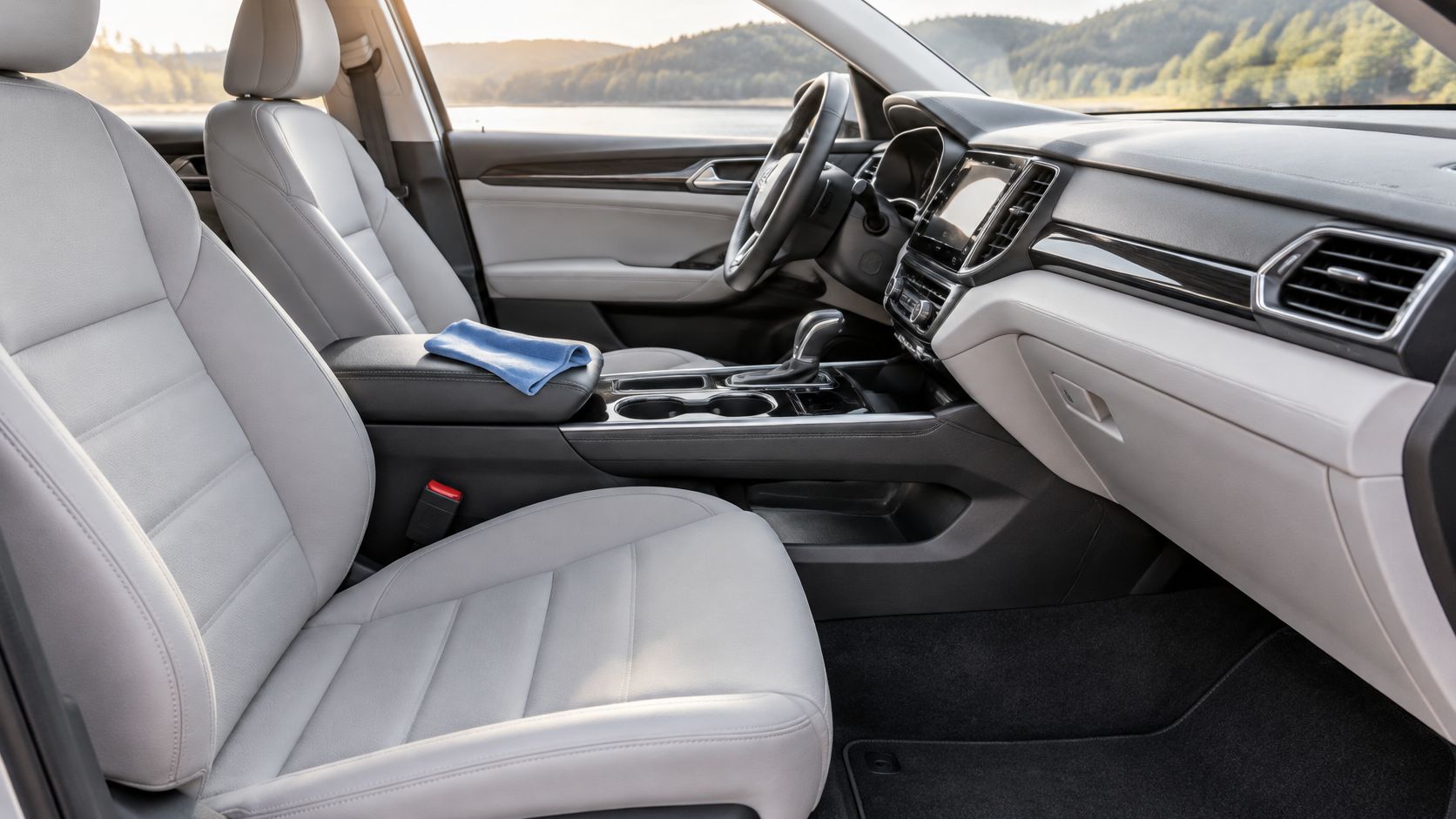
The cloth on the console is the right tool only after the grit is already in the vacuum, not before.
- Floors first: Sand on the mat is what shoes carry back onto the sill you just cleaned.
- Separate glass: One towel for screens, one for plastic, or you haze both.
- Dilute and dwell: Soaking a stain beats scrubbing a dry one into the foam.
- Dry before handover: A damp carpet in a closed car is tomorrow’s smell.
Book an interior reset or a steam clean
8. What Has to Be True Before You Hand the Car Back?
Move the car into daylight, or under an even light if the job finished after dark. Water spots hide under workshop lamps and show up in the owner’s driveway. Check glass for streaks, wheel faces for dried cleaner, trim for white residue, seat rails and boot edges for the vacuum path you missed, and every jamb for a drip. Shut the doors, mirrors, windows, fuel cap and boot yourself. A door left on the latch is a simple way to undo a careful detail.
The Australian Car Wash Association’s 2023 consumer study found 63% of consumers somewhat or very satisfied on price. People judge the finish they can see, not the steps they did not watch. J.D. Power’s Australian customer-service study, in that same discussion of visible extras, found only 31% of authorised-dealer service customers received a post-service wash and vacuum, yet satisfaction was 842 out of 1,000 when they received both and 762 out of 1,000 when they did not, an 80-point gap. That study is about dealer service, not an independent detail, and it still makes the operational point. High-visibility checks before handover change how the whole job feels.
Walk the car with the owner when you can. Photos of pre-existing chips stay in the file. The technician signs the checklist. Say what was done, what was left because it is a deep scratch, a permanent stain or failed clear coat, and how to wash whatever protection went on. A ceramic-coated car leaves with the cure time and a compatible shampoo, not with a mystery bottle from the supermarket. A night job gets a morning light check before you call it finished.
We recommend a full detail about every 6 to 12 months for cars that work hard, with shorter washes in between. Older, high-mileage and heavily used cars are the ones that usually need that deeper reset rather than another quick exterior. Personal items come out before we start. You do not have to wash the car yourself first.
The handover is finished when the owner can see the limit of the work, not when the last towel is in the bucket.
- Daylight loop: Bonnet, roof, glass, wheels, jambs, boot lip.
- Clean inspection towel: A fresh microfibre only, or you put a mark on at the last minute.
- Name the exclusions: Deep scratches and set-in stains stay written down.
- Care in one minute: Cure time, compatible shampoo, and when to come back.
Book a checked handover detail
The Eight Detailing Steps Compared by Effort, Skill and Consequence of Skipping
| Step | Typical Time | Skill Level | Best For | Risk If Skipped |
|---|---|---|---|---|
| Pre-Wash Assessment and Vehicle Condition Check | Brief inspection; varies by condition | Basic to professional | Choosing suitable products and documenting existing damage | Unsuitable treatment or confusion about pre-existing damage |
| Wheel, Tyre, and Brake-Dust Decontamination | Variable; may require repeated cleaning | Basic to intermediate | Removing brake dust and road grime from wheels and tyres | Abrasive grit may scratch paint during drying |
| Safe Hand Wash and Two-Bucket Method | Longer than an automated wash | Basic to intermediate | Gentle, controlled cleaning of painted surfaces | Dirt or poor technique may cause swirls and scratches |
| Paint Decontamination and Swirl-Risk Inspection | Variable; depends on contamination | Intermediate | Preparing paint for correction or protection | Bonded grit may mar paint or reduce protection bonding |
| Machine Cut, Polish, and Paint Correction | Time-intensive; depends on correction level | Advanced | Improving gloss and reducing light paint defects | Defects remain, or improper correction may damage clear coat |
| Ceramic Coating and Long-Term Paint Protection | Preparation and curing are time-intensive | Advanced | Longer-term paint protection and easier maintenance | Reduced protection, poor bonding, or uneven finish |
| Interior Vacuum, Surface Cleaning, and Sanitisation | Variable; depends on cabin condition | Basic to intermediate | Cleaning cabin surfaces, carpets, seats, and trim | Trapped debris, stains, odours, or residue may remain |
| Final Inspection, Finishing Check, and Handover | Brief final check; varies by job | Basic to professional | Verifying quality and explaining care requirements | Missed areas or unclear service and maintenance expectations |
Choose the detailing steps your car needs
Ready to Put This Car Detailing Checklist to Work?
Decide from the panel, not from a package name. If the paint feels smooth after a rinse and the cabin only has loose dust, run the wheels, the two-bucket wash and the handover checks, then stop. That is a maintenance detail. Clay, compound and a coating would spend clear coat and money on a defect that is not there.
If the paint still feels gritty once it is dry, start at decontamination and do not wax yet. Wax on bonded iron is how you seal the problem you just paid to find. If swirls show in sunlight and your nail does not catch, correction comes before any protection. If your nail catches, stop and talk about paint repair. Protection on a torn clear coat only makes the tear shinier.
Two rules outlast the list. Never move contamination from a dirty surface onto a clean one. Never seal a defect you have not inspected in daylight. Skip steps when those rules are already satisfied. Do not skip them because the car is only “a bit dirty”. Neglected paint is exactly where the mitt, the clay and the pad do their damage.
We are Prime Shine Hand Car Wash in Westminster, at 9/436 Wanneroo Rd. The steps that need a lift, a machine polisher or a controlled cure are the ones to book rather than improvise on a hot driveway. Mini Car Detailing starts from $199. Full Car Detailing starts from $349. You pick a time online, and the job is assigned to a technician instead of a queue you cannot see.
Use the shorter wash when the inspection says the paint is sound. Use the full detail when seats, carpets, boot, windows, jambs, wheels and paint all need the reset, including a clean and a protective wax. Add cut and polish only for light defects you have already decontaminated. Add ceramic coating only on paint that is clean, dry and worth maintaining between washes.
If you are prepping a car for sale or a lease return, book the inspection first so deep marks are documented before anyone discusses gloss. If you drive rideshare or delivery, book the wheel and cabin steps on a short cycle so brake dust and seat grit never become a Saturday correction. Families on the school run usually need the interior vacuum and a safe exterior wash more often than they need a polish. Enthusiast and luxury paint is the opposite risk. The finish is already good, and the only acceptable wash is the one that does not add swirls.
Bring the car as it is. Take the valuables out. We will tell you which steps to skip.
Prime Shine Hand Car Wash in Westminster handles the hand wash, interior detail, decontamination, cut and polish, and ceramic coating in the order that keeps grit off the next panel. If you would rather not risk the mitt, the clay or the cure on your own driveway, book the steps that match the car you have at Prime Shine Hand Car Wash.